
-

Beside the Sickle Moon: A Palestinian Story
From: USD $ 5.00Select options This product has multiple variants. The options may be chosen on the product page
Beside the Sickle Moon: A Palestinian Story
From: USD $ 5.00Beside the Sickle Moon is near future literary activism based on Israel’s occupation of Palestine. The story tells a first person narrative through Laeth Awad, a Palestinian who lives above his convenience store experiencing days pass through smoke clouds with his cousin Aylul. One night upon returning to their village from Ramallah they encounter an Israeli checkpoint within the buffer zone that hadn’t been there before. It isn’t long until the two stumble upon Israel’s plans to construct a luxury hotel for incoming settlers, Ma’al Luz. Demolition crews and military personnel are due to fulfill this contract in the months to come and with them as overseer is the infamous Meir Cohen, a Mossad operative who played a key role in the fall of Gaza.
Aylul believes from their father, an Al Qassam militant who died in the battle for Jericho, that only the threat of annihilation breeds the best of human action. They use their contacts to connect with the factions, who grant them strength to defend their village from occupation. With these resources in hand Aylul forms Al Mubarizun, a group crowning themselves Palestine’s final resistance.
Laeth doubts the existence of a future, lost in philosophical ambivalence as he tries to follow his cousin into the depths of guerrilla warfare. He questions the futility of resistance when all former allies have normalized relations with Israel. And what of the innocents on the other side of the Wall who had no say in where they were born? Though a minority of the population, he is not alone in this sentiment. Palestinian youth begin to empathize with this logic enough to create a new social movement, the Forgotten Ones. Coining the derogatory term that their critics slung, the NGO advocates for a peaceful transition to Israel’s colonization where most Palestinians hear whimpers of surrender.
Set in a hauntingly plausible future, where Israel has marked a century of Palestinian occupation … As a novel of the future, Beside the Sickle Moon is, unsurprisingly, preoccupied with temporality, attempting to reconcile the vastness of macro-historical events with the immediacy of everyday life. … One of the most chilling features of Husien’s novel as history is the world’s renewed abandonment of Palestine. In a future of systemic global crisis, nations have closed ranks and shut their eyes. Israeli mines run on the slave labor of Palestinian captives, and refugee camps have become invisibilized death zones … — Londiwe Gamedze https://africasacountry.com/2024/11/reading-the-present-as-history
Select options This product has multiple variants. The options may be chosen on the product page -

WItness to War
Price range: USD $ 10.00 through USD $ 26.00Select options This product has multiple variants. The options may be chosen on the product page
WItness to War
Price range: USD $ 10.00 through USD $ 26.00Witness to War: An American Doctor in El Salvador offers a personal account of Dr. Charles Clements’ year-long mission providing medical care behind rebel lines during El Salvador’s brutal civil war from 1981-1982. Clements, a former decorated U.S. Air Force pilot disillusioned by his Vietnam experiences, transformed into a Quaker doctor committed to non-violence and the principle of “bearing witness”—observing a situation firsthand and speaking truth about power.
The book chronicles his harrowing struggle, at times one of only two fully trained physicians, for approximately 10,000 people in a guerrilla-controlled zone, confronting “scenes of almost unbelievable horror” and an “anguished view of the low value on life”. With virtually no supplies, Clements improvised, performing amputations with a Swiss Army knife and suturing with dental floss, all while battling dysentery, malaria, and hunger himself. His narrative is extraordinarily restrained yet both disturbing and gripping.
Witness to War serves as a testimony from behind the lines, vividly portraying a conflict of constant aerial bombardments by U.S.-supplied aircraft. Clements’ commitment to medical neutrality, treating any patient regardless of their affiliation, is a central theme, challenging readers to confront uncomfortable truths about U.S. foreign policy and the immense human cost of conflict. This new edition, published decades later, underscores the enduring relevance of imperialism and militarism, urging new generations to reflect on their potential impact on the Global South.
First published in 1984, and again in 1985, the book has long been out of print. This is an expanded edition including materials previously absent in previous editions.
Select options This product has multiple variants. The options may be chosen on the product page -

A Zone of Nonbeing
Price range: USD $ 7.99 through USD $ 20.00Select options This product has multiple variants. The options may be chosen on the product page
A Zone of Nonbeing
Price range: USD $ 7.99 through USD $ 20.00While racism in Western Europe has been extensively documented, the experiences of racism in Eastern Europe remain underexplored, particularly from the perspective of Black individuals born and raised in the region. This book, written by a Polish author of African descent, sheds light on the racial struggles in Poland, situating them within a broader global context.
The first part of the book delves into the historical dynamics of racial relationships between Black individuals and white Poles. It highlights the lives of Black Polish citizens and residents from the 18th century to the fall of communism in 1989, including figures like Katarzyna Rohoczewska and August Agbola O’Browne. It also celebrates the contributions of two prominent Polish anti-racists: General Tadeusz Kościuszko and the poet Cyprian Kamil Norwid. This section further examines Poland’s colonial ambitions, from Maurycy Beniowski’s attempt to colonize Madagascar in the late 18th century to colonial expeditions in the 1930s. Additionally, it analyzes the paradoxical nature of anti-racism in the People’s Republic of Poland, exploring the government’s official stance alongside the attitudes of its white citizens.
The second part offers a deeply personal account of the author’s experiences as both a student and a teacher, revealing the pervasive racism within Poland’s education system. It critiques the anti-migrant rhetoric propagated by Polish and European Union politicians, exposing their hypocrisy during the EU refugee crisis. A central chapter focuses on the tragic murder of Maxwell Itoya in May 2010, framing it within the global context of police brutality against Black individuals.
The final part of the book examines the racist undertones in Polish culture, particularly in literature and mass media, with a critical analysis of Henryk Sienkiewicz’s In Desert and Wilderness. It also pays tribute to James Baldwin, the author’s literary hero, exploring how Baldwin’s essays have profoundly influenced the author’s own writing and worldview. The book concludes with a reflection on the absence of a cohesive movement among Black Poles and poses the urgent question: What is to be done?
Select options This product has multiple variants. The options may be chosen on the product page -
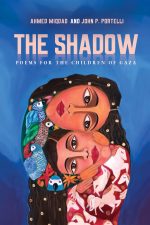
The Shadow
USD $ 16.00Select options This product has multiple variants. The options may be chosen on the product page
The Shadow
USD $ 16.00Discover The Shadow: Poems for the Children of Gaza, a poignant collection by Palestinian poet Ahmed Miqdad and Maltese-Canadian poet John P. Portelli. Written amidst the horrors of Gaza’s genocide and the personal battle with cancer, these 42 poems bear witness to the intersection of political violence and personal mortality. Through raw emotion and lyrical defiance, the poets forge solidarity across borders, offering a glimmer of hope in the face of erasure.
Featuring evocative art by Malak Mattar and a foreword by Professor Jamil Khader, this collection is a call to remember, resist, and reclaim humanity. A portion of proceeds will support Palestinian relief efforts.
Select options This product has multiple variants. The options may be chosen on the product page -
 Select options This product has multiple variants. The options may be chosen on the product page
Once I Forget
“Once I Forget,” a collection of poems by John P. Portelli, originally written in Maltese and translated by Aaron Aquilina and John Martin. These sections include the title page, a preface by Professor Norbert Bugeja, and portions of the poems themselves, which explore themes of memory, exile, loss, and the poet’s childhood village, Ħad-Dingli. The preface highlights Portelli’s struggle with forgetfulness and his focus on the vanishing past, connecting his work to literary figures like Yeats and Walcott. Furthermore, the source provides biographical notes on the author, translators, and cover artist, Carmel Micallef, along with endorsements that praise the poetry’s transcendence of the lyric and its powerful exploration of nostalgia and the impossibility of return.
Translated from the Maltese by Aaron Aquilina and John Martin.
John P. Portelli treads along those nebulous cliff-edges where forgetfulness attempts to pick at the treacherous scabs of recall, capturing the vertigo of a distant childhood as it inches outward
into the land’s end of metaphor. — Prof. Norbert BugejaPortelli’s gorgeous poems speak of exile, searching, and loss in such a way that the reader becomes one with the village of his birth, the cliffs, the smells, his frail body, and the sea. —Jennifer Hosein, Tiohtià:ke/ Montreal-born writer, visual artist and educator, author A Map of Rain Days
..the poems of Once I Forget restore our faith in the transcendence of the lyric, in the power of song and secular psalm. — Karen Shenfeld, Canadian writer and film-maker,
author The Law of ReturnSelect options This product has multiple variants. The options may be chosen on the product page -

Jackson Rising
Price range: USD $ 5.00 through USD $ 20.00Select options This product has multiple variants. The options may be chosen on the product page
Jackson Rising
Price range: USD $ 5.00 through USD $ 20.00Mississippi is the poorest state in the U.S. with the highest percentage of Black people and a history of vicious racial terror. The concurrent Black resistance is the backdrop and context for the drama captured in the collection of essays that is Jackson Rising: The Struggle for Economic Democracy and Black Self-Determination in Jackson, Mississippi. The long-awaited release of this seminal anthology will unveil the strategies and methods being pursued by this ongoing movement for Black community control and people-centered economic development.
“Jackson Rising is an exploration of our experiment in radical social transformation and governance that is directly challenging the imperatives of neoliberalism and the logic and structures of the capitalist system in Jackson and beyond.”
—Kali Akuno of Cooperation JacksonUndeterred by the uncertainty, anxiety and fear brought about by the steady deterioration of the neoliberal order over the last few years, the response from radical activists in Jackson, Mississippi has been to concentrate on building a radical anti-capitalist alternative from the ground up. Inspired by the rich history of struggle and resistance in Mississippi and committed to the vision of the Jackson-Kush Plan, these activists are building institutions rooted in community power that combine politics and economic development into an alternative model for change, while addressing real, immediate needs of the people.
The experiences and analyses in this compelling collection reflect the creative power that is unleashed when political struggle is grounded by a worldview freed from the inherent contradictions and limitations of reform liberalism. As such, Jackson Rising is ultimately a story about a process that is organized and controlled by Black working people who are openly declaring that their political project is committed to economic democracy and radical participatory governance.
“Jackson is rising and emerging as a model for resistance and visioning beyond the challenges of the present. It stands as the dynamic counter to economic redundancy, political marginalization, and systematic state violence.”
Select options This product has multiple variants. The options may be chosen on the product page -

Decolonization and Afro-Feminism
Price range: USD $ 10.00 through USD $ 30.00Select options This product has multiple variants. The options may be chosen on the product page
Decolonization and Afro-Feminism
Price range: USD $ 10.00 through USD $ 30.00In Decolonization and Afro-Feminism, Sylvia Tamale presents a powerful and urgent call for Africa’s intellectual, cultural, and political liberation through an Afro-feminist lens. The book critically examines how colonialism has deeply entrenched systems of oppression—based on race, gender, sexuality, class, and knowledge production—and argues that true decolonization requires more than political independence; it demands a radical rethinking of African identities, histories, and futures.
Tamale challenges Eurocentric and patriarchal frameworks that continue to dominate African societies, institutions, and academia. She explores themes such as:
-
The coloniality of gender and sexuality, using case studies like Caster Semenya to expose how Western norms pathologize African bodies.
-
The importance of intersectionality in understanding overlapping systems of oppression.
-
The role of Afro-ecofeminism in reconnecting African ecological wisdom with social justice.
-
The need to decolonize African academia, law, and family structures to recenter Indigenous knowledge and epistemologies.
-
The potential of Ubuntu as a framework for justice, community, and relationality.
The book is both a scholarly critique and a visionary roadmap, emphasizing that decolonization must be a feminist, inclusive, and holistic project—one that reclaims Africa’s dignity, autonomy, and intellectual sovereignty.
Written with clarity and passion, Decolonization and Afro-Feminism is essential reading for students, activists, scholars, and anyone committed to understanding and advancing Africa’s liberation in the 21st century.
Select options This product has multiple variants. The options may be chosen on the product page -
-
 Select options This product has multiple variants. The options may be chosen on the product page
Mobilizing for Health Justice
Since its first edition in 2005, Global Health Watch (GHW) – the flagship publication of the People’s Health Movement (PHM) – has been critically reporting on the state of the world’s health. Published every three or four years, it comments on developments in global health while focusing on continuities with past popular struggles.
As with previous editions, GHW7 comes to life with contributions from over one hundred activists around the world, sharing experiences and analysis on issues affecting people’s health in the contexts they live in and efforts to progress towards greater health justice. This process was energized by the fifth People’s Health Assembly (PHA5), the global gathering of PHM, that took place in Argentina in April 2024 under the motto “Making ‘Health for All’ our struggle for ‘Buen Vivir”.
Political contributions from Latin America are manifest in the first GHW7 section, dedicated to “The global political and economic architecture”, where an up-to-date analysis of current health crises is followed by contributions that frame them in an eco-feminist perspective, showing how alternatives can be rooted in ancestral wisdoms and the practice of ‘Buen Vivir’. The second section addresses old and new challenges for public and global health systems through the critical lenses of gender justice and decoloniality. The third section, “Beyond Healthcare,” addresses key social and environmental determinants of health, while the “Watching” section critically apprises the state of global governance for health with a focus on several key institutions. The final section, “Resistance, struggles and alternatives,” highlights areas of transformative change by health activists in a global context of increasing repression. The book ends with a chapter on PHA5, highlighting how collective action is the most powerful medicine against ill health and health inequality at the human and planetary levels.
Global Health Watch 7 will include the following chapters
Chapters A2 and A3 have been translated from Spanish by Lila Esther Silgado Villadiego.
Summaries of the chapters that are currently available can be viewed by scrolling down and clicking on the “Description” tab. You can also download the chapters highlighted below.
Introduction: Mobilizing for Health Justice
A1. From a Political Economy of Disease to a Political Economy for Wellbeing
A2. Life at the Center: Ecofeminisms and Ecoterritorial Feminisms in the Struggle for Life
A3. Ancestral and Popular Knowledge for Buen Vivir
B1. Privatization and Financialization of Health Systems: Challenges and Public Alternatives
B2. Artificial Intelligence, Digital Technologies, and Health
B3. Building Equitable Health Systems: A Transformative Proposal from an Intersectional Gender Perspective
B4. Abolition Medicine as a Tool for Health Justice
B5. Decolonizing Global Health
C1. War, Conflict and Displacement
C2. People on the Move
C3. Putting the Right to Health to Work
C4. Tax Justice: A Pathway to Better Health
C5. Commercial/Corporate Determination of Health
D1. WHO’s Compromised Role in Global Health Leadership
D2. Unpacking Our Pandemic Failures for Future Pandemic Prevention, Preparedness, and Response
D3. Financing Pandemic Recovery, Prevention, Preparedness and Response
E1. National Struggles for the Right to Health
E2. Taking Extractives to Court
E3. Fear and Hope in ‘Speaking Truth to Power’: Struggles for Health in Times of Repression and Shrinking Spaces
E4. 5th People’s Health Assembly: Advancing in the Struggle for Liberation and Against CapitalismSelect options This product has multiple variants. The options may be chosen on the product page -
 Select options This product has multiple variants. The options may be chosen on the product page
Una movilización por la justicia en salud
Desde su primera edición en 2005, el Observatorio Global de la Salud (GHW) -la publicación insignia del Movimiento por la Salud de los Pueblos (MSP)- ha venido informando críticamente sobre el estado de la salud en el mundo. Publicada cada tres o cuatro años, comenta la evolución de la salud mundial al tiempo que se centra en la continuidad con las luchas populares del pasado.
Al igual que en ediciones anteriores, el GHW7 cobra vida con las contribuciones de más de cien activistas de todo el mundo, que comparten experiencias y análisis sobre cuestiones que afectan a la salud de las personas en los contextos en los que viven y los esfuerzos por avanzar hacia una mayor justicia en salud. Este proceso fue dinamizado por la quinta Asamblea Mundial por la Salud de los Pueblos (ASP5), el encuentro mundial del MSP, que tuvo lugar en Argentina en abril de 2024 bajo el lema “Haciendo de la ‘Salud para Todos’ nuestra lucha por el ‘Buen Vivir’”.
Las contribuciones políticas de América Latina se manifiestan en la primera sección del GHW7, dedicada a “La arquitectura política y económica global”, donde a un análisis actualizado de las crisis de la salud actuales le siguen contribuciones que las enmarcan en una perspectiva ecofeminista, mostrando cómo las alternativas pueden arraigarse en las sabidurías ancestrales y en la práctica del ‘Buen Vivir’. La segunda sección aborda viejos y nuevos retos para los sistemas de salud públicos y globales a través de las lentes críticas de la justicia de género y la decolonialidad. La tercera sección, “Más allá de la atención en salud”, aborda los principales determinantes sociales y ambientales de la salud, mientras que la sección “Vigilancia” analiza críticamente el estado de la gobernanza mundial de la salud centrándose en varias instituciones clave. La última sección, “Resistencia, luchas y alternativas”, destaca las áreas de cambio transformador de los y las activistas de la salud en un contexto mundial de creciente represión. El libro termina con un capítulo sobre la ASP5, en el que se destaca cómo la acción colectiva es la medicina más poderosa contra la mala salud y la desigualdad de la salud a nivel humano y planetario.
Global Health Watch 7 incluye los siguientes capítulos:
Los resúmenes de los capítulos actualmente disponibles, junto con el PDF descargable correspondiente, pueden consultarse desplazándose hacia abajo y haciendo clic en la pestaña “Descripción”.
Todos los capítulos, excepto A2 y A3, han sido traducidos del inglés por Lila Esther Silgado Villadiego
Introducción: Una Movilización por la Justicia en Salud
A1. De la Economía Política de la Enfermedad a la Economía Política del Bienestar
A2. La Vida en el Centro: Ecofeminsmos y Feminismos Ecoterritoriales en la Disputa por la Vida
A3. Saberes Ancestrales y Populares para el Buen Vivir
B1. Privatización y Financierización de los Sistemas de Salud: Retos y Alternativas Públicas
B2. Inteligencia Artificial, Tecnologías Digitales y Salud
B3. Construyendo Sistemas de Salud Equitativos: Una Propuesta Transformadora Desde una Perspectiva Interseccional de Género
B4. La Medicina de la Abolición como Herramienta para la Justicia en Salud
B5. Descolonización de la Salud Mundial
C1. Guerra, Conflicto y Desplazamiento
C2. Personas en Movimiento
C3. Poniendo el Derecho a la Salud ¡A Trabajar!
C4. Justicia fiscal: El camino Hacia una Mejor Salud
C5. Determinación comercial/empresarial de la salud
D1. El papel de la Organización Mundial de la Salud en el liderazgo de la salud mundial, bajo amenaza
D2. Desembalaje de Nuestros Fracasos Pandémicos para la Prevención y Preparación ante futuras pandemias
D3. Financiación de la Recuperación, Prevención, Preparación y Respuesta ante una Pandemia
E1. Luchas Nacionales por el Derecho a la Salud
E2. Llevando a las Empresas Extractivas a los Tribunales
E3. Miedo y esperanza en “Decir la verdad al poder”: Luchas por la salud en tiempos de represión y reducción de espacios
E4. 5ª Asamblea Mundial por la Salud de los Pueblos: Avanzando en la lucha por la liberación y contra el capitalismoSelect options This product has multiple variants. The options may be chosen on the product page -
 Select options This product has multiple variants. The options may be chosen on the product page
Welfare for a Humane Future
Welfare for a Humane Future by David Matthews and Howard Waitzkin critiques the capitalist welfare state, emphasizing its role in sustaining racial capitalism’s exploitative structures. The authors argue that welfare under capitalism reinforces racial and class divisions, as seen in historical policies like the New Deal, which excluded Black workers. They envision a post-capitalist welfare system rooted in communal values—love, solidarity, and participatory democracy—drawing inspiration from global examples like Rojava’s democratic confederalism, Venezuela’s communes, and Cooperation Jackson’s solidarity economy. Key components include cooperative housing, community-controlled healthcare, and universal basic income, all managed through local assemblies. The book highlights mutual aid and grassroots organizing as pathways to transformative change, urging readers to build alternative institutions within capitalist societies. By prioritizing collective well-being over profit, the authors advocate for a welfare system that empowers communities and fosters equity.
Select options This product has multiple variants. The options may be chosen on the product page -

Being Anti-Colonial
Price range: USD $ 5.00 through USD $ 25.00Select options This product has multiple variants. The options may be chosen on the product page
Being Anti-Colonial
Price range: USD $ 5.00 through USD $ 25.00Being Anti-Colonial by Jayan Nayar presents a profound critique of the contemporary engagements with ‘decolonial theory’ and the popular usage of ‘decolonisation’. This work argues that much of the current discourse within critical theory tends to overlook the intricate, essentially praxiological underpinnings of the anti-colonial struggle, thereby comfortably situating itself within the post-colonial status quo. Nayar’s book serves as a radical call to authentically re-engage with the anti-colonial ethos, emphasizing the necessity to confront the enduring architectures of coloniality that define our present. Distinctly divided into two parts, the book first elucidates the conceptual groundwork to reconceptualise ‘anti-colonial’ as a philosophical stance deeply entwined with the fabric of the global (post)colonial reality. Through meticulously argued philosophical foundations, Nayar underscores the (post)colonial present as a state of ‘resettlement’, where the architecture of post-colonial world-making loses sight of its colonial matrices. Being Anti-Colonial is both an invitation and a challenge to the academic community to critically revisit and re-energize the conversation about coloniality.
With his impressive scholarship, Jayan Nayar challenges critics of coloniality, himself included, to question their standpoints. Critical scholars are implicated in assuming the reality of a post-colonial world as ‘(b)ordered’ but requiring reform and justice. Through an incisive critique of coloniality, of the idea of ‘Europe’ of ‘Blacked Lives Matter’ of ‘Zionist-Israelism’, he demands engagement on the frontline of anti-colonial struggles of the violated, subjugated, impoverished ‘subjects’ of (post) colonial normality. — Abdul Paliwala, Professor of Law at School of Law, University of Warwick
Select options This product has multiple variants. The options may be chosen on the product page -
 Select options This product has multiple variants. The options may be chosen on the product page
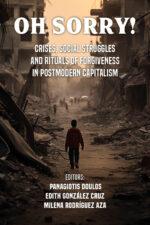
Oh, Sorry! Rituals of Forgiveness, Crises and Social Struggles in Postmodern Capitalism
USD $ 20.00As the world grapples with the legacy of crimes of enslavement, colonialism, genocide and mass killings, imprisonment and murder of children, attempts at eliminating cultures and history of Indigenous peoples, looting and other crimes against humanity, the performance of public atonement has become increasingly prevalent. Apologies from state actors and institutions are issued in solemn ceremonies, often acknowledging the collective guilt for historical atrocities. Despite the solemnity of these events, there is a growing scepticism surrounding the sincerity of these apologies, particularly when they are not accompanied by tangible reparations, healing, reconciliation or systemic change. This scepticism is rooted in a perception that these acts of contrition are sometimes less about making amends to the aggrieved and more about assuaging the guilt of the aggressors and maintaining the status quo, providing the illusion of progress without the substance.
In this compelling work, Oh, Sorry! Rituals of Forgiveness, Crises and Social Struggles in Postmodern Capitalism, the authors unveil the complex interplay between public apologies, social justice and popular mobilisations. The chapters are devoted primarily to the experiences of Latin America, particularly of Mexico, Guatemala, Chile, and Brazil. But there is also a chapter on the struggles for Palestine — so relevant in the face of the current genocidal invasion by the Zionist State of Israel into Gaza, the world’s largest and most densely populated concentration camp.Select options This product has multiple variants. The options may be chosen on the product page -

The Stories We Could Tell
Price range: USD $ 10.00 through USD $ 25.00Select options This product has multiple variants. The options may be chosen on the product page
The Stories We Could Tell
Price range: USD $ 10.00 through USD $ 25.00This book is an effort to contribute to the preservation of El Salvador’s historical memory. It recounts the tragedy of a civil war that lasted nearly two decades and resulted in the loss of over 75,000 lives. It highlights the perspectives of significant figures from that era, a challenging endeavour for those unaccustomed to sharing their stories. The book also examines the Salvadoran people’s aspirations for a new nation and lasting peace.
The Stories We Could Tell is an attempt to push back against current strategies that distort and erase historical memory. It begins with the testimony of Rufina Amaya (to whom the book is dedicated), a poor peasant woman and the sole survivor of one of the worst civilian massacres in modern times, vilified, ridiculed, and discredited by both the Salvadoran and US governments in her desperate attempts to reveal the truth about the rape, torture, and slaughter of some 1,000 men, women, children, and the elderly in the village of El Mozote between December 11 and 12, 1981.
The book provides a concise overview of the war and its origins, highlighting how the United States contributed to the ongoing suffering and escalating costs for El Salvador and its citizens. It outlines the unwavering efforts of key figures striving for a peaceful resolution through a lengthy and challenging negotiation process. Inspiring and sometimes harrowing testimonies of bravery and hope from pivotal individuals in the fight for a fairer and more democratic nation showcase their dedication and resilience in a prolonged struggle.
Select options This product has multiple variants. The options may be chosen on the product page -
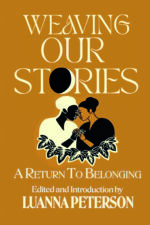
Weaving Our Stories: Return To Belonging – An Anthology
Price range: USD $ 5.00 through USD $ 26.00Select options This product has multiple variants. The options may be chosen on the product page
Weaving Our Stories: Return To Belonging – An Anthology
Price range: USD $ 5.00 through USD $ 26.00Weaving Our Stories is a Hawaii-rooted abolitionist program that utilizes storytelling as a vehicle for liberation. Our mission revolves around teaching storytelling as an act of resistance, dismantling harmful existing narratives, and nurturing our ability to weave counter-narratives that acknowledge and celebrate the inherent beauty and brilliance within our storytellers. Through our stories, we advocate for justice and liberation.
This anthology follows the trail of esteemed works such as “This Bridge Called My Back: Writings of Radical Women of Color” and “Na Wahine Koa: Hawaiian Women for Sovereignty and Demilitarization.” This anthology includes poetry, essays, visual art, and narratives penned by authors and artists who identify as Black, Indigenous, and people of color from Hawaii and beyond. While our contributors span a diverse spectrum of experiences and identities, they all share a common commitment to individual and collective well-being. Our contributors astutely showcase how their expressions of resistance and liberation, whether through visual art or written text, align with one or more of the central themes of Weaving Our Stories: resistance through cultural memory, accountability, resisting false binaries, and countering hegemony.
In tandem with the community collection of stories that revolve around resistance, this anthology also highlights the remarkable achievements of our six accomplished Black youth organizers. These young individuals dedicated a year to the Weaving Our Stories Youth Series during the pandemic, delving into the power and relevance of storytelling in our journey of resistance and liberation. Each of the six youth activists provides an overview of their Community Impact Design Projects.
These culminating endeavors addressed community issues by proposing interventions that harness our resistance themes and our three Pillars of Liberation—namely, institutions, structures/methodology, and people.
This anthology offers celebrations of our triumphs, our joys, and our unwavering resilience. Simultaneously, they advocate for our ongoing resistance, insisting on justice and a sincere confrontation with the often-overlooked lived experiences that deserve acknowledgement.
Select options This product has multiple variants. The options may be chosen on the product page -
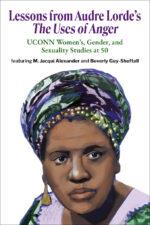
Lessons from Audre Lorde’s The Uses of Anger: UCONN Women’s, Gender, and Sexuality Studies at 50
USD $ 15.00Select options This product has multiple variants. The options may be chosen on the product page
Lessons from Audre Lorde’s The Uses of Anger: UCONN Women’s, Gender, and Sexuality Studies at 50
USD $ 15.00In recent years, we have witnessed renewed calls for women to embrace anger as a source of power. These voices have Lorde’s “The Uses of Anger”, first delivered at the University of Connecticut (UCONN), Storrs, in 1981, to thank for charting an innovative scholarly and poetic terrain that theorizes anger as much more empowering and liberating than conventional discussions of the term typically allow.
Lorde’s essay redefined anger productively, approaching it as an epistemological tool igniting a desire for self and collective liberation. The result was a remarkable critical reflection that laid the groundwork for deconstructing broader systems of oppression, particularly, heteronormativity, heteropatriarchy, institutionalized racial poverty, racial capitalism, and white privilege. Lorde’s essay moved with precision, centering Black women’s struggles in a world built around the use – and abuse – of racialized people subjected to systematic dehumanization.
In their introduction, Jane Anna Gordon, Elva Orozco Mendoza, and Sherry Zane reflect on the inheritance, lessons, and responsibilities that Women’s, Gender, and Sexuality Studies must grapple with if it is to deepen and fulfill its radical mission.
Guided by the imperative to look backward to understand the present and forge a future, the book closes with a sankofic interview with M. Jacqui Alexander and Beverly Guy-Sheftall, conducted by Briona Simone Jones.
Select options This product has multiple variants. The options may be chosen on the product page -

Artificial Intelligence, Society and Religion
Price range: USD $ 10.00 through USD $ 55.00Select options This product has multiple variants. The options may be chosen on the product page
Artificial Intelligence, Society and Religion
Price range: USD $ 10.00 through USD $ 55.00The underlying objective of this book is to promote equality, global peace, harmony, transparency, inter-faith solidarity and broad-based awareness so that new technologies like AI can be developed, controlled and harnessed in the endeavor to tackle problems like hunger, poverty, disease, poor education, misinformation, pandemics, loss of biodiversity, environmental damage, authoritarianism, militarism, irresponsible consumerism, mental alienation and corporate domination that are facing the human race today.
This objective is pursued by adopting an interdisciplinary approach to explore the intriguing confluence of artificial intelligence, social structure and faith at many levels. Numerous illustrative examples from religion majority and other nations grace these pages. They elucidate the structure, uses, benefits, and productivity gains of AI as well as the flaws, abuses, biases, hype, hallucinations, and harms associated with AI systems. Secular and religious ethical codes for AI are examined. It is seen that despite theological concerns, religion―Hinduism, Buddhism, Christianity, Islam, or Secularism―is not a barrier to wide practical adoption of AI. AI in education, medical diagnosis, science research and industry, the impact of AI on mental health and the environment, the notion of artificial super intelligence, military uses of AI, especially in the genocidal war on Gaza, AI in the Global South and the views of late Pope Francis on AI garner central attention. This book makes the case that corporate driven AI operating in the profit-oriented neoliberal, imperial setting will harm human cognitive abilities and mental health, undermine education, foster bias and mediocrity, facilitate the spread of misinformation, exacerbate national and international inequality, support authoritarian rule, worsen climate change and make warfare deadlier. AI can benefit humanity only under an egalitarian, genuinely democratic, environmentally aware social order.
Based on a depth of research, Karim Hirji’s Artificial Intelligence, Society and Religion presents, in readable prose, a comprehensive portrait of the inter-relationship between an ancient human pre- occupation and a modern multi-faceted instrument that may presage a post-human future. Covering Hinduism, Buddhism, Christianity, Islam and Secularism, it explores how these traditions use AI tools and navigate the ethical challenges of AI. The perspectives of religious dignitaries like the late Pope Francis and the Dalai Lama on AI are compared. Providing a broad introduction to the attainments as well as limitations of AI systems, the book also discusses the potential for the emergence of super-intelligent AI systems. Unlike other books on AI, Hirji’s magnum opus contextualizes AI and religions within the global neoliberal system and discusses how AI systems enable violations of human rights and facilitate the commission of genocide. —Abdul Paliwala, Emeritus Professor of Law, University of Warwick
Using a broad range of sources with fascinating insight, Karim Hirji explores the ever-expanding world of Artificial Intelligence to inquire: Will AI benefit or endanger humanity? Using numerous country-level case studies, he explores multiple instances of the utility and harms of AI and argues that corporate-controlled AI will not only exacerbate inequality, but also cause more harm than good. Focusing on Hinduism, Buddhism, Christianity, Islam and secularism, he critically examines faith-based reactions to AI. Among other topics cogently covered are the ethics of AI, education and AI, military applications of AI and the possibility of a superintelligent AI. Addressing questions vital for our and the future generations from a progressive perspective, this book deserves attention from all concerned with where AI is driving our world. —Elizabeth Jones, MA, Teacher, Quaker, Former Co-editor of Christian Today, UK.
Karim Hirji’s Artificial Intelligence, Society and Religion: Crossroads of Algorithm, Neoliberalism and Faith is a path-breaking, inspiring and challenging book on AI that will help strengthen the social movements of resistance throughout the world. It delegitimizes the ideological obfuscations of imperialism—from the crimes of Eugenics to the fantasy of a happy AI future. It takes us on a fascinating and challenging journey, warns us of the grave dangers posed by corporate AI, and prepares us for the next stage of the lifetime battle for anti-imperialist and socialist humanity. —Eric Mann, Author and Co-Director, Labor/Community Strategy Center, South Central Los Angeles.
Select options This product has multiple variants. The options may be chosen on the product page -

Then He Sent Prophets
Price range: USD $ 10.00 through USD $ 20.00Select options This product has multiple variants. The options may be chosen on the product page
Then He Sent Prophets
Price range: USD $ 10.00 through USD $ 20.00Morocco, 1359. The people of Fes are living in deprivation under the rule of an unjust sultan. Zakaria is a young Muslim scholar trying to sustain his family while committing to a rigid moral code. To provide for his sickly daughter, he sacrifices his principles and seeks a job at the palace, where he gradually becomes entangled in a web of intrigue, his conscience tormented by serving the sultan. In the hope of fleeing from the constraints of his world, he joins the quest of Muhammad ibn Yusuf, the exiled king of Granada, and his enchanting sister, Aisha, to reclaim their throne. Together, they set out to Andalusia on a journey that will call into question all of Zakaria’s beliefs and change the history of the Iberian Peninsula for decades to come.
Then He Sent Prophets is a story about the suffering of young idealists in a world of inevitable compromise. Throughout his journey, Zakaria faces internal struggles that are timeless and universal, strives to reconcile his faith with the world, doubts the motives behind his desire to live morally, and ends up wondering whether a life consisting of one compromise after another is one worth living.
Then He Sent Prophets is a novel for our moment. Set around the political struggles of fourteenth-century Granada, it is a deeply sympathetic and passionately human look at how one might make—or fail to make—moral, decent choices when living in a violent, indecent world.
— Marcia Lynx Qualey, founding editor of ArabLitCircumstances present Zakaria with a position at the palace. […] Can someone critical of the sultan and conscious of his corruption maintain integrity while serving at the palace? And what’s the line between complete innocence and partial complicity? These are the questions at the crux of his ethical dilemma. […] It’s easy to make connections between Zakaria’s inner dilemmas and those many of us grapple with today.
— Hafsa Lodi in The New ArabSelect options This product has multiple variants. The options may be chosen on the product page -
 Select options This product has multiple variants. The options may be chosen on the product page
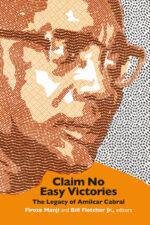
Claim No Easy Victories: The Legacy of Amilcar Cabral
USD $ 26.00“Never has it been more certain that our victory depends principally on our own actions. Tell no lies, claim no easy victories . . .” —Amílcar Cabral On the centennial of Amílcar Cabral’s birth, and fifty years after his passing, Claim No Easy Victories brings to life the resonance of his thought for today’s freedom movements. World-renowned revolutionary, poet, liberation philosopher, and leader of the anticolonial independence movement of Guinea Bissau and Cape Verde, Amílcar Cabral’s legacy stretches well beyond the shores of West Africa. His profound influence on the pan-Africanist movement and the Black liberation movement in the United States and the English-speaking world spans the ages—and is only growing in an era of renewed anti-imperialist internationalist struggle. In this unique collection of essays, radical thinkers from across Africa, the United States, and internationally commemorate Cabral’s life and legacy and his relevance to contemporary struggles for self-determination and emancipation. Claim No Easy Victories serves equally as an introduction or reintroduction to a figure and militant history that the rulers and beneficiaries of global racial capitalism would rather see forgotten. Understanding Cabral then and now sheds light on the necessity of grounding radical change in the creation of theory based on the actual conditions within which movements develop. The depth and dimension of Cabral’s theoretical ideas and revolutionary practice of building popular movements for liberation are assessed by each of the authors and critically reanimated for a new generation of freedom fighters. The book features contributions by: Kali Akuno, Samir Amin, David Austin, Jesse Benjamin, Angela Davis, Bill Fletcher Jr, Mireille Fanon-Mendès France, Lewis Gordon, Firoze Manji, Asha Rodney, Patricia Rodney, Olúfémi Táíwò—and others.
Select options This product has multiple variants. The options may be chosen on the product page -
Night Settles Upon The City
Price range: USD $ 15.00 through USD $ 16.00Select options This product has multiple variants. The options may be chosen on the product page
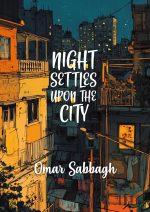
Night Settles Upon The City
Price range: USD $ 15.00 through USD $ 16.00Written with urgency out of a war-time Beirut, this poetry collection registers the griefs and the heroism of the Lebanese, under siege yet again. Sabbagh lends his lyrical voice here, to give a voice to the voiceless, trying to find some harmonic sense out of catastrophe. This book will compel readers, both Lebanese and those with any kind of human heart. While much of the work was written swiftly, on impulse, and almost like, as one of the poem’s title’s has it, a ‘War Diary,’ in verse, this work aims nonetheless to last in its significance and resonance at a time when the world as a whole (let alone Lebanon herself) has become so unpredictable, so fickle and so perilous. Night Settles Upon The City aims to be a worthwhile addition to the contemporary literature of war and, more specifically, to the literary representations of the modern Lebanese reality and experience.
Omar Sabbagh is a poet who is privileged to write about war and destruction from the relative safety of his study. But this double-edged illusion is insidious — mental and emotional inwardly, and physical for those who are directly under attack. It is visceral, political, heart-wrenching — yet the poet seeks out light and hope through the act of writing, for the sake of ownership and sharing. He may say that “I cannot read minds and nor / will I ever wish to”, but he writes for the importance of record-keeping, seeking solace, both private and public — as the Night Settles Upon The City of Beirut.
— Sudeep Sen, Winner of the Rabindranath Tagore Literary PrizeOmar Sabbagh has long brought us a world in which personal experience stitches a hyphen between the eastern Mediterranean and the northerly British archipelago. Now he makes the tension inherent within that richness explicit, in a love-letter to his family and home city of Beirut. Written while the ‘night’ of war ‘settles upon the city’, his introductory ‘Thoughts’ show us how unthinkable war remains, even when it arrives on the doorstep. This is a book of witness to what cannot happen, and yet does.
– Fiona Sampson, Professor Fiona Sampson MBE FRSL.Two-Way Mirror: The Life of Elizabeth Barrett Browning WW Norton 2022 – Washington Post Book of the Year, New York Times Editors’ Choice, finalist Plutarch Prize, finalist PEN Jacqueline Bograd Award, Sunday Times Paperback of the year.The poet Omar Sabbagh lives in Beirut. His voice is playful, almost surreal at times. He talks of ‘the hairbrained monocle of war’ and suggests that if you live long enough in a place like Beirut ‘laughter becomes a lover’s distance-giving kiss’. Night Settles Upon the City offers us a poetry that is neither ideological nor partisan, not of the frontline but of a deeply threatened warzone. Its terms are easy-going, sorrowful, humane, formally intelligent and tinged with apprehension. It is humanity being human. Reading it is relief and hope.’
— George Szirtes FRSL, Eliot Prize winner.Night Settles Upon the City by Omar Sabbagh is a profoundly reflective and evocative collection that blends personal experience with the brutal realities of life in a war-torn Beirut. Through a tapestry of poems, essays, and prose, Sabbagh explores the intersections of love, grief, intellectual contemplation, and the relentless backdrop of violence. The writing oscillates between moments of tender introspection and stark depictions of societal collapse, embodying a kind of philosophical meditation on suffering and survival. Sabbagh’s voice is distinctively lyrical, capturing both the intimacy of individual loss and the broader existential weight of conflict. His reflections on war and its aftermath are imbued with a sense of historical consciousness, yet deeply grounded in the immediacy of personal anguish and resilience. The collection is not just about bearing witness to destruction, but also about finding fragments of humanity amidst the ruins. A haunting and powerful work that invites readers into the fragile space between beauty and despair.—Dr. Pamela Chrabieh, Kulturnest Co-founder & Managing Director
The Arabic term for poet means the one who feels, unlike the Greek origin of poetry, which describes the craft itself. Omar Sabbagh is the quintessential poet in the Arabic sense. In this collection, he vibrates with Beirut, where he now lives, at a time when the city’s famous cultural vibrations are overwhelmed by murderous quakes caused by the Israeli war machine.
—Gilbert Achcar, Professor of Development Studies and International Relations at SOAS University of London.Beirut’s Omar Sabbagh, lover of beauty, poet of lush lyrical power, addresses the spirit of the great Dr. Edward W. Said in one poem, saying these troubled seasons make him “restless now in (his) resting place.” I’m captivated by a further description of Said, “living paper, breathing ink of one whose thoughts still seem to think.” There is healing in such sensitive recognition. Wise voices we always needed are suddenly needed desperately. Sabbagh invokes his love for a precious home frequently under siege and his care for all the people who made and surround him. Gratitude for the wisdom, kindness and rich affections of Night Settles Upon the City.—Naomi Shihab Nye, recipient Lifetime Achievement in Poetry Award, the Wallace Stevens prizeIn Night Settles on the City, Omar Sabbagh gives voice to the bewilderment, fear, rage, and despair so many of us in the Middle East are currently feeling. His eloquent, tender poems grapple with the impossibility—yet absolute necessity—of language at a moment when words otherwise fail. Like all the best poems, Sabbagh’s challenge, soothe, haunt, and rehumanize us, ultimately arousing our better selves.
—Mai Al-Nakib, author of An Unlasting Home and The Hidden Light of ObjectsBoth erudite and demotic, felt through the body and ‘guided by ear’ Omar Sabbagh’s voice powers through the remote attacks on Beirut – the city in which he currently lives – the hourly atrocities and unspeakable suffering to reach us and to speak for us. ‘What’s to understand?’ he asks ‘That murder can be finessed?’ In his seminal new collection, Night Settles Upon the City, night becomes a ‘dark and violent animal’ with its ‘panther’s pelt’ of terror ‘slowly curving round us’ through which we hear the voice of the aggressor reflecting that ‘…each murderous attack/ I order seems to drain this world of innocence.’ Yet Sabbagh’s own voice remains measured, balanced, especially in the portraits he paints of his beloved father…‘It gets worse each day watching him/ ageing’ (‘The Old Man and his Walking Stick’). This poem ends with the lines ‘an old man and his son, fighting a war/ in a warzone we all must visit’. Alongside unimaginable horror we are shown the ordinary griefs and losses that we all suffer – of ageing, of failing, of being human; and it’s the humanity and compassion with which Sabbagh bears witness that will secure this book’s future among the handful of classics that will come to define our era.
— Jenny Lewis, MA Oxon., MPhil., PhD, Tutor for Poetry, Oxford UniversitySelect options This product has multiple variants. The options may be chosen on the product page -
Insurgent Feminisms: Writing War
Price range: USD $ 5.00 through USD $ 35.00Select options This product has multiple variants. The options may be chosen on the product page
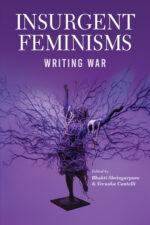
Insurgent Feminisms: Writing War
Price range: USD $ 5.00 through USD $ 35.00War is never just the war itself, it’s not the event or the epoch. War is the impossible and unending afterlife, the struggle to breathe after being bludgeoned, and the re-situating of one’s self and of one’s place after displacement and fragmentation.
Insurgent Feminisms: Writing War advances a new paradigm of war writing by focusing on gender. War is always fought upon the backs of women, often under the pretense of saving them. Yet, along the way, the brutalities unleashed on women during wartime remain relentless. In this collection, insurgency emerges in the raw and meticulous language of witnessing, and in the desire to render the space of conflict in radically different ways. These feminist and queer perspectives on war come out of regions and positions that disobey the rules of war writing. Comprising reportage, fiction, memoir, poetry, and conversations from over sixty writers, the collection includes contributions by Chika Unigwe, Nathalie Handal, Ubah Cristina Ali Farah, Suchitra Vijayan, Bélen Fernández, Uzma Falak, Otoniya Juliane Okot Bitek, Sarah Ladipo Manyika, Lara Pawson, Gaiutra Bahadur, Robtel Neajai Pailey, Sumana Roy and Lina Mounzer, among several others.
Bhakti Shringarpure co-founded Warscapes magazine in November 2011 and it has now transitioned into the Radical Books Collective.
Veruska Cantelli is a writer, translator, editor, and Associate Professor of Interdisciplinary Studies at Champlain College in Vermont, USA.
Select options This product has multiple variants. The options may be chosen on the product page
