ONLY AVAILABLE IN EASTERN AND SOUTHERN AFRICA
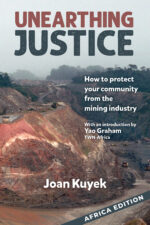
We are pleased to announce that Daraja Press will soon be making Unearthing Justice, originally published by Between The Lines, available in Africa through our partners at Zand Graphics Ltd (throughout East Africa and the Horn) and Sherwood Books (South Africa, Namibia, Botswana, Lesotho, Mozambique and Swaziland).
Originally published in 2019, this new edition has an Introduction by Yao Graham, TWN-Africa. The author, Joan Kuyek, is a community-focused mining analyst and organizer living in Ottawa. She was the founding National Co-ordinator of MiningWatch Canada from 1999–2009 and continues to do work for MiningWatch and for a number of communities affected by mining.
The mining industry continues to be at the forefront of colonial dispossession around the world. It controls information about its intrinsic costs and benefits, propagates myths about its contribution to the economy, shapes government policy and regulation, and deals ruthlessly with its opponents.
Brimming with case studies, anecdotes, resources, and illustrations, Unearthing Justice exposes the mining process and its externalized impacts on the environment, Indigenous Peoples, communities, workers, and governments. But, most importantly, the book shows how people are fighting back. Whether it is to stop a mine before it starts, to get an abandoned mine cleaned up, to change laws and policy, or to mount a campaign to influence investors, Unearthing Justice is an essential handbook for anyone trying to protect the places and people they love.







Alexandra Walker
Delinked:
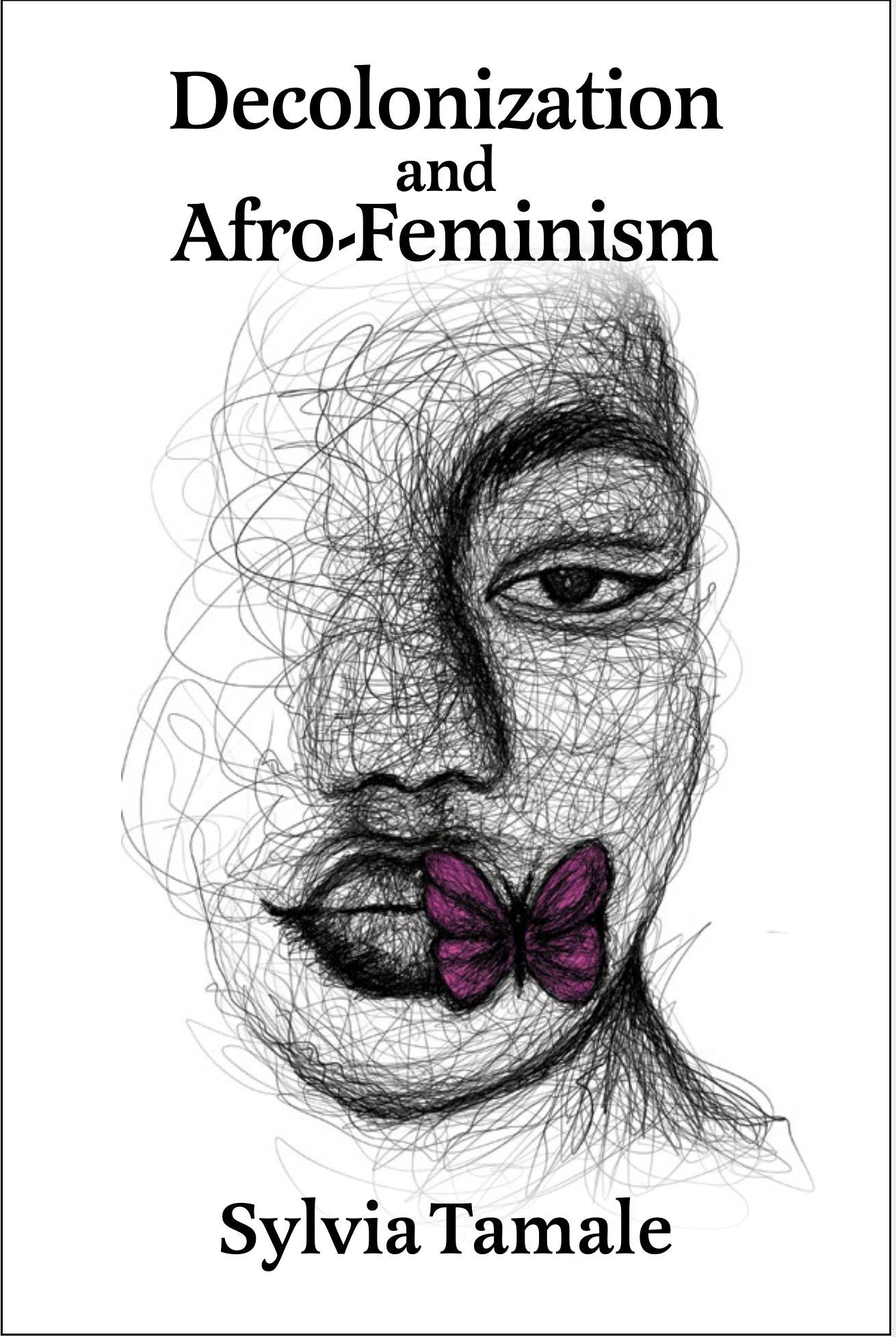
A Review of Sylvia Tamale’s Decolonization and Afro-Feminism
By Alexandra Walker (Howard University C’27) as part of the Black Feminist Theory taught in Howard University’s Women’s, Gender and Sexuality Studies Program
Decolonization and Afro-Feminism by Sylvia Tamale is an intricate work that weaves together the intersectional relationship between racialism, capitalism, patriarchy, and gender roles within an African context to center decolonization as integral to the advancement of Afro-feminism. Professor Sylvia Tamale is a feminist, a legal scholar, and human rights practitioner whose fearlessness in speaking truth to power led her to serve as the first woman Dean of Makerere University School of Law. Fittingly, Tamale critically examines the historical, cultural, and socio-political dimensions of decolonization and its implications for the advancement of Afro-feminist thought.
Tamale begins by setting a historical backdrop for the work, because a clear understanding of the past enables one to walk with discernment in the present. In chapter one, Tamale explains that decolonization cannot be a one-time moment or thing. Decolonization and decolonial effects have historically been “Band-Aids” from people picking at the scabs that colonialism left on the continent. Tamale suggests that there needs to be more than a “Band-Aid” effort to fix the deep scars that have been left so to completely understand the complex damages left by colonization. The reversal of colonial legacies may take centuries and require unique and creative approaches.
Tamale’s notion of decolonization is multifaceted. Africans must think beyond “de-construction” of colonial structures and systems. Without a clear plan to rebuild and reconstruct there is no reason to de-construct and Tamale suggests that this sends Africans back into the arms of the colonizers. Moreover, the African agenda for decolonization and decolonial thought and activism should include reconstructions that prioritize: a) reclaiming humanity, b) reasserting self-determination, c) restoring spirituality, d) rebuilding territorial and bodily integrity, and above all, Africanness and the celebration of womanness.
Tamale makes one thing very clear, the goal of African decolonization and the decolonial project is about one thing: the restoration of dignity to the African people. Tamale does this by analyzing decolonization through a feminist lens. She asserts that decolonization cannot only address political independence but they must all challenge patriarchal structures inherited from colonial rule. Tamale draws attention to the often-overlooked contributions of African women in the struggle for liberation and asserts the need for an inclusive decolonization that recognizes and values the agency of women.
Later, Tamale breaks down some of the methods Europeans and Asians used to colonize Africa. From political colonization to the insidious and dangerous methods of psychological colonization, Tamale suggests that these same tactics can be used in reverse to decolonize and deconstruct colonial structures in Africa. She continues to say that Africans’ sense of history needs to be “delinked ” from the empire in order to delve deeper into Africa’s past (beyond the period of colonialism). Colonial powers were able to maintain their grip, influence, and imperialism through laws, education, religion, and pop culture. Tamale shows that through these mechanisms of globalization, naturalization, and rationalization colonists have been able to blur Africa’s vision to anything “indigenous”, which she aptly identifies as internalized colonization. Moreover, internalized colonization is so entrenched in global structures that the path to decolonization seems difficult and tortuous.
The intersectionality of identities is a central theme in Tamale’s analysis. She contends that Afro-feminism must confront the interconnected systems of oppression based on race, gender, and class. Tamale states that it is impossible to analyze race without also analyzing gender. Tamale continues to explain that until there is a shift to an understanding where there does not have to be an other to understand self, colonial structures will remain in place.
Sylvia Tamale’s Decolonization and Afro-Feminism is a groundbreaking exploration of the intersections between decolonization and feminism in the African context. The work explores and challenges prevailing colonial political, economic, and social structures. Tamale advocates for a more inclusive understanding of colonial structures as this is the only way to decolonize and delink African thought from colonial teachings. Tamale emphasizes the agency of women, while calling for a radical approach that recognizes the complexity and interconnectedness of racial, gender, and other colonial structures. Tamale’s book outlines key strategies, plans, and goals for the decolonization movement and the quest for the restoration of African dignity.
Tamale presents the possibility for a more just future in her critique of the present and suggestions for a pragmatic step forward. Tamale challenges reluctant minds, affirms African feminism as distinct within the spectrum of the global feminism, and places herself within the ever-developing canon of pivotal Black feminist thought for the 21st century. It becomes evident why the Black Feminist Theory course at Howard University incorporates Tamale into the list of authors and the book as assigned reading. It leads us to ask ourselves, “How do we get the work in front of the individuals who need to review them most?” whether in Africa or in one region of the global African Diaspora.