
-
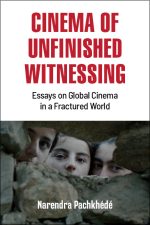
Cinema of Unfinished Witnessing
USD $ 15 USD $ 34.95Price range: USD $ 15 through USD $ 34.95Select options This product has multiple variants. The options may be chosen on the product page
Cinema of Unfinished Witnessing
USD $ 15 USD $ 34.95Price range: USD $ 15 through USD $ 34.95This is not a book about films in the conventional sense. It is a book about the conditions under which films become legible, forgettable, weaponised, or necessary.
Across essays that move between review and reportage, festival and platform, myth and documentary, Narendra Pachkhédé reads global cinema as a moral technology of the present. He follows the contemporary attention regime, the coercions of watchability, the choreography of awards and public virtue, and the quiet ways propaganda teaches a society what to feel plausible. The question is not only what we watch, but how we have been conditioned to watch: how viewing is trained by ideological settings, how sensibility is numbed by repetition and spectacle, how attention is corralled into habits that feel like choice.
This is a book about the world of cinema and its assemblages. It attends to cinema’s extended life in media ecologies: streaming interfaces and festival circuits, platform logics and institutional gatekeeping, the politics of narrative and the global circulation of stories. It returns repeatedly to the politics of reception, where a work is domesticated or rejected, where controversy polices a field, where filmmakers bond, quarrel, protect, and betray, and where institutions decide what counts as witness. Cinema, here, is not only an art form but a system of mediation that defines the political terms under which stories are consumed.
The book crosses geographies and film worlds, tracing how nations dream through genre and how history is refashioned into culture, suspended between memory and forgetting. From the seductions of nostalgia to the endurance of Béla Tarr, from Korean modernity’s neutralised ruptures to Palestinian cinema’s custody under pressure, these essays insist that cinema is never only an image. It is an argument about reality, and a rehearsal for what a public can bear to know.
The Cinema of Unfinished Witnessing asks a simpler, harsher question: why do some stories become global vigils while others vanish into the feed? It is a book about how we come to believe what we believe, and what cinema has to do with that failure. It is also a wager that, by looking closely and naming the terms of looking, one can still be a form of care.
Standing firmly astride continents, Narendra Pachkhédé is perfectly positioned to evaluate the political aesthetics of global cinema. His clear and forceful writing disperses the fog of complaisance that collects around so many “important” films, and celebrates those that invite audiences to stay alert to injustice and alive to feeling. — Dr. Laura U. Marks, philosopher and scholar of new media and film; Grant Strate University Professor, School for the Contemporary Arts, Simon Fraser University, Vancouver
“Myth and memory are never separate in political life,” says Pachkhédé somewhere near the beginning of this book. What follows is an astute and wide-ranging examination of the relationship between ethics, aesthetics and the political in cinema — drawing on Bollywood spy thrillers such as Dhurandhar, not to mention Western examinations of genocide such as Vanderbilt’s Nuremberg and Glazer’s Zone of Interest. You can feel Pachkhédé’s moral drive at every turn in this book — as he ranges over Charlie Kirk’s killing, the far-right gatherings in the UK (“Unite the Kingdom”) and the protest movements in Nepal, the aesthetic question of the political and its representation is at the heart of this timely, detailed book. — Dr. Ian Almond, Professor of World Literatures, School of Foreign Service, Georgetown University, Qatar
Perhaps it’s the first book on film criticism of its kind. The Cinema of Unfinished Witnessing doesn’t confine itself to the temporal-spatial analysis or the social and political climate a film is made in and speaks to, but it incorporates the noise outside the screen, the “buzz” — festival premiere, awards, reviews, public debate and controversy — that create the conditions in which spectators experience the weather within the film. Narendra Pachkhédé stays long and ploughs deep. He moves from the Oscars’ ceasefire pins to a Bollywood blockbuster’s use of genre grammar to craft propaganda; from Béla Tarr’s durée as an ethical method to the algorithmic afterlife of a political assassination; from a Tajik child’s search for a mythical fairy to bring back her absent father to a year-long Indian farmers’ protest filmed not as spectacle but as “a society-in-miniature,” built from kitchens, stages, and the unglamorous labour of staying. He reads festivals and awards as legitimacy machines, and asks what a viral clip or a release date does to a film’s meaning. Pachkhédé doesn’t let cinema off the hook — and he doesn’t let the algorithm off either.— Nishtha Jain, International Award-winning Indian filmmaker and member of the Academy of Motion Picture Arts and Sciences
Narendra Pachkhédé offers a lucid account of cinema’s reception under the platform economy of attention, caught between the reel, the portable clip, and the long take, reclaimed by filmmakers as a counter-technique that restores duration, agency, and ethical looking — une rééducation du regard. Astute and tightly argued, his analysis names the ideological apparatus shaping what we watch, how we watch, and what spectatorship can still demand, renewing, with urgency, the political question of cinema’s reception today. — Jean Gagnon, PhD, independent curator and art critic; former Curator of Media Arts at the National Gallery of Canada and former Director of Preservation and Access to Collections at the Cinémathèque québécoise
Select options This product has multiple variants. The options may be chosen on the product page -
 Select options This product has multiple variants. The options may be chosen on the product page
The In-Between World of Kenya’s Media: South Asian Journalism, 1900-1992
USD $ 35This book, originally published by AwaaZ in Kenya, provides insights into journalists of Indian origin who wrote about the struggles of Kenyan people.
Select options This product has multiple variants. The options may be chosen on the product page -

Struggling to be seen: The travails of Palestinian cinema
USD $ 5 USD $ 15Price range: USD $ 5 through USD $ 15Select options This product has multiple variants. The options may be chosen on the product page
Struggling to be seen: The travails of Palestinian cinema
USD $ 5 USD $ 15Price range: USD $ 5 through USD $ 15The book explores the challenges Palestinian filmmakers confront to develop a cinema that gives expression to the national narrative. The research is based on collaborative work to research and screen Palestinian films involving Film Lab Palestine, Sheffield Palestine Cultural Exchange and Sheffield Hallam University as part of the Creative Interruptions research project (https://creativeinterruptions.com/palestiniancinema/). We explored the political, economic and cultural factors that impact on Palestinian film production and some of the barriers encountered in profiling and screening Palestinian films in Britain.
Select options This product has multiple variants. The options may be chosen on the product page