
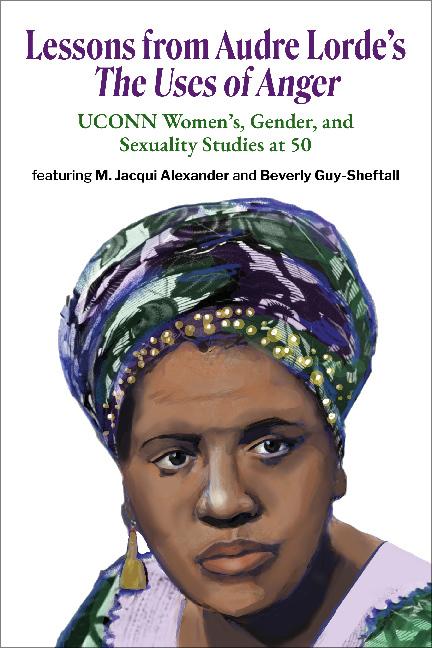
Lessons from Audre Lorde’s The Uses of Anger: UCONN Women’s, Gender, and Sexuality Studies at 50
In recent years, we have witnessed renewed calls for women to embrace anger as a source of power. These voices have Lorde’s “The Uses of Anger”, first delivered at the University of Connecticut (UCONN), Storrs, in 1981, to thank for charting an innovative scholarly and poetic terrain that theorizes anger as much more empowering and liberating than conventional discussions of the term typically allow.
Lorde’s essay redefined anger productively, approaching it as an epistemological tool igniting a desire for self and collective liberation. The result was a remarkable critical reflection that laid the groundwork for deconstructing broader systems of oppression, particularly, heteronormativity, heteropatriarchy, institutionalized racial poverty, racial capitalism, and white privilege. Lorde’s essay moved with precision, centering Black women’s struggles in a world built around the use – and abuse – of racialized people subjected to systematic dehumanization.
In their introduction, Jane Anna Gordon, Elva Orozco Mendoza, and Sherry Zane reflect on the inheritance, lessons, and responsibilities that Women’s, Gender, and Sexuality Studies must grapple with if it is to deepen and fulfill its radical mission.
Guided by the imperative to look backward to understand the present and forge a future, the book closes with a sankofic interview with M. Jacqui Alexander and Beverly Guy-Sheftall, conducted by Briona Simone Jones.
USD $ 15

| Book Format | Print Book, PDF |
|---|
Customer Reviews
There are no reviews yet.
Only logged in customers who have purchased this product may leave a review.
Related products
-

Silence Would Be Treason
USD $ 10 USD $ 20Price range: USD $ 10 through USD $ 20Select options This product has multiple variants. The options may be chosen on the product page
Silence Would Be Treason
USD $ 10 USD $ 20Price range: USD $ 10 through USD $ 20These letters and poems are invaluable fragments of a living conversation that portrays the indomitable power in humans to stay alive in the face of certain death – to stay alive even in death.
Reading through the treasure trove of the letters and poems compiled here as The Last Writings of Ken Saro-Wiwa evokes intense memories of his resolute struggles against an oil behemoth and a deaf autocratic government. His crusade frames one of the most tumultuous periods of Nigeria’s history; his tragic story evokes anger and demands action to resolve the crises that first led the Ogoni people to demand that Shell clean up Ogoni lands or clear out of the territory.
Select options This product has multiple variants. The options may be chosen on the product page -
Love after Babel and other poems
USD $ 5 USD $ 15.30Price range: USD $ 5 through USD $ 15.30Select options This product has multiple variants. The options may be chosen on the product page
Love after Babel and other poems
USD $ 5 USD $ 15.30Price range: USD $ 5 through USD $ 15.30Love after Babel is a collection of poems that deal with themes such as caste, the resistance of Dalit people, Dalit literature, islamophobia and other political themes, with almost one hundred poems divided into three sections (Call Me Ishmail Tonight; Name Me a Word; Love after Babel). The introduction is by Suraj Yengde (award-winning scholar and activist from India, author of the bestseller Caste Matters, inaugural postdoctoral fellow at the Initiative for Institutional Anti-racism and Accountability, Shorenstein Center on Media, Politics and Public Policy at the Harvard Kennedy School).
Chandramohan’s poems are dialogues of the ‘ self’ with the ‘other’. He brings to life a world that subverts myths, literary canons, gender and caste stereotypes by pooling in sparklingly new metaphors with sensitivity and care. He draws his images from contemporary incidents as well as myths and legends of yore, and delves deep into the politicized realm, thus ‘rupturing the hymen of demarcations’ of identity, resistance, repression and love.
Select options This product has multiple variants. The options may be chosen on the product page -

The great climate robbery: How the food system drives climate change and what we can do about it
USD $ 25.99The industrial food system is a major driver of climate change. Food sovereignty is critical to any lasting and just solution. The Great Climate Robbery shows readers how the industrial food system causes climate change, how food and agribusiness corporations are getting away with it and what can be done to turn things around.
-

Oil Politics
USD $ 1 USD $ 25Price range: USD $ 1 through USD $ 25Select options This product has multiple variants. The options may be chosen on the product page
Oil Politics
USD $ 1 USD $ 25Price range: USD $ 1 through USD $ 25The essays here contribute to developing and deepening an understanding of the ecological challenges ravaging Nigeria, Africa and our world today. They illustrate the global nature of these terrors. These essays are not meant just to enable for coffee table chatter: they are intended as calls to action, as a means of encouraging others facing similar threats to share their experiences.
Set out in seven sections, this book of 54 essays deals with deep ecological changes taking place primarily in Nigeria but with clear linkages to changes elsewhere in the world. The essays are laid out with an undergird of concerns that characterise the author’s approach to human rights and environmental justice advocacy. The first section rightly presents broad spectrum ecological wars manifesting through disappearing trees, spreading desertification, floods, gas flaring and false climate solutions.
Select options This product has multiple variants. The options may be chosen on the product page -
Dialectics of revolution : Hegel, Marxism, and its critics through a lens of race, class, gender, and colonialism
USD $ 5 USD $ 18Price range: USD $ 5 through USD $ 18Select options This product has multiple variants. The options may be chosen on the product page
Dialectics of revolution : Hegel, Marxism, and its critics through a lens of race, class, gender, and colonialism
USD $ 5 USD $ 18Price range: USD $ 5 through USD $ 18This book collects four decades of writings on dialectics, a number of them published here for the first time, by Kevin B. Anderson, a well-known scholar-activist in the Marxist-Humanist tradition. The essays cover the dialectics of revolution in a variety of settings, from Hegel and the French Revolution to dialectics today and its poststructuralist and pragmatist critics. In these essays, particular attention is given to Lenin’s encounter with Hegel and its impact on the critique of imperialism, the rejection of crude materialism, and more generally, on world revolutionary developments. Major but neglected works on Hegel and dialectics written under the impact of the struggle against fascism like Lukács’s The Young Hegel and Marcuse’s Reason and Revolution are given full critical treatment. Dunayevskaya’s intersectional revolutionary dialectics is also treated extensively, especially its focus on a dialectics of revolution that avoids class reductionism, placing gender, race, and colonialism at the center alongside class. In addition, key critics of Hegel and dialectics like Jacques Derrida, Michel Foucault, Antonio Negri, Pierre Bourdieu, and Richard Rorty, are themselves analysed and critiqued from a twenty-first century dialectical perspective. The book also takes up the dialectic in global, intersectional settings via a reconsideration of the themes of Anderson’s Marx at the Margins, where nationalism, race, and colonialism were theorized alongside capital and class as key elements in Marxist dialectical thought. As a whole, the book offers a discussion of major themes in the dialectics of revolution that still speak to us today at a time of radical transformation in all spheres of society and of everyday life.
Select options This product has multiple variants. The options may be chosen on the product page -
Cozinhar Um Continente: A Extração Destrutiva e a Crise Climática na África
USD $ 25.99Críticas da obra:
“Uma provocante crítica à extração contemporânea dos recursos (talvez mais adequadamente, “exploração” dos recursos) na África Subsariana. Na sua convincente análise, e em momentos abrasadora, Bassey apresenta uma critica cativante e abrangente da crise social e ambiental que se vive na África” – Chatham House
“De escravos a diamantes e passando pelo petróleo, há muito que os países mais consumistas têm vindo a pilhar a África a seu bel-prazer. Bassey explica muito bem como tudo isso tem vindo a acontecer, frisando bem o que procura a África: Justiça. Leia a obra e junte-se ao apelo de Bassey” – Annie Leonard, autora d´A estória das coisas
“Um livro que explica, de forma perspicaz e eloquente, o que a África pode fazer para travar as novas formas de colonização exacerbadas pelo caos das mudanças climáticas” – Pablo Solon, ex-embaixador da Bolívia nas Nações Unidas
“É uma obra que, a par da forte denúncia que faz da ganância e do saque da riqueza africana, apresenta perspetivas de esperança” – Camilla Toulmin, presidente do Instituto Internacional de Desenvolvimento e Meio Ambiente
“A África e o seu ambiente. Com um estilo refrescante, o autor torna as suas ideias extremamente acessíveis. Um dos mais proeminentes ambientalistas da África, faz uma análise abrangente dos desafios que enfrenta o continente, inspirando as pessoas a agir.” – David Fig, Presidente da Biowatch South Africa e autor do Staking Their Claims
“Para aqueles que ainda estão sépticos dos efeitos das mudanças climáticas, este livro vai deixa-los não apenas incomodados e preocupados, mas também motiva-los a fazer alguma coisa” – Nigerian CompassO nigeriano Nnimmo Bassey é arquiteto, ativista ambiental e escritor. Foi presidente dos Amigos da Terra Internacional (Friends of the Earth International) de 2008 a 2012 e Diretor Executivo da Ação pelos Direitos Ambientais (Environmental Rights Action) durante duas décadas. Em 2009, foi nomeado “Herói do Ambiente” pela revista Time e, em 2010, foi co-vencedor do prestigiado Right Livelihood Award (considerado o Prémio Nobel Alternativo). Em 2012, ganhou o Rafto Prize. É atualmente diretor da Fundação Health of Mother Earth, uma organização ambientalista de reflexão e advocacia.
-

Stop the Continent Grab and the REDD-ification of Africa
So-called Reducing Emissions from Deforestation and Forest Degradation (REDD) is emerging as a new form of colonialism and economic subjugation. This book shows how these unjust mechanisms were designed to usher in a new phase of colonization through an invasion of genetically modified crops and trees which threatens to take over entire ecosystems.
-

Liberalism and its discontents: Social movements in West Africa
USD $ 25.99The engaging and wide-ranging discussions published here explore contemporary political realities in Africa through a ‘social movement’ lens.
Detailing the nuances of social movement politics in 12 West African countries during the 2010-2013 period, they present a chronicle of the socio-political struggles that have taken place in the region. In so doing, this volume answers key questions related to these movements. What logic drives them? What forms do they take? What has been their political impact? Can we speak of a resurgence of social movements? If so, are these a response to the crisis of ‘representative democracy’? Did they give rise to new forms of expression and democratic participation? What challenges do they bring?
Discontent vis-à-vis liberalism in its political and economic dimensions seems to be the trigger of the numerous popular uprisings and protests that occur in the region. In spite of their ambiguities and limitations, these struggles currently seek to remove a double disconnect: that between citizens and the ‘representatives’ and that between the economy and society, between what capital wants and what the people aspire to.
Ndongo Samba Sylla, the editor of this volume, is a Senegalese economist, programme and research manager at the West Africa Office of the Rosa Luxemburg Foundation. Author of The Fair Trade Scandal. Marketing poverty to benefit the Rich (translated from French by Pluto Press 2014), he is the editor of “Rethinking Development” (Rosa Luxemburg Foundation 2014). His recent research work deals with the history of the word ‘democracy’.