
-
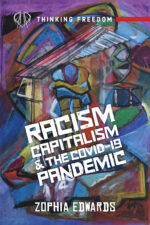
Racism, Capitalism, and COVID-19 Pandemic
USD $ 5 USD $ 15Price range: USD $ 5 through USD $ 15Select options This product has multiple variants. The options may be chosen on the product page
Racism, Capitalism, and COVID-19 Pandemic
USD $ 5 USD $ 15Price range: USD $ 5 through USD $ 15he COVID-19 pandemic has brought into sharp relief the deep structural problems affecting nonwhite racialized workers in the core and periphery. Yet, many social scientific analyses of the global political economy, at least in the pre-COVID era, are race neutral or willfully indifferent to the persistent racial pattern of global inequalities. This pamphlet explains how the unremitting super-exploitation of Black and other nonwhite racialized labor in the core and the periphery persisted throughout the COVID-19 crisis through the lens of Black radical scholarship on racism and capitalism.
Edwards not only captures how people of African descent have been disproportionately impacted by COVID, but also the historical, sociological and structural roots of the inequalities that affect vulnerable groups across the world, tied to what she has described as the architecture of the global economy linked to race and gender. She represents a refreshing voice in our time and part of a Caribbean radical tradition in the spirit of Claudia Jones, Eric Williams, Oliver C. Cox, and C.L.R. James, from her native Trinidad, as well as Guyana’s Walter Rodney and Andaiye.Select options This product has multiple variants. The options may be chosen on the product page -
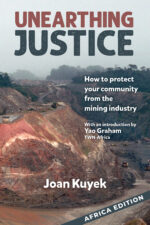
Unearthing justice: How to protect your community from the mining industry AFRICA EDITION
ONLY AVAILABLE IN EASTERN AND SOUTHERN AFRICA
We are pleased to announce that Daraja Press will soon be making Unearthing Justice, originally published by Between The Lines, available in Africa through our partners at Zand Graphics Ltd (throughout East Africa and the Horn) and Sherwood Books (South Africa, Namibia, Botswana, Lesotho, Mozambique and Swaziland).
Originally published in 2019, this new edition has an Introduction by Yao Graham, TWN-Africa. The author, Joan Kuyek, is a community-focused mining analyst and organizer living in Ottawa. She was the founding National Co-ordinator of MiningWatch Canada from 1999–2009 and continues to do work for MiningWatch and for a number of communities affected by mining.
The mining industry continues to be at the forefront of colonial dispossession around the world. It controls information about its intrinsic costs and benefits, propagates myths about its contribution to the economy, shapes government policy and regulation, and deals ruthlessly with its opponents.
Brimming with case studies, anecdotes, resources, and illustrations, Unearthing Justice exposes the mining process and its externalized impacts on the environment, Indigenous Peoples, communities, workers, and governments. But, most importantly, the book shows how people are fighting back. Whether it is to stop a mine before it starts, to get an abandoned mine cleaned up, to change laws and policy, or to mount a campaign to influence investors, Unearthing Justice is an essential handbook for anyone trying to protect the places and people they love.
-
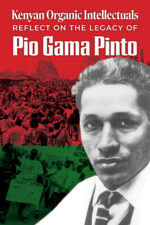
Kenyan Organic Intellectuals Reflect on the Legacy of Pio Gama Pinto
USD $ 5 USD $ 11Price range: USD $ 5 through USD $ 11Select options This product has multiple variants. The options may be chosen on the product page
Kenyan Organic Intellectuals Reflect on the Legacy of Pio Gama Pinto
USD $ 5 USD $ 11Price range: USD $ 5 through USD $ 11This booklet on Pio Gama Pinto has been produced in the tradition of ‘looking back, in order to move forward’ to not only salvage history but also to use it as a mirror to reflect on the current political, economic and social conditions in Kenya. The essays, dubbed reflections, that appear in the booklet are a product of the efforts and dedication of young women and men under the banner of the ‘Organic Intellectuals Network’ in Kenya. We use the concept of ‘organic intellecutal’ as developed by Antonio Gramsci.
Members of the Organic Intellectual Network selected the book Pio Gama Pinto: Kenya’s Unsung Martyr 1927-1965 by Shiraz Durrani (Vita Books, 2018) as a basis for discussion for celebrating and remembering the life of Pio Gama Pinto, Kenya first Martyr, a dedicated and selfless individual in the struggle for freedom in Kenya.Select options This product has multiple variants. The options may be chosen on the product page -

Partisan Universalism: Essays in Honour of Ato Sekyi-Otu
USD $ 5 USD $ 18Price range: USD $ 5 through USD $ 18Select options This product has multiple variants. The options may be chosen on the product page
Partisan Universalism: Essays in Honour of Ato Sekyi-Otu
USD $ 5 USD $ 18Price range: USD $ 5 through USD $ 18The collection of essays in Partisan Universalism celebrates the work of Ato Sekyi-Otu, a scholar, teacher and friend, marking his extraordinary contribution to the philosophy, politics and praxis of liberation. As Ato Sekyi-Otu has argued in his recent book, Left Universalism, Africacentric Essays (Routlege 2019), universalism is an ‘inescapable presupposition of ethical judgment in general and critique in particular, especially indispensable for radical criticism of conditions of existence in postcolonial society and for vindicating visions of social regeneration’. Universalism must and can only be partisan.
“Responding to the invitation ‘to re-member severed but shareable things’, these lovers of truth, freedom, and dignity celebrate the searing intellect, generosity, wit, and compassion of the person and the scholar Ato Sekyi-Otu. … this is a precious contribution. Not to be missed!” —Jane Anna Gordon, author of Statelessness and Contemporary Enslavement and co-editor (with Drucilla Cornell) of Creolizing Rosa Luxemburg. /
“Critically engaging Ato Sekyi-Otu’s notion of partisan universalism, this timely volume of essays speaks directly to the onto-metaphysical issues that will give Africana thought the new foundations that will enable it to move beyond the linguistic turn, brush aside the ashes of Afro-pessimism. … A must read for all concerned with the future of Africana theory and praxis.” —Paget Henry, author of Caliban’s Reason/
“Ato Sekyi-Otu’s thought is one of the most important and exciting in Africa today. The texts compiled in this volume celebrate and engage with the work of Sekyi-Otu … They bear eloquent witness to Sekyi-Otu’s stature as a thinker and to his consistent commitment to the universalization of humanity in both theory and practice.” — Michael Neocosmos, Emeritus Professor in the Humanities, Rhodes University, South Africa.Select options This product has multiple variants. The options may be chosen on the product page -

Extracting Profit: Imperialism, Neoliberalism and the New Scramble for Africa
A piercing historical explanation of poverty and inequality in African societies today and the social impact of resource-driven growth, Extracting Profit explains why Africa, in the first decade and a half of the twenty-first century, has undergone an economic boom. Rising global prices in oil and minerals have produced a scramble for Africa’s natural resources, led by investment from U.S., European and Chinese companies, and joined by emerging economies from around the globe. African economies have reached new heights, even outpacing rates of growth seen in much of the rest of the world. Examined through the lens of case studies of the oil fields of the Niger River Delta, the Chad-Cameroon Pipeline and the East African infrastructure boom, this period of “Africa rising” did not lead to the creation of jobs, but has instead fueled the extraction of natural resources, profits accruing to global capital, and an increasingly wealthy African ruling class.
Extracting Profit argues that the roots of today’s social and economic conditions lie in the historical legacies of colonialism and the imposition of so-called “reforms” by global financial institutions such as the World Bank and International Monetary Fund. The chokehold of debt and austerity of the late twentieth century paved the way for severe assaults on African working classes through neoliberal privatization and deregulation. And while the scramble for Africa’s resources has heightened the pace of ecological devastation, examples from Somalia and the West African Ebola outbreak reveal a frightening surge of militarization on the part of China and the U.S.
Yet this “new scramble” has not gone unchallenged. With accounts of platinum workers’ struggles in South Africa, Nigerian labor organizing and pro-democracy upheavals in Uganda and Burkina Faso, Extracting Profit offers several narratives of grassroots organizing and protest, pointing to the potential for resistance to global capital and fundamental change, in Africa and beyond.
And in an updated Preface, the author analyses the implications of the Covid-19 pandemic and escalating climate emergency, as both the crises and resistance to extraction accelerate across the continent.
Reviews-
“Lee Wengraf’s Extracting Profit – Imperialism, Neoliberalism and The New Scramble for Africa is at once historical and contemporary. It unpacks ongoing resource crimes by analytically exposing its historical roots and pointing to ways by which the oppressed can cut off the bonds that lock in their subjugation.” —Nnimmo Bassey, Director, Health of Mother Earth Foundation
“Lee Wengraf provides an important reminder that Africa’s position within the world economy is heavily determined by its unequal insertion into the global capitalist system and ongoing manifestations of imperialism.” –James Chamberlain, Sheffield Political Economy Research Institute
“Lee Wengraf’s Extracting Profit provides a breathtakingly detailed account and analysis of some of the major socioeconomic ills that have been plaguing Africa for centuries. Amongst the host of issues she tackles, arguably the most consequential are mass poverty in African societies, their indefensible economic inequalities and the steady plundering of the continent’s resources, starting from the slave-trade era up till the present-day.” –Remi Adekoya, Review of African Political Economy
“Extracting Profit offers several narratives of grassroots organizing and protest, pointing to the potential for resistance to global capital and fundamental change, in Africa and beyond.” –Developing Economics
“Evidently, this book is well-researched and it contributes to the expansion of the frontiers of Marxist scholarship on Africa’s development dilemma within the global capitalist order. This book lends credence to the pioneering works of such notable radical scholars as Andre Gunder Frank, Walter Rodney, and Samir Amin among several others. It should be read by students and teachers of political economy, development studies, Marxism and philosophy.” –Marx & Philosophy Review of Books
“Extracting Profit provides a great arch of scutiny from the earliest carve-up of the African continent, through colonialism, war, imperialism, to the recent neoliberal takeover. The book demonstrates the continued importance of Marxist analysis on the continent, asserting the centrality of class analysis and a project of revolutionary change. Wengraf provides us with a major contribution, that highlights contemporary developments and the role of China on the African continent that has perplexed and baffled scholars. An indispensable volume.” —Leo Zeilig, author of Frantz Fanon: The Militant Philosopher of Third World Revolution
“The history of resource frontiers everywhere is always one of lethal violence, militarism, empire amidst the forcing house of capital accumulation. Lee Wengraf in Extracting Profit powerfully reveals the contours of Africa’s 21st century version of this history. The scramble for resources, markets, and investments have congealed into a frightening militarization across the continent, creating and fueling the conditions for further political instability. Wengraf documents how expanded American, but also Chinese, presence coupled with the War on Terror, point to both the enduring rivalry among global superpowers across the continent and a perfect storm of resource exploitation. Wengraf offers up a magisterial synopsis of the challenges confronting contemporary Africa.” —Michael Watts, University of California, Berkeley
“One of the most well-known stylized facts of Africa’s recent growth experience is that it has been inequality-inducing in ways that previous growth spurts were not. Lee Wengraf, in her new book Extracting Profit , expertly utilises the machinery of Marxian class analysis in making sense of this stylized fact. Along the way we learn much about Africa’s historical relationship with imperialism and its contemporary manifestations. This book should be required reading for all those who care about Africa and its future.” —Grieve Chelwa, Contributing Editor, Africa Is A Country
“In recent years countries in the African continent have experienced an economic boom—but not all have benefited equally. Extracting Profit is a brilliant and timely analysis that explodes the myth of “Africa Rising,” showing how neoliberal reforms have made the rich richer, while leaving tens of millions of poor and working class people behind. Lee Wengraf tells this story within the context of an imperial rivalry between the United States and China, two global superpowers that have expanded their economic and military presence across the continent. Extracting Profit is incisive, powerful, and necessary: If you read one book about the modern scramble for Africa, and what it means for all of us, make it this one.” —Anand Gopal, author, No Good Men Among the Living: America, the Taliban, and the War Through Afghan Eyes
“Thorough and thoughtful, Wengraf’s book has a radical depth that underscores its significance. It’s definitely a must-read for anyone who cherishes an advanced knowledge on the exploitation of Africa as well as the politics that undermines Africa’s class freedom.” —Kunle Wizeman Ajayi, Convener, Youths Against Austerity and General Secretary of the United Action for Democracy, Nigeria
“Extracting Profit is a very important book for understanding why the immense majority of the African population remain pauperised, despite impressive growth rates of mineral-rich countries on the continent. It continues the project of Walter Rodney’s How Europe Underdeveloped Africa. And in several ways, it also goes beyond it, capturing the changing dynamics of global capitalism 45 years after Rodney’s magnus opus.
In this book, Lee Wengraf debunks the myth of “Africa Rising” and the supposed expansion of an entrepreneurial middle-class, revealing “reforms” imposed by international financial institutions as mechanisms for fostering imperialism in an era of sharpening contradictions of the global capitalist economy. The adverse social, economic, political and environmental impact of these are elaborated on as a systemic whole, through the book’s examination of the sinews of capital’s expansion in the region: the extractive industries.
But, Wengraf does not stop at interrogating the underdevelopment of Africa. Her book identifies a major reason for the failures of national liberation projects: while the working masses were mobilised to fight against colonial domination, the leadership of these movements lay in the hands of aspiring capitalists, and intellectuals. The urgency of the need for a strategy for workers’ power internationally, she stresses correctly, cannot be overemphasized.
Reading Extracting Profit would be exceedingly beneficial for any change-seeking activist in the labour movement within and beyond Africa.” —Baba Aye, editor, Socialist Worker (Nigeria)
-
-
Politics, Democratization and Academia in Uganda: The Case of Makerere University
USD $ 6.99 USD $ 20Price range: USD $ 6.99 through USD $ 20Select options This product has multiple variants. The options may be chosen on the product page
Politics, Democratization and Academia in Uganda: The Case of Makerere University
USD $ 6.99 USD $ 20Price range: USD $ 6.99 through USD $ 20As the oldest (and arguably best-known) university in Uganda and the wider eastern and central Africa region, Makerere University looms large in the history of higher education on the continent. Alma mater to presidents, public intellectuals and pundits of all disciplines, Makerere has attracted considerable scholarly and popular attention, both in respect of its prominence and achievements, and well as with regard to its failures and foibles. The proposed book focuses on a particularly understudied aspect of the place of higher education in the African context, i.e. the relationship between a public university of unique historical importance and the contestations over democratization that have taken place both within campus and outside of it. It is built around the late-1980s struggle by the Makerere University Academic Staff Association (MUASA) for improved living conditions against the backdrop of the early programs of structural adjustment and economic reform that the National Resistance Army/Movement (NRA/M) government adopted soon after taking power in 1986. Although seemingly introverted in focus, in many respects the MUASA action represented the earliest forms of political struggle against a regime of governance that promised a great deal, but disappointingly delivered considerably less.
The focus on MUASA provides a critical entry-point to a wider debate about the place of organized democratic action by academics in a post-conflict context where the traditional institutions of political and civil society, i.e. political parties and non-governmental organizations (NGOs) have either been severely compromised or discredited, or where they are too weak and inorganic to provide any form of significant counter-juxtaposition to the government in power. By organizing the first strike by academic staff in the sixty-seven (67) year history of the university, for a time MUASA became the focal-point for democratic organizing against a regime that was yet to fully expose its nefarious and anti-democratic colours. The book examines the broader issues concerning the relationship between organized academic action and democratization; the place of the Media in reviewing these struggles; the position of students as a critical component of academe; “big P” and “small p” politics affecting female academics, and finally, the paradoxical role of the School of Law in both aiding and inhibiting the struggle against dictatorship in a country which has enjoyed
Select options This product has multiple variants. The options may be chosen on the product page -
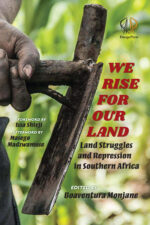
We Rise for Our Land: Land Struggles and Repression in Southern Africa
USD $ 5 USD $ 18Price range: USD $ 5 through USD $ 18Select options This product has multiple variants. The options may be chosen on the product page
We Rise for Our Land: Land Struggles and Repression in Southern Africa
USD $ 5 USD $ 18Price range: USD $ 5 through USD $ 18In recent years southern Africa has aroused the interest of domestic and foreign investors targeting several sectors. Agrarian and extractive capital has been penetrating the countryside, causing land conflicts, displacement of local peasant communities and in worse cases, deaths. Rural people in general have not, been passive—alone or in alliance with non-governmental organizations and activists, they have organized raised their voices. Resistance movements to capital are taking place throughout the region, even when faced with repression. The book provides critical assessments of the dynamics of agrarian and extractive capital in southern Africa: with contributions from DRC, Namibia, Zambia, Malawi, Zimbabwe, Swaziland, Mozambique, Mauritius and Madagascar.
Select options This product has multiple variants. The options may be chosen on the product page -

Revolutionary Hope vs Free-Market Fantasies Keeping the Southern Africa Liberation Struggle Alive: Theory, Practice, Context
USD $ 5 USD $ 20Price range: USD $ 5 through USD $ 20Select options This product has multiple variants. The options may be chosen on the product page
Revolutionary Hope vs Free-Market Fantasies Keeping the Southern Africa Liberation Struggle Alive: Theory, Practice, Context
USD $ 5 USD $ 20Price range: USD $ 5 through USD $ 20John S. Saul, born and first educated in Toronto, Canada, moved to Tanzania almost sixty years ago and, since then, has also taught in Mozambique and South Africa as well as back in Canada at York University. In Tanzania, he discovered the centrality of the war for freedom from white rule and global capitalist dictate then taking shape further south – in Mozambique, Angola, Zimbabwe, Namibia and South Africa. Both his scholarly interest and his activist bent drew him to support and to seek to better understand the struggles in these nations-in-the-making, a political choice that now culminates in a final trilogy of books under the general title, The Rethinking Southern African Liberation Trilogy. The first volume of this trilogy, On Building a Social Movement: The North American Campaign for Southern African Liberation Revisited, was published by Africa World Press / Fernwood Books (2017). The present book is the second in that trilogy, with a third volume entitled Class, Race and the Thirty Years War for Southern African Liberation – A History set to conclude his work to be published by Cambridge University Press in 2022.
Here, Saul’s extended first chapter lays out the broad premises of the thinking that has guided his endeavours, ideas that takes the core reality of economic production and exploitation centrally but that are alive to the tangible impact on outcomes of a wide range of other social realities, including class, race, gender, sexuality, nationalism, the environment, politics and the state. A second section covers the essential unity of theory and political practice that underpins Saul’s findings. And a third and final section paints illuminating pictures of some core aspects of the diverse regional contexts — sites of both recolonization and continuing struggle, and all contexts whose trajectories will be further explored in his forthcoming third volume.
Select options This product has multiple variants. The options may be chosen on the product page -
 Select options This product has multiple variants. The options may be chosen on the product page
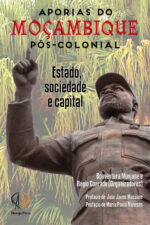
Aporias de Moçambique pós-colonial: Estado, Sociedade e Capital
USD $ 20Moçambique celebrou, em Junho de 2020, 45 anos de sua independência. Os ganhos e avanços que o país alcançou nesta quase meia década de independência são inegáveis, mas os desafios que subsistem são muitos. Este livro reflecte sobre Moçambique contemporâneo nos seus vários aspectos, destacando a formação e o papel do Estado, a democracia, a participação dos cidadãos, a política económica e social e o desenvolvimento. Como se pode ver, o livro não é temático e oferece diversas perspectivas de autores e autoras que se dedicam à investigação, ao jornalismo e ao activismo. O livro pretende exactamente oferecer uma leitura do país a partir dos olhos daqueles que não ocupam uma posição de poder mas que vivem, experienciam e lêem a realidade do país a partir de uma perspectiva crítica da sociedade.
O objectivo deste livro é dar uma melhor compreensão do que tem sido o processo de independência em Moçambique e porque é que o país pós-colonial ainda é ‘colonial’ na sua estrutura política e económica. Assim, são dados muitos exemplos para dar ao leitor a possibilidade de confrontar as perspectivas teóricas aqui utilizadas com os casos concretos.
Todos os estudos deste livro mostram que quarenta e cinco anos de independência não foram vividos da mesma forma pelas elites que governam o país e pelas populações que vivem sob o seu domínio. Por um lado, as elites no poder e os seus parentes beneficiaram, e ainda beneficiam, dos recursos do país, enquanto que uma grande parte da população continua à espera das promessas da independência. De um ponto de vista político e económico, os estudos que compõem o livro destacam como o “desenvolvimento” em Moçambique tem estado em contradição com as necessidades do país. Significa que o actual modelo de desenvolvimento responde muito mais ao capital internacional do que à transformação social de Moçambique.Select options This product has multiple variants. The options may be chosen on the product page -
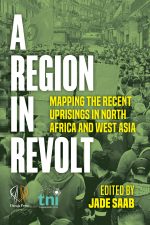
A region in revolt: Mapping the recent uprisings in North Africa and West Asia
USD $ 5 USD $ 15Price range: USD $ 5 through USD $ 15Select options This product has multiple variants. The options may be chosen on the product page
A region in revolt: Mapping the recent uprisings in North Africa and West Asia
USD $ 5 USD $ 15Price range: USD $ 5 through USD $ 15A wave of mass protest movements has spread across North Africa and West Asia, including Sudan, Algeria, Iraq, Lebanon and Iran. The mass protests have much in common, from opposing authoritarian regimes and worsening economic situations to demanding radical changes in social relations. Despite their similarities, each protest movement operates under different conditions that cannot be ignored. The specific historic, political and economic contexts of each country have determined who the key actors of the uprisings are and their location across old and new divides. This book elaborates on these similarities and differences to paint a clearer picture of these movements and draw out lessons to inform future struggles.
Select options This product has multiple variants. The options may be chosen on the product page -
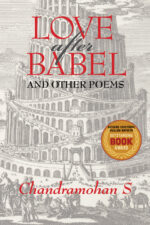
Love after Babel and other poems
USD $ 5 USD $ 15.30Price range: USD $ 5 through USD $ 15.30Select options This product has multiple variants. The options may be chosen on the product page
Love after Babel and other poems
USD $ 5 USD $ 15.30Price range: USD $ 5 through USD $ 15.30Love after Babel is a collection of poems that deal with themes such as caste, the resistance of Dalit people, Dalit literature, islamophobia and other political themes, with almost one hundred poems divided into three sections (Call Me Ishmail Tonight; Name Me a Word; Love after Babel). The introduction is by Suraj Yengde (award-winning scholar and activist from India, author of the bestseller Caste Matters, inaugural postdoctoral fellow at the Initiative for Institutional Anti-racism and Accountability, Shorenstein Center on Media, Politics and Public Policy at the Harvard Kennedy School).
Chandramohan’s poems are dialogues of the ‘ self’ with the ‘other’. He brings to life a world that subverts myths, literary canons, gender and caste stereotypes by pooling in sparklingly new metaphors with sensitivity and care. He draws his images from contemporary incidents as well as myths and legends of yore, and delves deep into the politicized realm, thus ‘rupturing the hymen of demarcations’ of identity, resistance, repression and love.
Select options This product has multiple variants. The options may be chosen on the product page -

Mau Mau From Within: The Story of the Kenya Land and Freedom Army
USD $ 12 USD $ 30Price range: USD $ 12 through USD $ 30Select options This product has multiple variants. The options may be chosen on the product page
Mau Mau From Within: The Story of the Kenya Land and Freedom Army
USD $ 12 USD $ 30Price range: USD $ 12 through USD $ 30The inside story of the struggles of the Kenya Land and Freedom Army, referred to by British colonialism as the ‘Mau Mau rebellion’, is little known today. The autobiographical material written by Karari Njama (a senior leader in the Mau Mau hierarchy) and compiled by Donald L. Barnett was first published by Monthly Review Press in 1966 as Mau Mau From Within: An Analysis of Kenya’s Peasant Revolt. It was reprinted in 1970; it has remained out of print for many years. As the late Basil Davidson put it in his review of the first edition: “Njama writes of the forest leaders’ efforts to overcome dissension, to evolve effective tactics, to keep discipline, mete out justice … and to teach men how to survive in those merciless forests. His narrative is crowded with excitement. Those who know much of Africa and those who know little will alike find it compulsive reading. Some 10,000 Africans died fighting in those years . Here, in the harsh detail of everyday experience, are the reasons why.”
The book is an extraordinary story of courage, passion, heroism, combined with recounting of colonial terror, brutality and betrayal. It is a story of how the very idea of being ‘Kenyan’ was intimately linked to the idea of freedom, a connection that was destroyed not only by the firepower of the British, but also by those who collaborated and established themselves as the beneficiaries of neocolonial rule. Disconnecting notions of freedom from identity left only a caricature that rapidly descended into tribalism and ethnicity.
This momentous story of the struggle for freedom described here is relevant not only for a new generation of Kenyans but also for all those engaged in emancipatory struggles internationally. For so long as the experiences arising from the struggles described in this book are perceived as merely ‘African’ or ‘Kenyan’, it is not possible to fully grasp the contributions they have made to the struggle for a universalist humanity.
What is recounted in this publication is more than an ‘analysis of a peasant revolt’. It is, above all, a history of the Kenya Land and Freedom Army. As Ngūgī wa Thiong’o points out in his Preface to this new edition, ‘we don’t have to use the vocabulary of the colonial to describe our struggles.’ We were tempted to rename the book ‘Kenya Land and Freedom Army from Within.’ But because the original title has wide recognition, and one of the characteristics of movements of the oppressed is to appropriate derogatory terms
Select options This product has multiple variants. The options may be chosen on the product page -

You’re Not Here
USD $ 5 USD $ 20Price range: USD $ 5 through USD $ 20Select options This product has multiple variants. The options may be chosen on the product page
You’re Not Here
USD $ 5 USD $ 20Price range: USD $ 5 through USD $ 20One brother goes missing in action in Afghanistan, the other falls in love with an Afghan girl in England.
Bitter divisions engulf an English town where young Muslims oppose the British army’s presence in Afghanistan, whilst white youth condemn the Muslims as traitors.
To the disgust of his white friends, 17-year-old Jake Marlesden, whose brother is missing in action in Afghanistan, is in love with Leila Khan, an Afghan. When Jake tries to find out what happened to his brother, neighbour turns against neighbour and lover against lover.
Leila joins young Muslims protesting against the returning bodies of dead British soldiers, and Jake stands with the families of the soldiers. The lovers fall apart.
But far off events, and sinister forces at home, bring the lovers together again in a journey in which they will not only discover themselves, but also heal the wounds of their families and friends.
This is the sequel to You’re Not Proper.
Select options This product has multiple variants. The options may be chosen on the product page -

For the love of the struggle: Memoirs from El Salvador
USD $ 5 USD $ 18Price range: USD $ 5 through USD $ 18Select options This product has multiple variants. The options may be chosen on the product page
For the love of the struggle: Memoirs from El Salvador
USD $ 5 USD $ 18Price range: USD $ 5 through USD $ 18From his home in El Salvador, the author shares an intimate personal and political memoir that follows his remarkable journey from the comfort and security of a picturesque New England town to a stirring and heroic engagement in common cause with the struggle for peace and justice in El Salvador. After four years as a Peace Corp worker in northern Liberia beginning in the late 1960’s, followed by a stretch back in the United States as a street worker in the ghettos of North Philadelphia, McKinley finds himself in Central America as an aid worker in 1978. He quickly becomes engulfed by the political violence of the region and engaged with the people and their struggles against five decades of military dictatorship, centuries of poverty and exploitation. The story is marked by terror, adventure and courage, by trials and tragedy redeemed by the beauty and transcendence of people in struggle. Originally based in Guatemala heading up a Catholic relief agency, his commitment to the struggles for change in the country attracts the attention of the military, and his own government, forcing him to leave the country in late 1980. He moves to El Salvador where he begins a gradual incursion into the revolutionary struggle of this country, in a commitment that will last the rest of his life. Interwoven with this personal journey, is the story of Teresa Rivas, her husband Antonio, and their five children, a peasant family It also describes their life after the war, with resettlement in the lowlands of Guazapa where many ex-combatants were building a new life. It explains in detail the gradual emergence of the objective and subjective conditions for revolution in El Salvador, including the difficult choice for the use of violence as the only available option for transformative change in the country. The book also details the challenges of reconstruction after the Peace Accords that end the war in 1992, and the tragedy of opportunities lost during the immediate post-war period in the face of the ongoing resistance of traditional opponents to reform. As the memoir closes, the author reflects on his choice to be in El Salvador over the past 43 years, and the country as he finds it in these changing times; on the family with whom he has shared love and life there; on his continuing relationship with Antonio Rivas and his surviving family; and his gradual reconciliation, from a distance, with the country of his birth.
Select options This product has multiple variants. The options may be chosen on the product page -

Being human after 1492
USD $ 5 USD $ 13Price range: USD $ 5 through USD $ 13Select options This product has multiple variants. The options may be chosen on the product page
Being human after 1492
USD $ 5 USD $ 13Price range: USD $ 5 through USD $ 13The pamphlet begins with two letters written by Paul the Apostle in which Christianity first acquires a universal address. The new religion came to exclude people who were not Christians from the count of the human. This became explicit around a thousand years later when Pope Urban II authorised the First Crusade.
In 1492 planetary history was split in to two. Muhammad XII of Granada conceded defeat to Isabella and Ferdinand, the Catholic monarchs of Portugal and Spain, who went on to expel the Jews from the territory under their control. Europe became a Christian project. In the same year Christopher Columbus arrived in the Caribbean and Europe also became an imperial project with a planetary reach.
The origins of the racial ideology can be seen in this period, in which ideas about religion came to be entangled with fantastical ideas about the imagined purity of blood. But it was in the English colony of Virginia in the seventeenth century that the legitimation for the exclusion from the count of the human began to move from claims made in the name of religion to claims made in the name of science. This is the point at which modern racism, rooted in the appearance of the body, began to cast its malignant shadow across the planet.
The author argues that the struggle to put an end to the epoch of world history that opened in 1492 will require new ideas, and new practices. It follows the Caribbean tradition that runs from Aimé Césaire to Frantz Fanon and Sylvia Wynter in affirming the need for a counter-humanism, a radical humanism, a humanism that, in Césaire’s famous phrases, is “made to the measure of the world”. There is a need for a shift in the ground of reason towards the lived experience and struggles of people rendered, in Wynter’s phrase, as ‘pariahs outside of the new order’.
Select options This product has multiple variants. The options may be chosen on the product page -

Lenin150 (Samizdat): 2nd expanded edition
USD $ 5 USD $ 30Price range: USD $ 5 through USD $ 30Select options This product has multiple variants. The options may be chosen on the product page
Lenin150 (Samizdat): 2nd expanded edition
USD $ 5 USD $ 30Price range: USD $ 5 through USD $ 30Lenin150 (Samizdat) aims to contribute to the re-kindling of the communist attractor by engaging, in the spirit of critical solidarity, with Vladimir Ilyich Ulyanov in the year of his 150th anniversary. Conceived out of the former Soviet republic of Kyrgyzstan, the book brings together contributions from all continents, ranging in style from the academic to the lyrical. As such, these compelling, and in some cases absolutely urgent, appropriations of (the spectre of) Lenin aspire to be of considerable use-value for the struggles ahead.
Select options This product has multiple variants. The options may be chosen on the product page -
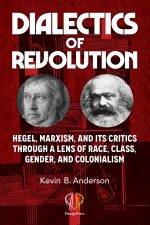
Dialectics of revolution : Hegel, Marxism, and its critics through a lens of race, class, gender, and colonialism
USD $ 5 USD $ 18Price range: USD $ 5 through USD $ 18Select options This product has multiple variants. The options may be chosen on the product page
Dialectics of revolution : Hegel, Marxism, and its critics through a lens of race, class, gender, and colonialism
USD $ 5 USD $ 18Price range: USD $ 5 through USD $ 18This book collects four decades of writings on dialectics, a number of them published here for the first time, by Kevin B. Anderson, a well-known scholar-activist in the Marxist-Humanist tradition. The essays cover the dialectics of revolution in a variety of settings, from Hegel and the French Revolution to dialectics today and its poststructuralist and pragmatist critics. In these essays, particular attention is given to Lenin’s encounter with Hegel and its impact on the critique of imperialism, the rejection of crude materialism, and more generally, on world revolutionary developments. Major but neglected works on Hegel and dialectics written under the impact of the struggle against fascism like Lukács’s The Young Hegel and Marcuse’s Reason and Revolution are given full critical treatment. Dunayevskaya’s intersectional revolutionary dialectics is also treated extensively, especially its focus on a dialectics of revolution that avoids class reductionism, placing gender, race, and colonialism at the center alongside class. In addition, key critics of Hegel and dialectics like Jacques Derrida, Michel Foucault, Antonio Negri, Pierre Bourdieu, and Richard Rorty, are themselves analysed and critiqued from a twenty-first century dialectical perspective. The book also takes up the dialectic in global, intersectional settings via a reconsideration of the themes of Anderson’s Marx at the Margins, where nationalism, race, and colonialism were theorized alongside capital and class as key elements in Marxist dialectical thought. As a whole, the book offers a discussion of major themes in the dialectics of revolution that still speak to us today at a time of radical transformation in all spheres of society and of everyday life.
Select options This product has multiple variants. The options may be chosen on the product page -

Fanon and the rationality of revolt
USD $ 5 USD $ 12Price range: USD $ 5 through USD $ 12Select options This product has multiple variants. The options may be chosen on the product page
Fanon and the rationality of revolt
USD $ 5 USD $ 12Price range: USD $ 5 through USD $ 12We inhabit extraordinary times: times in which we are acutely aware of the intensity of what revolutionary thinker Frantz Fanon called “the glare of history’s floodlights.” The velocity and scale at which the revolt against police murder that began in Minnesota after the death of George Floyd on May 25th and moved throughout the US, and then other parts of the world, was astonishing. It was impossible to predict, but then, in retrospect, it is George Floyd’s death becomes a nodal point: calling for action as well as rethinking and self-clarification. Thinking about this moment with the world revolutionary Frantz Fanon, we need to be aware of continuities and discontinuities — or, as he puts it, opacities — between the ages, his and ours. Fanon is always speaking to us, but often in ways we cannot hear. We have to work to listen to him and to understand the new contexts and meanings in relative opacity. It is this constant dialogue that helps illuminate the present and enable ongoing fidelity to Fanon’s call in the conclusion of The Wretched of the Earth the necessity to work out new concepts to confront one of Fanon’s greatest concerns, the betrayal of the revolutionary movement. In this pamphlet we consider how Fanon’s idea of liberation is connected with “the rationality of revolt.” The practice of engaging Fanon not only with revolt but with the reason or rationality of revolt connects with Fanon’s idea of how this liberated humanity is a product of a new consciousness of collectivity open to rethink everything.
Select options This product has multiple variants. The options may be chosen on the product page -

Class, gender, race and colonialism
USD $ 5 USD $ 11Price range: USD $ 5 through USD $ 11Select options This product has multiple variants. The options may be chosen on the product page
Class, gender, race and colonialism
USD $ 5 USD $ 11Price range: USD $ 5 through USD $ 11Description (1600 / 2500)
It is important to see both Marx’s brilliant generalisations about capitalist society and the very concrete ways in which he examined not only class, but also gender, race, and colonialism, and what today would be called the intersectionality of all of these. His underlying revolutionary humanism was the enemy of all forms of abstraction that denied the variety and multiplicity of human experience, especially as his vision extended outward from Western Europe. For these reasons, no thinker speaks to us today with such force and clarity.It is clear today that the emancipation of labour from capitalist alienation and exploitation is a task that still confronts us. Marx’s concept of the worker is not limited to European white males, but includes Irish and Black super-exploited and therefore doubly revolutionary workers, as well as women of all races and nations. But, his research and his concept of revolution go further, incorporating a wide range of agrarian non-capitalist societies of his time, from India to Russia and from Algeria to the Indigenous peoples of the Americas, often emphasising their gender relations. In his last, still partially unpublished writings, he turns his gaze Eastward and Southward. In these regions outside Western Europe, he finds important revolutionary possibilities among peasants and their ancient communistic social structures, even as these are being undermined by their formal subsumption under the rule of capital. In his last published text, he envisions an alliance between these non-working-class strata and the Western European working class.
Select options This product has multiple variants. The options may be chosen on the product page -

Finding a Voice: Asian Women in Britain (New and Expanded Edition)
USD $ 5 USD $ 20Price range: USD $ 5 through USD $ 20Select options This product has multiple variants. The options may be chosen on the product page
Finding a Voice: Asian Women in Britain (New and Expanded Edition)
USD $ 5 USD $ 20Price range: USD $ 5 through USD $ 20irst published in 1978, and winning the Martin Luther King Memorial Prize for that year, Finding a Voice established a new discourse on South Asian women’s lives and struggles in Britain. Through discussions, interviews and intimate one-to-one conversations with South Asian women, in Urdu, Hindi, Bengali and English, it explored family relationships, the violence of immigration policies, deeply colonial mental health services, militancy at work and also friendship and love. The seventies was a time of some iconic anti-racist and working-class struggles. They are presented here from the point of view of the women who participated in and led them.
This new edition includes a preface by Meena Kandasamy, some historic photographs, and a remarkable new chapter titled ‘In conversation with Finding a Voice: 40 years on’ in which younger South Asian women write about their own lives and struggles weaving them around those portrayed in the book.
Select options This product has multiple variants. The options may be chosen on the product page