
-
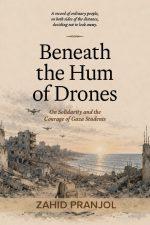
Beneath the Hum of Drones
USD $ 5.00 USD $ 24.00Price range: USD $ 5.00 through USD $ 24.00Select options This product has multiple variants. The options may be chosen on the product page
Beneath the Hum of Drones
USD $ 5.00 USD $ 24.00Price range: USD $ 5.00 through USD $ 24.00Royalties from this book go to the students in Gaza.
The Gazan students who refused to stop learning
Beneath the Hum of Drones: On Solidarity and the Courage of Gaza’s Students, a new book by Professor Zahid Pranjol, tells the story of how students in Gaza continued to learn through war, displacement and siege, and how an extraordinary network of volunteers from the UK came together to support them, drawing on first-hand testimony from Gaza, stories from inside the atrocities and personal reflection.
The new book follows students who continued to study, write, paint and organise while their universities and homes were being destroyed around them. Alongside their stories, it traces a grassroots movement that connected academics, teachers and communities across the UK with students in Gaza, providing teaching, financial support and opportunities for the students’ artwork and poetry to be seen and heard outside of the walls of Gaza and for their voices to be carried to the world. This book is about the author’s journey with a community of students in Gaza built together, across an impossible distance and in the middle of a genocide.
“This is not a book I set out to write. It began as a question asked over coffee by a scholarship student from Gaza who wanted to know what the two of us, in a university in the south of England, could actually do in the face of annihilation of the people of Palestine.” Professor Pranjol writes.
What followed was an extraordinary international effort. University academics, more than 70 volunteer English teachers, artists, healthcare professionals and hundreds of ordinary people came together, united by the belief that they could not stand by while Gaza’s students were denied their education. Together, they built a network of solidarity with members centred around the University of Sussex and communities across East Sussex, UK. Among those involved were English teachers, doctors, artists and university lecturers from across the UK who volunteered hundreds of hours to teach students in Gaza remotely.
Since early 2024, the initiative has grown into a wide-ranging programme of educational, creative and psychological support for students in Gaza. Its work includes English language teaching delivered by volunteer teachers, art therapy for children, specialist psycho-trauma therapy delivered remotely through Zoom and WhatsApp, and medical and psycho-trauma training for healthcare professionals working in Gaza. The wider initiative documented in the book has supported an estimated 4,000 to 5,000 students through educational programmes, financial assistance and wellbeing support.
The initiative has been shaped by listening to students in Gaza themselves to understand what their needs are. Organisers asked them to identify their most urgent priorities, time and again, they told of their immediate need for access to emergency medical training and mental health training, alongside financial support.
This new book tells their story. Rather than focusing on governments or institutions, Beneath the Hum of Drones centres the experiences of Gaza’s students themselves. Through essays, paintings, poems and personal testimony, the book presents young people determined to continue learning despite extraordinary circumstances.
Professor Pranjol says the students of Gaza became his teachers.
“I was not the teacher in this story. I was the student. The young people of Gaza, studying under bombardment, writing from the side of the road, painting the sea from rooftops beneath the drones, were the ones with something to teach, and this book is mostly a record of what they taught me.”
Since October 2023, universities across Gaza have been devastated, every school has been damaged or destroyed, and hundreds of thousands of students have seen their education disrupted. Palestinian academics have described the destruction of the higher education system as ‘scholasticide’, the systematic destruction of educational institutions and knowledge itself.
While much has been written about the destruction of Gaza, few books tell the story through the eyes of its students, or document the international community that emerged to support them. Beneath the Hum of Drones documents not only that destruction, but also the determination of students and educators to continue learning, and the communities around the world that chose to stand beside them.
“I have tried to write this book without looking away, and without reducing anyone person to a number or a symbol. The people in these chapters have names, and tastes, and ambitions. They argue and they make jokes. They are still hoping. They are, against years of siege and horror, still here.” Professor Pranjol remarks.
All author royalties from Beneath the Hum of Drones will go directly to supporting students in Gaza. By purchasing the book, readers are helping to fund educational opportunities and ensure that young people can continue learning despite the ongoing destruction of Gaza’s education system.
Professor Zahid Pranjol is Professor of Biomedical Sciences at the University of Sussex and a leading voice in inclusive science education and curriculum reform. He is also the co-author, with Dr Jacob Norris, of We Are Still Here, the 2025 anthology bringing together the voices of 58 university students writing from Gaza during the destruction of their universities and homes. Beneath the Hum of Drones tells the story behind that project and the wider movement it inspired.
Endorsements
“An extraordinary and inspiring story of the effort by global solidarity activists to keep Gaza’s students learning against near-impossible odds.” — Norman Finkelstein and Deborah Maccoby
“Testifies to the resilience of Gaza’s younger generation, whose determination should humble us all.” — Ilan Pappé
“A fellowship of endeavour proving that the truest bonds of humanity acknowledge neither distance nor siege.” — Vusi Madonsela
“An inspiring story of what happens when individuals decide to make a difference.” — Caroline Lucas
“Heart wrenching and inspiring, a model of what humanity can do in the rubble of the inhuman.” — Lila Abu-Lughod
“A remarkable testament to the enduring power of education, compassion, and courage.” — Professor Dr. Omar Kh. Melad
“In the face of scholasticide, Palestinian students give us hope.” — Neve Gordon
Closing
The genocide continues. Yet so does the extraordinary courage of Gaza’s students, and the growing network of solidarity that stands beside them. They are still teaching. They are still writing. They are still painting. They are still dreaming of a future. They are still here.
“The people of Gaza were never waiting to be saved. They were already doing the work. They asked only that the rest of us not leave them to do it alone.”
Select options This product has multiple variants. The options may be chosen on the product page -

Singing to Liberation: Songs of Freedom and Nights of Resistance on Indian Campuses
USD $ 5.00 USD $ 16.00Price range: USD $ 5.00 through USD $ 16.00Select options This product has multiple variants. The options may be chosen on the product page
Singing to Liberation: Songs of Freedom and Nights of Resistance on Indian Campuses
USD $ 5.00 USD $ 16.00Price range: USD $ 5.00 through USD $ 16.00Student activism and cultural activism go hand in hand on Indian campuses. Over the last few years, especially after 2014, student movements in the country against social injustice have increased in numbers and tenacity. Cultural modes of expressing dissent have played a key role within this new wave of student movements that have gripped the nation. This book takes the reader through a journey into the ways cultural activists analyse cultural modes of protest, especially in the context of student movements in the Global South. The book delves into the political and ideological contours set by organisations such as the Indian Progressive Theatre Association (IPTA) and the Progressive Writers’ Association (PWA), and by figures such as Faiz Ahmed Faiz, Habib Jalib, Hemanga Biswas and Safdar Hashmi. The book locates them within the contemporary wave of cultural protests, analyses their continued relevance and argues for a revival of theoretical and practical engagement with the early progenitors of the progressive cultural movement in India.
Select options This product has multiple variants. The options may be chosen on the product page -
Politics, Democratization and Academia in Uganda: The Case of Makerere University
USD $ 6.99 USD $ 20.00Price range: USD $ 6.99 through USD $ 20.00Select options This product has multiple variants. The options may be chosen on the product page
Politics, Democratization and Academia in Uganda: The Case of Makerere University
USD $ 6.99 USD $ 20.00Price range: USD $ 6.99 through USD $ 20.00As the oldest (and arguably best-known) university in Uganda and the wider eastern and central Africa region, Makerere University looms large in the history of higher education on the continent. Alma mater to presidents, public intellectuals and pundits of all disciplines, Makerere has attracted considerable scholarly and popular attention, both in respect of its prominence and achievements, and well as with regard to its failures and foibles. The proposed book focuses on a particularly understudied aspect of the place of higher education in the African context, i.e. the relationship between a public university of unique historical importance and the contestations over democratization that have taken place both within campus and outside of it. It is built around the late-1980s struggle by the Makerere University Academic Staff Association (MUASA) for improved living conditions against the backdrop of the early programs of structural adjustment and economic reform that the National Resistance Army/Movement (NRA/M) government adopted soon after taking power in 1986. Although seemingly introverted in focus, in many respects the MUASA action represented the earliest forms of political struggle against a regime of governance that promised a great deal, but disappointingly delivered considerably less.
The focus on MUASA provides a critical entry-point to a wider debate about the place of organized democratic action by academics in a post-conflict context where the traditional institutions of political and civil society, i.e. political parties and non-governmental organizations (NGOs) have either been severely compromised or discredited, or where they are too weak and inorganic to provide any form of significant counter-juxtaposition to the government in power. By organizing the first strike by academic staff in the sixty-seven (67) year history of the university, for a time MUASA became the focal-point for democratic organizing against a regime that was yet to fully expose its nefarious and anti-democratic colours. The book examines the broader issues concerning the relationship between organized academic action and democratization; the place of the Media in reviewing these struggles; the position of students as a critical component of academe; “big P” and “small p” politics affecting female academics, and finally, the paradoxical role of the School of Law in both aiding and inhibiting the struggle against dictatorship in a country which has enjoyed
Select options This product has multiple variants. The options may be chosen on the product page -

The imperative of Utu / Ubuntu in Africana scholarship
USD $ 5.00 USD $ 15.00Price range: USD $ 5.00 through USD $ 15.00Select options This product has multiple variants. The options may be chosen on the product page
The imperative of Utu / Ubuntu in Africana scholarship
USD $ 5.00 USD $ 15.00Price range: USD $ 5.00 through USD $ 15.00Written in commemoration of the 50th anniversary of Africana Studies and Research Center, Cornell University, this publication celebrates the birth of Black studies as a liberated academic zone. Professor Mũgo reflects upon the significance of Africana studies, specifically within the context of America’s predominantly White universities, revisiting the hers/his/torical context that birthed Black studies as a field of knowledge. She reflects on the ownership of knowledge, its production, dissemination and custodianship while proposing utu/ubuntu as imperatives in defining transformative education. The hypothesis and heart of the argument is that knowledge and scholarship can either be colonizing, alienating and enslaving; or, alternatively, they can be conscientizing, humanizing and liberating, creating new human beings with the agency to transform life and the world, for the better. he dismisses the false myth of dominating, colonizing and imperialist cultures that claim to have a monopoly of knowledge and whose purpose is to justify the dehumanization of the conquered, the attempted erasure of their knowledges, heritages and ultimately, entire cultures.
Select options This product has multiple variants. The options may be chosen on the product page -

Transforming ourselves, Transforming the World: An open conspiracy for social change – Second Edition
USD $ 5.00 USD $ 20.00Price range: USD $ 5.00 through USD $ 20.00Select options This product has multiple variants. The options may be chosen on the product page
Transforming ourselves, Transforming the World: An open conspiracy for social change – Second Edition
USD $ 5.00 USD $ 20.00Price range: USD $ 5.00 through USD $ 20.00This book is for all those—community workers, adult educators, social activists of every kind—who want to overcome pessimism and play a part in changing society in the direction of peace, justice and dignity for all human beings. As author Brian Murphy points out, many of us are pessimistic about our ability to change the world when confronted by the powerful forces of big corporations and big government. Murphy reveals the social and personal dilemmas which hold people back from social engagement, and argues that the various constraints we face can be overcome.
In this new edition, David Austin explains in his Introduction why this book, first published in 1999, is perhaps more relevant to our times than ever, offering insights from his own experiences of engaging critically with the book and with others. And in his Afterword, Brian Murphy reflects on the continued relevance of the original text, emphasizing how our humanity is being corroded and commodified. To reclaim our humanity, he argues, we must transform ourselves to transform the world.
Brian Murphy’s immensely inspiring book,Transforming Ourselves, Transforming the World, deeply challenges us to think and rethink everything we knew and thought we knew.—Nnimmo Bassey, Executive Director, Health of Mother Earth Foundation & Right Livelihood Award Laureate in 2010
We need more conversations like the one in this book, which are rooted in hope while honestly working through a foundational way of seeing and understanding ourselves in the bigger picture.— Christina Warner, Co-Executive Director and Director of Campaigns and Organising, Council of Canadians.
This is one of the coolest, enjoyable and important books I have read in recent years. Written from the heart as well as the head, it is a breathtakingly visionary, unique and insightful take on the life of the ultimate activist.—Hope Chigudu, Feminist activist
Select options This product has multiple variants. The options may be chosen on the product page -
Under-Education in Africa
USD $ 22.00Select options This product has multiple variants. The options may be chosen on the product page
Under-Education in Africa
USD $ 22.00Under-Education in Africa: From Colonialism to Neoliberalism is a collection of essays on diverse aspects of educational systems that were written over a period of four and a half decades, written from the point of view of an activist educator.
With the focus on Tanzania, they cover education in the German colonial era, the days of Ujamaa socialism and the present neo-liberal times. Themes include the social function of education, the impact of external dependency on education, practical versus academic education, democracy and violence in schools, the role of computers in education, the effect of privatization on higher education, misrepresentation of educational history, good and bad teaching styles, book reading, the teaching of statistics to doctors and student activism in education.
Two essays provide a comparative view of the situation in Tanzania and the USA. Linking the state of the educational system with society as a whole, they explore the possibility of progressive transformation on both fronts. They are based on the author’s experience as a long-term educator, his original research, relevant books, newspaper reports and discussions with colleagues and students.
The author is a retired professor of medical statistics who has taught at colleges and universities in Tanzania and at universities in the USA and Norway.
Select options This product has multiple variants. The options may be chosen on the product page -

The Travails of a Tanzanian Teacher
USD $ 18.00Select options This product has multiple variants. The options may be chosen on the product page
The Travails of a Tanzanian Teacher
USD $ 18.00The Travails of a Tanzanian Teacher is a riveting account of the bumpy first decade of the work life of Karim F Hirji, a retired Professor of Medical Statistics. Filled with a distinctive variety of eye-opening episodes, it covers lecturing at the University of Dar es Salaam, the life of a political exile in a remote rural area and the challenges of setting up from scratch a one-of-a-kind educational institute in Africa. With a style that seamlessly combines the personal with the general, Hirji provides an illuminating description of different aspects of the Tanzanian political, educational, economic and rural landscape during the 1970s. Starting with a commentary on teacher training, he concludes with a critical comparison of modern university education in the nation with that of the earlier era.
Select options This product has multiple variants. The options may be chosen on the product page -

Rinky-Dink Revolution: Moving Beyond Capitalism
USD $ 5.00 USD $ 15.00Price range: USD $ 5.00 through USD $ 15.00Select options This product has multiple variants. The options may be chosen on the product page
Rinky-Dink Revolution: Moving Beyond Capitalism
USD $ 5.00 USD $ 15.00Price range: USD $ 5.00 through USD $ 15.00This pamphlet tackles the question: how do we get from A to B, capitalism to post-capitalism?
It is critical reading to understand why:
* Capitalist-oriented industrial agriculture and its destruction of habitat are the upstream causes that led to the COVID-19 pandemic as well as other past and future pandemics of devastating, emerging viral pathogens.
* COVID-19 may trigger a collapse of the global capitalist system but it is not the cause.
* Health-care and public-health systems organized around capitalist principles don’t do well in pandemics, compared to those not organized around capitalist principles.
* The current economic collapse, triggered by a pandemic, opens a door for revolutionary transformation.The pamphlet is also available in Spanish and Korean.
Select options This product has multiple variants. The options may be chosen on the product page