
-

Hand On The Sun: A passionate and powerful novel of race and class
USD $ 5.00 USD $ 18.00Price range: USD $ 5.00 through USD $ 18.00Select options This product has multiple variants. The options may be chosen on the product page
Hand On The Sun: A passionate and powerful novel of race and class
USD $ 5.00 USD $ 18.00Price range: USD $ 5.00 through USD $ 18.00This was Tariq Mehmood’s first novel, published by Penguin Books in 1983, charting the experience of the second generation migrants to the UK. Set in the declining textile industry of the North of England, it is a raw story of pain and anger at the relentlessness of British racism, from the street to the state – a story of an unquenchable desire for justice, and reclaiming human dignity. A dignity that is wrapped around new questions of Identity, a crossroad between religion, language, history and resistance. It is a little big story, that talks to the extremities of social, political and literary issues today? Can stories of a generation be appropriated? How important is religion in identity? If all you have is a story to tell, who should you tell it? Are the issues of today, just the issues of today or can we learn something from the past? In these stories, friendship is not defined by religion or colour, but by humanity. And racism is much more than skin deep. It is an exhilarating read that bears witness to the urgent 80’s battles against state and popular racism. As important now as then. In this new edition, Mehmood provides a Foreword that describes how the novel came to be written and the lives of real people on whom the characters were created. In the Afterword, Mehmood revisits some of the characters who are now 40-years older, and reflects on how the book would have been written today where the conditions of mass mobilizations no longer exist in neoliberal Britain.
Select options This product has multiple variants. The options may be chosen on the product page -

Left Alone: On Solitude and Loneliness amid Collective Struggle
USD $ 5.00 USD $ 28.00Price range: USD $ 5.00 through USD $ 28.00Select options This product has multiple variants. The options may be chosen on the product page
Left Alone: On Solitude and Loneliness amid Collective Struggle
USD $ 5.00 USD $ 28.00Price range: USD $ 5.00 through USD $ 28.00Left Alone brings together 13 authors and 6 visual artists from Africa, Asia, Latin America, Europe and North America to individually and collectively reflect – in words and images – on an urgent psycho-political issue that has not yet been explicitly addressed through a left political lens, that is, Left Loneliness. Combining academic and more personal-political texts, including an interview, poetry, a Rap and a powerful short story, the book explores the contributors personally and/or vicariously lived experiences of Left Loneliness from a variety of genres and left political currents: Marxist, Feminist, Anti-/De-Colonial, Anti-Racist, Queer, Post-Soviet, Anti-Ableist and others. Says Feminist writer Sara Ahmed: “Loneliness might be what we are threatened with if we persist in being or doing what we are being or doing.” In this sense, Left Loneliness is neither a metaphor nor a secondary contradiction and definitely not a type of petty bourgeois “personalism”. Rather, it might be considered one of the rank and file psycho-affective elements shaping and at the same time resulting from our myriad, intersecting, unremitting, yet always fragile and potentially shattering political attempts to revolutionise our inner and outer worlds. Given its (growing?) existence in our everyday left subjectivities, the book argues that Left Loneliness and related states of solitude, isolation and alienation, among others, have both debilitating and productive (epistemic) dimensions, with very concrete psycho-somatic repercussions for Left Mental and Physical Health and hence our capacities to persist and build on “being or doing what we are being or doing”. Given that continuing and deepening our multiple ongoing struggles for liberation will depend on our constant ability to (re-)create, sustain and care for both our individual selves and the communities that we are a part of, the aim of Left Alone is to contribute to the strengthening of these personal collectivities in action in-against-and beyond capitalism, colonialism and heteropatriarchy by inviting the comrade-readers into what will ideally be a deeply stimulating and enabling personal-political engagement with the texts and images hailing from countries such as Argentina, Kenya, Kyrgyzstan, Guinea-Bissau/Portugal, Turkey/Kurdistan, Jamaica, Italy, the UK, Germany and the USA. As Lena Grace Anyuolo from Kenya puts it, “My sisters and brothers, Come, Let us gather, To lay the structures for a joyous existence.”
Select options This product has multiple variants. The options may be chosen on the product page -
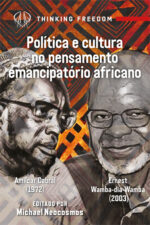
Política e cultura no pensamento emancipatório africano
USD $ 5.00 USD $ 9.00Price range: USD $ 5.00 through USD $ 9.00Select options This product has multiple variants. The options may be chosen on the product page
Política e cultura no pensamento emancipatório africano
USD $ 5.00 USD $ 9.00Price range: USD $ 5.00 through USD $ 9.00Description (2132 / 2500)
A atual ausência de uma visão emancipatória para a África está no centro dos nossos problemas políticos relacionados à opressão racial capitalista e colonial. Qualquer tentativa de repensar a emancipação política no continente africano deve ser capaz de localizar uma concepção universal de liberdade no interior das experiências culturais singulares que as pessoas vivem. Quando esteve baseada nas tradições populares, a política emancipatória exibiu tais traços dialéticos, independentemente da maneira específica na qual cada luta pela liberdade foi pensada em diferentes contextos históricos. No entanto, apenas alguns intelectuais militantes compreenderam a importância dessa dialética no pensamento.O presente volume esboça e discute dois pontos de vista particularmente importantes sobre o papel e a relevância da cultura popular na política emancipatória em África. Cada um deles resulta de formas distintas de exploração capitalista e colonialista: o primeiro viu a luz do dia em um contexto colonial, enquanto o segundo é diretamente confrontado pelo estado neocolonial. Todas as políticas emancipatórias são desenvolvidas em confronto com o poder estatal, e todas começam com um processo de discussão e debate através do qual um sujeito coletivo começa a se formar. No continente africano, a construção de tal sujeito político coletivo tem sido informada, de maneira fundamental, pelas culturas populares.
Os dois autores cujos ensaios estão aqui incluídos entenderam isso e colocaram a cultura popular no centro de suas políticas. O primeiro, Amílcar Cabral, aborda o papel central da cultura popular na luta pela independência da Guiné-Bissau nos anos 1970; o segundo, Ernest Wamba-dia-Wamba, aborda a centralidade da cultura popular africana para uma política emancipatória endereçada à atual República Democrática do Congo. Apesar das décadas que os separam, tanto Cabral como Wamba-dia-Wamba desenvolvem, no centro de sua política, uma dialética que ativa os universais da cultura no presente. É essa característica que confere às suas visões uma importância central para o pensamento emancipatório contemporâneo.
Select options This product has multiple variants. The options may be chosen on the product page -
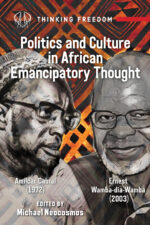
Politics and Culture in African Emancipatory Thought
USD $ 5.00 USD $ 15.00Price range: USD $ 5.00 through USD $ 15.00Select options This product has multiple variants. The options may be chosen on the product page
Politics and Culture in African Emancipatory Thought
USD $ 5.00 USD $ 15.00Price range: USD $ 5.00 through USD $ 15.00The current absence of any emancipatory vision for Africa lies at the heart of our political problems of racial capitalist and colonial oppression. Any attempt to rethink political emancipation on the African continent must be able to locate a universal conception of freedom within singular cultural experiences where people live. Irrespective of the specific manner in which such struggles for freedom were thought within different historical contexts, emancipatory politics always exhibited such a dialectic when it was based within popular traditions. Yet only some militant intellectual leaders understood the importance of this dialectic in thought.
The present volume outlines and discusses two particularly important views concerning the role and importance of popular culture in emancipatory politics in Africa. Each is the product of distinct forms of colonial capitalist exploitation: the former saw the light of day within a colonial context while the latter is directly confronted by the neocolonial state. All emancipatory politics are developed in confrontation with state power, and all begin with a process of discussion and debate whereby a collective subject begins to be formed. The formation of such a collective political subject has been fundamentally informed by popular cultures on the African continent.
The two authors whose essays are included here understood this and posit popular culture at the centre of their politics. The first, Amílcar Cabral, addresses the central role of popular culture in the independence struggle of Guinea Bissau in the 1970s; the second, Ernest Wamba-dia-Wamba, addresses the centrality of African popular culture in an emancipatory politics for the current Democratic Republic of Congo. Despite the distance in time that separates them, both Cabral and Wamba-dia-Wamba develop a dialectics at the core of their politics which activates the universals of culture in the present. It is this that makes their views of central importance to emancipatory thought today.Select options This product has multiple variants. The options may be chosen on the product page -

Politique et culture dans la pensée émancipatrice Africaine
USD $ 5.00 USD $ 9.00Price range: USD $ 5.00 through USD $ 9.00Select options This product has multiple variants. The options may be chosen on the product page
Politique et culture dans la pensée émancipatrice Africaine
USD $ 5.00 USD $ 9.00Price range: USD $ 5.00 through USD $ 9.00Au cœur de nos problèmes politiques issus d’un capitalisme racial et d’une oppression (néo)coloniale en Afrique aujourd’hui se trouve l’absence de toute vision émancipatrice véritable. Toute tentative de repenser une politique émancipatrice en Afrique doit pouvoir situer une vision universaliste de la liberté parmi les expériences culturelles singulières que les gens vivent. Les politiques émancipatrices quand elles existaient, bien que pensées dans les luttes pour la liberté ayant lieu dans des contextes historiques particuliers, mettaient toujours en vue une dialectique de ce genre quand elles étaient vraiment basées parmi les traditions populaires. Cependant, seulement une minorité de dirigeants intellectuels et militants comprenait l’importance d’une telle dialectique pour la pensée et l’action.
Ce petit livre trace le contour et discute de deux points de vue très importants sur le rôle de la culture populaire dans la politique émancipatrice en Afrique. Chacun d’entre eux émane de formes d’exploitation capitalistes coloniales distinctes : le premier a vu le jour dans un contexte colonial classique tandis que le second est directement issu d’un contexte étatique néocolonial. Toute politique émancipatrice est développée vis-à-vis le pouvoir d’état et toutes commencent avec un processus de discussion ou est formé un sujet collectif. Un tel sujet politique doit être fondamentalement informé par et conçu en relation avec les cultures populaires.
Les deux auteurs ci-inclus ont compris ce principe et mettent la culture populaire au centre de leur pensées politiques. Le premier, Amílcar Cabral se réfère au rôle principal de la culture dans la lutte contre le colonialisme au Guinée Bissau dans les années 1970 ; le second, Ernest Wamba-dia-Wamba insiste sur le rôle central de la culture populaire pour une politique émancipatrice dans la République Démocratique du Congo aujourd’hui. Malgré la distance temporelle qui les sépare, tous les deux développent au centre de leurs politiques distinctes, une pensée dialectique qui déclenche des pensées universalistes depuis la culture populaire dans le présent. C’est pour cela que leurs points de vue sont d’une importance capitale pour la pensée de la politique émancipatrice en Afrique aujourd’hui.
Select options This product has multiple variants. The options may be chosen on the product page -
![Aufbruch in Jackson [German edition of Jackson Rising: Black self-management and solidarity economy]](https://darajapress.com/wp-content/uploads/2023/12/174_Akuno_Jackson_web-150x225.jpg)
Aufbruch in Jackson [German edition of Jackson Rising: Black self-management and solidarity economy]
USD $ 24.00German translation of Jackson Rising: The Struggle for Economic Democracy and Black Self-Determination in Jackson, MississippiHow black activists are building liberation practically from below: Departure in Jackson documents the history of one of the most exciting revolutionary experiments in the USA Present.
Since the 1970s, black liberation movements in majority-black Mississippi have taken change into their own hands. The Deep South should become the center of their independence – “Free the Land!” In the 2010s, the election of Chokwe Lumumba as mayor in the capital Jackson took an important step towards implementing the vision of assembly democracy, solidarity economy and an end to racial inequality. Lumumba dies unexpectedly in 2014, but his son Antar and the Cooperation Jackson continue to move forward.
We learn about the pitfalls of radical local politics and struggles for housing and land, democratic economic models and ecology, internationalist solidarity and the parallels to the Rojava Revolution and the Zapatistas, about encouraging experiences in which different concerns go hand in hand.
-
 Select options This product has multiple variants. The options may be chosen on the product page
From Citizen to Refugee: Uganda Asians Come to Britain
USD $ 15.50In his introduction to this new edition of From Citizen to Refugee: Uganda Asians Come to Britain, Mahmood Mamdani reminds us that long before 1972, most Ugandan ‘Asians’ had already been disenfranchised by law, both Ugandan and British. Despite a global industry that insists otherwise, Uganda Asians are a poor fit as victims: there was no large-scale loss of life during the expulsion, nor were there massacres of Asians, only of ‘indigenous’ peoples. Asians in Uganda, as in East or Southern Africa, he argues, were immigrants, not settlers: immigrants are prepared to be a part of the political community, whereas settlers ‘create their own political community, a colony, more precisely, settler colonialism.’ Mamdani insists that there is no single Asian legacy. there are several and they are contradictory. The Asian question in Uganda remains, but it is no longer the original Asian question. But it does allow us to think more broadly. Just as US law recognizes African Americans as Americans of African descent, so too must those of Asian origin in Africa consider themselves, and be considered, Asian Africans. It is in his bittersweet and touching book on the Asian expulsion from Uganda that one can trace the beginnings of author and intellectual Mahmood Mamdani’s world-view.. … In From Citizen to Refugee: Uganda Asians Come to Britain Mamdani offers portraits of people reduced to a vegetative existence in refugee camps, feeling the burden of not being fluent in English and struggling with the uncomfortably cold weather. Not surprisingly, these few months played a pivotal role in shaping Mamdani’s theoretical and political leanings, and it is here that one can locate his preoccupation with the formation of racial, ethnic and class identities during the colonial era and his overarching concern with issues of citizenship.
Select options This product has multiple variants. The options may be chosen on the product page -

Settler Colonialism
USD $ 5.00 USD $ 10.00Price range: USD $ 5.00 through USD $ 10.00Select options This product has multiple variants. The options may be chosen on the product page
Settler Colonialism
USD $ 5.00 USD $ 10.00Price range: USD $ 5.00 through USD $ 10.00Settler Colonialism examines the genesis in the USA of the first full-fledged settler state in the world, which went beyond its predecessors in 1492 Iberia and British-colonized Ireland with an economy based on land sales and enslaved African labor, an implementation of the fiscal-military state. Both the liberal and the rightwing versions of the national narrative misrepresent the process of European colonization of North America. Both narratives serve the critical function of preserving the “official story” of a mostly benign and benevolent USA as an anticolonial movement that overthrew British colonialism. The pre-US independence settlers were colonial settlers just as they were in Africa and India or like the Spanish in Central and South America. The nation of immigrants myth erases the fact that the United States was founded as a settler state from its inception and spent the next hundred years at war against the Native Nations in conquering the continent. Buried beneath the tons of propaganda—from the landing of the English “pilgrims” (Protestant Christian evangelicals) to James Fenimore Cooper’s phenomenally popular The Last of the Mohicans claiming settlers’ “natural rights” not only to the Indigenous peoples’ territories but also to the territories claimed by other European powers—is the fact that the founding of the United States created a division of the Anglo empire, with the US becoming a parallel empire to Great Britain, ultimately overcoming it. From day one, as was specified in the Northwest Ordinance, which preceded the US Constitution, the new “republic for empire,” as Thomas Jefferson called the new United States, envisioned the future shape of what is now the forty-eight states of the continental US. The founders drew up rough maps, specifying the first territory to conquer as the “Northwest Territory.” That territory was the Ohio Valley and the Great Lakes region, which was already populated with Indigenous villages and farming communities thousands of years old. Even before independence, mostly Scots Irish settlers had seized Indigenous farmlands and hunting grounds in the Appalachians and are revered historically as first settlers and rebels, who in the mid-twentieth century began claiming indigeneity. Self-indigenizing by various groups of settlers is a recurrent theme in story of settler colonialism, white supremacy, and the history of erasure and exclusion about which I have written elsewhere.
Select options This product has multiple variants. The options may be chosen on the product page -

A Mutiny of Morning: Reclaiming the Black Body from Heart of Darkness
USD $ 5.00 USD $ 15.00Price range: USD $ 5.00 through USD $ 15.00Select options This product has multiple variants. The options may be chosen on the product page
A Mutiny of Morning: Reclaiming the Black Body from Heart of Darkness
USD $ 5.00 USD $ 15.00Price range: USD $ 5.00 through USD $ 15.00Nikesha Breeze has taken pages from Joseph Conrad’s Heart of Darkness, taken his words, and forced them to leave his colonized mind. She has made the words her own in poetic form. She illuminates the invisible Black voices inside, a radical, surgical, and unapologetic Black appropriation, at the same time as a careful birthing and spiritual road map. The resulting poems are sizzling purifications, violent restorations of integrity, pain, wound, bewilderment, rage, and, sometimes, luminous generosity. This is a work of Reclamation. The author, Nikesha Breeze, has slowly, page by page, reclaimed the text of the book Heart of Darkness by Joseph Conrad. This racist turn-of-the-19th-century book was pivotal in the continued dehumanization of Black people and in particular of African people, as it painted an image of bestiality on the Congo people and the continent. It is laced with racist imagery and language. The author has reappropriated the book, page by page, making “BlackOut” poetry for each page, isolating methodically the words to create new poems of power and black voice within the text —stealing the language and reappropriating the power.
Select options This product has multiple variants. The options may be chosen on the product page -
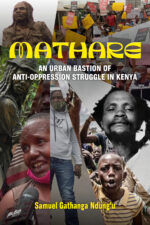
MATHARE: An Urban Bastion of Anti-Oppression Struggle in Kenya.
USD $ 5.00 USD $ 15.00Price range: USD $ 5.00 through USD $ 15.00Select options This product has multiple variants. The options may be chosen on the product page
MATHARE: An Urban Bastion of Anti-Oppression Struggle in Kenya.
USD $ 5.00 USD $ 15.00Price range: USD $ 5.00 through USD $ 15.00History is written by the victors of any war. But what happens when the victors forget to write down their history or omit the cog of the struggle? This is the untold story of Mathare Slum that has never been told to the world: of the role it played in anti-colonial struggle and the planning ground for the Mau Mau struggle which culminated with the fall of the British Colonial Empire in Kenya in the midnight of December 12th 1963. Mathare has also played a critical role in anti-oppression struggle against the four regimes that we’ve had since independence and continues to do so up to date. This history has not been documented and has only been done piecemeal. This has overtime eroded the rich history of Mathare and led to a distorted history of once a planning ground and a bulwark of Kenya Land and Freedom Army (KFLA). The current generation are not cognizant with the critical role Mathare played in the independence of our country. Presently, Mathare is majorly known for all the negative reasons and its proximity to Mathari Mental Hospital has contorted its image to the outside world. My story tries to re-tell the history of Mathare from an informed insider perspective by threading the struggles from the colonial era to the present day and the role it has played in agitating for social justice. My story brings to view the past history of this informal settlement in the heart of Nairobi, the present struggle and the promising future through community organizing.
Select options This product has multiple variants. The options may be chosen on the product page -
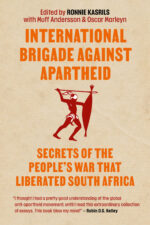
International Brigade Against Apartheid: Secrets of the People’s War That Liberated South Africa
USD $ 27.00Select options This product has multiple variants. The options may be chosen on the product page
International Brigade Against Apartheid: Secrets of the People’s War That Liberated South Africa
USD $ 27.00We hear for the first time from the internationalist secretly working for the ANC’s armed wing, Umkhonto we Sizwe (MK), in the struggle to liberate South Africa from apartheid rule. They acted as couriers, provided safe houses in neighbouring states and within South Africa, helped infiltrate combatants across borders, and smuggled tons of weapons into the country in the most creative ways. Driven by a spirit of international solidarity, they were prepared to take huge risks and face great danger. The internationalists reveal what motivated them as volunteers, not mercenaries: they gained nothing for their endeavours save for the self-esteem in serving a just cause. Against such clandestine involvement, the book includes contributions from key people in the international Anti-Apartheid Movement and its public mobilisation to isolate the apartheid regime. These include worldwide campaigns like Stop the Sports Tours, boycotting of South African products and black American solidarity. The Cuban, East German and Russian contributions outlined those countries’ support for the ANC and MK. The public, global Anti-Apartheid Movement campaigns provide the dimensions from which internationalists who secretly served MK emerged. Edited by Ronnie Kasrils. First published by Jacana Media (Pty) Ltd in 2021, ISBN: 978-1-4314-3202-8, this Daraja Press edition is available in North America and East Africa.
Select options This product has multiple variants. The options may be chosen on the product page -
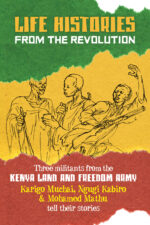
Life Histories from the Revolution: Three militants from the Kenya Land and Freedom Army tell their stories
USD $ 5.00 USD $ 18.00Price range: USD $ 5.00 through USD $ 18.00Select options This product has multiple variants. The options may be chosen on the product page
Life Histories from the Revolution: Three militants from the Kenya Land and Freedom Army tell their stories
USD $ 5.00 USD $ 18.00Price range: USD $ 5.00 through USD $ 18.00In the early 1970s, Donald Barnett — who worked with Karari Njama to produce Mau Mau From Within (published by Daraja Press) — also worked with three militants of the Kenya Land and Freedom Army to enable them to tell the story of their experience in fighting for freedom and against British colonialism. These rarely acknowledged militants were Karigo Muchai, Ngugi Kabiro and Mohamed Mathu. Their stories were published in 1973 by LSM Information Center (Richmond, British Columbia, Canada) as part of a series entitled Life Histories of the Revolution, as The Hardcore: The Story of Karigo Muchai; The Man in the Middle by Ngugi Kabiro; and The Urban Guerrilla by Mohamed Mathu.
As part of its mission of Nurturing reflection, sheltering hope and inspiring audacity, Daraja Press is please to republish the three booklets as a book that will help a new generation of activists — Kenyan and international — reflect on a history that might inspire audacious struggles to continue the struggle for freedom that was the goal of the Kenya Land and Freedom Army.
Donald Barnett’s introduction to each booklet contained the following text:
The life histories in this series have been recorded and prepared as historical documents from the revolutionary struggles of our time. The techniques and methods employed at each stage of the process, from initial contact to final editing, have therefore been chosen or fashioned with the purpose of guaranteeing the authenticity and integrity of the life history concerned. These stories, then, to the best of our ability to make them so, constitute a body of data and testimony as revealed by a few of those history-makers normally condemned to silence while others speak on their behalf.Select options This product has multiple variants. The options may be chosen on the product page -
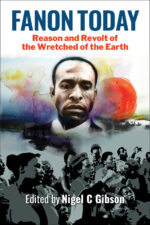
Fanon Today: Reason and Revolt of the Wretched of the Earth
USD $ 10.00 USD $ 30.00Price range: USD $ 10.00 through USD $ 30.00Select options This product has multiple variants. The options may be chosen on the product page
Fanon Today: Reason and Revolt of the Wretched of the Earth
USD $ 10.00 USD $ 30.00Price range: USD $ 10.00 through USD $ 30.00Fanon Today: Reason and Revolt of the Wretched of the Earth is about how new generations are discovering their mission of humanizing the world by claiming Fanon as a thinker for our times. Why Fanon, why now? For the wretched of the earth, conditions have not improved since Fanon’s time and in some cases they have worsened. Reason and revolt are inescapable, quite simply because, as Fanon wrote, it has become ‘impossible for them to breathe, in more than one sense of the word’. To mark the sixtieth anniversary of Fanon’s death (in 1961), the contributors to this book address the resonances of Fanon’s thinking on movements of resistance and mass revolutionary uprisings occurring in response to repression or state violence in Algeria, Brazil, Ghana, Ireland, Kenya, Pakistan, Palestine, Portugal, South Africa, Syria, Trinidad, USA and beyond. The driving force of each chapter of this unique collection of writings is Fanonian praxis, engaging with Fanon the thinker and Fanon the revolutionary.
Select options This product has multiple variants. The options may be chosen on the product page -
Nigeria and the Challenge of Federalism
USD $ 5.00 USD $ 14.00Price range: USD $ 5.00 through USD $ 14.00Select options This product has multiple variants. The options may be chosen on the product page
Nigeria and the Challenge of Federalism
USD $ 5.00 USD $ 14.00Price range: USD $ 5.00 through USD $ 14.00The book identifies three key moments in Nigeria’s experience with federalism and makes the argument that a complex and socially-diverse country like Nigeria can only be successfully governed by a truly federal arrangement, and not the present unitary contraption that has only delivered poverty, social unrest and the powerful centrifugal forces that are now threatening the very existence of the country itself. The time has come, write Ike Okonta, to convene a conference with sovereign powers to design a federal constitution for the country. The current process of amending the 1999 Constitution by the National Assembly will not suffice. The document is so hopelessly flawed that only its discarding and a fresh effort at constitution-making will suffice.
Select options This product has multiple variants. The options may be chosen on the product page -

JACKSON EN REVUELTA
Suggested Price: USD $ 10.00[Spanish edition of Jackson Rising]
Mississipi; el estado más pobre de los EEUU, el que tiene el porcen- taje más alto de población Negra y con una historia dramática de terror racial y de resistencia Negra. Este es el contexto de la resistencia presentada en este recopilatorio de escritos.
Sin desanimarse por la incertidumbre, el miedo y la an- siedad causadas por el constante deterioro del orden ne- oliberal, la respuesta de las activistas Negras de Jackson ha sido organizarse. Inspiradas por la rica historia de lucha y resistencia en Mississipi y comprometidas con la Estra- tegia Jackson-Kush, construyen instituciones arreladas en el poder comunitario, que combinan política y desarrollo económico y que satisfacen necesidades reales de la gente para crear un model social alternativo.
Las experiencias y análisis recogidas reflejan el poder creativo que se genera cuando la lucha política se basa en una visión del mundo liberada de las contradicciones y li- mitaciones inherentes al liberalismo. Esta es, en definitiva, una historia sobre un porceso decolonial y socialista, orga- nizado y dirigido por personas Negras.
-
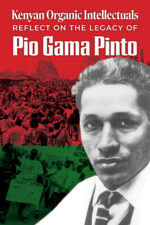
Kenyan Organic Intellectuals Reflect on the Legacy of Pio Gama Pinto
USD $ 5.00 USD $ 11.00Price range: USD $ 5.00 through USD $ 11.00Select options This product has multiple variants. The options may be chosen on the product page
Kenyan Organic Intellectuals Reflect on the Legacy of Pio Gama Pinto
USD $ 5.00 USD $ 11.00Price range: USD $ 5.00 through USD $ 11.00This booklet on Pio Gama Pinto has been produced in the tradition of ‘looking back, in order to move forward’ to not only salvage history but also to use it as a mirror to reflect on the current political, economic and social conditions in Kenya. The essays, dubbed reflections, that appear in the booklet are a product of the efforts and dedication of young women and men under the banner of the ‘Organic Intellectuals Network’ in Kenya. We use the concept of ‘organic intellecutal’ as developed by Antonio Gramsci.
Members of the Organic Intellectual Network selected the book Pio Gama Pinto: Kenya’s Unsung Martyr 1927-1965 by Shiraz Durrani (Vita Books, 2018) as a basis for discussion for celebrating and remembering the life of Pio Gama Pinto, Kenya first Martyr, a dedicated and selfless individual in the struggle for freedom in Kenya.Select options This product has multiple variants. The options may be chosen on the product page -

Partisan Universalism: Essays in Honour of Ato Sekyi-Otu
USD $ 5.00 USD $ 18.00Price range: USD $ 5.00 through USD $ 18.00Select options This product has multiple variants. The options may be chosen on the product page
Partisan Universalism: Essays in Honour of Ato Sekyi-Otu
USD $ 5.00 USD $ 18.00Price range: USD $ 5.00 through USD $ 18.00The collection of essays in Partisan Universalism celebrates the work of Ato Sekyi-Otu, a scholar, teacher and friend, marking his extraordinary contribution to the philosophy, politics and praxis of liberation. As Ato Sekyi-Otu has argued in his recent book, Left Universalism, Africacentric Essays (Routlege 2019), universalism is an ‘inescapable presupposition of ethical judgment in general and critique in particular, especially indispensable for radical criticism of conditions of existence in postcolonial society and for vindicating visions of social regeneration’. Universalism must and can only be partisan.
“Responding to the invitation ‘to re-member severed but shareable things’, these lovers of truth, freedom, and dignity celebrate the searing intellect, generosity, wit, and compassion of the person and the scholar Ato Sekyi-Otu. … this is a precious contribution. Not to be missed!” —Jane Anna Gordon, author of Statelessness and Contemporary Enslavement and co-editor (with Drucilla Cornell) of Creolizing Rosa Luxemburg. /
“Critically engaging Ato Sekyi-Otu’s notion of partisan universalism, this timely volume of essays speaks directly to the onto-metaphysical issues that will give Africana thought the new foundations that will enable it to move beyond the linguistic turn, brush aside the ashes of Afro-pessimism. … A must read for all concerned with the future of Africana theory and praxis.” —Paget Henry, author of Caliban’s Reason/
“Ato Sekyi-Otu’s thought is one of the most important and exciting in Africa today. The texts compiled in this volume celebrate and engage with the work of Sekyi-Otu … They bear eloquent witness to Sekyi-Otu’s stature as a thinker and to his consistent commitment to the universalization of humanity in both theory and practice.” — Michael Neocosmos, Emeritus Professor in the Humanities, Rhodes University, South Africa.Select options This product has multiple variants. The options may be chosen on the product page -
 Select options This product has multiple variants. The options may be chosen on the product page
Undaunted: Stories of Freedom in a Shackled Society
USD $ 15.00….to free oneself or assist in liberating others involves taking risks, being suspicious of the status quo, leaving the safety of the shore and launching out into the deep and the unknown. This is a very lonely calling too as one immerses oneself into the whole of reality with courage to confront and listen. Yet, the calling is not to be the liberator of the oppressed but to make a commitment to fight alongside them, as Paulo Freire wrote in Pedagogy of the Oppressed. — Fr Gabriel Dolan
From his work in Turkana, Kitale, Kapenguria and Mombasa, Father Gabriel reminds us that true transformative change comes from the people themselves, from the bottom up. This is a challenge that the social justice/human rights practitioners must internalize and the sooner the better. The idea of being the “voice of the voiceless” must transform to facilitating, encouraging and giving space to those who suffer the indignities of injustice, violence, poverty and repression. Indeed, one of the most significant tasks for the human rights community is to devolve away from Nairobi, in real, practical, and substantive ways.
It is not easy for a white man, with all the attendant privileges that brings, to become an integral part of the struggle for pro-poor transformative change in Kenya, and be subject to arrest, harassment, and repression. For those who read these memoirs, please circulate them to everyone you know. Translate them, read them in the mosques, churches and under trees so that Kenyans can get a sense of where we have come from, what we should avoid, and what it takes to make some gains that benefit the majority of our people. — Maina Kiai
Select options This product has multiple variants. The options may be chosen on the product page -

Extracting Profit: Imperialism, Neoliberalism and the New Scramble for Africa
A piercing historical explanation of poverty and inequality in African societies today and the social impact of resource-driven growth, Extracting Profit explains why Africa, in the first decade and a half of the twenty-first century, has undergone an economic boom. Rising global prices in oil and minerals have produced a scramble for Africa’s natural resources, led by investment from U.S., European and Chinese companies, and joined by emerging economies from around the globe. African economies have reached new heights, even outpacing rates of growth seen in much of the rest of the world. Examined through the lens of case studies of the oil fields of the Niger River Delta, the Chad-Cameroon Pipeline and the East African infrastructure boom, this period of “Africa rising” did not lead to the creation of jobs, but has instead fueled the extraction of natural resources, profits accruing to global capital, and an increasingly wealthy African ruling class.
Extracting Profit argues that the roots of today’s social and economic conditions lie in the historical legacies of colonialism and the imposition of so-called “reforms” by global financial institutions such as the World Bank and International Monetary Fund. The chokehold of debt and austerity of the late twentieth century paved the way for severe assaults on African working classes through neoliberal privatization and deregulation. And while the scramble for Africa’s resources has heightened the pace of ecological devastation, examples from Somalia and the West African Ebola outbreak reveal a frightening surge of militarization on the part of China and the U.S.
Yet this “new scramble” has not gone unchallenged. With accounts of platinum workers’ struggles in South Africa, Nigerian labor organizing and pro-democracy upheavals in Uganda and Burkina Faso, Extracting Profit offers several narratives of grassroots organizing and protest, pointing to the potential for resistance to global capital and fundamental change, in Africa and beyond.
And in an updated Preface, the author analyses the implications of the Covid-19 pandemic and escalating climate emergency, as both the crises and resistance to extraction accelerate across the continent.
Reviews-
“Lee Wengraf’s Extracting Profit – Imperialism, Neoliberalism and The New Scramble for Africa is at once historical and contemporary. It unpacks ongoing resource crimes by analytically exposing its historical roots and pointing to ways by which the oppressed can cut off the bonds that lock in their subjugation.” —Nnimmo Bassey, Director, Health of Mother Earth Foundation
“Lee Wengraf provides an important reminder that Africa’s position within the world economy is heavily determined by its unequal insertion into the global capitalist system and ongoing manifestations of imperialism.” –James Chamberlain, Sheffield Political Economy Research Institute
“Lee Wengraf’s Extracting Profit provides a breathtakingly detailed account and analysis of some of the major socioeconomic ills that have been plaguing Africa for centuries. Amongst the host of issues she tackles, arguably the most consequential are mass poverty in African societies, their indefensible economic inequalities and the steady plundering of the continent’s resources, starting from the slave-trade era up till the present-day.” –Remi Adekoya, Review of African Political Economy
“Extracting Profit offers several narratives of grassroots organizing and protest, pointing to the potential for resistance to global capital and fundamental change, in Africa and beyond.” –Developing Economics
“Evidently, this book is well-researched and it contributes to the expansion of the frontiers of Marxist scholarship on Africa’s development dilemma within the global capitalist order. This book lends credence to the pioneering works of such notable radical scholars as Andre Gunder Frank, Walter Rodney, and Samir Amin among several others. It should be read by students and teachers of political economy, development studies, Marxism and philosophy.” –Marx & Philosophy Review of Books
“Extracting Profit provides a great arch of scutiny from the earliest carve-up of the African continent, through colonialism, war, imperialism, to the recent neoliberal takeover. The book demonstrates the continued importance of Marxist analysis on the continent, asserting the centrality of class analysis and a project of revolutionary change. Wengraf provides us with a major contribution, that highlights contemporary developments and the role of China on the African continent that has perplexed and baffled scholars. An indispensable volume.” —Leo Zeilig, author of Frantz Fanon: The Militant Philosopher of Third World Revolution
“The history of resource frontiers everywhere is always one of lethal violence, militarism, empire amidst the forcing house of capital accumulation. Lee Wengraf in Extracting Profit powerfully reveals the contours of Africa’s 21st century version of this history. The scramble for resources, markets, and investments have congealed into a frightening militarization across the continent, creating and fueling the conditions for further political instability. Wengraf documents how expanded American, but also Chinese, presence coupled with the War on Terror, point to both the enduring rivalry among global superpowers across the continent and a perfect storm of resource exploitation. Wengraf offers up a magisterial synopsis of the challenges confronting contemporary Africa.” —Michael Watts, University of California, Berkeley
“One of the most well-known stylized facts of Africa’s recent growth experience is that it has been inequality-inducing in ways that previous growth spurts were not. Lee Wengraf, in her new book Extracting Profit , expertly utilises the machinery of Marxian class analysis in making sense of this stylized fact. Along the way we learn much about Africa’s historical relationship with imperialism and its contemporary manifestations. This book should be required reading for all those who care about Africa and its future.” —Grieve Chelwa, Contributing Editor, Africa Is A Country
“In recent years countries in the African continent have experienced an economic boom—but not all have benefited equally. Extracting Profit is a brilliant and timely analysis that explodes the myth of “Africa Rising,” showing how neoliberal reforms have made the rich richer, while leaving tens of millions of poor and working class people behind. Lee Wengraf tells this story within the context of an imperial rivalry between the United States and China, two global superpowers that have expanded their economic and military presence across the continent. Extracting Profit is incisive, powerful, and necessary: If you read one book about the modern scramble for Africa, and what it means for all of us, make it this one.” —Anand Gopal, author, No Good Men Among the Living: America, the Taliban, and the War Through Afghan Eyes
“Thorough and thoughtful, Wengraf’s book has a radical depth that underscores its significance. It’s definitely a must-read for anyone who cherishes an advanced knowledge on the exploitation of Africa as well as the politics that undermines Africa’s class freedom.” —Kunle Wizeman Ajayi, Convener, Youths Against Austerity and General Secretary of the United Action for Democracy, Nigeria
“Extracting Profit is a very important book for understanding why the immense majority of the African population remain pauperised, despite impressive growth rates of mineral-rich countries on the continent. It continues the project of Walter Rodney’s How Europe Underdeveloped Africa. And in several ways, it also goes beyond it, capturing the changing dynamics of global capitalism 45 years after Rodney’s magnus opus.
In this book, Lee Wengraf debunks the myth of “Africa Rising” and the supposed expansion of an entrepreneurial middle-class, revealing “reforms” imposed by international financial institutions as mechanisms for fostering imperialism in an era of sharpening contradictions of the global capitalist economy. The adverse social, economic, political and environmental impact of these are elaborated on as a systemic whole, through the book’s examination of the sinews of capital’s expansion in the region: the extractive industries.
But, Wengraf does not stop at interrogating the underdevelopment of Africa. Her book identifies a major reason for the failures of national liberation projects: while the working masses were mobilised to fight against colonial domination, the leadership of these movements lay in the hands of aspiring capitalists, and intellectuals. The urgency of the need for a strategy for workers’ power internationally, she stresses correctly, cannot be overemphasized.
Reading Extracting Profit would be exceedingly beneficial for any change-seeking activist in the labour movement within and beyond Africa.” —Baba Aye, editor, Socialist Worker (Nigeria)
-
-
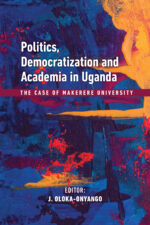
Politics, Democratization and Academia in Uganda: The Case of Makerere University
USD $ 6.99 USD $ 20.00Price range: USD $ 6.99 through USD $ 20.00Select options This product has multiple variants. The options may be chosen on the product page
Politics, Democratization and Academia in Uganda: The Case of Makerere University
USD $ 6.99 USD $ 20.00Price range: USD $ 6.99 through USD $ 20.00As the oldest (and arguably best-known) university in Uganda and the wider eastern and central Africa region, Makerere University looms large in the history of higher education on the continent. Alma mater to presidents, public intellectuals and pundits of all disciplines, Makerere has attracted considerable scholarly and popular attention, both in respect of its prominence and achievements, and well as with regard to its failures and foibles. The proposed book focuses on a particularly understudied aspect of the place of higher education in the African context, i.e. the relationship between a public university of unique historical importance and the contestations over democratization that have taken place both within campus and outside of it. It is built around the late-1980s struggle by the Makerere University Academic Staff Association (MUASA) for improved living conditions against the backdrop of the early programs of structural adjustment and economic reform that the National Resistance Army/Movement (NRA/M) government adopted soon after taking power in 1986. Although seemingly introverted in focus, in many respects the MUASA action represented the earliest forms of political struggle against a regime of governance that promised a great deal, but disappointingly delivered considerably less.
The focus on MUASA provides a critical entry-point to a wider debate about the place of organized democratic action by academics in a post-conflict context where the traditional institutions of political and civil society, i.e. political parties and non-governmental organizations (NGOs) have either been severely compromised or discredited, or where they are too weak and inorganic to provide any form of significant counter-juxtaposition to the government in power. By organizing the first strike by academic staff in the sixty-seven (67) year history of the university, for a time MUASA became the focal-point for democratic organizing against a regime that was yet to fully expose its nefarious and anti-democratic colours. The book examines the broader issues concerning the relationship between organized academic action and democratization; the place of the Media in reviewing these struggles; the position of students as a critical component of academe; “big P” and “small p” politics affecting female academics, and finally, the paradoxical role of the School of Law in both aiding and inhibiting the struggle against dictatorship in a country which has enjoyed
Select options This product has multiple variants. The options may be chosen on the product page