
-

in, against, beyond, corona
USD $ 5 USD $ 12Price range: USD $ 5 through USD $ 12Select options This product has multiple variants. The options may be chosen on the product page
in, against, beyond, corona
USD $ 5 USD $ 12Price range: USD $ 5 through USD $ 12Description (1711 / 2500)
Part of what is revealed is what is wrong and toxic – in ourselves, in our relations with others, and in our relation with the rest of non-human nature. But it’s also terribly important to listen for and to seek out what is revealed that is good and life-affirming. Both are vital. Our current situation is deeply structured by capitalism and as such has made all of our lives, livelihoods, relations and goods tied up with, and dependent on, reproducing that system. It is clear that the real catastrophe is the inevitable and accelerating spiral of death that flows from that logic of capital and of money. But new (and old too) forms of experimenting in radically different ways of doing/being/relating that flow from it are also revealed – the ways of thinking and doing that reject the logic of power-over, of competition or profit, of exploitation and humiliation. Can these be sustained beyond the immediate corona crisis?; shouldn’t we be encouraging people to identify these areas and think/act them as a present future, planning and imagining how to extend them forward in time?; and expanding them to growing spheres of life? At the level of values and principles, we do wonder whether kindness, social solidarity, and an appropriate scale of time, aren’t perhaps the most important of these?We are much more likely to actually change the world when we listen and tap into all the many ways in which people’s own questions and thinking, their ways of relating and acting, refuse the logic of toxic power and monetised exchange for profit. Here, we will discover already-existing breaks and practices that, instead, embody and embrace the values and principles for a better way of reproducing life.
Select options This product has multiple variants. The options may be chosen on the product page -
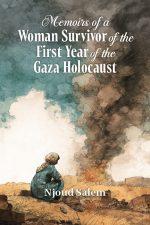
Memoirs of a Woman Survivor of the First Year of the Gaza Holocaust
USD $ 0.01 USD $ 15Price range: USD $ 0.01 through USD $ 15Select options This product has multiple variants. The options may be chosen on the product page
Memoirs of a Woman Survivor of the First Year of the Gaza Holocaust
USD $ 0.01 USD $ 15Price range: USD $ 0.01 through USD $ 15Stop press
We have just learned that this book has won a prize from the Eyelands Book Awards https://eyelandsawards.com/2025/12/30/2025-prize-grand-prize-winners/
Congratulatons Njoud Salem!!
These memoirs bear witness to the harrowing reality of survival during the devastating war on Gaza. Through vivid personal narratives, they capture the daily struggle for existence—the scarcity of food and water, the constant threat of bombardment, and the profound psychological trauma. Yet, they delve far deeper than mere physical survival, exploring the profound wounds of displacement: the heartbreak of leaving behind a home, a street, a neighborhood, and the irreplaceable fragments of a life forever shattered.
The pages reveal families huddled in schools-turned-shelters, sharing morsels of bread and whispering prayers for a safe dawn. This collection is both a testament and an act of resistance. It refuses to let the world reduce human beings to mere statistics, insisting instead on honoring every story, every face, and every name. It bears witness not only to the destruction but also to the unbroken spirit of a people determined to live, dream, and rise again.
While rooted in immense suffering, these narratives are also profound meditations on dignity, love, and an unshakable will to persevere. At once personal and collective, they amplify the voices of a generation too often silenced by conflict, posing urgent questions about justice, memory, and the future. They ensure these essential stories are never buried beneath rubble or lost to cold statistics.
In the midst of fire and fear, these words declare: “We are still here. We remember.” This act of testimony—to feel, to survive, and to hold onto love when the world offers none—becomes the most honest act of living. Through these pages, the reader is invited not only into a world of unimaginable hardship but also into the profound depths of human endurance, the richness of Arab culture, and the unwavering faith that guides a people forward.
Select options This product has multiple variants. The options may be chosen on the product page -
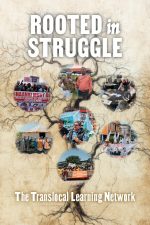
Rooted in struggle
USD $ 25Edited by
Anne Harley and Jonathan LangdonWith
Edward Adeti, Coleman Agyeyomah, Sheena Cameron, Amanor Dzeagu, Leocadio Juracan Salome, Thapelo Mohapi, Zodwa Nsibande, Ro Paradela, Alhassan Shani, Wojciech Tokarz, & Nyeya YenThis book is the culmination of several years of partnership between social movements, social justice organizations and academics in Ghana, South Africa, Guatemala and Canada. Called the Translocal Learning Network, this partnership has generated a space for those facing the multiple and overlapping crises of our time to come together and share knowledge and mutually solidarize with each other’s struggles. This knowledge exchange and mutual solidarity has been non-hierarchical and collaborative in nature, and has taken the form of sharing and commenting on complex stories of these struggles through a participatory research methodology known as narrative restorying. As such, this book will focus on the stories each partner has shared, along with engagement with these stories by other members of the network. This interplay of knowledge sharing will provide a window into the social movement learning of network members.
The central argument of the book was best captured by Thapelo Mohapi from South Africa’s Abahlali baseMjondolo: “It is always assumed that when you are poor, when you are living in a shack, when you live in a rural area, when you are marginalized, that you cannot think for yourself, that you cannot be involved in development, because you are poor”; instead of this “People must make decisions and must be consulted, and they must have a voice to speak about their own development. It must be initiated and completed with the people.” This book is literally a space where those on the front line of struggles against land & livelihood dispossession, violent resource exploitation, climate-fueled emergencies, and the denigration of cultural and traditional indigenous knowledge share their experiences, learning, successes, and defeats, with those facing similar and related struggles but in different contexts.
In addition to the stories of these front-line voices, scholars working alongside these struggles also share some of their learnings and ideas that have emerged from the partnership in the book. Students supporting the partnership also share their learning in the book, as well as describing how their activism also provoked learning in the network. In other words, this book provides a window into a rich, ongoing dialogue of mutual learning and support that will speak to audiences in the activist and critical academic communities.
To that point, this translocal network uses the notion of translocality to push back on the capitalist, colonial, and neo-liberal agenda of a) maintaining divisions between people struggling against oppression in different parts of the world (through border controls, language divisions, and colonial racialized othering); and, b) maintaining a knowledge hierarchy that states, international institutions, intellectual institutions, and corporations are those best able to contend with the many crises we face, and even within activists, it is those movements and organizations with broad, multinational reach that can best speak for the affected. Translocality argues that it is those with local knowledge of crises and context that are best positioned to speak to what needs to change, and that local struggles meeting each other as equals, translocally, is the best way to learn from one another without imposing new forms of knowledge hierarchies. Everaldo Morales Baján, from Commité Campisino del Altiplano (CCDA) in Guatemala captures this sentiment well when he says: “This book captures the essence and importance of the different struggles that exist in various parts of the world, but which converge on always caring for the planet and human rights.”
Chapter Summaries
Introduction: Translocal social movement learning: building mutual solidarity and contesting development for social and environmental justice
Jonathan Langdon; Sheena Cameron; Rodrigo Paradela; Wojciech Tokarz
In an effort to encourage connection and mutual learning between local movements, the Translocal Learning Network (TLN) serves as an effective social justice framework that attempts to build and maintain local to local (i.e. translocal) non-hierarchical connections between movements. The overall goal of this research partnership is to catalyze and animate translocal learning as a means to build capacity among localized movements in their struggles for a climate just and anti-capitalist future, and in so doing trace the contours of a theory of translocal learning – learning based on local to local learning as opposed to top down learning that mimics the very problematic of global dominance these movements contest. Key to this process is an insistence that movements and groups rooted in local social change efforts are crucial authors and actors of a climate just and anti-capitalist future. The members of the TLN address ongoing and emergent injustices to claim rights, assert agency, and demand representation and the redistribution of resources for marginalized communities in South Africa, Ghana, Guatemala and Canada. Creating shared spaces for connection, support, and learning through the ongoing struggles of each social movement has provided continuous moments of solidarity and opportunities for reimagining being in the world. This book showcases the perspectives of our partners, providing rich accounts of their experiences that illuminate struggles, insights, and successes. It also includes academic reflections on intercultural exchanges and offers an in-depth analysis of the collaborative learning process.
‘Players change but the game remains the same’: current realities of the poor, particularly in KwaZulu Natal
Zodwa Nsibande, Church Land Programme
This phrase was used by one member of Abahlali baseMjondolo in a meeting where we were talking about elections and the impact it has on people on the ground, especially who are marginalized and yet they are still expected to participate in the upcoming elections. She cautions that we need to be mindful that even if we change the ruling party, the ‘game’, the electoral system, remains the same, producing elites. Apartheid system favored ‘white’ people. Now the current system favors the elite. The ones who are poor remain poor and left with hope that someday things will change; hope that is shattered yet renewed every five years.
While there is less intense focus on South Africa now that apartheid is over, the sociological legacies continue and the fundamental nature or rules of the game remain intact. It points to the idea that regardless of who is involved, the main objectives, strategies, and overall dynamics of the game do not change. It emphasizes the notion that although the participants may alter, the essence of the game remains unchanged.
CLP will discuss the current realities of the poor, particularly in KwaZulu Natal, under the ongoing oppressive systems in South Africa, that permeates to all aspects of life, including the electoral system that favors the elites, the failing electricity system with load-sharing, and the improper stormwater drainage systems in townships and shack settlements, flood-prone areas (compounded by climate change) that results in loss of homes, food, and lives when it rains.
The Talensi-Nabdam Gold Rush: Local Complicity, Resource Exploitation, and the Crisis of Dignity
Coleman Agyeyomah Venceremos & Alhanssan Shani
This discussion will delve into the profound impact of multi-national mining activities on the communities of the Upper East Region in Ghana, specifically focusing on the alarming stories of dispossession of ancestral lands. The region, rich in cultural heritage and agricultural livelihoods, faces a growing threat as multi-national mining companies seek to exploit its abundant gold resources in collusion with State Institutions.
Through an exploration of real-life stories, light will be shed on the multifaceted consequences of multinational mining-induced dispossession of community lands. From the loss of cultural identity to the disruption of traditional farming practices and land degradation, this narrative will highlight the social, economic, and environmental toll on the affected communities.
The discussion will also provide a comprehensive overview of the mechanisms employed by multinational mining companies to acquire land and the subsequent displacement of local populations. Additionally, throws light on the challenges and complicity faced by these communities in seeking justice and recognition of their rights in the face of powerful corporate interests.
Gold Slavery in Talensi
Edward Adeti & Yen Nyeya, Savannah Research and Advocacy Network
Talensi is a small community in the Upper East Region of Ghana. The Upper East is one of the smallest regions in the country in terms of land size. The people of Talensi are predominantly subsistence farmers who rely on livestock and crop cultivation for their livelihoods.
Mining is one of the commercial activities that require huge parcels of land. Lands earmarked for mining are often fenced and are not available for any other activity even grazing of animals is often not allowed.
The people of Talensi stand the risk of losing their livelihoods due to the influx of a number of mining companies taking up almost 70% of lands earmarked for farming activities
The Río Negro massacre: The abandonment and criminalization of communities in Resistance by the State of Guatemala
Leocadio Juracan Salome, Commité Campisino del Altiplano (CCDA)
The water resource in the highlands of Guatemala, especially in the Verapaces region, has been the scene of large massacres against Indigenous peoples for the implementation of Hydroelectric Plants.
In the 70’s, resistance communities in the banks of Río Negro began facing persecution, dispossession, and criminalization. Río Negro is one of the great rivers that supply the largest Hydroelectric Plant in Guatemala called Chixoy. There were massacres, many disappeared, others forcibly displaced, exiled from their territories where they were born and others who remained in resistance.
With the largest hydroelectric plant in the country 4 kilometers away and despite suffering dispossession and criminalization, more than 500 families from the departments of Quiché, Alta and Baja Verapaz live in conditions of abandonment, without electricity, without development programs for health, housing, education etc.
Despite all the violations against humanity committed in the Río Negro Massacre, many Q’eqch’i’ Mayan families are still waiting for compliance with the resolutions of the Inter-American Court of Human Rights -IACHR-, which mandates the recognition of the violations of Human Rights, the compensation to the families and the legalization of some 1,500 caballerías of territory in favor of the families by the State of Guatemala.
We are not opposed to the energy transition, but respect for the lives of families, their development, respect for the life cycle of Rivers and Mother Nature.
Nothing about us without us – Everybody Thinks!
Thapelo Mohapi, Abahlali baseMjondolo
The dignity of the poor can only be achieved if they are part of their own development, becoming stewards and active participants on their own terms and by their own design. This must be a process undertaken from below, democratically, with people being consulted and making decisions, having a voice to speak about their own development. It must be initiated and completed with the people. “Nothing about us, without us”, the slogan used by many movements to demand that the full and direct participation of members must be integral to decision-making, grounds the work of Abahlali baseMjondolo, a shack dwellers movement in South Africa, with more than 180,000 members that was formed in 2005 to fight for, promote and advance the interests of the poor and marginalized.This contribution grows out of a critique of development and is grounded in the understanding that development is neo-colonial and neo-imperial and that is something that is imposed and done to poor people in the formerly colonized countries, with the backing and financial support of Western governments, aid agencies, companies, and local governments. It is always assumed that when you are poor, when you are living in a shack, when you live in a rural area, when you are poor and marginalized, that you cannot think for yourself, that you cannot be involved in development, because you are poor. AbM demonstrates that people and movements are capable of determining what is best for themselves and to ensure the dignity and rights of the poor.
Ada Songor Lagoon; Our Heartbeat!
Amanor Dzeagu, Radio Ada
November 6, 2023 has become another taboo day for the local salt producers in Ada, just as the police confrontation with community members that led to the death of a pregnant woman in 1985. The Story of the Songor Lagoon: Who Killed Maggie?
Mr. John Korletey Agormedah, a 52 year old salt winner died of bullet wounds after he has been shot three times during an attempt to protect his salt winning business. His killing occurred when a joint taskforce and state police sent by Electrochem Ghana Limited, a private company awarded the entire Ada Songor Lagoon in a monopoly lease by the government and some local chiefs to destroy the community members salt winning equipment in the lagoon communities. Local chiefs fail to condemn the barbaric killing of their subject after three months, rather, they quickly reacted and condemn a political candidate for his comments which has been deemed, uncultured language in a viral video. He has been fined 30,000 Ghana cedis, 4 Rams, 4 foreign schnapps or face a ban in the elections. The police continue to arrest, detain and prosecuting community members including chiefs with the offence of inciting community members against the private company.
Translation, Care, and Political Commitment in the Translocal Learning Network
Ro Paradela; Wojciech Tokarz
This chapter examines translation within the Translocal Learning Network as political infrastructure that shapes collaborative knowledge production. Through translator Ro Paradela’s work – employing gender-inclusive Spanish, strategic domestication, and simultaneous interpretation – translation emerges as relational labor that negotiates power, affirms identities, and fosters belonging across linguistic boundaries, transforming communication into an act of care and solidarity.
Research Assistant Learning from Social Movements (Pending)
Sheena Cameron; Ro Paradela
Cameron and Paradela add another dimension of learning in their chapter, sharing their own learnings and reflections from their participation in this network as research assistants, in relation to the changing context and expressed learnings of other former research assistants over the last twelve years, while simultaneously engaged in their own studies – Paradela as an undergraduate honours student, and Cameron as a PhD student.
Learning from subaltern social movements
Anne Harley; Jonathan Langdon
As engaged scholars, with a long interest in social movements, we have been working with some of the social movements who form part of this group over a number of years. We have learned a great deal from our interaction with them, and have worked together to begin to theorize this learning. In this contribution, we discuss what we mean by the concept ‘subaltern social movement’, and why we feel that the learning from such social movements is critical in current times.
Concluding Chapter
Translocal Learning Network
This chapter emerges from the collective reflections of the network on the process of creating the book, and what we have learned along the way. It will respond to the emergent themes and interlinkages identified in the opening chapter, but also highlight the ways in which we have all responded to each other’s stories, comments and analyses.
Author Bios
Edward Adeti, is a Ghanaian-born investigative journalist widely known for his anti-corruption work and courageous journalism despite facing threats. He was named Ghana’s best journalist in 2024 and won the best investigative journalist award the same year. Some of his notable works include: exposing Ghana’s justice system, leading to a judge’s recusal and a minister’s resignation; the documentary “Cash for Justice”, which led to a senior state attorney’s dismissal; “Stealing from the Sick”, an investigative piece exposing medicine theft at a government hospital, leading to arrests and prosecution of some members of a syndicate; and “Blood Gold”, a series he co-authored with Eryk Bagshaw, an Australian investigative journalist, on human rights violations by mining companies in Ghana, winning multiple international awards in 2023. He is a member of SRAN.
Coleman Agyeyomah formerly of Venceremos Development Consult is currently the Director, of Innovation Development Alternatives (IDEAs), a devolvement and organizational change NGO. Agyeyomah has over 20 years in facilitating and the mobilizing of Community Based Organizations/leaders for social change in poor and vulnerable communities of northern Ghana. Above all, he also teaches and provides field-based experiential learning support for students from Universities of Trent and St. Francis Xavier Canada.
Sheena Cameron is a Lecturer at St. Francis Xavier University (Canada) as well as a Research Coordinator of the Translocal Learning Network. She brings decades of community work in West Africa, Guatemala and Canada and community radio and podcasting experience to the writing of her chapter. She holds a Masters in Communication and Social Justice and she is currently completing a PhD in Social Justice Education at the Ontario Institute for the Study of Education (OISE) at the University of Toronto.
Amanor Dzeagu is a community radio practitioner and development communicator working with Radio Ada, a community radio station in the Greater Accra Region of Ghana. He works closely with local communities to tell their stories, document their traditions, and advocate for inclusive development through radio and community engagement. With a deep respect for the Dangme culture and indigenous systems, Amanor uses the community radio as a bridge between tradition, development, and the voices of the people. He brings more than two decades of community broadcasting experience to the writing of this chapter.
Anne Harley is a senior lecturer in adult education at the University of KwaZulu-Natal (Pietermaritzburg) in South Africa. Working within the radical adult education tradition, she is particularly interested in informal adult education/learning in/through/with struggle, and her work focuses on counter-hegemonic learning and theorising, particularly in subaltern social movements, and is thus related to issues of emancipatory politics, the notion of civil society, and discourses of ‘development’ in South Africa and beyond.
Leocadio Juracan Salome is one of the leaders of the Comité Campasino del Altiplano (CCDA), a large movement of peasant farmers in Guatemala. Leocadio brings decades of political and community organizing experience to CCDA’s contribution to the book.
Jonathan Langdon is a Professor at St. Francis Xavier University (Canada) in Development Studies and Adult Education. Langdon has over 20 years of community engagement, activist organizing and facilitation work, as well as being the convener of the Translocal Learning Network for the last 3 years.
Thapelo Mohapi was born in Matatiele in the Eastern Cape and raised in Durban, KwaZulu Natal. He is the current elected General Secretary of Abahlali baseMjondolo Movement SA, the movement of informal settlements in South Africa, numbering over 180,000 members. Prior to that, he was the chairperson of the Briardene branch in Durban within the movement. He also served as the Provincial Secretary of KwaZulu Natal. AbM is a movement that fights for land, housing and the dignity of the poor in South Africa.
Zodwa Nsibande is a social justice advocate and community leader from Durban, South Africa. She served as General Secretary of the Abahlali baseMjondolo youth league in 2009, she spoke out against the harmful effects of the FIFA 2010 World Cup on shack settlements , leading to threats that forced her into hiding. In 2011, she joined the South African delegation to the Ecumenical Accompaniment Programme in Israel and Palestine (EAPPI), spending three months advocating for peace and human rights. Since 2013, Zodwa has served as a Programme Activist at the Church Land Programme, supporting marginalized communities in securing land rights and dignified living conditions in both rural and urban areas. Most recently, she was a visiting scholar at the University of Sheffield’s School of Law in the United Kingdom from June 24 to July 26, 2024.
Ro Paradela (they/she) is a transfeminist activist from Mexico City. They graduated St. Francis Xavier University with Honours in Sociology and a Subsidiary in Women’s and Gender Studies. They are currently organizing in the fight against the crisis of transfemicidal violence in Mexico.
Alhassan Shani is a development practitioner and works with IDEAs, Northern-Ghana. He has over nine (9) years of experience in development research, community mobilization, social accountability, monitoring and evaluation of projects and development planning process. Alhassan’s development orientation is firmly rooted in participatory development. Additionally, he is passionate about research that encourages community participation, learning and action.
Wojciech Tokarz is a scholar and administrator serving as Associate Professor of Spanish and Interim Dean of the Faculty of Arts at St. Francis Xavier University (Canada). His research examines post-dictatorship Argentine literature, Indigenous representation, and translation theory, in particular how translation facilitates negotiation of Indigenous and LGBTQ+ identities, fostering belonging and advancing decolonial ethics. More information: https://wojciechtokarz.academia.edu
Nyeya Yen is a lifelong social justice activist with over 50 years of advocacy in Ghana and Africa. Exiled in 1982 under the Rawlings regime, he lived in Togo and the UK while campaigning for political justice. Returning in 2014, he continues to fight marginalization in mining-affected communities in Ghana’s Upper East Region.
-
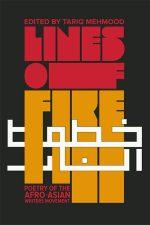
Lines of Fire (2nd Edition)
USD $ 60Lines of Fire: Recovering the Lost Arsenal of Anti-Colonial Poetry
Born in Tashkent , forged in clandestine presses, and echoing in today’s streets—this is the recovered front line of a global poetic resistance.
In 1958, at the Afro-Asian Writers’ Conference in Tashkent, a 90-year-old W.E.B. Du Bois stood before the decolonizing world and declared: “I am an American—I am an African.” It was a moment of radical, transnational self-definition.
From that conference emerged a literary movement and its journal, The Call—a direct line for poets from Algiers to Hanoi, Cairo to Beijing, to speak to one another, bypassing the languages and borders of their colonial masters. Though the movement later fractured under Cold War pressures, its two wings—The Call and the Soviet-backed Lotus—remained united in their stand against Zionism, racism, and empire.
Their poetry, often crafted under threat of torture, exile, and surveillance, became a clandestine weapon. Some of it was passed hand to hand, read aloud in underground meetings, and chanted at mass gatherings from Delhi to Ramallah, Cape Town to Gaza.
Now, for the first time, this vital corpus is restored. Lines of Fire, edited by Tariq Mehmood—former leading defendant in the landmark Bradford 12 case and now professor at the American University of Beirut—gathers these living weapons into a single, incendiary anthology. In an age of resurgent fascism and genocide, these voices speak with renewed, unyielding force: their anguish, rage, love, and hope are as urgent now as the day they were penned.
Why This Book Is Essential:
- A Lost Canon, Recovered: Features seminal, often inaccessible work by giants like Mahmoud Darwish, Faiz Ahmed Faiz, Leopold Senghor, Adunis, , Ousmane Sembène, and dozens more from across Africa and Asia.
- Drawn from Rare Sources: Poems curated from scarce issues of The Call and Lotus, long out of print and hidden in archives.
- A Groundbreaking Scholarly Frame: Includes a major introduction tracing the movement’s history, its surveillance by the CIA, the impact of the Sino-Soviet split, and a radical re-examination of solidarity.
- Built to Last & Teach: Published in archival-quality hardcover for libraries, scholars, and lifelong activists. An indispensable text for courses in Decolonial Studies, Global South Literatures, Cold War History, and Postcolonial Poetry.
A Call to Arms for a New Generation.
Edited by Tariq Mehmood, this collection includes poems by:
Salah Abdel Sabour (1931-1981, Ali Ahmad Said Esber, also known as Adunis (1930- ), Mulk Raj Anand (1905-2004), Anar Rasul oghlu Rzayef (1938- ), Nobuo Ayukawa (1920-1986), Fadhil al-Azzawi (1940- ), Abd Al-Wahhab al-Bayati (1926-1999), Mahim Bora (1917- ), Bernard Binlin Dadié (1916- ), Mahmoud Darwish (1942-2008), Osamu Dazai (1909-1948), Mário Pinto de Andrade (1928-1990), D.B. Dhanapala (1905-1971), Mohammed Dib (1920-2003), Gevorg Emin (1918-1998), Sengiin Erdene (1929-2000), Faiz Ahmed Faiz (1911-1984), Rasul Gamzatov (1923-2003), Daniil Granin (1919- ), Colette Anna Gregoire, better known as Anna Greki (1931-1966), Malek Haddad (1927-1978), Pham Ba Ngoan, better known by his pen name Thanh Hai (1930-1980), Buland al-Haidari (1926-1996), Suheil Idris (1925-2008), Yusuf Idris (1927-1991), Fazil Iskander (1929- ), Zulfiya Isroilova (1915-1996), Ali Sardar Jafri (1913-2000), Ghassan Kanafani (1936-1972), Edward al-Kharrat (1926- 2015), Hajime Kijima (1928-2004), Mazisi Kunene (1930-2006), Alex La Guma (1925-1985), U Gtun Kyi, better known by his pen name Minn Latt Yekhaun (1925-1985), Abdul Hayee better known by his pen name Sahir Lundhianvi (1921-1980), Zaki Naguib Mahmoud (1905-1993), Nazik Al-Malaika (1923-2007), Mouloud Mammeri (1917-1989), Yuri Nagibin (1920-1994), Sergey Narovchatov (1919-1981), Dashdorjiin Natsagdorj (1906-1937), Hiroshi Noma (1915-1991), Gabriel jibaba Okara (1921- ), Amrita Pritam (1919-2005), Jean-Joseph Rabearivelo (1901-1937), Richard Rive (1931-1989), Rady Saddouk (1938-2010), Badr Shakir al-Sayyab (1926-1964), Ousmane Sembene (1923- 2007), Leopold Sedar Senghor (1906-2001), Yusuf al-Sibai (1917-1978), Fadwa Tuqan (1917-2003), Sonomyn Udval (1921-1991), Ramses Younan (1913-1966), and Tawfiq Ziad (1929-1994).
Listen to our conversation with Tariq Mehmood here:
#AfroAsianWritersMovement #Lotusjournal #TheCalljournal #NonAlignedMovement #BandungConference #Tashkent1958 #ColdWarculturalhistory #SinoSovietsplit #antiimperialism #anticolonialpoetry #resistanceliterature #resistancepoetry #revolutionarysolidarity #antiracism #antiZionism #settlercolonialism #racialviolence #genocide #GlobalSouthliterature #Africanpoetry #Asianpoetry #Arabpoetry #Palestinianliterature #SouthAsianliterature #AfricanLiterature #Arabpoets #Africanwriters #AfroAsiansolidarity #WEBDuBois #politicalpoetry #20thcenturypoetry
-
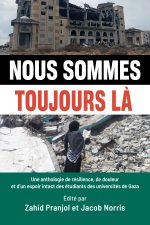
Nous sommes toujours là
USD $ 18Select options This product has multiple variants. The options may be chosen on the product page
Nous sommes toujours là
USD $ 18Depuis le début du génocide contre les Palestiniens à Gaza, mené par la violence coloniale israélienne, les établissements d’enseignement supérieur ont été systématiquement détruits. Les campus sont en ruines, les universitaires et les étudiants ont été tués ou déplacés de force, et ce qui était autrefois une population étudiante florissante et intellectuellement dynamique vit maintenant sous la menace quotidienne de bombardement, de famine forcée et de mort. Pendant près de deux ans, les étudiants ont été coupés non seulement de leurs universités, mais aussi de leurs rêves, de leur avenir et même de leur sentiment de sécurité le plus élémentaire.
Pourtant, malgré ce traumatisme inimaginable, beaucoup écrivent encore.
Nous sommes toujours là est une anthologie de ces voix – brutes, non filtrées et courageuses. Il présente des histoires courtes et longues, des poèmes, des essais et des témoignages écrits par des étudiants des universités de Gaza. Ce ne sont pas des réflexions rétrospectives ou des analyses à distance ; ce sont des mots en temps réel, émergeant des profondeurs du génocide, du déplacement et du deuil. Ces écrits peuvent être leurs derniers espoirs d’atteindre le monde, un dernier acte de résistance par l’expression.
Les droits d’auteur de la vente de ce livre sont intégralement reversés aux étudiants auteurs de Gaza.
Survivant aux extrêmes les plus sombres de la souffrance, de la destruction et du déplacement, de la famine et de la menace constante de mutilation ou de mort, ces jeunes écrivains nous parlent avec une lucidité perçante. Leur résilience est leur seule forme d’optimisme. Paradoxalement, les lire soulève le cœur.
– Ian McEwan, auteur d’Expiation et d’Amour ÉternelUn recueil bouleversant, douloureux et pourtant plein d’espoir, de la jeune génération du peuple de Gaza. Le Sumud, la résilience, n’a jamais été aussi puissant et clair qu’il ne l’apparaît dans cette collection incontournable et urgente. —Ilan Pappé, professeur au Collège des Sciences Sociales et des Études Internationales de l’Université d’Exeter, auteur de Une histoire très courte du conflit israélo-palestinien
Au cœur de la souffrance, les mots naissent — et sous les décombres, la créativité s’élève. Ce livre est plus qu’un recueil de pages écrites ; c’est l’écho d’âmes résilientes et le cri de plumes qui ont parlé lorsque les voix ont été réduites au silence. — Professeur Dr. Omar Kh. Melad, Président de l’Université Al-Azhar de Gaza
Nous Sommes Toujours Là n’est pas un livre sur la guerre — c’est un livre sur le fait d’être en vie après que le monde a décidé que vous avez déjà disparu, écrit dans des pièces qui ne tiennent peut-être plus debout. Ces pages sont des dépêches du fil étroit du présent : des lettres de la faim, des fragments de vies interrompues, des éclairs d’espoir si inflexibles qu’ils brûlent. Ici, des jeunes gens façonnent le témoignage de leur temps sur terre, sachant que leur temps peut être court. Vous ne quitterez pas ce livre avec le confort d’une conclusion. Il restera avec vous bien après que la dernière page aura été tournée. — Leila Sansour, réalisatrice et fondatrice d’Open Bethlehem
Ces réflexions poignantes de Gaza, en prose et en poésie, du milieu d’un génocide, sont à la fois déchirantes et pleines de vie et de promesse. Israël a peut-être physiquement tué nombre de leurs jeunes auteurs, mais il ne tuera jamais leurs mots, qui vivent dans ce puissant recueil de leurs écrits. — Ghada Karmi.
La mort n’est pas une idée pour ces jeunes écrivains, mais une réalité quotidienne. Ce recueil témoigne de la puissance des mots. Il révèle comment l’amour, la créativité et l’espoir peuvent nous galvaniser contre la peur et l’inaction. — Selma Dabbagh, auteure du roman Out of It et éditrice de l’anthologie We Wrote in Symbols; Love and Lust by Arab Women Writers.
Sara Alkhaldy, l’une des contributrices de Nous Sommes Toujours Là, une nouvelle anthologie d’écrits d’étudiants de Gaza, déclare : “Je voudrais pouvoir mettre en bouteille l’odeur de notre maison et l’emporter avec moi en partant.” Rula Elkhair écrit à propos des études pendant le déplacement : “Même dans des endroits sans électricité, sans eau et sans internet stable, j’ai installé un eSIM sur mon téléphone et je suis montée sur le toit sous le bourdonnement des drones pour télécharger des cours. J’ai passé des examens dans des cafés au bord de la mer. J’ai étudié en ayant faim, en ayant peur, en étant en deuil.” — Selma Dabbagh dans la London Review of Books Connaissance des Faits Pertinents.
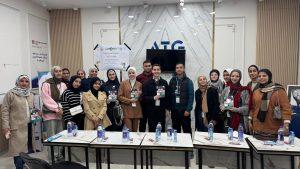 Écoutez notre conversation en podcast
avec les étudiants contributeursLa version anglaise de ce livre est disponible ici : We Are Still Here
Select options This product has multiple variants. The options may be chosen on the product page -

Class, gender, race and colonialism
USD $ 5 USD $ 11Price range: USD $ 5 through USD $ 11Select options This product has multiple variants. The options may be chosen on the product page
Class, gender, race and colonialism
USD $ 5 USD $ 11Price range: USD $ 5 through USD $ 11Description (1600 / 2500)
It is important to see both Marx’s brilliant generalisations about capitalist society and the very concrete ways in which he examined not only class, but also gender, race, and colonialism, and what today would be called the intersectionality of all of these. His underlying revolutionary humanism was the enemy of all forms of abstraction that denied the variety and multiplicity of human experience, especially as his vision extended outward from Western Europe. For these reasons, no thinker speaks to us today with such force and clarity.It is clear today that the emancipation of labour from capitalist alienation and exploitation is a task that still confronts us. Marx’s concept of the worker is not limited to European white males, but includes Irish and Black super-exploited and therefore doubly revolutionary workers, as well as women of all races and nations. But, his research and his concept of revolution go further, incorporating a wide range of agrarian non-capitalist societies of his time, from India to Russia and from Algeria to the Indigenous peoples of the Americas, often emphasising their gender relations. In his last, still partially unpublished writings, he turns his gaze Eastward and Southward. In these regions outside Western Europe, he finds important revolutionary possibilities among peasants and their ancient communistic social structures, even as these are being undermined by their formal subsumption under the rule of capital. In his last published text, he envisions an alliance between these non-working-class strata and the Western European working class.
Select options This product has multiple variants. The options may be chosen on the product page -

Finding a Voice: Asian Women in Britain (New and Expanded Edition)
USD $ 5 USD $ 20Price range: USD $ 5 through USD $ 20Select options This product has multiple variants. The options may be chosen on the product page
Finding a Voice: Asian Women in Britain (New and Expanded Edition)
USD $ 5 USD $ 20Price range: USD $ 5 through USD $ 20irst published in 1978, and winning the Martin Luther King Memorial Prize for that year, Finding a Voice established a new discourse on South Asian women’s lives and struggles in Britain. Through discussions, interviews and intimate one-to-one conversations with South Asian women, in Urdu, Hindi, Bengali and English, it explored family relationships, the violence of immigration policies, deeply colonial mental health services, militancy at work and also friendship and love. The seventies was a time of some iconic anti-racist and working-class struggles. They are presented here from the point of view of the women who participated in and led them.
This new edition includes a preface by Meena Kandasamy, some historic photographs, and a remarkable new chapter titled ‘In conversation with Finding a Voice: 40 years on’ in which younger South Asian women write about their own lives and struggles weaving them around those portrayed in the book.
Select options This product has multiple variants. The options may be chosen on the product page -
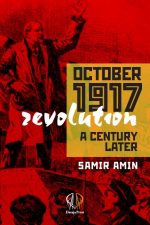
October 1917 Revolution
USD $ 5 USD $ 15Price range: USD $ 5 through USD $ 15Select options This product has multiple variants. The options may be chosen on the product page
October 1917 Revolution
USD $ 5 USD $ 15Price range: USD $ 5 through USD $ 15Great revolutions make history. Conservative resistance and counter-revolutions only delay their progress. The French revolution invented modern politics and democracy, the Russian revolution paved the way for the socialist transition, while the Chinese revolution connected the emancipation of those peoples oppressed by imperialism with the path to socialism. These revolutions are great precisely because they are bearers of undertakings that are far ahead of the immediate demands of their time. beacons that illuminate the still unfinished struggles of the peoples for the realization of these goals. It is impossible to understand the contemporary world by ignoring these great revolutions. To commemorate these revolutions, says Samir Amin, one needs both to assess their ambitions (the utopia of today will be the reality of tomorrow), and to understand the reasons for their temporary setbacks. Conservative and reactionary minds refuse to do so—they wish us to believe that great revolutions have been nothing more than unfortunate accidents, that the peoples who have made them were carried away by their deceitful enthusiasm, diversions from the normal current of history. This collection of essays helps to situate the lessons of the October 1917 Russian Revolution from a perspective of 100 years.
Egyptian economist and intellectual, Samir Amin (1931-2018), was one of the world’s greatest radical thinkers —a creative Marxist’. He was the director of Third World Forum (Forum du tiers monde), Dakar and President of the World Forum for Alternatives. He published numerous books and papers, including The Law of Value and Historical Materialism, Eurocentrism – Modernity, Religion and Democracy: A Critique of Eurocentrism and Culturalism, Ending the Crisis of Capitalism or Ending Capitalism?‘, Global History – a View from the South and Russia and the Long Transition from Capitalism to Socialism
Select options This product has multiple variants. The options may be chosen on the product page -
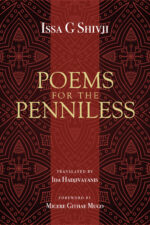
Poems for the Penniless
USD $ 5 USD $ 18Price range: USD $ 5 through USD $ 18Select options This product has multiple variants. The options may be chosen on the product page
Poems for the Penniless
USD $ 5 USD $ 18Price range: USD $ 5 through USD $ 18These poems by Issa Shivji, lawyer, activist and Tanzanian public intellectual, were written at different times in different circumstances. They give vent to personal anguish and political anger. Mostly originally written in Kiswahili, here accompanied by English translations, and they are intensely personal and political.
Poems are clustered under several headings to provide a context. The first combines personal agony at the loss of comrades and friends with poems about love and affection for living ones. The second is about robberies of freedom, resources, and dignity and the loss of justice under neoliberalism. The third section, entitled Hopes and Fears, comprises short poems tweeted over the last five years expressing despair, fear and hope in the human capacity for freedom.
The last section are poems, concerned with Shivji’s period in South Africa in 2018, reflect on the emergence of neo-apartheid with its wanton and shameless exploitation of the majority.
Wonderfully translated by Ida Hadjivayanis.
Select options This product has multiple variants. The options may be chosen on the product page -
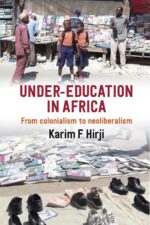
Under-Education in Africa
USD $ 22Select options This product has multiple variants. The options may be chosen on the product page
Under-Education in Africa
USD $ 22Under-Education in Africa: From Colonialism to Neoliberalism is a collection of essays on diverse aspects of educational systems that were written over a period of four and a half decades, written from the point of view of an activist educator.
With the focus on Tanzania, they cover education in the German colonial era, the days of Ujamaa socialism and the present neo-liberal times. Themes include the social function of education, the impact of external dependency on education, practical versus academic education, democracy and violence in schools, the role of computers in education, the effect of privatization on higher education, misrepresentation of educational history, good and bad teaching styles, book reading, the teaching of statistics to doctors and student activism in education.
Two essays provide a comparative view of the situation in Tanzania and the USA. Linking the state of the educational system with society as a whole, they explore the possibility of progressive transformation on both fronts. They are based on the author’s experience as a long-term educator, his original research, relevant books, newspaper reports and discussions with colleagues and students.
The author is a retired professor of medical statistics who has taught at colleges and universities in Tanzania and at universities in the USA and Norway.
Select options This product has multiple variants. The options may be chosen on the product page -

The Travails of a Tanzanian Teacher
USD $ 18Select options This product has multiple variants. The options may be chosen on the product page
The Travails of a Tanzanian Teacher
USD $ 18The Travails of a Tanzanian Teacher is a riveting account of the bumpy first decade of the work life of Karim F Hirji, a retired Professor of Medical Statistics. Filled with a distinctive variety of eye-opening episodes, it covers lecturing at the University of Dar es Salaam, the life of a political exile in a remote rural area and the challenges of setting up from scratch a one-of-a-kind educational institute in Africa. With a style that seamlessly combines the personal with the general, Hirji provides an illuminating description of different aspects of the Tanzanian political, educational, economic and rural landscape during the 1970s. Starting with a commentary on teacher training, he concludes with a critical comparison of modern university education in the nation with that of the earlier era.
Select options This product has multiple variants. The options may be chosen on the product page -

Silence Would Be Treason
USD $ 10 USD $ 20Price range: USD $ 10 through USD $ 20Select options This product has multiple variants. The options may be chosen on the product page
Silence Would Be Treason
USD $ 10 USD $ 20Price range: USD $ 10 through USD $ 20These letters and poems are invaluable fragments of a living conversation that portrays the indomitable power in humans to stay alive in the face of certain death – to stay alive even in death.
Reading through the treasure trove of the letters and poems compiled here as The Last Writings of Ken Saro-Wiwa evokes intense memories of his resolute struggles against an oil behemoth and a deaf autocratic government. His crusade frames one of the most tumultuous periods of Nigeria’s history; his tragic story evokes anger and demands action to resolve the crises that first led the Ogoni people to demand that Shell clean up Ogoni lands or clear out of the territory.
Select options This product has multiple variants. The options may be chosen on the product page -

Wreaths for a Wayfarer: An Anthology in Honour of Pius Adesanmi
USD $ 5 USD $ 22Price range: USD $ 5 through USD $ 22Select options This product has multiple variants. The options may be chosen on the product page
Wreaths for a Wayfarer: An Anthology in Honour of Pius Adesanmi
USD $ 5 USD $ 22Price range: USD $ 5 through USD $ 22Pius Adesanmi died in the doomed Ethiopian Airline flight 302 on March 10, 2019. Wreaths for a Wayfarer: An Anthology in Honour of Pius Adesanmi is an assemblage of 267 original poems written by 127 established and emerging African writers. While some of the poets celebrate Adesanmi, others reflect philosophically on existence, mortality, immortality and/or offer hope for the living. In this memorably textured collection, the poets – some who knew, and some who did not know Adesanmi – exorcise the pains of loss through provocative poems that pour out their beating hearts with passion.
Pius Adesanmi died in the doomed Ethiopian Airline flight 302 on March 10, 2019. Wreaths for a Wayfarer: An Anthology in Honour of Pius Adesanmi is an assemblage of 267 original poems written by 127 established and emerging African writers. While some of the poets celebrate Adesanmi, others reflect philosophically on existence, mortality, immortality and/or offer hope for the living. In this memorably textured collection, the poets – some who knew, and some who did not know Adesanmi – exorcise the pains of loss through provocative poems that pour out their beating hearts with passion.
Select options This product has multiple variants. The options may be chosen on the product page -

Strategic litigation and the struggle for Lesbian, Gay and Bisexual equality in Africa
USD $ 5 USD $ 25Price range: USD $ 5 through USD $ 25Select options This product has multiple variants. The options may be chosen on the product page
Strategic litigation and the struggle for Lesbian, Gay and Bisexual equality in Africa
USD $ 5 USD $ 25Price range: USD $ 5 through USD $ 25There has been a rise in the use of strategic litigation related to seeking equality for lesbian, gay, and bisexual (LGB) persons. Such developments are taking place against the backdrop of active homophobia in Africa. The law and the general public should, argues the author, treat LGB persons in the same way that heterosexuals are treated. In the past two decades,30 strategic cases have been fi led by LGB activists in the Common Law African countries, namely in Botswana, Kenya, Nigeria, South Africa, and Uganda. While the majority of the cases have been successful, they have not resulted in significant social change in any of the countries. On the contrary, there have been active backlashes, counter-mobilisations, and violence against LGB persons, as well as the further criminalisation of same-sex relations and constitutional prohibitions on same-sex marriages in some of the jurisdictions. The author argues that activists in Common Law Africa have to design LGB strategic litigation in such a way as to fi t within the actual social and political conditions in their countries if strategic litigation is to spur social change.
Adrian Jjuuko is an exceptional scholar. A rare combination of intellectual brilliance, commitment and hard work. The book is born of this. It reflects his incisive analytical skills, anchored in solid knowledge of the law and jurisprudential developments in the field. His ventures into political theory, philosophy, and the social sciences give the analysis additional clarity and empirical grounding.
In Strategic Litigation, Adrian Jjuuko has hugely succeeded in bringing to light pertinent issues regarding LGB rights in the African context today. By making reference to various scholarly works and critical analyses, the author has cleverly driven home the message that progressive decriminalization of LGB relationships and constitutional protection of LGB persons in Common Law Africa should be deliberate steps towards demystifying the erstwhile taboo of LGB persons’ equality and social justice. Yet, Jjuuko throws in a word of caution; societal attitudes towards LGB persons still remain largely negative, as exemplified in pervasive disapproval (including religious) of their rights. This implies that a lot is still required from all stakeholders to demystify and accommodate the social position of the LGB community in Common Law Africa today. Kisito, J. M. (2022). Book Review: Strategic litigation and the struggle for lesbian, gay and bisexual equality in Africa by Adrian Jjuuko. Feminism & Psychology, 32(4), 584-587. https://doi-org.proxy.library.carleton.ca/10.1177/09593535221104876 (Original work published 2022)
Select options This product has multiple variants. The options may be chosen on the product page -
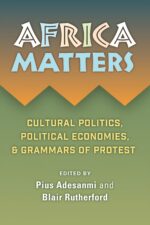
Africa Matters
USD $ 5 USD $ 18Price range: USD $ 5 through USD $ 18Select options This product has multiple variants. The options may be chosen on the product page
Africa Matters
USD $ 5 USD $ 18Price range: USD $ 5 through USD $ 18Africa Matters: Cultural politics, political economies, & grammars of protest provides a sampling of insightful articles from the first five issues of Nokoko, journal of the Institute of African Studies, Carleton University, Ottawa, Canada. It brings together pieces that the journal’s editorial board felt were particularly perspicacious in their analysis and resonant in their crafting. Uniting them in this book permits a new dialogue to emerge around the key themes of cultural politics, political economies and grammars of protest. Their intersection here sheds light on important issues for Africans in the twenty-first century.
Select options This product has multiple variants. The options may be chosen on the product page -

Oil Politics
USD $ 1 USD $ 25Price range: USD $ 1 through USD $ 25Select options This product has multiple variants. The options may be chosen on the product page
Oil Politics
USD $ 1 USD $ 25Price range: USD $ 1 through USD $ 25The essays here contribute to developing and deepening an understanding of the ecological challenges ravaging Nigeria, Africa and our world today. They illustrate the global nature of these terrors. These essays are not meant just to enable for coffee table chatter: they are intended as calls to action, as a means of encouraging others facing similar threats to share their experiences.
Set out in seven sections, this book of 54 essays deals with deep ecological changes taking place primarily in Nigeria but with clear linkages to changes elsewhere in the world. The essays are laid out with an undergird of concerns that characterise the author’s approach to human rights and environmental justice advocacy. The first section rightly presents broad spectrum ecological wars manifesting through disappearing trees, spreading desertification, floods, gas flaring and false climate solutions.
Select options This product has multiple variants. The options may be chosen on the product page -

Stratégies familiales, diasporas et investissements
USD $ 5 USD $ 30Price range: USD $ 5 through USD $ 30Select options This product has multiple variants. The options may be chosen on the product page
Stratégies familiales, diasporas et investissements
USD $ 5 USD $ 30Price range: USD $ 5 through USD $ 30À rebours des thèses soutenant que la migration contribue au développement ou que l’in- vestissement dans le développement réduit la croissance de la migration « irrégulière », ce livre marque une rupture tonifiante avec les idées communes abondamment véhiculées dans la littérature sur les liens entre migration, mobilités et développement en Afrique. Il accorde un intérêt manifeste pour la plus grande part des mobilités africaines, lesquelles se situent à l’intérieur du continent, et à la formation des diasporas en dehors des fron- tières nationales et continentales. Cette considération conjointe des mobilités « Sud-Sud » et « Sud-Nord » permet de remettre en cause l’hypothèse selon laquelle il existe des diffé- rences fondamentales entre elles.
Cet ouvrage examine les fluctuations ordinaires des mouvements de populations – à travers l’Afrique, comme dans le reste du monde –, qui étendent les familles, génèrent de nouvelles relations, reconfigurent les connexions économiques et politiques, et sont intégrées dans l’expérience quotidienne des millions de personnes qui y prennent part.
The in-depth knowledge of the mostly African authors adds to the quality of a research field, which was for long far too Eurocentric. – Ilke ADAM, Vrije Universiteit Brussel (Belgium)
Il était temps de mettre en lumière ce que migration et mobilité représentent en Afrique. L’ouvrage offre une perspective originale et décoloniale sur le sujet. – Eric HAHONOU, Roskilde Universitet (Denmark)
Christian Bouquet, « Quelques éclairages nouveaux sur les migrations africaines », EspacesTemps.net [En ligne], Books, 2020 | Mis en ligne le 20 November 2020, consulté le 20.11.2020. URL : https://www.espacestemps.net/en/articles/quelques-eclairages-nouveaux-sur-les-migrations-africaines/ ; DOI : 10.26151/esapcestemps.net-jc2a-6b03
Avec la participation de John O. IGUE, Saydou KOUDOUGOU, Pierre-Joseph LAURENT, Bassirou MALAM SOULEY, Hamidou MANOU NABARA, Marème NIANG NDIAYE, Amadou SARR DIOP, Sadio SOUKOUNA , Eric Stève TAMO MBOUYOU et Astadjam YAOUBA.
Select options This product has multiple variants. The options may be chosen on the product page -

Rinky-Dink Revolution: Moving Beyond Capitalism
USD $ 5 USD $ 15Price range: USD $ 5 through USD $ 15Select options This product has multiple variants. The options may be chosen on the product page
Rinky-Dink Revolution: Moving Beyond Capitalism
USD $ 5 USD $ 15Price range: USD $ 5 through USD $ 15This pamphlet tackles the question: how do we get from A to B, capitalism to post-capitalism?
It is critical reading to understand why:
* Capitalist-oriented industrial agriculture and its destruction of habitat are the upstream causes that led to the COVID-19 pandemic as well as other past and future pandemics of devastating, emerging viral pathogens.
* COVID-19 may trigger a collapse of the global capitalist system but it is not the cause.
* Health-care and public-health systems organized around capitalist principles don’t do well in pandemics, compared to those not organized around capitalist principles.
* The current economic collapse, triggered by a pandemic, opens a door for revolutionary transformation.The pamphlet is also available in Spanish and Korean.
Select options This product has multiple variants. The options may be chosen on the product page -

Revolución Rinky-Dink: Yendo Más Allá del Capitalismo Negando Consentimiento, y Promoviendo Construcciones Creativas y Destrucciones Creativas
Suggested Price: USD $ 4.99Este panfleto aborda la pregunta: ¿cómo podemos pasar de A a B, del capitalismo al poscapitalismo? La revolución de Rinky-dink involucra acciones e inacciones que son fáciles, seguras, mundanas, sin glamour y factibles dentro de la vida de cada persona.
Howard Waitzkin presenta una intervención clara y directa para el cambio revolucionario en el sistema económico capitalista global. Cubre mucho terreno, con sofisticación, mientras mantiene la discusión en tierra. Su enfoque en las formas de facilitar un desafío al capital y construir una mayor transformación revolucionaria es crucial en esta coyuntura histórica. Esta discusión sobre construcciones creativas y destrucciones creativas es particularmente útil.
— Brett Clark, profesor de sociología de la Universidad de Utah y autor De El Robo De La Naturaleza: Capitalismo Y Grieta Ecológica, The Robbery of Nature: Capitalism and Ecological Rift en inglés.
El fin del capitalismo es posible. Waitzkin nos lleva un paso más allá en el proceso creativo para esta transformación. A través de ejemplos específicos de grupos organizados dentro de los Estados Unidos y en el extranjero, este trabajo constituye una guía práctica para todos. Waitzkin alienta nuestra creatividad para actos organizados y seguros además de omisiones para trascender el capitalismo.
— Nylca J. Munoz Sosa, abogada, líder de salud pública y activista centrada en la justicia sanitaria y la descolonización en Puerto Rico.
-

소소한 혁명
Suggested Price: USD $ 4.99어떻게 자본주의를 넘어설 것인가라는 질문에 대한 답을, 지금 우리가 “감히” 찾아보려고 한다. 이 소책자를 통해, 자본주의를 벗어나 생태사회주의로 향하는 길을 찾는 우리의 노력이 뚜렷해지길 바란다.
자본주의에 갇힌 우리는, 어떤 형태로든 행동 또는 비행동inaction에 관여하고 있다. 행동은, 자본주의를 직접 마주하기 보다는 자본주의가 초래하는 심각한 여러 문제를 개선하기 위한 투쟁에 참여하는 모습을 띈다. 즉, 우리의 행동은 원인이 아니라 결과에 초점을 맞추는 모순을 보인다.
반면, 비행동은 동의를 의미하게 된다. 우리는 자본주의 경제 체계를 영속시키는 경제 활동에 문제 제기를 하거나 변화를 요구하는 행동을 하지 않음으로써 자본주의에 [암묵적으로] 동의하고 있다. 결과적으로 평범한 우리가 자본주의에 봉사하는 자본가 역할을 계속하고 있는 것이다.
왜 자본주의 억압의 대상인 우리가 억압에 동의하는가? 그 이유가 단지 [외부의] 탄압 때문만은 아니라고, 이탈리아 파시즘 하의 감옥에서 그람시Antonio Gramci는 말했다. 즉, “헤게모니”를 장악하는 이념이 우리의 삶을 둘러싼 억압적인 환경을 설명하고 정당화하는 것이다.
“소소한 혁명”은, 개개인의 삶 속에서, 쉽고 안전하게, 엄청 근사하지는 않지만 일상적이고 실천가능한 행동과 비행동을 얘기한다. 지금까지의 혁명사는, 혁명을 가능하게 했던 전체 민중보다는 소수의 혁명가에 주목했었지만, 자본주의에 맞서는 “우리는” 마르크스나 엥겔스가 떠올렸던 주인공들보다 훨씬 다양하고 규모가 커졌다. 자본주의를 수호하기 위해 싸우는 “그들은” 전 세계 인구의 극소수일 뿐이다.
자본주의의 어떤 특징이 억압적이고 그래서 제거되어야 하는지, 또 반대로 어떤 사회경제구조의 특징이 억압적이지 않으며 그래서 남겨져야 하는지를 뚜렷이 설명하는 전략이 필요하다. 자본주의 이후 사회가 어떤 모습이어야 할지는 점점 명확해지고 있다. 소소한 혁명은, 자본주의의 영속과 발전에 필수적인 과정에 대한 우리의 동의를 거두는 데에서 시작하여, 수 백 만의 우리가, 여전히 적은 소수이긴 하지만, 건설적인 혹은 파괴적인 노력에 창의적으로 참여할 수 있는 방법 또한 포함한다.
세상은 자본주의 그 이후로 이미 진행 중이다. 세계 곳곳에서 창의적인 모습의 공동체communal organization들이 생겨나 스스로 통치하고 구성원들의 생존과 안녕을 보장하기 위해 활동하고 있다. 복지 국가를 포함한 자본주의 국가를 넘어서는 것은 국가 자체를 넘어서는 결과로 이어진다. 연대 경제solidarity economy는 먼저, 소규모의 협동조합 성격을 띄는, 저렴하고 유쾌하고 편안한 주거 공간을 구성하는 방법을 모색하여, 착취적인 임대료, 빚, 세금, 보험에 대한 공동의 해결책을 제시한다. 또한 이러한 공동체는, 영양이 풍부한 먹거리를 지역에서 생산하여 유통하는 방법으로, 자본주의식 농업으로부터 독립을 꾀할 수 있다.
창조적 파괴는, 허가를 받아 하는 대규모의 시위가 아니라 자본주의가 순조롭게 기능할 수 없게 멈추거나 둔화시키는 직접 행동으로 가능하게 된다. 우리가 투자나 세금으로 흘러가게 내버려 두는 돈의 흐름을 비자본주의적인 연대경제에 돌리는 것도 창조적 파괴의 한 방법이다.
소소한 혁명은, 간단하고 안전하며, 자신의 삶을 조금이라도 바꾸고 싶은 의지가 있는 사람이라면 실천가능하다. 자본주의가 우리의 안녕과 행복을 파괴하는 체계라는 것을 알면서도, 부지불식간에 자본주의를 지지하고 동의하는 행동을 멈추는 즐거움을 누릴 수 있다. 놀랍게도 혁명을 위해 다치거나 죽지 않아도 되고, 심지어 큰 불편을 감수하지 않아도 된다. 우리가 해야 할 일은 단 하나. 어차피 하기 싫었던 여러 일들을 이제 정말 그만두는 것이다.