
-
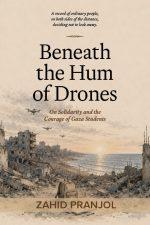
Beneath the Hum of Drones
The sound is always there. Hmmm. A low, continuous, mechanical hum that never stops. It is the sound of drones—circling above Gaza at all times, surveilling everything below, a permanent reminder that someone is always watching. It has been there since before the students could remember. Since childhood, when it disrupted their favourite cartoons. It is the backdrop against which Gaza’s students refused to stop learning.
Beneath the Hum of Drones tells the story of those students through their own words and paintings—and the story of how their voices reached the world.
Beneath the roar of drones and the shadow of annihilation, we will keep learning until our last breath. Education is our final refuge.– Saad Muhana, Mechanical engineering graduate, Islamic University of Gaza, Palestine and contributor to We Are Still Here.
It begins with a single conversation over coffee in England. A young Gazan scholar asked: What can we do? Not governments. Not international bodies. We, the two of us, here, with what we have. What could be done for the students of Gaza, right now?
What followed was a grassroots movement that nobody had planned. Seventy English teachers volunteered to teach through WhatsApp voice notes, listening to recordings made with the constant sound of surveillance overhead. Academics from across the UK delivered recorded lectures to medical students who walked miles through rubble for a signal. A community in Brighton and Hove raised funds for tuition fees and devices, sold student artwork as tote bags and stickers, and packed rooms for readings that left strangers weeping. A gallery in Hailsham hung the students’ paintings free of charge. A publisher brought out We Are Still Here, an anthology of poetry and prose by fifty-eight Gazan students writing from displacement tents and bombed-out neighbourhoods.
But this book is not only about what was built. It is about who built it—and who they built it for.
Hala painted a man pulling his family’s entire world on a wooden cart, refusing to look back at the ruins behind him. Sara drew an olive tree whose leaves had become shrouds, yet whose roots held firm. Lama sketched a starving child from life, because she would not let that child pass unwitnessed. Medical students climbed rooftops for a signal. Children who had not played in two years were finally given paint and paper. Young writers sent their most private words across a cracked phone screen, trusting that someone on the other side would handle them with care.
We are still here, they wrote. And we refuse to disappear in silence.
This is their story. It is a testament to courage, dignity, and the unbreakable will to learn—even beneath the hum of drones.
-

I Survived by Mistake
This deeply personal and introspective work explores survival—not merely physical survival, but emotional and spiritual endurance through love, war, and loss. Written by a Palestinian author against the backdrop of the Gaza conflict, the book weaves together reflections on love, betrayal, war, displacement, and the search for meaning in a world stripped of stability.
The narrative oscillates between intimate romantic relationships and the brutal realities of life under bombardment. The author chronicles a turbulent love affair marked by passion, jealousy, betrayal, and eventual dissolution, examining how relationships fracture under the weight of pride, misunderstanding, and external pressures. Simultaneously, he documents the devastating experience of war in Gaza: displacement, hunger, the loss of loved ones, the daily struggle for survival, and the erosion of human dignity.
Central themes include the nature of survival—questioning whether mere existence constitutes living, and whether those who survive emerge intact or fundamentally altered. The author grapples with grief over the death of his grandmother, the loss of his beloved, and the collective trauma of a people under siege. He explores the tension between hope and despair, the betrayal of humanitarian aid systems, the corruption of values in times of crisis, and the profound loneliness of carrying unspoken pain.
Writing serves as both confession and catharsis—an attempt to staunch internal bleeding and make sense of chaos. The prose is poetic, fragmented, and emotionally raw, reflecting the author’s belief that true survivors do not write; they simply endure. Ultimately, the book is a testament to the impossibility of returning unchanged from love or war, and the quiet dignity of continuing despite everything.