
-
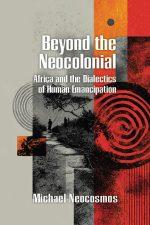
Beyond the Neocolonial
Price range: USD $ 7.99 through USD $ 30.00Select options This product has multiple variants. The options may be chosen on the product page
Beyond the Neocolonial
Price range: USD $ 7.99 through USD $ 30.00Humanity faces existential crises driven by the persistence of neocolonial capitalism and a state form that continues to de-humanise the majority. In Beyond the Neocolonial, Michael Neocosmos argues that the failure to enable, let alone to realise the popular desire for freedom in post-independence Africa lies in the continuity of the colonial state and the dominance of analytical, statist thought over the transformative power of the dialectic.
Tracing the genealogy of emancipatory politics from the ancient wisdom of Egypt’s Ma’at and Ionia’s isonomia to the revolutionary theories of Lenin, Mao, Fanon, and Cabral, Neocosmos asserts that politics must be understood as a collective thought-practice of universal equality. He challenges the “stasis” of the current world order by recovering silenced histories of African popular inventiveness: from the egalitarian society constructed by the Bossales in Haiti to the mass democratic experiments of the United Democratic Front in South Africa.
Critiquing the exhausted “party form” and the myth of the “heroic liberator,” the book highlights the emancipatory potential within African popular culture, arguing that proverbs and the Palaver contain latent prescriptions for resolving contradictions and healing community. This work is a call to abandon the “epistemology of ignorance” and revive a dialectics of becoming, locating the agency for a truly human future not in the state, but in the masses who make history.
Listen to Michael Neocosmos talking about his book.
Table of Contents
Three Poems by Bertolt Brecht, Okot p’Bitek, and Yannis Ritsos
Dedications and Acknowledgments
Prefatory Remark
In Lieu of a Foreword: some inspirational declarations and metaphors
Introduction: what is to be thought?
1. Politics as a Collective Thought-Practice and Human Emancipation as its Essence: thinking the common good
2. The Ancients and the Thought of Politics: arkhē and the dialectic of physis and nomos
3. Sourcing an Emancipatory Politics for Today: reviewing the classics
4. Thinking Emancipatory Politics through African Popular Culture
5. Resolving Contradictions among the People and the Dialectical Emancipatory Potential of Proverbial Metaphors
6. Haiti from Inventive Popular Sovereignty to Neocolonial State
7. Beyond the Party Form? An alternative political experiment and the figure of the heroic liberator
8. Democracy as Perverted Freedom: the anatomy of the African neocolonial state
Conclusion: silencing as analytical procedure in political theory and practice
References
Author bio
Select options This product has multiple variants. The options may be chosen on the product page -
Returning to the Source
In Upsetting the Familiar, Mugo Theuri, a Kenyan writer and former political prisoner, delivers a rigorous critique of socialist political organising in postcolonial Kenya. Drawing on his lived experience in the Mau Mau region, his imprisonment under the Moi regime, and decades of political engagement, Theuri argues that the Kenyan Left has failed to build a sustainable movement because it has uncritically adopted imported ideologies and organisational structures. The book posits that true liberation requires moving beyond imported slogans and elite-driven party politics. Instead, Theuri advocates for a politics rooted in indigenous political intelligence—the participatory, consensus-based governance systems like the Gikuyu kiama and grassroots formations like Bunge za Wananchi (People’s Parliaments) and chamas (mutual aid groups). A central theme is the need to reclaim suppressed histories, particularly the radical legacy of the Mau Mau and the erased contributions of women like Mekatilili wa Menza and Muthoni Nyanjiru. Theuri critiques the co-optation of opposition movements, the institutionalised caution of the Left, and the betrayal of socialist ideals by post-independence elites. Ultimately, he calls for a fundamental reimagining of democracy—one that is culturally grounded, feminist, and built from the ground up by the people themselves.
-
 Select options This product has multiple variants. The options may be chosen on the product page
We Are Still Not Counted As Human
S’bu Zikode’s reflections chronicle the profound struggle of Abahlali baseMjondolo (residents of the shacks), the largest popular movement to emerge in South Africa since apartheid. Founded in Durban in 2005, the movement now boasts over 180,000 members organised into more than 100 branches across four provinces (as of September 2025).
The movement arose from a deep disappointment following the initial promise of democracy, realizing that “freedom and the African National Congress (ANC) were two different things”. The poor were immediately excluded from public life and discussions about their own lives, often treated as “criminals” or “rubbish”. This systematic dehumanisation—where their very presence was deemed criminal—showed that democracy, in practice, referred primarily to the middle class and the rich.
At the heart of Abahlali baseMjondolo’s organizing is the non-negotiable demand for the recognition of their humanity and dignity. They built their foundation on the principles and values of ubuntu, viewing dignity as requiring respectful engagement and full participation in decision-making—not merely accepting ‘service delivery’. They insist on thinking and speaking for themselves, adopting the slogan ‘nothing for us, without us’.
AbM developed a unique ‘politics of the poor’ to create a space for the impoverished to think together, build power, and advance their interests outside of political parties or trade unions. The goal is establishing a democratic socialism built from below—a “living communism”—grounded in community praxis.
This struggle has been met with intense repression, including police violence, torture, criminalisation, and assassinations, with more than twenty lives lost. The state’s actions, intended to teach the poor to “know their place,” instead taught them that democracy was not for them, reinforcing the need to organize and be strong together. The movement continues to fight for the destruction of the capitalist system and the reconstruction of a new system centred on the humanity and dignity of all people.
STOP PRESS: Citation of Honour to S’bu Zikode.
29 October 2025
Human Rights Commission Presents a Citation of Honour to S’bu Zikode
Today the South African Human Rights Commission presented a Citation of Honour to S’bu Zikode.
Professor Tshepo Madlingozi, who presented the citation, specifically noted our movement’s work for land reparation, spatial justice and food sovereignty, and our commitment to oppose xenophobia and gender-based violence. He praised our movement as “true advocates of human rights, the restoration of dignity, and full liberation” and said that Zikode’s “legacy will forever guide and inspire future generations”.
In his acceptance speech Zikode accepted the Citation of Honour on behalf of the movement saying that “An award for me is also an award for the movement, Abahlali baseMjondolo, and for the determination and courage of all the people of South Africa — and all those who have kept our movement going for twenty years despite the challenges we continue to face.” He dedicated the award to the 25 comrades who have lost their lives in the course of our struggle.
Later, speaking to the leadership of the movement he said that “I am forever grateful to the red sea that has carried me over and over. I deeply appreciate you all.”
Our movement welcomes this award of a Citation of Honour to our president. It is an important recognition of the justice and power of our struggle, and the determination and courage of our members. In a time in which human rights are coming under sustained attack from right-wing forces, in and out of the ANC, we reaffirm our solidarity with the Commission, with the Socio-Economic Rights Institute and with all other human rights organisations under attack from the right.
The rights and dignity of every person must be respected – without exception – and we need to build a united front in support of this principle.
Contact:
Thapelo Mohapi 084 576 5117
Snenhlanhla Mcanyana 073 832 331
S’bu Zikode 083 547 0474Select options This product has multiple variants. The options may be chosen on the product page -
 Select options This product has multiple variants. The options may be chosen on the product page
Twenty Years of Courage and Struggle
Abahlali baseMjondolo (AbM) is the remarkable story of the South African shack dwellers movement, covering twenty years of courageous struggle. It is the largest movement to have emerged in South Africa after apartheid and one of the largest movements of the urban poor globally, boasting over 180,000 members across four provinces.
AbM emerged from the margins of South Africa’s cities, where residents faced life-threatening conditions, including shack fires, poverty, and systemic betrayal by the democratic state regarding land and housing. The movement is firmly committed to ethical principles, fighting not only for the right to the city but for the right to collectively occupy land and build occupations collectively. Abahlali insists on a humanist philosophy—”no one is illegal, everyone thinks and everyone must be counted and heard”—and works to build democracy and socialism from below.
Abahlali is abolition in action, seeking to interrupt capitalist logic by advocating for the total decommodification of land, recognizing it as a public good allocated based on human need. This commitment has led to significant victories, including securing land, providing services (like water and electricity), and winning a landmark Constitutional Court case against the unlawful Slums Act.
However, this quest for dignity has come at a tremendous cost, marked by severe repression, police violence, and the assassination of many activists by state forces and party thugs. Despite these challenges, AbM has persisted, developing occupations into working communes (such as eKhenana) that feature collective production, community halls, and political schools. Their story is a map for movements fighting inequality and authoritarianism globally. The movement continues to build collective power and struggle for a world where land, wealth, and power are shared on an equal basis.
“Your movement has shown the world that democracy extends beyond elections to a way of living together—through open assemblies and collective decision making. In doing so, you have advanced a vision grounded in humanity, solidarity, and courage. Your struggle has always been internationalist, and your solidarity with the people of Palestine, Swaziland, and the Congo, and the warm relations you have built with movements around the world, are exemplary.” Jeremy Corbyn in https://rajpatel.org/2025/10/13/4764/
The movement continues to grow, discovering that more and more settlements function better not when they function as an association of residents but as a commune. Agroecology is cropping up in more and more settlements thanks to exchanges with the MST. It’s a demonstration that when the wretched of the earth organize themselves without mediation, without NGO managers or academic gatekeepers, they can survive what would destroy any formation dependent on elite patronage. … This is the lesson Abahlali offers the world: genuine democracy is possible, but only when everyone thinks, everyone counts, everyone cares, and everyone acts. Raj Patel Everybody Thinks, Everybody Counts, Everybody Cares, Everybody Acts: Twenty Years of Abahlalism
Select options This product has multiple variants. The options may be chosen on the product page -

Decolonization and Afro-Feminism
Price range: USD $ 10.00 through USD $ 30.00Select options This product has multiple variants. The options may be chosen on the product page
Decolonization and Afro-Feminism
Price range: USD $ 10.00 through USD $ 30.00In Decolonization and Afro-Feminism, Sylvia Tamale presents a powerful and urgent call for Africa’s intellectual, cultural, and political liberation through an Afro-feminist lens. The book critically examines how colonialism has deeply entrenched systems of oppression—based on race, gender, sexuality, class, and knowledge production—and argues that true decolonization requires more than political independence; it demands a radical rethinking of African identities, histories, and futures.
Tamale challenges Eurocentric and patriarchal frameworks that continue to dominate African societies, institutions, and academia. She explores themes such as:
-
The coloniality of gender and sexuality, using case studies like Caster Semenya to expose how Western norms pathologize African bodies.
-
The importance of intersectionality in understanding overlapping systems of oppression.
-
The role of Afro-ecofeminism in reconnecting African ecological wisdom with social justice.
-
The need to decolonize African academia, law, and family structures to recenter Indigenous knowledge and epistemologies.
-
The potential of Ubuntu as a framework for justice, community, and relationality.
The book is both a scholarly critique and a visionary roadmap, emphasizing that decolonization must be a feminist, inclusive, and holistic project—one that reclaims Africa’s dignity, autonomy, and intellectual sovereignty.
Written with clarity and passion, Decolonization and Afro-Feminism is essential reading for students, activists, scholars, and anyone committed to understanding and advancing Africa’s liberation in the 21st century.
Select options This product has multiple variants. The options may be chosen on the product page -
-

I see the invisible
Price range: USD $ 5.00 through USD $ 20.00Select options This product has multiple variants. The options may be chosen on the product page
I see the invisible
Price range: USD $ 5.00 through USD $ 20.00Truth be told, I never thought I would write another volume of poetry after the last, I will not Dance to Your Beat (2011). The reason was that my previous volumes were reactive to the circumstances of the times. Patriots and Cockroaches (1992) was a reaction to the socio-political corruption that had engulfed Africa and dimmed the enthusiasm that had been built by the years of struggle for independence. Whereas we thought we were stepping into a post-colonial era, what we stepped into was a vicious neo-colonial times. The next collection, Poems on the Run (1995) was a reaction to military autocracy and the repression that followed. The volume was literally written underground. This was followed by Intercepted (1998) all written while detained at Kalakuta Republic of Alagbon Close. We Thought it was Oil But it was Blood (2002) responded to two things primarily – extractivism and the accompanying human and environmental rights abuses in the Niger Delta and elsewhere. The massive erosion of biodiversity and attacks on food sovereignty through the introduction of genetically modified organisms (GMOs) into our agricultural system inspired I Will not Dance to your Beat.
What you have in your hands, or on your screens, is a compilation that is largely more meditative than the previous collections. There are moments of reflection on the colonial and neoliberal foundations that permit a willful disconnection from nature and the resultant destructive extractivism.
Some of the poems came through conversations and poetry writing sessions with Peter Molnar, Maryam al-Khawaja — Rafto Human Rights laureates and Salil Tripathi, a member of the board of PEN International, in August 2017. The sessions held at a beautifully rustic location in Celleno, Italy, were documented on celluloid by the duo of Maria Galliana Dyrvik and Anita Jonsterhaug Vedå of SMAU, a multimedia firm in Norway. Poetic relationship with Maria and Anita has continued over the years and their work continues to inspire more and more poems.
Select options This product has multiple variants. The options may be chosen on the product page -

Rastafari Movement, The: A Beginners Guide
Price range: USD $ 5.00 through USD $ 15.00Select options This product has multiple variants. The options may be chosen on the product page
Rastafari Movement, The: A Beginners Guide
Price range: USD $ 5.00 through USD $ 15.00Why is this book necessary today?
Rastafari: A Beginner’s Guide” holds immense relevance due to its unique approach to addressing the complex movement of Rastafarianism. It’s complex nature, encompassing elements of social movements, Pan-Africanism, Afrocentrism, philosophy, and religion, can be overwhelming for new readers. This book serves as an accessible introduction, providing a foundational understanding that caters to both Rastafarians and individuals with limited knowledge of the movement.
By delving into the essence of the Rastafari lifestyle beyond superficial attributes like dreadlocks and cannabis use, the book helps dispel misconceptions and offers a more accurate representation of the movement’s beliefs and principles. Further, this guide aids in shedding light on the depth and significance of Rastafarianism’s contributions to culture, spirituality, and social thought but also its philosophical challenges.
The book’s coverage of Rastafarianism’s historical trajectory and foundational values provides crucial context for understanding its development over time. By highlighting its evolution from its origins in Jamaican ghettoes to its expansion into a more inclusive and diverse community that includes professionals and the middle class, the book underscores the movement’s adaptability and relevance in changing societal landscapes.
Despite existing scholarly contributions, there remains a need for a concise, approachable guide that synthesizes the wealth of information available on Rastafarianism. This book fills that gap, providing readers with a comprehensive yet accessible overview that can serve as a starting point for further exploration.
Select options This product has multiple variants. The options may be chosen on the product page -
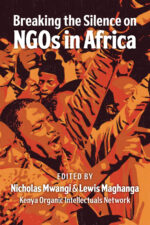
Breaking the Silence on NGOs in Africa
Price range: USD $ 5.00 through USD $ 14.00Select options This product has multiple variants. The options may be chosen on the product page
Breaking the Silence on NGOs in Africa
Price range: USD $ 5.00 through USD $ 14.00Members of the Organic Intellectuals Network are active organizers in the struggle to achieve social justice. They have experienced the contradictions of the NGO discourse and, just like others before them, have found themselves in the struggle versus survival dilemma. To get a clear picture of our contemporary struggles and the despair of NGOs operating in the proletarian movement, comrades decided to reflect, study, and analyze Prof. Issa Shivji’s book Silences in NGO Discourse: The Role and Future of NGOs in Africa. For the authors, these analyses and reflections are based on personal experiences in their day-to-day organizing. In summarizing the authors’ observations regarding the impacts of NGOs in organizing, this book calls into question the fundamental question, ‘why do NGOs exist?’ To answer this question, the authors provide a historical chronology of the resistance in Kenya, Zimbabwe and the rest of Africa, relating those to the subjective factors in existence at every period. Through this, a scientific relationship can be drawn between social movements and NGOs in our current epoch. From their experiences with NGOs, the authors, representing grassroots social movements, highlight the dangers associated with donor funding. Often, donor funding ends abruptly after making people dependent on them, creating severe strain on grassroots organizations. The more one engages with NGOs, the softer one becomes to critique NGOs, particularly in highlighting their relationship to imperialism. Further, NGOs usually help in driving reforms. However, they play no part in revolutionary work. As a result, they merely preserve the present order and help exacerbate the frustrations arising from massive inequality in our society. In the long run, NGOs play a critical role in stifling the development and independence of grassroots social movements. This publication also includes two previously published essays by Prof Issa G Shivji, Silences in NGO Discourse: The Role and Future of NGOs in Africa, &, Reflections on NGOs in Tanzania: What We Are, What We Are Not and What We Ought To Be.
Select options This product has multiple variants. The options may be chosen on the product page -
 Select options This product has multiple variants. The options may be chosen on the product page
The Unfinished Business of Liberation and Transformation: Revisiting The 1958 All-African People’s Conference
USD $ 47.00This book features essays, speeches, and reflections from the 60th-anniversary commemoration of the All-African People’s Conference (AAPC), an epochal event in the history of Africa’s fight for liberation. The four-day conference was a collaboration between the Institute of African Studies, the Trades Union Congress of Ghana, the Socialist Forum of Ghana, Lincoln University, and the Third World Network Africa. The stories, essays, speeches, and poems featured in this book are not simply a reflection of the past – they are a call to action for the present and future generations of Pan‑Africanists. May this book serve as a reminder that our liberation is intertwined with the liberation of others and that we must work together toward building a more just and equitable world. Let us continue to inspire the next generation of Pan-Africanists and keep the spirit of the All‑African People’s Conference alive. The book offers valuable perspectives on Africa’s current predicaments and what a truly liberated Africa can offer to the world.
The Unfinished Business of African Liberation is a path‐breaking collection of proceedings commemorating the 1958 landmark All African People’s Conference. The volume is essential reading for all those interested in pursuing African decolonization and liberation in the 21st century.
— Amina Mama, Professor, Gender, Sexuality & Women’s Studies, University of California, Davis, former Kwame Nkrumah Chair in African Studies at the University of GhanaIt is a must‐read for all who care about the contemporary plight of African people.
— Sylvia Tamale, Decolonial feminist & Professor of Law, School of Law, Makerere University, UgandaThis collection presents critical thinking by a wide spectrum of Pan‐African workers, youth, women, students, intellectuals, businesspeople, activists, academics, and politicians. — Adotey Bing-Pappoe, Senior Lecturer, Department of Economics and International Business, University of Greenwich
Select options This product has multiple variants. The options may be chosen on the product page -

Heroes of the African Revolution Volume 2
USD $ 11.50We made this coloring book in order to expose African children to their authentic history. Malcolm X told us decades ago that we had to take responsibility for our children’s education because he understood that our people had been intentionally robbed of their true history. We can no longer rely on institutions to educate our children and must take it upon ourselves to equip our children with the truth so that they can bring a positive contribution to our people’s struggle for justice and freedom.
In Volume 2 of the coloring book, new African revolutionaries are introduced. Some well-known figures, such as Patrice Lumumba and Amilcar Cabral, but we’ve also brought to light lesser-known freedom fighters, such as Fatima Ahmed Ibrahim of Sudan and Elma Francois of Trinidad and Tobago.We have also introduced some games, such as a word search and a maze, both with a Pan-Afican theme. Finally, we included a glossary (with Swahili translations ) highlighting the kind of vocabulary we wish to instill in our youth -

Heroes of the African Revolution: Colouring Book: Volume 1
USD $ 11.50We made this coloring book in order to expose African children to their authentic history. Malcolm X told us decades ago that we had to take responsibility for our children’s education because he understood that our people had been intentionally robbed of their true history. We can no longer rely on institutions to educate our children and must take it upon ourselves to equip our children with the truth so that they can bring a positive contribution to our people’s struggle for justice and freedom. This book highlights some of the key figures within the struggle to achieve Pan-Africanism which is the total liberation and unification of Africa. All of the brave women and men featured in this book were Pan-Africanists. They understood that people of African descent throughout the world faced the same issues and therefore had to unite in order to overcome those issues. We hope this book can inspire the next generation of African children to become Pan-Africanists and to join the struggle to liberate and unite Africa.
-

Les héros de la révolution africaine Tome 1
USD $ 11.50United African Diaspora est une organisation panafricaine basée à Calgary, au Canada. Nous nous engageons à construire une communauté africaine forte et autonome capable de répondre aux besoins de son peuple et de contribuer à la lutte mondiale pour réaliser le panafricanisme : la libération et l’unification de l’Afrique.
Nous avons réalisé ce livre de coloriage afin d’exposer les enfants africains à leur histoire authentique. Malcolm X nous a dit il y a plusieurs décennies que nous devrons être responsable de l’éducation de nos enfants. Il avait compris que notre peuple est intentionnellement dépossédé de sa véritable histoire. Nous ne pouvons plus compter sur les institutions pour éduquer nos enfants et nous devrons prendre sur nous la responsabilité de leur transmettre la vérité afin qu’ils puissent apporter une contribution positive à la lutte de notre peuple pour la justice et la liberté. Ce livre met en lumière quelques-unes des figures clés de la lutte pour le panafricanisme, c’est-à-dire la libération et l’unification totales de l’Afrique. Toutes les femmes et tous les hommes courageux présents dans ce livre étaient des panafricanistes. Ils ont compris que les personnes descendantes africaines du monde entier étaient confrontées aux mêmes problèmes et qu’elles devaient donc s’unir pour les surmonter. Nous espérons que ce livre inspirera la prochaine génération d’enfants africains à devenir des panafricanistes et à se joindre à la lutte pour la libération et l’unification de l’Afrique.
-

Les héros de la révolution africaine Tome 2
USD $ 11.50United African Diaspora est une organisation panafricaine basée à Calgary, au Canada. Nous nous engageons à construire une communauté africaine forte et autonome capable de répondre aux besoins de son peuple et de contribuer à la lutte mondiale pour réaliser le panafricanisme : la libération et l’unification de l’Afrique.
Nous avons réalisé ce livre de coloriage afin d’exposer les enfants africains à leur histoire authentique. Malcolm X nous a dit il y a plusieurs décennies que nous devrons être responsable de l’éducation de nos enfants. Il avait compris que notre peuple est intentionnellement dépossédé de sa véritable histoire. Nous ne pouvons plus compter sur les institutions pour éduquer nos enfants et nous devrons prendre sur nous la responsabilité de leur transmettre la vérité afin qu’ils puissent apporter une contribution positive à la lutte de notre peuple pour la justice et la liberté. Ce livre met en lumière quelques-unes des figures clés de la lutte pour le panafricanisme, c’est-à-dire la libération et l’unification totales de l’Afrique. Toutes les femmes et tous les hommes courageux présents dans ce livre étaient des panafricanistes. Ils ont compris que les personnes descendantes africaines du monde entier étaient confrontées aux mêmes problèmes et qu’elles devaient donc s’unir pour les surmonter. Nous espérons que ce livre inspirera la prochaine génération d’enfants africains à devenir des panafricanistes et à se joindre à la lutte pour la libération et l’unification de l’Afrique.
-

Bongoman and the Aliens
USD $ 16.25Select options This product has multiple variants. The options may be chosen on the product page
Bongoman and the Aliens
USD $ 16.25There have been a series of mysterious disappearances within Bongoman’s tranquil Eastlands Estate in Nairobi’s urban sprawl. The missing persons reappear days later with no recollection of where they have been and with altered personalities. In the course of his investigations, Bongoman bumps into an alien being who is also looking for him to enlist his services to help in fighting another alien race, building a force to annihilate humankind and take over the earth. Bongoman’s scepticism about the existence of aliens is tested as he finds himself forming an alliance of convenience with a star-hopper from a race that can move through dimensions and journey across space at will. Bongoman and his alien partner find themselves in a desperate race against time as they take on an aggressive race of aliens with seemingly invincible powers as they seek to undo what has been done and rid the world of this super race of invaders. In the war to save the world, the duo has to deal with aliens who have taken over the ‘essence’ of human beings and have mingled with the population. Bongoman must single them out and expel the alien within to save the poor souls.Select options This product has multiple variants. The options may be chosen on the product page -

Banana Girls, The
Price range: USD $ 5.00 through USD $ 20.00Select options This product has multiple variants. The options may be chosen on the product page
Banana Girls, The
Price range: USD $ 5.00 through USD $ 20.00The Banana Girls chronicles 2003 days in the lives of two bosom friends, Rehema and Fatuma, and millions of days in the existence of the banana, the fruit which, eaten either ripe or cooked, the girls at some point determine will be the only solid component of their daily diets. The banana becomes not only the symbol of ideal nutrition but also, by turns, of social engineering and neo-imperialist exploitation. …Rehema and Fatuma are Tanzanians by nationality and brainboxes by genetic coding, with an enduring monopoly of either the first or second position in any examination for which they sit. They excel in Mathematics, Chemistry and Physics particularly and are always the first two to solve any mathematical or scientific challenges that are presented to their successive year groups and, by extension, to readers of the book.
… As the days go by, Rehema and Fatuma abandon junk food forever, they also adopt wholesome tastes in what they watch and what they listen to, and they make a good friend, Alice, who, unlike them, is from a rich family but who is adequately informed to join them as committed activists in the BLF, the Banana Liberation Front. Their activism lands them in jail. All three girls see through the machinations of their own government to oppress their own people and of global capitalism to bring about régime change, the better to sustain a stranglehold over poorer economies and to prop up aptly named ‘banana republics’. One malevolent operator is pointed out by name: he is President Ronald Grump of the United States of America.
Select options This product has multiple variants. The options may be chosen on the product page -

Domains of politics and modes of rule/ Sphères politiques et contrôle étatique (en/fr)
Price range: USD $ 5.00 through USD $ 10.00Select options This product has multiple variants. The options may be chosen on the product page
Domains of politics and modes of rule/ Sphères politiques et contrôle étatique (en/fr)
Price range: USD $ 5.00 through USD $ 10.00This work consists of a brief attempt to orient the study of the neocolonial state in Africa through an assessment of the manner in which it rules its people. It is argued that the state produces different modes of rule by deploying different politics over different parts of the population. In this manner, it can combine a genuinely democratic rule in the image of the West over some while subjecting the majority to colonial forms of domination. Imported political subjectivities from the West and its obsession with human rights discourse are reserved largely for a sphere of civil society in which the right to have rights is conferred upon citizens. In the domains of uncivil society and traditional society, the right to rights is not observed by the state so that different subjectivities, regularly including violence, govern the manner political problems and solutions are addressed both by the state and by people. In consequence, distinct political subjectivities prevail in the conceptualization of popular resistance in all three domains, and it becomes difficult to rally such different concerns and conceptions within an overall anti-neocolonial struggle.
Il s’agit d’une brève tentative d’orienter l’étude de l’État néocolonial en Afrique à travers une évaluation de la manière dont il gouverne son peuple. On soutient que l’État produit différents modes de contrôle étatique en déployant différentes politiques sur différentes parties de la population. De cette manière, il peut combiner une règle véritablement démocratique à l’image de l’Occident sur certains tout en soumettant la majorité à des formes coloniales de domination. Les subjectivités politiques importées de l’Occident et son obsession du discours sur les droits de l’homme sont largement réservées à une sphère de la société civile dans laquelle le droit d’avoir des droits est conféré aux citoyens. Dans les domaines de la société incivile et de la société « traditionnelle », le droit aux droits n’est pas respecté par l’État, de sorte que différentes subjectivités, y compris régulièrement la violence, régissent la manière dont les problèmes politiques et leurs solutions sont abordés à la fois par l’État et par le peuple. En conséquence, des subjectivités politiques distinctes prévalent dans la conceptualisation de la résistance populaire dans chacun des trois domaines, et il devient difficile de rallier des préoccupations et des conceptions aussi différentes au sein d’une lutte anticoloniale nationSelect options This product has multiple variants. The options may be chosen on the product page -

Homestead, Homeland, Home
Price range: USD $ 5.00 through USD $ 19.00Select options This product has multiple variants. The options may be chosen on the product page
Homestead, Homeland, Home
Price range: USD $ 5.00 through USD $ 19.00This is a collection of observations and meditations by Professor Emeritus (York University, Toronto) and philosopher Ato Sekyi-Otu on events, issues, people and ideas culled from recent history and the world, from the US and Canada to Ghana. If there is a persistent thread in these entries, it is this: Virtually all of them testify to the ironic truth of the saying that there is no place like home, no place, that is to say, which looks like the lodestar called home or comes close to approximating its promise of being a just space of human flourishing. Most of the entries are, therefore, harsh, particularly those on the USA. That is because that nation, in his view, has, in recent history, made a major contribution to rendering the world and every homestead we inhabit unhomely and sabotaging attempts to better it. But no one or place is spared, certainly not the author’s native land, Ghana. Canada appears intermittently in these pages in rather fragmentary and contrastive observations. That paucity of comments may be taken to be the complement the author pays to Canada as a place of relative civility and glimmers of decency in a mad and cruel world. It is a short work of predominantly gloomy pictures. But there are a few countervailing images and invocations of hope here and there. There are 166 entries of unequal lengths arranged around 14 headings. These epigrams are contrapuntal variations on the philosopher’s searing imprecation and visionary invocation: unfinished ode, resounding with intermittent fury, to the dawn of human existence set free from all tyrannizing enclosures.
Select options This product has multiple variants. The options may be chosen on the product page -

Politics of Turbulent Waters: Reflections on Ecological, Environmental and Climate Crises in Africa
Price range: USD $ 5.00 through USD $ 20.00Select options This product has multiple variants. The options may be chosen on the product page
Politics of Turbulent Waters: Reflections on Ecological, Environmental and Climate Crises in Africa
Price range: USD $ 5.00 through USD $ 20.00For the past 10 years, the Health of Mother Earth Foundation (HOMEF) has been on the front line of the struggle for environmental justice, climate justice and food sovereignty in Africa and the globe. It has been a decade of non-stop probing of the exploitation of resources, peoples and nations, which has given rise to numerous environmental and climate injustices. HOMEF has had a decade of witnessing and standing against the injustice, the powers and structures (industries and policies) suffocating the rights of the people to a healthy environment and standing with the neglected to take charge of their once self-managed food and agricultural systems. The struggle has necessitated the reawakening of communities’ consciousness to the injustices that besiege them and to their ‘people power’ – power to be utilized in seeking the desired change.mPolitics of Turbulent Waters is a compendium of selected articles in the 36 issues of the Eco-instigator published from 2013 to 2022. The Eco-instigator is yet another tool used by HOMEF to pull together thoughts and reports of activities that advance environmental justice and food sovereignty. Issue by issue, these thoughts and reports flow from within HOMEF and other environmental/climate justice and food sovereignty advocates from across Africa and the globe.They form this rich assemblage (Politics of turbulent waters) to commemorate HOMEF’s 10th anniversary. The title of the book is one of Nnimmo Bassey’s (the director of HOMEF) numerous articles that have graced some pages of the different issues of the Eco-instigator. The article cum title encapsulates the messages that the book intends to convey to you, the reader. It crystallizes the dire condition of Africa and its waters and the power imbalance together with the spatial disposition that plunged the continent into the calamitous environmental situation it faces. It speaks of the politics of economic development and market fundamentalism that avows to maintain the status quo in terms of destructive exploitation of Africa’s marine and other natural resources.
Select options This product has multiple variants. The options may be chosen on the product page -
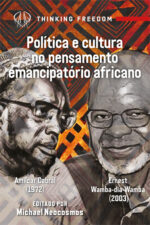
Política e cultura no pensamento emancipatório africano
Price range: USD $ 5.00 through USD $ 9.00Select options This product has multiple variants. The options may be chosen on the product page
Política e cultura no pensamento emancipatório africano
Price range: USD $ 5.00 through USD $ 9.00Description (2132 / 2500)
A atual ausência de uma visão emancipatória para a África está no centro dos nossos problemas políticos relacionados à opressão racial capitalista e colonial. Qualquer tentativa de repensar a emancipação política no continente africano deve ser capaz de localizar uma concepção universal de liberdade no interior das experiências culturais singulares que as pessoas vivem. Quando esteve baseada nas tradições populares, a política emancipatória exibiu tais traços dialéticos, independentemente da maneira específica na qual cada luta pela liberdade foi pensada em diferentes contextos históricos. No entanto, apenas alguns intelectuais militantes compreenderam a importância dessa dialética no pensamento.O presente volume esboça e discute dois pontos de vista particularmente importantes sobre o papel e a relevância da cultura popular na política emancipatória em África. Cada um deles resulta de formas distintas de exploração capitalista e colonialista: o primeiro viu a luz do dia em um contexto colonial, enquanto o segundo é diretamente confrontado pelo estado neocolonial. Todas as políticas emancipatórias são desenvolvidas em confronto com o poder estatal, e todas começam com um processo de discussão e debate através do qual um sujeito coletivo começa a se formar. No continente africano, a construção de tal sujeito político coletivo tem sido informada, de maneira fundamental, pelas culturas populares.
Os dois autores cujos ensaios estão aqui incluídos entenderam isso e colocaram a cultura popular no centro de suas políticas. O primeiro, Amílcar Cabral, aborda o papel central da cultura popular na luta pela independência da Guiné-Bissau nos anos 1970; o segundo, Ernest Wamba-dia-Wamba, aborda a centralidade da cultura popular africana para uma política emancipatória endereçada à atual República Democrática do Congo. Apesar das décadas que os separam, tanto Cabral como Wamba-dia-Wamba desenvolvem, no centro de sua política, uma dialética que ativa os universais da cultura no presente. É essa característica que confere às suas visões uma importância central para o pensamento emancipatório contemporâneo.
Select options This product has multiple variants. The options may be chosen on the product page -
Politics and Culture in African Emancipatory Thought
Price range: USD $ 5.00 through USD $ 15.00Select options This product has multiple variants. The options may be chosen on the product page
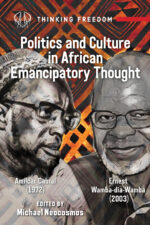
Politics and Culture in African Emancipatory Thought
Price range: USD $ 5.00 through USD $ 15.00The current absence of any emancipatory vision for Africa lies at the heart of our political problems of racial capitalist and colonial oppression. Any attempt to rethink political emancipation on the African continent must be able to locate a universal conception of freedom within singular cultural experiences where people live. Irrespective of the specific manner in which such struggles for freedom were thought within different historical contexts, emancipatory politics always exhibited such a dialectic when it was based within popular traditions. Yet only some militant intellectual leaders understood the importance of this dialectic in thought.
The present volume outlines and discusses two particularly important views concerning the role and importance of popular culture in emancipatory politics in Africa. Each is the product of distinct forms of colonial capitalist exploitation: the former saw the light of day within a colonial context while the latter is directly confronted by the neocolonial state. All emancipatory politics are developed in confrontation with state power, and all begin with a process of discussion and debate whereby a collective subject begins to be formed. The formation of such a collective political subject has been fundamentally informed by popular cultures on the African continent.
The two authors whose essays are included here understood this and posit popular culture at the centre of their politics. The first, Amílcar Cabral, addresses the central role of popular culture in the independence struggle of Guinea Bissau in the 1970s; the second, Ernest Wamba-dia-Wamba, addresses the centrality of African popular culture in an emancipatory politics for the current Democratic Republic of Congo. Despite the distance in time that separates them, both Cabral and Wamba-dia-Wamba develop a dialectics at the core of their politics which activates the universals of culture in the present. It is this that makes their views of central importance to emancipatory thought today.Select options This product has multiple variants. The options may be chosen on the product page
