
-
Islamophobia, Genocide, and Mental Health
This essay was published in April 2026 by Springer Nature Switzerland AG 2026 in the book Islamophobia and Psychiatry, H.S. Moffic et.al. (eds.) https://doi.org/10.1007/978-3-032-16483-4_24 The co-authors of this chapter and the editors of the volume were subsequently notified that senior management at Springer had determined that the chapter would be retracted.
Daraja Press decided that we should not allow corporate publishers to censor important works that challenge their own political prejudices and has decided to publish this as a pamphlet.
The authors describe the impact of Islamophobia on the mental health and wellbeing of the people of Palestine since the founding of the state of Israel. The historical context is described, including the evolution of Islamophobia as a particular expression of the phenomenon of Orientalism as explored by Edward Said, and the role of Islamophobia in the Western ambition to destabilize and colonize the Ottoman Empire. The current situation of genocide in Gaza is analyzed in terms of the use of Islamophobia to facilitate Israeli violence, to delegitimize the Palestinian response, and to influence global discourse on Palestine. Vignettes illustrate the impact of Islamophobia on the mental wellbeing of Palestinians from the perspective of individuals and of the community. Pathways of resilience and resistance within Palestine are suggested, as well as a global framework for mental health based on the principles of justice, public health, and human rights.
-
Mental Health and Human Rights in Palestine
From: USD $ 7.00Select options This product has multiple variants. The options may be chosen on the product pageMental Health and Human Rights in Palestine
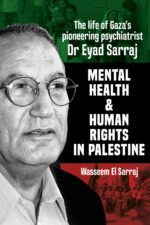
From: USD $ 7.00This is a biography of the life of Dr Eyad El Sarraj, Gaza’s pioneering psychiatrist and founder of the Gaza Community Mental Healthcare Programme, written by his son, Wasseem El Sarraj. It is also a history of Palestine with a focus on Gaza. Eyad’s life was intimately intertwined with Palestine’s struggles so his choices and reactions reflected many of the major historical moments of the last 70 years. The book is an effort to provide a perspective on how the forces around him impacted his life, and how he took control of what he could achieve in an intractable situation. The book is interspersed with Wasseem’s own reflections as a mixed-race Palestinian, and as someone who has lived under occupation in Gaza.
Select options This product has multiple variants. The options may be chosen on the product page