
-
Politics and Culture in African Emancipatory Thought
Price range: USD $ 5.00 through USD $ 15.00Select options This product has multiple variants. The options may be chosen on the product page
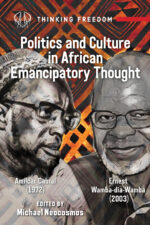
Politics and Culture in African Emancipatory Thought
Price range: USD $ 5.00 through USD $ 15.00The current absence of any emancipatory vision for Africa lies at the heart of our political problems of racial capitalist and colonial oppression. Any attempt to rethink political emancipation on the African continent must be able to locate a universal conception of freedom within singular cultural experiences where people live. Irrespective of the specific manner in which such struggles for freedom were thought within different historical contexts, emancipatory politics always exhibited such a dialectic when it was based within popular traditions. Yet only some militant intellectual leaders understood the importance of this dialectic in thought.
The present volume outlines and discusses two particularly important views concerning the role and importance of popular culture in emancipatory politics in Africa. Each is the product of distinct forms of colonial capitalist exploitation: the former saw the light of day within a colonial context while the latter is directly confronted by the neocolonial state. All emancipatory politics are developed in confrontation with state power, and all begin with a process of discussion and debate whereby a collective subject begins to be formed. The formation of such a collective political subject has been fundamentally informed by popular cultures on the African continent.
The two authors whose essays are included here understood this and posit popular culture at the centre of their politics. The first, Amílcar Cabral, addresses the central role of popular culture in the independence struggle of Guinea Bissau in the 1970s; the second, Ernest Wamba-dia-Wamba, addresses the centrality of African popular culture in an emancipatory politics for the current Democratic Republic of Congo. Despite the distance in time that separates them, both Cabral and Wamba-dia-Wamba develop a dialectics at the core of their politics which activates the universals of culture in the present. It is this that makes their views of central importance to emancipatory thought today.Select options This product has multiple variants. The options may be chosen on the product page -

White Saviorism in International Development: Theories, Practices and Lived Experiences
Price range: USD $ 5.00 through USD $ 22.00Select options This product has multiple variants. The options may be chosen on the product page
White Saviorism in International Development: Theories, Practices and Lived Experiences
Price range: USD $ 5.00 through USD $ 22.00Given the growing interest in understanding the meaning, manifestations, analyses and implications of racism in North/South relations, White Saviorism in International Development seeks to remedy the shortcomings of the development studies literature on the prevalence of White Saviorism in Western development initiatives in the Global South. The volume comprises theoretical chapters, testimonies, stories and lived experiences from 19 contributors from across the Global South. With sensitivity and intelligence, these practitioners and academics create a tapestry that unveils the implicit and explicit forms of White Saviorism in international development.
Select options This product has multiple variants. The options may be chosen on the product page -

Settler Colonialism
Price range: USD $ 5.00 through USD $ 10.00Select options This product has multiple variants. The options may be chosen on the product page
Settler Colonialism
Price range: USD $ 5.00 through USD $ 10.00Settler Colonialism examines the genesis in the USA of the first full-fledged settler state in the world, which went beyond its predecessors in 1492 Iberia and British-colonized Ireland with an economy based on land sales and enslaved African labor, an implementation of the fiscal-military state. Both the liberal and the rightwing versions of the national narrative misrepresent the process of European colonization of North America. Both narratives serve the critical function of preserving the “official story” of a mostly benign and benevolent USA as an anticolonial movement that overthrew British colonialism. The pre-US independence settlers were colonial settlers just as they were in Africa and India or like the Spanish in Central and South America. The nation of immigrants myth erases the fact that the United States was founded as a settler state from its inception and spent the next hundred years at war against the Native Nations in conquering the continent. Buried beneath the tons of propaganda—from the landing of the English “pilgrims” (Protestant Christian evangelicals) to James Fenimore Cooper’s phenomenally popular The Last of the Mohicans claiming settlers’ “natural rights” not only to the Indigenous peoples’ territories but also to the territories claimed by other European powers—is the fact that the founding of the United States created a division of the Anglo empire, with the US becoming a parallel empire to Great Britain, ultimately overcoming it. From day one, as was specified in the Northwest Ordinance, which preceded the US Constitution, the new “republic for empire,” as Thomas Jefferson called the new United States, envisioned the future shape of what is now the forty-eight states of the continental US. The founders drew up rough maps, specifying the first territory to conquer as the “Northwest Territory.” That territory was the Ohio Valley and the Great Lakes region, which was already populated with Indigenous villages and farming communities thousands of years old. Even before independence, mostly Scots Irish settlers had seized Indigenous farmlands and hunting grounds in the Appalachians and are revered historically as first settlers and rebels, who in the mid-twentieth century began claiming indigeneity. Self-indigenizing by various groups of settlers is a recurrent theme in story of settler colonialism, white supremacy, and the history of erasure and exclusion about which I have written elsewhere.
Select options This product has multiple variants. The options may be chosen on the product page -

A Mutiny of Morning: Reclaiming the Black Body from Heart of Darkness
Price range: USD $ 5.00 through USD $ 15.00Select options This product has multiple variants. The options may be chosen on the product page
A Mutiny of Morning: Reclaiming the Black Body from Heart of Darkness
Price range: USD $ 5.00 through USD $ 15.00Nikesha Breeze has taken pages from Joseph Conrad’s Heart of Darkness, taken his words, and forced them to leave his colonized mind. She has made the words her own in poetic form. She illuminates the invisible Black voices inside, a radical, surgical, and unapologetic Black appropriation, at the same time as a careful birthing and spiritual road map. The resulting poems are sizzling purifications, violent restorations of integrity, pain, wound, bewilderment, rage, and, sometimes, luminous generosity. This is a work of Reclamation. The author, Nikesha Breeze, has slowly, page by page, reclaimed the text of the book Heart of Darkness by Joseph Conrad. This racist turn-of-the-19th-century book was pivotal in the continued dehumanization of Black people and in particular of African people, as it painted an image of bestiality on the Congo people and the continent. It is laced with racist imagery and language. The author has reappropriated the book, page by page, making “BlackOut” poetry for each page, isolating methodically the words to create new poems of power and black voice within the text —stealing the language and reappropriating the power.
Select options This product has multiple variants. The options may be chosen on the product page -
MATHARE: An Urban Bastion of Anti-Oppression Struggle in Kenya.
Price range: USD $ 5.00 through USD $ 15.00Select options This product has multiple variants. The options may be chosen on the product page
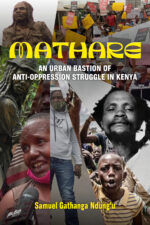
MATHARE: An Urban Bastion of Anti-Oppression Struggle in Kenya.
Price range: USD $ 5.00 through USD $ 15.00History is written by the victors of any war. But what happens when the victors forget to write down their history or omit the cog of the struggle? This is the untold story of Mathare Slum that has never been told to the world: of the role it played in anti-colonial struggle and the planning ground for the Mau Mau struggle which culminated with the fall of the British Colonial Empire in Kenya in the midnight of December 12th 1963. Mathare has also played a critical role in anti-oppression struggle against the four regimes that we’ve had since independence and continues to do so up to date. This history has not been documented and has only been done piecemeal. This has overtime eroded the rich history of Mathare and led to a distorted history of once a planning ground and a bulwark of Kenya Land and Freedom Army (KFLA). The current generation are not cognizant with the critical role Mathare played in the independence of our country. Presently, Mathare is majorly known for all the negative reasons and its proximity to Mathari Mental Hospital has contorted its image to the outside world. My story tries to re-tell the history of Mathare from an informed insider perspective by threading the struggles from the colonial era to the present day and the role it has played in agitating for social justice. My story brings to view the past history of this informal settlement in the heart of Nairobi, the present struggle and the promising future through community organizing.
Select options This product has multiple variants. The options may be chosen on the product page -
International Brigade Against Apartheid: Secrets of the People’s War That Liberated South Africa
USD $ 27.00Select options This product has multiple variants. The options may be chosen on the product page
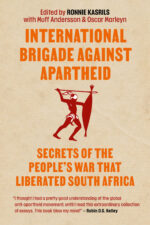
International Brigade Against Apartheid: Secrets of the People’s War That Liberated South Africa
USD $ 27.00We hear for the first time from the internationalist secretly working for the ANC’s armed wing, Umkhonto we Sizwe (MK), in the struggle to liberate South Africa from apartheid rule. They acted as couriers, provided safe houses in neighbouring states and within South Africa, helped infiltrate combatants across borders, and smuggled tons of weapons into the country in the most creative ways. Driven by a spirit of international solidarity, they were prepared to take huge risks and face great danger. The internationalists reveal what motivated them as volunteers, not mercenaries: they gained nothing for their endeavours save for the self-esteem in serving a just cause. Against such clandestine involvement, the book includes contributions from key people in the international Anti-Apartheid Movement and its public mobilisation to isolate the apartheid regime. These include worldwide campaigns like Stop the Sports Tours, boycotting of South African products and black American solidarity. The Cuban, East German and Russian contributions outlined those countries’ support for the ANC and MK. The public, global Anti-Apartheid Movement campaigns provide the dimensions from which internationalists who secretly served MK emerged. Edited by Ronnie Kasrils. First published by Jacana Media (Pty) Ltd in 2021, ISBN: 978-1-4314-3202-8, this Daraja Press edition is available in North America and East Africa.
Select options This product has multiple variants. The options may be chosen on the product page -

Revolutionary Hope vs Free-Market Fantasies Keeping the Southern Africa Liberation Struggle Alive: Theory, Practice, Context
Price range: USD $ 5.00 through USD $ 20.00Select options This product has multiple variants. The options may be chosen on the product page
Revolutionary Hope vs Free-Market Fantasies Keeping the Southern Africa Liberation Struggle Alive: Theory, Practice, Context
Price range: USD $ 5.00 through USD $ 20.00John S. Saul, born and first educated in Toronto, Canada, moved to Tanzania almost sixty years ago and, since then, has also taught in Mozambique and South Africa as well as back in Canada at York University. In Tanzania, he discovered the centrality of the war for freedom from white rule and global capitalist dictate then taking shape further south – in Mozambique, Angola, Zimbabwe, Namibia and South Africa. Both his scholarly interest and his activist bent drew him to support and to seek to better understand the struggles in these nations-in-the-making, a political choice that now culminates in a final trilogy of books under the general title, The Rethinking Southern African Liberation Trilogy. The first volume of this trilogy, On Building a Social Movement: The North American Campaign for Southern African Liberation Revisited, was published by Africa World Press / Fernwood Books (2017). The present book is the second in that trilogy, with a third volume entitled Class, Race and the Thirty Years War for Southern African Liberation – A History set to conclude his work to be published by Cambridge University Press in 2022.
Here, Saul’s extended first chapter lays out the broad premises of the thinking that has guided his endeavours, ideas that takes the core reality of economic production and exploitation centrally but that are alive to the tangible impact on outcomes of a wide range of other social realities, including class, race, gender, sexuality, nationalism, the environment, politics and the state. A second section covers the essential unity of theory and political practice that underpins Saul’s findings. And a third and final section paints illuminating pictures of some core aspects of the diverse regional contexts — sites of both recolonization and continuing struggle, and all contexts whose trajectories will be further explored in his forthcoming third volume.
Select options This product has multiple variants. The options may be chosen on the product page -

Finding A Voice
USD $ 20.00First published in 1978, and winning the Martin Luther King Memorial Prize for that year, Finding a Voice established a new discourse on South Asian women’s lives and struggles in Britain. Through discussions, interviews and intimate one-to-one conversations with South Asian women, in Urdu, Hindi, Bengali and English, it explored family relationships, the violence of immigration policies, deeply colonial mental health services, militancy at work and also friendship and love. The seventies was a time of some iconic anti-racist and working-class struggles. They are presented here from the point of view of the women who participated in and led them.
This new edition includes a preface by Meena Kandasamy, some historic photographs, and a remarkable new chapter titled ‘In conversation with Finding a Voice: 40 years on’ in which younger South Asian women write about their own lives and struggles weaving them around those portrayed in the book.
-
Lines of Fire (2nd Edition)
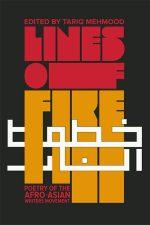
USD $ 60.00Lines of Fire: Recovering the Lost Arsenal of Anti-Colonial Poetry
Born in Tashkent , forged in clandestine presses, and echoing in today’s streets—this is the recovered front line of a global poetic resistance.
In 1958, at the Afro-Asian Writers’ Conference in Tashkent, a 90-year-old W.E.B. Du Bois stood before the decolonizing world and declared: “I am an American—I am an African.” It was a moment of radical, transnational self-definition.
From that conference emerged a literary movement and its journal, The Call—a direct line for poets from Algiers to Hanoi, Cairo to Beijing, to speak to one another, bypassing the languages and borders of their colonial masters. Though the movement later fractured under Cold War pressures, its two wings—The Call and the Soviet-backed Lotus—remained united in their stand against Zionism, racism, and empire.
Their poetry, often crafted under threat of torture, exile, and surveillance, became a clandestine weapon. Some of it was passed hand to hand, read aloud in underground meetings, and chanted at mass gatherings from Delhi to Ramallah, Cape Town to Gaza.
Now, for the first time, this vital corpus is restored. Lines of Fire, edited by Tariq Mehmood—former leading defendant in the landmark Bradford 12 case and now professor at the American University of Beirut—gathers these living weapons into a single, incendiary anthology. In an age of resurgent fascism and genocide, these voices speak with renewed, unyielding force: their anguish, rage, love, and hope are as urgent now as the day they were penned.
Why This Book Is Essential:
- A Lost Canon, Recovered: Features seminal, often inaccessible work by giants like Mahmoud Darwish, Faiz Ahmed Faiz, Leopold Senghor, Adunis, , Ousmane Sembène, and dozens more from across Africa and Asia.
- Drawn from Rare Sources: Poems curated from scarce issues of The Call and Lotus, long out of print and hidden in archives.
- A Groundbreaking Scholarly Frame: Includes a major introduction tracing the movement’s history, its surveillance by the CIA, the impact of the Sino-Soviet split, and a radical re-examination of solidarity.
- Built to Last & Teach: Published in archival-quality hardcover for libraries, scholars, and lifelong activists. An indispensable text for courses in Decolonial Studies, Global South Literatures, Cold War History, and Postcolonial Poetry.
A Call to Arms for a New Generation.
Edited by Tariq Mehmood, this collection includes poems by:
Salah Abdel Sabour (1931-1981, Ali Ahmad Said Esber, also known as Adunis (1930- ), Mulk Raj Anand (1905-2004), Anar Rasul oghlu Rzayef (1938- ), Nobuo Ayukawa (1920-1986), Fadhil al-Azzawi (1940- ), Abd Al-Wahhab al-Bayati (1926-1999), Mahim Bora (1917- ), Bernard Binlin Dadié (1916- ), Mahmoud Darwish (1942-2008), Osamu Dazai (1909-1948), Mário Pinto de Andrade (1928-1990), D.B. Dhanapala (1905-1971), Mohammed Dib (1920-2003), Gevorg Emin (1918-1998), Sengiin Erdene (1929-2000), Faiz Ahmed Faiz (1911-1984), Rasul Gamzatov (1923-2003), Daniil Granin (1919- ), Colette Anna Gregoire, better known as Anna Greki (1931-1966), Malek Haddad (1927-1978), Pham Ba Ngoan, better known by his pen name Thanh Hai (1930-1980), Buland al-Haidari (1926-1996), Suheil Idris (1925-2008), Yusuf Idris (1927-1991), Fazil Iskander (1929- ), Zulfiya Isroilova (1915-1996), Ali Sardar Jafri (1913-2000), Ghassan Kanafani (1936-1972), Edward al-Kharrat (1926- 2015), Hajime Kijima (1928-2004), Mazisi Kunene (1930-2006), Alex La Guma (1925-1985), U Gtun Kyi, better known by his pen name Minn Latt Yekhaun (1925-1985), Abdul Hayee better known by his pen name Sahir Lundhianvi (1921-1980), Zaki Naguib Mahmoud (1905-1993), Nazik Al-Malaika (1923-2007), Mouloud Mammeri (1917-1989), Yuri Nagibin (1920-1994), Sergey Narovchatov (1919-1981), Dashdorjiin Natsagdorj (1906-1937), Hiroshi Noma (1915-1991), Gabriel jibaba Okara (1921- ), Amrita Pritam (1919-2005), Jean-Joseph Rabearivelo (1901-1937), Richard Rive (1931-1989), Rady Saddouk (1938-2010), Badr Shakir al-Sayyab (1926-1964), Ousmane Sembene (1923- 2007), Leopold Sedar Senghor (1906-2001), Yusuf al-Sibai (1917-1978), Fadwa Tuqan (1917-2003), Sonomyn Udval (1921-1991), Ramses Younan (1913-1966), and Tawfiq Ziad (1929-1994).
Listen to our conversation with Tariq Mehmood here:
#AfroAsianWritersMovement #Lotusjournal #TheCalljournal #NonAlignedMovement #BandungConference #Tashkent1958 #ColdWarculturalhistory #SinoSovietsplit #antiimperialism #anticolonialpoetry #resistanceliterature #resistancepoetry #revolutionarysolidarity #antiracism #antiZionism #settlercolonialism #racialviolence #genocide #GlobalSouthliterature #Africanpoetry #Asianpoetry #Arabpoetry #Palestinianliterature #SouthAsianliterature #AfricanLiterature #Arabpoets #Africanwriters #AfroAsiansolidarity #WEBDuBois #politicalpoetry #20thcenturypoetry
