

Mugo Theuri was born on February 2, 1953, at Gathuthi village, Tetu sub-county, Nyeri county. This was during Kenya’s state of emergency—a turbulent moment that imprinted itself on his political imagination. His father, Allan Theuri Wanderi, who served briefly as an assistant chief for Thegenge Location, stood at the uneasy intersection between colonial authority and African society, a contradiction that would later shape Mugo’s reflections on power and liberation.
A self-taught intellectual who never attended university, Theuri’s political and ideological convictions were sharpened during imprisonment in the Moi era, when he was jailed for belonging to a clandestine socialist organisation. Those years of confinement deepened his commitment to socialism, self-determination, and cultural decolonisation—themes that have since defined his writing and activism.
He worked as a journalist for nearly three decades, retiring as Editor-in-Chief of The People, a national newspaper that gave voice to Kenya’s democratic struggles. His long engagement with public discourse honed his understanding of how words and ideas can shape political consciousness.
Theuri’s memoir, Threads of Time: Torture, Imprisonment and a Quest for Social Justice (Vita Books, 2023), recounts his experiences of repression and endurance, forming the foundation for the ideas explored in his subsequent works.
In Drumbeats of a Rising Sun: Decolonising Africa’s Political Imagination (2025), Theuri builds on that foundation to examine how colonialism fractured Africa’s systems of meaning and how culture can once again serve as the basis for socialist renewal.
His books are part of a lifelong project to reimagine freedom not as an event of the past, but as a living cultural process—one that begins in memory, matures in solidarity, and endures through collective struggle.
-
 Select options This product has multiple variants. The options may be chosen on the product page
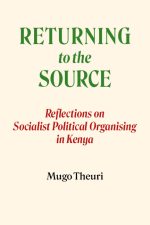
Returning to the Source
Returning to the Source offers a bold and critical examination of Kenya’s political evolution, tracing how colonial rule laid the groundwork for an exclusionary democracy that persists today. The book dissects the contradictions at the heart of the nation’s post-independence politics—from elite handshakes and voter cynicism to the repeated stalling of leftist organising. Moving beyond conventional histories, the author explores why socialist movements in Kenya have struggled to gain traction, examining internal rivalries, caution, and the lingering shadows of figures like Jaramogi Oginga Odinga and the banned Kenya People’s Union (KPU). The book also sheds light on the complex, contradictory unity among leaders such as Kenyatta, Mboya, and Odinga, and argues for a politics based on listening and moral authority rather than raw power. Crucially, Returning to the Source confronts the erasure of women from political memory and the patriarchal shackles that continue to limit liberation. It calls for localising heroism and recovering indigenous political intelligence as essential tools for rebuilding genuine socialist organising. By recovering erased histories and championing local heroes, the book offers both a critique and a path forward—urging a return to listening, collective action, and a more inclusive, transformative politics for Kenya and beyond.
The author is a Kenyan political thinker, organiser, and scholar whose work sits at the intersection of history, socialist theory, and grassroots mobilisation. Drawing on decades of engagement with social movements and a deep commitment to recovering suppressed narratives, they bring both academic rigour and lived political experience to the page. Having themselves been imprisoned and tortured for their political beliefs, the author writes not from abstract detachment but from the brutal reality of state repression. This personal history of surviving state violence infuses every chapter, lending the book an urgent moral weight and an unflinching honesty. Their writing challenges conventional hero worship and instead centres collective action, indigenous intelligence, and the often-overlooked roles of women and local figures in liberation struggles. Returning to the Source is the culmination of a lifelong commitment forged in resistance—understanding why progressive change in Kenya has repeatedly faltered, and how it might yet be revived through courage, listening, and solidarity.
1. How Colonialism Shaped an Exclusionary Democracy, 19
2, The Nationalist Inheritance and Its Blind Spots, 33
3, Democracy: Handshakes, Elite Pacts, Voter Cynicism, 44
4, Why Leftist Organising in Kenya Keeps Stalling, 69
5, Politics of Hesitation, Caution, and Internal Rivalry, 86
6, Lessons from Kenya’s Socialist Movements, 100
7, Challenges of Socialist Organising after Jaramogi’s KPU, 113
8, The Place of Indigenous Political Intelligence in Organising, 123
9, The Contradictory Unity: Kenyatta, Mboya and Odinga, 135
10, Leadership as Listening: Moral Authority Vs. Power, 146
11, The Erasure of Women from Political Memory, 158
12, Liberating Women from the Shackles of Patriarchy, 179
13, Localising Liberation Heroism to Rescue Erased Histories, 194
14, Local Heroes and the Struggle for Socialist Organising, 221
Bibliography, 240
About the Author, 251Select options This product has multiple variants. The options may be chosen on the product page