ONLY AVAILABLE IN EASTERN AND SOUTHERN AFRICA
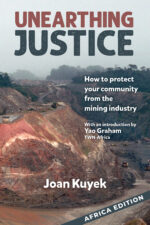
We are pleased to announce that Daraja Press will soon be making Unearthing Justice, originally published by Between The Lines, available in Africa through our partners at Zand Graphics Ltd (throughout East Africa and the Horn) and Sherwood Books (South Africa, Namibia, Botswana, Lesotho, Mozambique and Swaziland).
Originally published in 2019, this new edition has an Introduction by Yao Graham, TWN-Africa. The author, Joan Kuyek, is a community-focused mining analyst and organizer living in Ottawa. She was the founding National Co-ordinator of MiningWatch Canada from 1999–2009 and continues to do work for MiningWatch and for a number of communities affected by mining.
The mining industry continues to be at the forefront of colonial dispossession around the world. It controls information about its intrinsic costs and benefits, propagates myths about its contribution to the economy, shapes government policy and regulation, and deals ruthlessly with its opponents.
Brimming with case studies, anecdotes, resources, and illustrations, Unearthing Justice exposes the mining process and its externalized impacts on the environment, Indigenous Peoples, communities, workers, and governments. But, most importantly, the book shows how people are fighting back. Whether it is to stop a mine before it starts, to get an abandoned mine cleaned up, to change laws and policy, or to mount a campaign to influence investors, Unearthing Justice is an essential handbook for anyone trying to protect the places and people they love.









Joachim Zeller
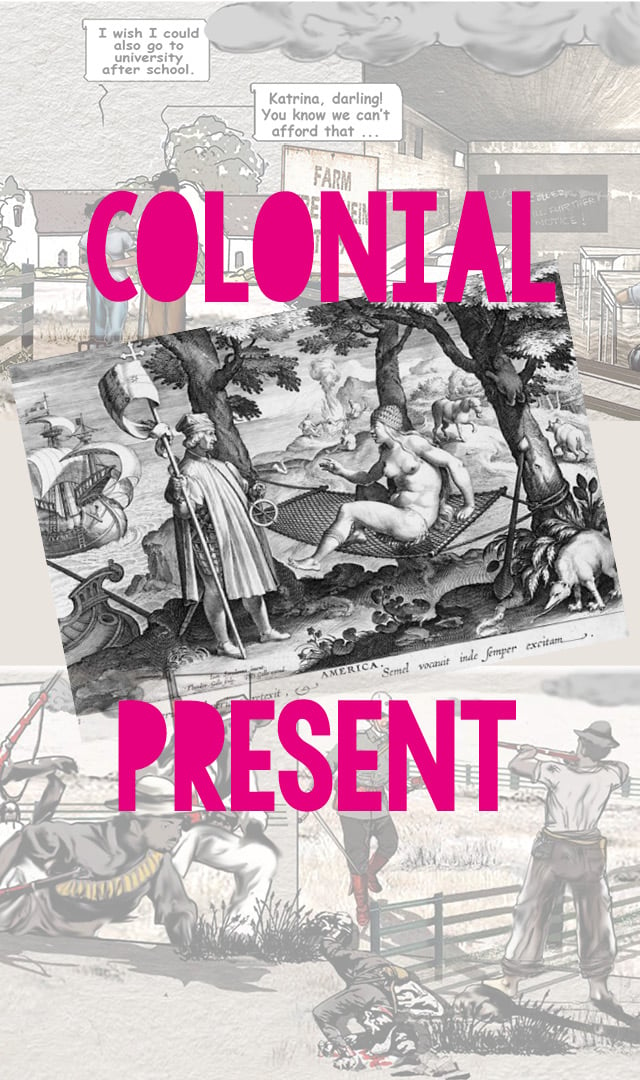
The collaborative anthology focuses on the profound inequalities and injustices as a result of “1492”. The authors and artists look closely and stumble upon the violence resulting from the colonial past, which is inherent in global inequality. Lights are being topped the coloniality of our everyday life today. At the same time, reference is made to the decolonializing potential of the everyday struggles of activists. The detailed introduction explains the postcolonial approach of the book. The collaboration on the artistic level, through dialogue and solidarity, has given hope, it says. Last but not least, the non-profit project sees itself as a contribution to the commitment to development education. A literature list in the appendix rounds off the volume. The moving “Episodes from a Colonial Present” must not be missing in any postcolonial library! Joachim Zeller https://www.iz3w.org/artikel/rezension-zeller-episodes-colonial-present-bendix
CLIP-Editorial
In nine stories, (post)colonial conditions are linked to the personal experiences of the authors and the historical conditions of colonial life are made transparent. This is what the story is about the story of tracking trauma. The German Genocides at Home and Abroad, the complexity demanded by the FES and illustrated, as the Nama groups changed alliances in connection with the German colonial aggression: “The Witbooi (/Khowesin) initially fought against the Ovaherero, then closed peace and fought side by side with the Ovaherero under German command against other peoples. 43). An explanatory text states: “Today, 70 percent of the private land belong to a few thousand whites, most of which are German-speaking farmers” (p. 45). They wanted a German version in all waiting rooms of our perpetrator country. https://www.cilip.de/2024/12/05/literatur-78/