

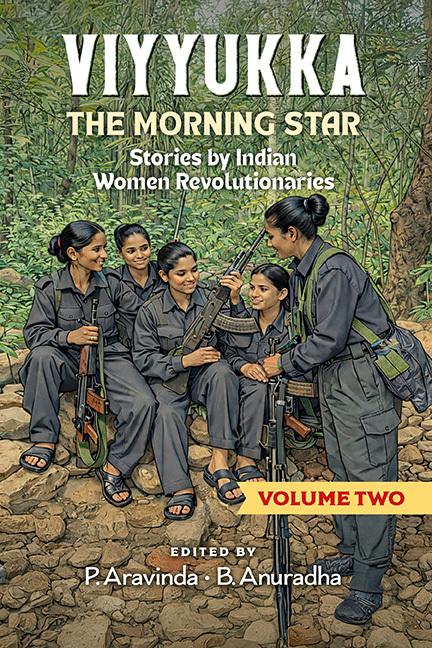
Viyyukka – The Morning Star (Vol 2)
Voices of India's Women Revolutionaries
Co-publisher:Revolutionary Writers Association
Categories: Asia, Biography, Colonialism, Feminism, India
Edited by P. Aravinda and B. Anuradha
This second volume of Viyyukka continues the powerful anthology of stories written by women revolutionaries in India’s Maoist movement, translated from Telugu to English. The collection brings together narratives penned by guerrilla soldiers who document their lived experiences within the revolutionary struggle, offering rare insights into the intersection of armed resistance, gender politics, and Adivasi community life.
The stories span four decades of revolutionary movement history, capturing both tactical engagements and intimate human moments—love, loss, camaraderie, and daily existence in guerrilla squads. What distinguishes this volume is the inclusion of autobiographical sketches by Adivasi women, narrated in their own tongues, detailing the circumstances that led them to become guerrillas. These first-person accounts reveal how poverty, land dispossession, state repression, and patriarchal violence converge to shape revolutionary consciousness.
Set primarily in the Dandakaranya forest region spanning multiple Indian states, the narratives illuminate the movement’s efforts to build alternative structures of governance through Janatana Sarkars (people’s governments), which implemented collective farming, education, healthcare, and resistance to mining corporations. The stories confront the brutal reality of state counter-insurgency operations including Salwa Judum and Operation Green Hunt, while celebrating the resilience of women who constitute nearly half the guerrilla army.
The collection demonstrates how women revolutionaries perform multiple roles—soldiers, writers, historians, doctors, and teachers—documenting their own history while fighting for land, dignity, and self-determination. These are not conventional fictions but testimonies written under extreme duress, smuggled across regions and preserved against overwhelming odds, offering a window into one of India’s most significant contemporary resistance movements.
This is a powerful and timely book. Reading Viyyukka is to encounter history in its most urgent form: not as abstract doctrine, but as the lived, written, and too-often silenced testimony of women for whom the pen was as vital as the gun. This anthology does not simply add voices to a historical record; it fundamentally questions the record itself. By foregrounding the female guerrilla imaginary—with its profound complexities of comradeship, grief, motherhood, and even the critique of revolutionary justice—these stories exceed the boundaries of political propaganda to become essential documents of human endurance and creativity. In a time when their politics is declared defeated, the women of Viyyukka remind us that some struggles are not measured by victory alone, but by the indestructible insistence on bearing witness. — Sharmila Purkayastha, independent researcher, New Delhi
ISBN Print: 9781997742272
Publication Date: March 2026
Page Count: 302
Binding Type: Soft cover
Trim Size: 6in x 9in
Language: English
USD $ 26.00
| Book Format | Print Book, PDF |
|---|
Customer Reviews
There are no reviews yet.
Only logged in customers who have purchased this product may leave a review.
Related products
-
MATHARE: An Urban Bastion of Anti-Oppression Struggle in Kenya.
USD $ 5.00 USD $ 15.00Price range: USD $ 5.00 through USD $ 15.00Select options This product has multiple variants. The options may be chosen on the product page
MATHARE: An Urban Bastion of Anti-Oppression Struggle in Kenya.
USD $ 5.00 USD $ 15.00Price range: USD $ 5.00 through USD $ 15.00History is written by the victors of any war. But what happens when the victors forget to write down their history or omit the cog of the struggle? This is the untold story of Mathare Slum that has never been told to the world: of the role it played in anti-colonial struggle and the planning ground for the Mau Mau struggle which culminated with the fall of the British Colonial Empire in Kenya in the midnight of December 12th 1963. Mathare has also played a critical role in anti-oppression struggle against the four regimes that we’ve had since independence and continues to do so up to date. This history has not been documented and has only been done piecemeal. This has overtime eroded the rich history of Mathare and led to a distorted history of once a planning ground and a bulwark of Kenya Land and Freedom Army (KFLA). The current generation are not cognizant with the critical role Mathare played in the independence of our country. Presently, Mathare is majorly known for all the negative reasons and its proximity to Mathari Mental Hospital has contorted its image to the outside world. My story tries to re-tell the history of Mathare from an informed insider perspective by threading the struggles from the colonial era to the present day and the role it has played in agitating for social justice. My story brings to view the past history of this informal settlement in the heart of Nairobi, the present struggle and the promising future through community organizing.
Select options This product has multiple variants. The options may be chosen on the product page -

Decolonization and Afro-Feminism
USD $ 10.00 USD $ 30.00Price range: USD $ 10.00 through USD $ 30.00Select options This product has multiple variants. The options may be chosen on the product page
Decolonization and Afro-Feminism
USD $ 10.00 USD $ 30.00Price range: USD $ 10.00 through USD $ 30.00In Decolonization and Afro-Feminism, Sylvia Tamale presents a powerful and urgent call for Africa’s intellectual, cultural, and political liberation through an Afro-feminist lens. The book critically examines how colonialism has deeply entrenched systems of oppression—based on race, gender, sexuality, class, and knowledge production—and argues that true decolonization requires more than political independence; it demands a radical rethinking of African identities, histories, and futures.
Tamale challenges Eurocentric and patriarchal frameworks that continue to dominate African societies, institutions, and academia. She explores themes such as:
-
The coloniality of gender and sexuality, using case studies like Caster Semenya to expose how Western norms pathologize African bodies.
-
The importance of intersectionality in understanding overlapping systems of oppression.
-
The role of Afro-ecofeminism in reconnecting African ecological wisdom with social justice.
-
The need to decolonize African academia, law, and family structures to recenter Indigenous knowledge and epistemologies.
-
The potential of Ubuntu as a framework for justice, community, and relationality.
The book is both a scholarly critique and a visionary roadmap, emphasizing that decolonization must be a feminist, inclusive, and holistic project—one that reclaims Africa’s dignity, autonomy, and intellectual sovereignty.
Written with clarity and passion, Decolonization and Afro-Feminism is essential reading for students, activists, scholars, and anyone committed to understanding and advancing Africa’s liberation in the 21st century.
Select options This product has multiple variants. The options may be chosen on the product page -
-

Settler Colonialism
USD $ 5.00 USD $ 10.00Price range: USD $ 5.00 through USD $ 10.00Select options This product has multiple variants. The options may be chosen on the product page
Settler Colonialism
USD $ 5.00 USD $ 10.00Price range: USD $ 5.00 through USD $ 10.00Settler Colonialism examines the genesis in the USA of the first full-fledged settler state in the world, which went beyond its predecessors in 1492 Iberia and British-colonized Ireland with an economy based on land sales and enslaved African labor, an implementation of the fiscal-military state. Both the liberal and the rightwing versions of the national narrative misrepresent the process of European colonization of North America. Both narratives serve the critical function of preserving the “official story” of a mostly benign and benevolent USA as an anticolonial movement that overthrew British colonialism. The pre-US independence settlers were colonial settlers just as they were in Africa and India or like the Spanish in Central and South America. The nation of immigrants myth erases the fact that the United States was founded as a settler state from its inception and spent the next hundred years at war against the Native Nations in conquering the continent. Buried beneath the tons of propaganda—from the landing of the English “pilgrims” (Protestant Christian evangelicals) to James Fenimore Cooper’s phenomenally popular The Last of the Mohicans claiming settlers’ “natural rights” not only to the Indigenous peoples’ territories but also to the territories claimed by other European powers—is the fact that the founding of the United States created a division of the Anglo empire, with the US becoming a parallel empire to Great Britain, ultimately overcoming it. From day one, as was specified in the Northwest Ordinance, which preceded the US Constitution, the new “republic for empire,” as Thomas Jefferson called the new United States, envisioned the future shape of what is now the forty-eight states of the continental US. The founders drew up rough maps, specifying the first territory to conquer as the “Northwest Territory.” That territory was the Ohio Valley and the Great Lakes region, which was already populated with Indigenous villages and farming communities thousands of years old. Even before independence, mostly Scots Irish settlers had seized Indigenous farmlands and hunting grounds in the Appalachians and are revered historically as first settlers and rebels, who in the mid-twentieth century began claiming indigeneity. Self-indigenizing by various groups of settlers is a recurrent theme in story of settler colonialism, white supremacy, and the history of erasure and exclusion about which I have written elsewhere.
Select options This product has multiple variants. The options may be chosen on the product page -
Memoirs of a Woman Survivor of the First Year of the Gaza Holocaust
USD $ 7.99 USD $ 15.00Price range: USD $ 7.99 through USD $ 15.00Select options This product has multiple variants. The options may be chosen on the product page
Memoirs of a Woman Survivor of the First Year of the Gaza Holocaust
USD $ 7.99 USD $ 15.00Price range: USD $ 7.99 through USD $ 15.00Stop press
We have just learned that this book has won a prize from the Eyelands Book Awards https://eyelandsawards.com/2025/12/30/2025-prize-grand-prize-winners/
Congratulatons Njoud Salem!!
These memoirs bear witness to the harrowing reality of survival during the devastating war on Gaza. Through vivid personal narratives, they capture the daily struggle for existence—the scarcity of food and water, the constant threat of bombardment, and the profound psychological trauma. Yet, they delve far deeper than mere physical survival, exploring the profound wounds of displacement: the heartbreak of leaving behind a home, a street, a neighborhood, and the irreplaceable fragments of a life forever shattered.
The pages reveal families huddled in schools-turned-shelters, sharing morsels of bread and whispering prayers for a safe dawn. This collection is both a testament and an act of resistance. It refuses to let the world reduce human beings to mere statistics, insisting instead on honoring every story, every face, and every name. It bears witness not only to the destruction but also to the unbroken spirit of a people determined to live, dream, and rise again.
While rooted in immense suffering, these narratives are also profound meditations on dignity, love, and an unshakable will to persevere. At once personal and collective, they amplify the voices of a generation too often silenced by conflict, posing urgent questions about justice, memory, and the future. They ensure these essential stories are never buried beneath rubble or lost to cold statistics.
In the midst of fire and fear, these words declare: “We are still here. We remember.” This act of testimony—to feel, to survive, and to hold onto love when the world offers none—becomes the most honest act of living. Through these pages, the reader is invited not only into a world of unimaginable hardship but also into the profound depths of human endurance, the richness of Arab culture, and the unwavering faith that guides a people forward.
Select options This product has multiple variants. The options may be chosen on the product page -
Some Of Us Are Brave (Vol 2): Interviews and Conversations with Sistas in Life and Struggle
USD $ 5.00 USD $ 23.00Price range: USD $ 5.00 through USD $ 23.00Select options This product has multiple variants. The options may be chosen on the product page
Some Of Us Are Brave (Vol 2): Interviews and Conversations with Sistas in Life and Struggle
USD $ 5.00 USD $ 23.00Price range: USD $ 5.00 through USD $ 23.00A society born of white supremacy and patriarchy must, by definition, ignore the voices of Black women. We know that unfortunately, such an attitude will also naturally seep into every stratum of that society
Part of the contribution to correct that was the centering and airing of Black women’s voices through Some of Us Are Brave: A Black Women’s Radio Program that aired on Pacifica’s Los Angeles radio station (KPFK) from 2003 until 2011.
The program covered a myriad of issues by amplifying the voices of a broad cross-section of Black women. Some of those voices have been preserved here in this volume. In addition to capturing various moments in time with a variety of women, this is also a means of taking the intellectual production of and about Black women out of the hands of institutions that are both fundamentally anti-Black and anti-woman.
Volume 1 contains interviews under the headings The Shoulders on Which We Stand and Black Lives Have Always Mattered.
Volume 2 covers Black Women’s Health, Bruthas on Sistas, and Sistas in Struggle.
Select options This product has multiple variants. The options may be chosen on the product page -
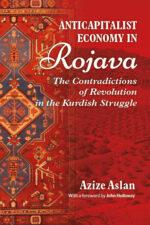
Anticapitalist Economy in Rojava: The Contradictions of Revolution in the Kurdish Struggles
USD $ 5.00 USD $ 22.00Price range: USD $ 5.00 through USD $ 22.00Select options This product has multiple variants. The options may be chosen on the product page
Anticapitalist Economy in Rojava: The Contradictions of Revolution in the Kurdish Struggles
USD $ 5.00 USD $ 22.00Price range: USD $ 5.00 through USD $ 22.00This book looks at the anti-capitalist economy and the organization of social relations in the context of the revolution and autonomy of Rojava (Kurdistan-Syria). It questions both the limitations and the historical problems of the phenomenon of revolution, and the conflicts and contradictions that emerge in this process. It also draws from the conflicts and contradictions the author has consistently felt as a “political subject” who wants to change the world, especially through her experience in the Kurdish struggle and the Kurdish Movement. For this reason, every question she raises and attempts to answer in this book—about the Kurds, Rojava, and the world in general, involves what she says is her own subjectivity.
The idea and dreams of revolution have existed since humans created systems of domination. Indeed, revolution, meaning the liberation from systems of domination, has undoubtedly been one of the most discussed subjects in history. There have been moments when the possibility of revolution has been clearer, and there have also been certain agreements on what it is and how to get there, but it has never been something completely definable. This continues to be true today. This book does not intend to define this great phenomenon, rather it looks at the revolutionary practices that create emancipating realities and embraces revolution as an undefined, contradictory and dynamic process. Although the rulers have traditionally written history, the history of social struggles has been and is still being created by many revolutionary and transformational processes. The future is being shaped based on desired revolutions and the struggles that, in turn, transform their actors, the people. Therefore, the desire and quest of the Kurdish people for liberation from the colonial rule of the nation-states of the Middle East—the subject of this book—has always been directly linked to the phenomenon of revolution.Select options This product has multiple variants. The options may be chosen on the product page -

International Brigade Against Apartheid: Secrets of the People’s War That Liberated South Africa
USD $ 27.00Select options This product has multiple variants. The options may be chosen on the product page
International Brigade Against Apartheid: Secrets of the People’s War That Liberated South Africa
USD $ 27.00We hear for the first time from the internationalist secretly working for the ANC’s armed wing, Umkhonto we Sizwe (MK), in the struggle to liberate South Africa from apartheid rule. They acted as couriers, provided safe houses in neighbouring states and within South Africa, helped infiltrate combatants across borders, and smuggled tons of weapons into the country in the most creative ways. Driven by a spirit of international solidarity, they were prepared to take huge risks and face great danger. The internationalists reveal what motivated them as volunteers, not mercenaries: they gained nothing for their endeavours save for the self-esteem in serving a just cause. Against such clandestine involvement, the book includes contributions from key people in the international Anti-Apartheid Movement and its public mobilisation to isolate the apartheid regime. These include worldwide campaigns like Stop the Sports Tours, boycotting of South African products and black American solidarity. The Cuban, East German and Russian contributions outlined those countries’ support for the ANC and MK. The public, global Anti-Apartheid Movement campaigns provide the dimensions from which internationalists who secretly served MK emerged. Edited by Ronnie Kasrils. First published by Jacana Media (Pty) Ltd in 2021, ISBN: 978-1-4314-3202-8, this Daraja Press edition is available in North America and East Africa.
Select options This product has multiple variants. The options may be chosen on the product page -
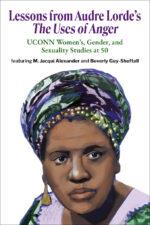
Lessons from Audre Lorde’s The Uses of Anger: UCONN Women’s, Gender, and Sexuality Studies at 50
USD $ 15.00Select options This product has multiple variants. The options may be chosen on the product page
Lessons from Audre Lorde’s The Uses of Anger: UCONN Women’s, Gender, and Sexuality Studies at 50
USD $ 15.00In recent years, we have witnessed renewed calls for women to embrace anger as a source of power. These voices have Lorde’s “The Uses of Anger”, first delivered at the University of Connecticut (UCONN), Storrs, in 1981, to thank for charting an innovative scholarly and poetic terrain that theorizes anger as much more empowering and liberating than conventional discussions of the term typically allow.
Lorde’s essay redefined anger productively, approaching it as an epistemological tool igniting a desire for self and collective liberation. The result was a remarkable critical reflection that laid the groundwork for deconstructing broader systems of oppression, particularly, heteronormativity, heteropatriarchy, institutionalized racial poverty, racial capitalism, and white privilege. Lorde’s essay moved with precision, centering Black women’s struggles in a world built around the use – and abuse – of racialized people subjected to systematic dehumanization.
In their introduction, Jane Anna Gordon, Elva Orozco Mendoza, and Sherry Zane reflect on the inheritance, lessons, and responsibilities that Women’s, Gender, and Sexuality Studies must grapple with if it is to deepen and fulfill its radical mission.
Guided by the imperative to look backward to understand the present and forge a future, the book closes with a sankofic interview with M. Jacqui Alexander and Beverly Guy-Sheftall, conducted by Briona Simone Jones.
Select options This product has multiple variants. The options may be chosen on the product page