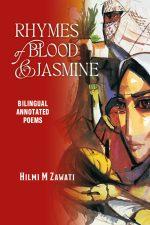
Rhymes of Blood and Jasmine is far more than a bilingual poetry collection; it is a poetic and cultural testimony that merges lyrical beauty with critical depth. Spanning over five decades of creative expression, Dr. Hilmi Zawati weaves verses charged with spiritual and romantic love, exile, memory, resistance, and identity. Symbols like jasmine, oranges, figs, and blood evoke a profound sense of homeland, sacrifice, and longing, forming an emotional tapestry firmly rooted in the Palestinian experience. This is poetry that does not simply describe a reality but embodies it, offering readers an intimate portal into a world shaped by history and sustained by hope.
KEY WORDS
Palestinian resistance poetry, alienation and exile, comparative world literature, translation studies, global resistance literature, Palestinian literature in the diaspora, modern Arabic poetry.
What makes this collection truly singular is its self-translation—a rare act that unites author and translator into a single, cohesive poetic voice. Zawati transcends conventional translation by recreating the essence of his Arabic poems in English with unmatched emotional and stylistic fidelity. His bilingual artistry breathes life into both texts, allowing them to resonate authentically across languages and cultures, ensuring that the nuance and musicality of the original are never lost.
This work speaks to a broad audience of readers, scholars, poets, translators, and students of translation studies, comparative literature, Palestinian history, and Arab diaspora cultures. It asserts translation as a form of cultural sovereignty—rejecting distortion, simplification, and marginalisation—while affirming the enduring presence of Arab poetic tradition within global literature. Rhymes of Blood and Jasmine is not just to be read; it is to be lived. A poetic bridge between languages and worlds, it revives silenced memories and restores the voice of love and homeland with grace, dignity, and truth. This collection is an essential contribution to world literature, offering a poignant reminder of poetry’s power to heal, resist, and connect.
Reviews
“This exquisite poetry collection interweaves Palestinian resistance, exile, love, and universal humanism into a moving tapestry of memory and justice. The spirit of the jurist-poet infuses each verse, where poetry transcends the limits of law to restore moral balance through beauty. With refined free verse, incantatory rhythms, and vivid imagery, Hilmi Zawati’s landmark book transforms stifled revolt into art—a luminous contribution to Palestinian, Arabic, and world literature.” —Daniela Rodica Firanescu, Associate Professor (Retired) of Arabic Studies, Dalhousie University, and poet.
“In this unique bilingual collection of Palestinian resistance poetry, Zawati offers a self-curated, self-translated selection from his poetic works. Rooted in Palestinian themes—love, exile, memory, and longing—his poems blend the personal and universal, linking the Palestinian experience with the broader human condition. The side-by-side presentation of Arabic and English makes this collection valuable for scholars and students of modern Arabic literature, universal comparative literature, and translation studies.” —Ines Aščerić-Todd, PhD, Senior Lecturer in Arabic &Middle Eastern Cultures, School of Literatures, Languages and Cultures, University of Edinburgh.
“‘History,’ said Byron, ‘is the devil’s scripture.’ This dismal fact’s inked in scarlet blood—especially in conflict annals, wherein saints get deemed sadists, while the slain get labelled suicides. Thus, Hilmi M. Zawati pens, for Palestine, plaidoiries—pleadings—because, ‘I returned to you, and you became the graveyard….’ He echoes Wilfred Owen: ‘The Poetry is in the pity.’ His poetry warns, where Justice is not, neither flourishes Freedom nor Love.” —George Elliott Clarke, E.J. Pratt Professor of Canadian Literature, University of Toronto
“A member of the Palestinian Diaspora and a prolific poet, Hilmi M. Zawati’s Rhymes of Blood and Jasmine present an emblematic story of heartbreak and displacement. His inspired verses evoke his peoples suffering coupled with a passionate devotion to ‘the beloved,’ as a free Palestine yet to be realized. This self-translated, dual language collection offers poems teeming with powerful, evocative imagery and lyric language that unflaggingly ‘look forward to freedom’.” —Giovanna Riccio, prize-winning poet, author of Plastic’s Republic.
“Powerful lyrical poems of one of the best poets of the Palestinian resistance. It provides a double witness of the act of creation: the original poems and the translations. With bubbling emotions and perceptive reflections, it offers a bridge between the past and the present, the painful reality and the metaphor of a country raped by colonialists, and forced exiting and the desire to return. Because of his love, he still hopes!” —John P. Portelli, Professor Emeritus, University of Toronto, poet and fiction writer.
“Though dedicated to Palestine, Zawati’s poems embody a universal story of dispossession, love, and longing. They speak from the heart to the heart, confronting belligerence and clinging to a distantbeloved—Palestine. For him, forgetting is a second death, the cruellest exile. Thus, he endures, steadfast, with nothing but his pen, while the only bullet he is willing to fire is its ink.” —Mireille Rebeiz, PhD, SJD, Chair of Middle East Studies & Associate Professor, Dickinson College
“Resistance in Zawati’s poetry extends beyond its immediate political dimension and manifests in various forms, including resistance to oblivion, marginalization, oppression, tyranny, and cultural or linguistic distortion, particularly within the context of poetry translation. Zawati’s engagement in translating his own works introduces an additional creative dimension, reflecting a deep critical awareness of the complexities inherent in conveying poetry and underscoring that translation constitutes a re-creation of the text in another language rather than a literal rendering”. —CAlī cAbd al-Fattāḥ, The Algerian Cultural Journal (August 2026)
“Zawati rejected ‘rigid literalism’ and instead used a methodology based on ‘symbolic precision’ and ‘emotional resonance.’ This approach highlights his dual role as author and translator, granting him a unique ‘interpretative authority’ to bridge Arabic poetic traditions and English-speaking audiences without resorting to ‘Orientalist simplification.’ His self-translation is described as ‘narrative justice’ and ‘moral diplomacy,’ as it resists the ‘westernisation’ of Arabic texts and challenges dominant representational politics that marginalise diverse Palestinian voices”. —Al-Qabas Newspaper (August 23, 2026)
“Rhymes of Blood and Jasmine is more than a translated selection of poetry—it is a poetic proclamation, a critical stance, and a vivid testament to the power of creativity to transcend linguistic, geographical, and symbolic borders. Through his meticulous self-translation, Dr. Hilmi Zawati not only conveys the beauty of his poetry but also takes a firm stand against reductive representation, engaging the political and cultural frameworks that have shaped how Palestinian poetry is received globally. This collection affirms the ability of resistant Palestinian verse to cross boundaries—linguistic, political, and emotional—enriching the global literary scene with a bilingual Arabic voice that remains true to its singular soul”. —Nada Chaddad, PhD., Addustour Newspaper (September 4th, 2026)\





Daraja Press
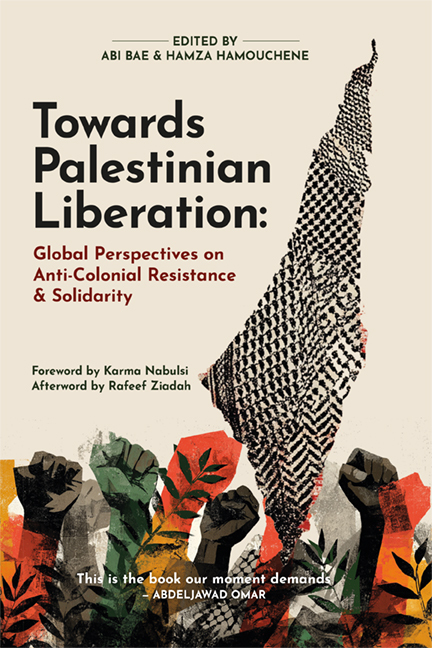
Praise for Towards Palestinian Liberation
I can think of no other book that addresses the question of solidarity with Palestine and Palestinians as urgently and as eloquently as this collection of essays by a global cast of authors does. Ranging from histories oforganising for Palestine in the Global North, China and Latin America, to the anti-colonial struggles of Algeria andVietnam passing on the torch to Palestine, to the politics of joining hands across Egypt, Sudan and Palestine, theessays in this book shine a beacon of hope in a bleak moment of despair.
– Laleh Khalili, author of The Heroes and Martyrs of Palestine:
The Politics of National Commemoration
What distinguishes this collection is its refusal to treat Palestine as an exception. It places Palestinian liberationwhere it belongs – at the centre of a global confrontation with empire, fossil capitalism, and the architectures of racial domination. This is internationalism not as sentiment but as strategy for liberation.
– Yanis Varoufakis, Greek economist and author of Technofeudalism: What Killed Capitalism
Abi Bae and Hamza Hamouchene have put together a collection of invaluable essays that locate the Palestinian people’s struggle within the larger global quest for national liberation from the late 19th century onwards, bringingout the common threads binding Palestinians to the peoples of China, Vietnam, Algeria, Cuba, South Africa, andother countries in the Global South. At the same time, these contributions underline the unique features of the Palestinian struggle, where the settler colonialism of Israel is united to the imperial power of the United States, andto the legacy of guilt in Europe. This creates the volatile mix that has driven the West to support the genocide perpetrated by Israel in Gaza. This volume of essays by activists and engaged intellectuals from the Global Southis indispensable for an acquaintance with Palestinian resistance that goes beyond reading the headlines.
– Walden Bello, Filipino scholar-activist and Right Livelihood awardee 2003
Towards Palestinian Liberation: Global Perspectives on Anti-Colonial Resistance and Solidarity is a crucialintervention in these tumultuous times – when it seems there is a war on humanity itself, and when hope for freedom and justice feels like it is dwindling across the world. Now more than ever, scholarly enquiry into resistance and solidarity is not only timely but necessary. The book offers vital reflections on solidarity with Palestine, insisting that it must be rooted in anti-imperialism and anti-colonialism. It also argues for a deepimmersion in the histories of Third World internationalism and anti-colonial resistance – traditions that illuminate the present with uncomfortable clarity. Ultimately, this book emphasises that from Turtle Island to Africa andbeyond, our struggles for liberation are intimately intertwined: woven from the same histories of dispossession and injustice, they point toward the same horizon of freedom.
– Yara Hawari, co-director at Al-Shabaka: The Palestinian Policy Network
Abi Bae and Hamza Hamouchene have gifted us an indispensable book about one of our times’ most important political causes. In Towards Palestinian Liberation the editors do not frame phenomena as single events but as an accumulation of experiences that are analytically understood through a longue durée lens. The authors of the chapters resurrect forgotten histories of global solidarity and reveal previously unseen or disguised acts of militarism and greenwashing. Together, they analyse, diagnose and reframe the social and economic forces that maintain Israeli settler colonialism. The book not only takes the side of the oppressed – unlike liberal academia, which has effectively enabled oppression – it also makes clear what mainstream media deliberately distorts. From the intersections of Sudan and Palestine to Vietnam and Algeria’s historic passing on of the torch of the anti-colonial struggle, this book provides key insights about internationalism, which has shaped – and continues to shape – anti-colonial solidarity.
– Miriyam Aouragh, professor and author of Palestine Online
As the authors powerfully write, ‘Gaza has awakened the world, and Palestine has become the defining struggle of our time’. This book de-exceptionalises the current holocide, revealing it as a brutal expression of a destructive socio-economic system – capitalism – whose lifeblood is the systematic oppression of the Global South. Bycentring solidarities from India to Brazil and Sudan, it reclaims scholarship as a tool of emancipation. This work stands as a guiding light for those committed to a liberated Palestine in a liberated world.
– Clara Mattei, author of Escape from Capitalism, founder of The Forum For Real Economic Emancipation (FREE)
At a time when solidarity with the Palestinian people is increasingly criminalised, Zionist violence intensifies, and colonial wars are spreading across the Middle East, Towards Palestinian Liberation offers a sharp and compelling historical and strategic reflection on anti-imperial resistance from a Global South standpoint. This reflection highlights the book’s key strength: Palestine has long been – and continues to be – a central focal point for theconvergence of global struggles confronting oppression and dispossession, and striving for justice. An essentialread to keep hope alive and to remember Ghassan Kanafani’s words: ‘As long as we struggle, we are notdefeated.’
– Olfa Lamloum, Political scientist, filmmaker and president of The Legal Agenda,Tunisia
An astonishing book – an answer to despair. It simultaneously presents the horrors of Israel’s genocide in Gaza and how this is hard-baked into the Zionist colonial project, while also telling thrilling stories of solidarity and resistance to Palestine’s occupation. When we are faced with the horror of the endless slaughter ofPalestinians this book offers a passionate balm by showing us the central role of Palestine in global (and specifically South-South) liberation and decolonisation. Situating this collection in the heady, inspiring days of anti-colonial resistance and revolution from the 1950s in Vietnam, Algeria, Ghana and South Africa reminds the reader of the challenges posed by the uprisings and struggles we have seen across the Global South since 7 October 2023. These are brilliant but fleeting movements and more is needed: we need change. Which is why we need Towards Palestinian Liberation. The project of changing the world is made much easier by this collection. I canthink of no more necessary or important book for those of us determined to revolutionise our world.
– Leo Zeilig, writer, novelist and author of A Revolutionary of Our Time: The Walter Rodney Story
This remarkable record of the external and fragmented solidarity for Palestinian liberation needs to be widely read. This edited collection fills a gap in literature around Palestinian struggles – its tragedies, bravery, and collectiveresistance, whichtouchothernationsandpeoples. Theessaysshow that the dividing lines between hegemony and anti-imperialism, between ethics and banality, and between humanity and barbarity lie in how nations and individuals support or invisibilise the Palestinian liberation struggle. This collection analyses more thanjust global responses to Palestinian liberation: it deconstructs empire, neocolonialism and settler colonialism, and itreveals the contradictions of state behaviour by both Global South and Global North countries in their relations with the Zionist state. At the same time, these essays show the common threads of resistance that connect peopleglobally with Palestine. It is a book that proves once again that writing and recording is itself resistance. I would class it as essential reading.
– Anuradha Chenoy, Adjunct Professor, Jindal Global University, Haryana, India; Associate, Transnational Institute; Professor and Former Dean (Retired), Jawaharlal Nehru University, New Delhi, India
Weaving together history and present, critique and hope, provisional defeats and steadfast resistance, and a commitment to collective care, Towards Palestinian Liberation is a powerful study of the dialectics of imperialism and resistance across the longue durée. By illuminating links with so many other movements for freedom and self-determination across the globe, the authors in this urgent collection demonstrate the world-historic characterof the struggle for Palestinian liberation.
– Thea Riofrancos, author of Extraction: The Frontiers of Green Capitalism
To understand the ins and outs of the Palestinian liberation struggle and why it critically matters for anti-colonial andanti-imperialist resistance worldwide, this timely and generous collective effort by renowned scholars and activists is amust read. This volume will be of interest to the growing majority everywhere looking for progressive alternatives toour chaotic and violent present.
– Ndongo Samba Sylla, Head of Research and Policy for the Africa Region at International Development Economics Associates (IDEAs)
What this collection grasps, and grasps firmly, is that the attack on Palestine is a structure. It is the condensedform of a global system of racial capitalism and imperial domination that reproduces itself through theelimination of peoples, the erasure of ecologies, and the violent management of the dispossessed. To read these pages is to see that structure illuminated from every direction – from Africa, Asia, Latin America, from Turtle Island to the favelas of Brazil – by thinkers who understand that liberation is not a local affair but a planetary vocation.This is the book our moment demands. It folds within it the necessary work of building an anti-colonial internationalism adequate to the scale of what confronts us.”
– Abdaljawad Omar, writer and Assistant Professor at the Philosophy and Cultural StudiesDepartment in Birzeit
This thing called Israel is almost always viewed through Western eyes. Here, for the first time, we get a chance tosee Palestine and its struggle through the eyes of the majority of humanity – the Global South, that is. How havebonds of solidarity formed between people in Palestine and India, China, Brazil, Vietnam and Sudan? This book is an invaluable resource for situating the present phase of the struggle within a long history, and for understandingthe dynamics of a settler colonial outpost that is bent on turning West Asia into a continent of rubble so as topreserve the empire. A few on top are terrified by the idea of Palestinian freedom, most down below see it as a keythat will open prisons, break down walls and topple pyramids across the globe.
– Andreas Malm, author of The Destruction of Palestine Is the Destruction of the Earth
In this fascinating collection, some of the most erudite scholar activists working against colonialism and racial and fossil capitalism combine to produce both a searing diagnosis of the “deadly and dehumanising forces of empire and capital” and also inspiring accounts of internationalism, humanity and solidarity. Adopting a longue duréeperspective of anti-colonial resistance, this book eschews defeatism even as it confronts the horrifying and depraved reality of the US/Israeli/EU/UK genocide of Palestinians. The contributions draw vital connections – from the favelas of Brazil to Turtle Island, from Sudan to Vietnam – showing how the struggle for Palestine is inseparable from fights against eco-apartheid, militarism and capitalist extraction. In doing so, the authorsinsist on rebuilding transnational networks of anti-colonial solidarity. This book is an indispensable resource for anyone committed to the belief thata better world is necessary and must be fought for – from many rivers to many seas.
– Salim Vally, Professor, Faculty of Education, University of Johannesburg
Birthed from the horrors of a genocide and shaped by the unrelenting will of the Palestinian people in their decades-long resistance against apartheid and settler colonialism, which is supported now by millions of peopleacross the world fighting for a free Palestine, this book comes at a time when it is most needed. Galvanising the optimism that we will be victorious in our collective struggles for a better world and as a critical call to action, it is an immense honour for me to endorse this book.
– Tasneem Essop, internationalist and former anti-Apartheid activist
Towards Palestinian Liberation is an indispensable intervention. It masterfully situates Palestine within the longue durée of anti-colonial struggle, exposing how settler colonialism operates as a fulcrum of the global capitalist-imperialist system, all the while rebuilding the theoretical and political infrastructure of Third World solidarity. Reading this book is an essential antidote to the darkness and despair that permeates this moment.
– Grieve Chelwa, Associate Professor of Political Economy, The Africa Institute, Global Studies University
This historically informed, strategically oriented collection about solidarity with Palestine is crucially important and timely. The contributions show why activist-organised internationalism from below is now an irreducible imperative in every aspect of our struggle for a just and better world, including ridding the world of settler colonial apartheid and achieving genuine solutions to ecological and other existential crises generated by capitalism. Towards Palestinian Liberation serves as a powerful reminder that like the victorious revolution of slaves in Haiti at the dawn of the 19th century, Palestinian resistance today is ‘in service of freedoms greater than its own’. Theeditors, Abi Bae and Hamza Hamouchene, deserve special commendation for their labour of care and commitment in producing this resource for all of us.
– Gyekye Tanoh, Freedom and Justice for Palestine (Ghana) and member, Global EcosocialistNetwork
This book is one of the most intellectually stimulating and politically rigorous volumes on Palestine in the wake of the genocide. It powerfully situates Palestine’s anti-colonial struggle within a longue durée of global liberation movements across history and geographies, showing how hope emerges from enduring practices of solidarity and resistance that continue to shape our world. A must-read for anyone interested in understanding the struggle for Palestine and beyond.
– Rima Majed, Associate Professor of Sociology at the American University of Beirut
For too long, our imagination of liberation has been fragmented. The genocide in Gaza has shattered this fragmentation and planted seeds of unity among the global majority. In this moment of tectonic changes in the world order, we require a clear-eyed vision of global emancipation and unity. It is to this urgent task that this book responds. The ideas in this book are at the core of a liberation project for the global majority, in which Palestineserves as a microcosm. The book brings together a powerful coalition of ‘guerrilla intellectuals’ who provide a clear, grounded vision for the struggles ahead, building on lessons learned from past intersectional struggles. This book arrives at a critical moment when such strategic visions are essential for unifying voices of resistanceworldwide. It stands as both an ode to hope and a practical manual for liberation, offering a wealth of knowledge sourgently needed to fill the epistemic void maintained by the dominating world order.
– Shahd Hammouri, Lecturer in International Law and Legal Theory at the Universityof Kent
At a moment when Palestine is routinely stripped of its history and reduced to a humanitarian tragedy, TowardsPalestinian Liberation restores the political stakes with clarity, range and moral force. Bringing together movement-rooted voices from across the Global South, this urgent collection situates the struggle for Palestine where it belongs: within the long history of anti-colonial resistance, internationalist solidarity, and battles against empire, racial capitalism, and ecological devastation. Wide-ranging yet coherent, intellectually ambitious yet grounded inpraxis, it is a powerful reminder that Palestine is not a marginal issue but one of the defining questions of our time.
– Hossam El-Hamalawi, scholar specialising in the Egyptian military and policing
To live is to resist, and to resist is to live. This book is a living archive of resistance – unfolding across geographies, histories and generations. What Towards Palestinian Liberation does with remarkable clarity is toremind us that Palestine is not a distant question: it is a mirror held up to the world, a test of our moral and politicalimagination, a site where the promises of the international order stand exposed. The Palestinian struggle has never been confined to its geography: it has travelled through the streets of Cairo, the movements of Latin America, thesolidarities of Africa, the histories of Asia. It is this long history that this volume carefully and powerfully reclaims. Toread this book is to understand that Palestine is not only a political struggle: it is a global history of conscience. If thereis one book to read in these times, this is it.
– Madhuresh Kumar, Resistance Studies Fellow at the University of Massachusetts Amherst and former national convener of the National Alliance of People’s Movements, India
This book is a lesson in internationalism and the need to organise in order to practise it. The authors remind us that solidarity with Palestine is a basic tenet of ecosocial justice and that the anti-colonial struggles have historically bound the whole of the Global South and marginalised peoples together. If we truly support Palestinian liberation, it can help to liberate us all.
– Sabrina Fernandes, Brazilian economist, author and ecosocialist activist
While international law admittedly reflects the hegemonic power dynamics of the time when it was first established, it can only be considered meaningful if it applies to everyone, including the most powerful. The law of the dominant powers during the British colonial era is now superseded by that of Zionist colonialism and its allies. The entire Global South condemns the dehumanising abuses committed by Israel and admires Palestinian resilience. The struggle for liberation must aim for a viable state so that this battered nation may reclaim its rights. This book works toward that end.
– Aziz Salmone Fall, President of the Centre Internationaliste RFA
This book is essential reading for anyone who wants to understand why Palestinian liberation cannot be separated from revolutionary and anti-colonial struggles across the world, drawing on histories of solidarity in the struggle against oppression and injustice which span generations and continents. With contributions fromSudan, Egypt, Brazil, India, the Americas and Palestine among many others, this collection strikes a note of resolute hope in the midst of genocide and war. It raises urgent questions for debate within the wider movements against imperialism and racism and will play a vital role in educating a new generation of activists.
– Anne Alexander, author of Revolution is the Choice of People
Towards Palestinian Liberation: Global Perspectives on Anti-Colonial Resistance and Solidarity is a crucialcollection for those of us trying to find a way forward in a world shaped by genocide, rising fascism, aggressive imperialism, and climate catastrophe. The collection editors, Abi Bae and Hamza Hamouchene, start by asking their readers how to maintain revolutionary hope and forge a way forward in these circumstances. Their and the collection’s contributors answer is to extend our frame of analysis – in both space and time. By re-positioning thePalestinian freedom struggle within a wider century of revolutionary struggles, both in Palestine and across theglobal South, the authors remind their readers that the struggle for liberation is always fought against extraordinaryodds, in unfavourable circumstances, and through terrible hardship. Yet it is in the process of struggle against the forces of capitalism, fascism, and imperialism, that millions of people across the world took control of their lives andbrought down the world’s most powerful empires. If they did it once, we can do it again. So read on, and organise.
– Sai Englert, author of Settler Colonialism: An Introduction
This book could not be more timely. Just as in the 1960s – when it became a key revolutionary node alongsideVietnam, Cuba, Algeria and Southern Africa – Palestine has reemerged as the epicentre of the global anti-imperialist struggle. With its historical and analytical depth, Towards Palestinian Liberation situates the current conjuncture within a longer trajectory of imperial violence and Third World solidarities. A book from the movement and for the movement, it provides us with essential tools to continue and to globalise this struggle. For Palestine is truly, as Ghassan Kanafani reminds us, ‘a cause of the exploited and oppressed masses in our era’.
– Lucia Pradella, Reader in International Political Economy, King’s College London
Towards Palestinian Liberation shines a new and revealing light on decades of anti-colonial, anti-imperialiststruggles for national liberation, with Palestine as the epicentre. By centering voices from the Global South and calling for re-strategising on a South-South axis it presents an open challenge to the Eurocentric and Northern-Western hegemony regarding interpretations of struggles for self-determination and liberation. This book will be welcomed by both analysts and activists as it contributes to catalysing a broad political debate essential to re-framing new militant strategies of transnational resistance, solidarity and internationalism. Even as the failure andbankruptcy of the current imperialist and capitalist system is widely registered across continents, so the struggle for Palestinian liberation – and its crucial role in past and contemporary struggles – gives us grounded optimism to engage those struggles that will shape future decades. The future is indeed blown open and as the poet Yeatswrote of a defining moment in the Irish revolution “all is changed, changed utterly: a terrible beauty is ”
– Brid Brennan, Fellow of the Transnational Institute
The Palestinian struggle for liberation is inseparable from histories of anticolonial resistance and internationalist solidarity—from Algeria and Vietnam to Turtle Island and Abya Yala. With rigor and with love, this volume reclaims that radical tradition, insisting that this cumulative knowledge and practice are indispensable to reimagining and remaking the world in this moment of unhinged imperial brutality.
– Omar Jabary Salamanca is a writer, teacher and organizer, and Professor of Social Sciences at Université libre de Bruxelles.
Hossam el-Hamalawy
Towards Palestinian Liberation celebrates neither suffering nor sacrifice in isolation, but the capacity of oppressed peoples to think, organise, resist and transmit knowledge across generations. Palestine appears not as a passive object of sympathy but as a revolutionary force that has educated movements around the world. The collection restores a language of liberation at a moment when political horizons are being deliberately narrowed. It reminds readers that empires can be defeated, colonial orders can collapse and solidarities can be rebuilt after long periods of retreat. From Palestine to Africa, Asia and the Americas, its contributors offer a map of shared enemies and, more importantly, shared possibilities. https://www.middleeasteye.net/discover/towards-palestinian-liberation-contextualising-palestinian-cause-within-global-fight?utm_source=linkedin&utm_medium=social&utm_campaign=Social_Traffic&utm_content=ap_ahwfokzq6a