

Amrit Wilson
Amrit Wilson is a writer and activist on issues of race and gender in Britain and South Asian politics. She is a founder member of South Asia Solidarity Group and the Freedom Without Fear Platform, and board member of Imkaan,…
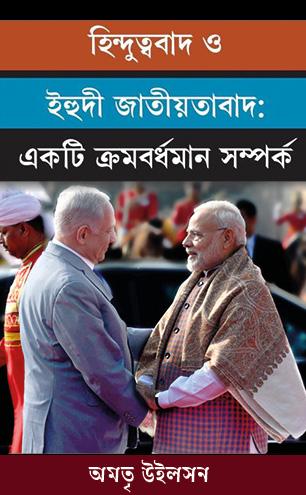
This is a Bengali translation of Hindutva and its relationship with Zionism, by Amrit Wilson: ISBN 978-1-990263-76-7. Written in December 2022, this text is based on a lecture given earlier at the invitation of the Institute of Palestine Studies. Since then, the relationship between Israel and India has deepened further and atrocities have skyrocketed in both countries. On 5 April 2023, Israeli forces stormed Al Aqsa Mosque compound in occupied East Jerusalem and attacked worshippers inside. At the same time, Israel is facing internal turmoil in a battle between a diverse group, including those who think the current settler colony is a democratic nation and want things to remain as they are, and those who stand even further to the right. Significantly, the BJP, India’s ruling party, supports the latter. This book is about Hindutva, the ideology which drives the Hindu-supremacist Bharatiya Janata Party (BJP) regime of Prime Minister Narendra Modi, and Zionism, the ideology of the Israeli apartheid state. In this era of rising fascism, these two remarkably similar ideologies are crucially important in cementing the economic and military alliance between two of the world’s most repressive right-wing states – while helping to legitimize them in cultural arenas. Israel is, of course, a settler colonial state, but it is also, like India, a fascist state, not only because of ‘the extremist parties that [are] part of the government’ but also because of ‘their enablers – Netanyahu and his chauvinistic Likud party which long strove for a Jewish state dominating both sides of the Jordan River.’ In the words of Marwan Bishara, Netanyahu is ‘the godfather of modern Israeli fascism.’ This essay focuses primarily on Hindutva, discussing Zionism mainly to highlight its similarities, links and increasing alliances with Hindutva.
USD $ 5 USD $ 10Price range: USD $ 5 through USD $ 10
Amrit Wilson is a writer and activist on issues of race and gender in Britain and South Asian politics. She is a founder member of South Asia Solidarity Group and the Freedom Without Fear Platform, and board member of Imkaan,…
| Book Format | Print Book, PDF |
|---|
There are no reviews yet.
Only logged in customers who have purchased this product may leave a review.

This is a collection of observations and meditations by Professor Emeritus (York University, Toronto) and philosopher Ato Sekyi-Otu on events, issues, people and ideas culled from recent history and the world, from the US and Canada to Ghana. If there is a persistent thread in these entries, it is this: Virtually all of them testify to the ironic truth of the saying that there is no place like home, no place, that is to say, which looks like the lodestar called home or comes close to approximating its promise of being a just space of human flourishing. Most of the entries are, therefore, harsh, particularly those on the USA. That is because that nation, in his view, has, in recent history, made a major contribution to rendering the world and every homestead we inhabit unhomely and sabotaging attempts to better it. But no one or place is spared, certainly not the author’s native land, Ghana. Canada appears intermittently in these pages in rather fragmentary and contrastive observations. That paucity of comments may be taken to be the complement the author pays to Canada as a place of relative civility and glimmers of decency in a mad and cruel world. It is a short work of predominantly gloomy pictures. But there are a few countervailing images and invocations of hope here and there. There are 166 entries of unequal lengths arranged around 14 headings. These epigrams are contrapuntal variations on the philosopher’s searing imprecation and visionary invocation: unfinished ode, resounding with intermittent fury, to the dawn of human existence set free from all tyrannizing enclosures.

Desde su primera edición en 2005, el Observatorio Global de la Salud (GHW) -la publicación insignia del Movimiento por la Salud de los Pueblos (MSP)- ha venido informando críticamente sobre el estado de la salud en el mundo. Publicada cada tres o cuatro años, comenta la evolución de la salud mundial al tiempo que se centra en la continuidad con las luchas populares del pasado.
Al igual que en ediciones anteriores, el GHW7 cobra vida con las contribuciones de más de cien activistas de todo el mundo, que comparten experiencias y análisis sobre cuestiones que afectan a la salud de las personas en los contextos en los que viven y los esfuerzos por avanzar hacia una mayor justicia en salud. Este proceso fue dinamizado por la quinta Asamblea Mundial por la Salud de los Pueblos (ASP5), el encuentro mundial del MSP, que tuvo lugar en Argentina en abril de 2024 bajo el lema “Haciendo de la ‘Salud para Todos’ nuestra lucha por el ‘Buen Vivir’”.
Las contribuciones políticas de América Latina se manifiestan en la primera sección del GHW7, dedicada a “La arquitectura política y económica global”, donde a un análisis actualizado de las crisis de la salud actuales le siguen contribuciones que las enmarcan en una perspectiva ecofeminista, mostrando cómo las alternativas pueden arraigarse en las sabidurías ancestrales y en la práctica del ‘Buen Vivir’. La segunda sección aborda viejos y nuevos retos para los sistemas de salud públicos y globales a través de las lentes críticas de la justicia de género y la decolonialidad. La tercera sección, “Más allá de la atención en salud”, aborda los principales determinantes sociales y ambientales de la salud, mientras que la sección “Vigilancia” analiza críticamente el estado de la gobernanza mundial de la salud centrándose en varias instituciones clave. La última sección, “Resistencia, luchas y alternativas”, destaca las áreas de cambio transformador de los y las activistas de la salud en un contexto mundial de creciente represión. El libro termina con un capítulo sobre la ASP5, en el que se destaca cómo la acción colectiva es la medicina más poderosa contra la mala salud y la desigualdad de la salud a nivel humano y planetario.
Global Health Watch 7 incluye los siguientes capítulos:
Los resúmenes de los capítulos actualmente disponibles, junto con el PDF descargable correspondiente, pueden consultarse desplazándose hacia abajo y haciendo clic en la pestaña “Descripción”.
Todos los capítulos, excepto A2 y A3, han sido traducidos del inglés por Lila Esther Silgado Villadiego
Introducción: Una Movilización por la Justicia en Salud
A1. De la Economía Política de la Enfermedad a la Economía Política del Bienestar
A2. La Vida en el Centro: Ecofeminsmos y Feminismos Ecoterritoriales en la Disputa por la Vida
A3. Saberes Ancestrales y Populares para el Buen Vivir
B1. Privatización y Financierización de los Sistemas de Salud: Retos y Alternativas Públicas
B2. Inteligencia Artificial, Tecnologías Digitales y Salud
B3. Construyendo Sistemas de Salud Equitativos: Una Propuesta Transformadora Desde una Perspectiva Interseccional de Género
B4. La Medicina de la Abolición como Herramienta para la Justicia en Salud
B5. Descolonización de la Salud Mundial
C1. Guerra, Conflicto y Desplazamiento
C2. Personas en Movimiento
C3. Poniendo el Derecho a la Salud ¡A Trabajar!
C4. Justicia fiscal: El camino Hacia una Mejor Salud
C5. Determinación comercial/empresarial de la salud
D1. El papel de la Organización Mundial de la Salud en el liderazgo de la salud mundial, bajo amenaza
D2. Desembalaje de Nuestros Fracasos Pandémicos para la Prevención y Preparación ante futuras pandemias
D3. Financiación de la Recuperación, Prevención, Preparación y Respuesta ante una Pandemia
E1. Luchas Nacionales por el Derecho a la Salud
E2. Llevando a las Empresas Extractivas a los Tribunales
E3. Miedo y esperanza en “Decir la verdad al poder”: Luchas por la salud en tiempos de represión y reducción de espacios
E4. 5ª Asamblea Mundial por la Salud de los Pueblos: Avanzando en la lucha por la liberación y contra el capitalismo

Written in commemoration of the 50th anniversary of Africana Studies and Research Center, Cornell University, this publication celebrates the birth of Black studies as a liberated academic zone. Professor Mũgo reflects upon the significance of Africana studies, specifically within the context of America’s predominantly White universities, revisiting the hers/his/torical context that birthed Black studies as a field of knowledge. She reflects on the ownership of knowledge, its production, dissemination and custodianship while proposing utu/ubuntu as imperatives in defining transformative education. The hypothesis and heart of the argument is that knowledge and scholarship can either be colonizing, alienating and enslaving; or, alternatively, they can be conscientizing, humanizing and liberating, creating new human beings with the agency to transform life and the world, for the better. he dismisses the false myth of dominating, colonizing and imperialist cultures that claim to have a monopoly of knowledge and whose purpose is to justify the dehumanization of the conquered, the attempted erasure of their knowledges, heritages and ultimately, entire cultures.

Description (1711 / 2500)
Part of what is revealed is what is wrong and toxic – in ourselves, in our relations with others, and in our relation with the rest of non-human nature. But it’s also terribly important to listen for and to seek out what is revealed that is good and life-affirming. Both are vital. Our current situation is deeply structured by capitalism and as such has made all of our lives, livelihoods, relations and goods tied up with, and dependent on, reproducing that system. It is clear that the real catastrophe is the inevitable and accelerating spiral of death that flows from that logic of capital and of money. But new (and old too) forms of experimenting in radically different ways of doing/being/relating that flow from it are also revealed – the ways of thinking and doing that reject the logic of power-over, of competition or profit, of exploitation and humiliation. Can these be sustained beyond the immediate corona crisis?; shouldn’t we be encouraging people to identify these areas and think/act them as a present future, planning and imagining how to extend them forward in time?; and expanding them to growing spheres of life? At the level of values and principles, we do wonder whether kindness, social solidarity, and an appropriate scale of time, aren’t perhaps the most important of these?
We are much more likely to actually change the world when we listen and tap into all the many ways in which people’s own questions and thinking, their ways of relating and acting, refuse the logic of toxic power and monetised exchange for profit. Here, we will discover already-existing breaks and practices that, instead, embody and embrace the values and principles for a better way of reproducing life.
Moçambique celebrou, em Junho de 2020, 45 anos de sua independência. Os ganhos e avanços que o país alcançou nesta quase meia década de independência são inegáveis, mas os desafios que subsistem são muitos. Este livro reflecte sobre Moçambique contemporâneo nos seus vários aspectos, destacando a formação e o papel do Estado, a democracia, a participação dos cidadãos, a política económica e social e o desenvolvimento. Como se pode ver, o livro não é temático e oferece diversas perspectivas de autores e autoras que se dedicam à investigação, ao jornalismo e ao activismo. O livro pretende exactamente oferecer uma leitura do país a partir dos olhos daqueles que não ocupam uma posição de poder mas que vivem, experienciam e lêem a realidade do país a partir de uma perspectiva crítica da sociedade.
O objectivo deste livro é dar uma melhor compreensão do que tem sido o processo de independência em Moçambique e porque é que o país pós-colonial ainda é ‘colonial’ na sua estrutura política e económica. Assim, são dados muitos exemplos para dar ao leitor a possibilidade de confrontar as perspectivas teóricas aqui utilizadas com os casos concretos.
Todos os estudos deste livro mostram que quarenta e cinco anos de independência não foram vividos da mesma forma pelas elites que governam o país e pelas populações que vivem sob o seu domínio. Por um lado, as elites no poder e os seus parentes beneficiaram, e ainda beneficiam, dos recursos do país, enquanto que uma grande parte da população continua à espera das promessas da independência. De um ponto de vista político e económico, os estudos que compõem o livro destacam como o “desenvolvimento” em Moçambique tem estado em contradição com as necessidades do país. Significa que o actual modelo de desenvolvimento responde muito mais ao capital internacional do que à transformação social de Moçambique.

À rebours des thèses soutenant que la migration contribue au développement ou que l’in- vestissement dans le développement réduit la croissance de la migration « irrégulière », ce livre marque une rupture tonifiante avec les idées communes abondamment véhiculées dans la littérature sur les liens entre migration, mobilités et développement en Afrique. Il accorde un intérêt manifeste pour la plus grande part des mobilités africaines, lesquelles se situent à l’intérieur du continent, et à la formation des diasporas en dehors des fron- tières nationales et continentales. Cette considération conjointe des mobilités « Sud-Sud » et « Sud-Nord » permet de remettre en cause l’hypothèse selon laquelle il existe des diffé- rences fondamentales entre elles.
Cet ouvrage examine les fluctuations ordinaires des mouvements de populations – à travers l’Afrique, comme dans le reste du monde –, qui étendent les familles, génèrent de nouvelles relations, reconfigurent les connexions économiques et politiques, et sont intégrées dans l’expérience quotidienne des millions de personnes qui y prennent part.
The in-depth knowledge of the mostly African authors adds to the quality of a research field, which was for long far too Eurocentric. – Ilke ADAM, Vrije Universiteit Brussel (Belgium)
Il était temps de mettre en lumière ce que migration et mobilité représentent en Afrique. L’ouvrage offre une perspective originale et décoloniale sur le sujet. – Eric HAHONOU, Roskilde Universitet (Denmark)
Christian Bouquet, « Quelques éclairages nouveaux sur les migrations africaines », EspacesTemps.net [En ligne], Books, 2020 | Mis en ligne le 20 November 2020, consulté le 20.11.2020. URL : https://www.espacestemps.net/en/articles/quelques-eclairages-nouveaux-sur-les-migrations-africaines/ ; DOI : 10.26151/esapcestemps.net-jc2a-6b03
Avec la participation de John O. IGUE, Saydou KOUDOUGOU, Pierre-Joseph LAURENT, Bassirou MALAM SOULEY, Hamidou MANOU NABARA, Marème NIANG NDIAYE, Amadou SARR DIOP, Sadio SOUKOUNA , Eric Stève TAMO MBOUYOU et Astadjam YAOUBA.
The volume includes two sections exploring nonviolence in the long Black freedom struggle within the US. From Ella Baker to Martin Luther King, Jr. and Fannie Lou Hamer, from Vincent Harding and Grace Lee Boggs to Colin Kaepernick, the two sections on the Black liberation movement highlight the theory of nonviolence in direct and indirect ways and foreground the relevance of these historic texts for the present moment of political uprisings on both the left and the right. Black strategies for survival and power are analyzed in terms of the ongoing US economic and epidemiological crises as well as the global climate crisis and ecological collapse. A section on revolutionary nonviolence in Africa presents a previously unpublished piece on the role of armed struggle by Franz Fanon, as well as essays by Amilcar Cabral, Barbara Deming, Graca Machel, Kenneth Kaunda, and Nozizwe Madlala-Routledge This section clearly contextualizes the continent’s anti-colonial struggles with the practical thinking about military and unarmed tactics which those movements faced over the course of a half-century.
The section on nonviolence and feminist struggle highlight the work of Grace Paley, Audre Lorde, and Arundhati Roy, along with a little-read piece by Johnnie Tilmon, a leader of the 1960s welfare rights movement. The section on resistance against empire tilts toward Latin American scholars/activists with essays by Maria Lugones, Anibla Quijano and Berta Caceres. This section includes pieces that draw from current debates about the role of state power in building towards radical change and the push to build holistic perspectives on what liberation means for all peoples. The final section on social change in the 21st Century reflects on specific aspects of organizing that are facing campaigns and movements of today and tomorrow. Our goal is to provide challenges and insights for building effectively against all forms of oppression! Though primarily compiling key texts not often seen or contextualized together, the book also provides new strategic commentaries from key leaders including Ela Gandhi, Ruby Sales, ecofeminist Ynestra King, Africa World Press’ Kassahun Checole, and Palestinian Quaker Joyce Ajlouney, Hakim Williams, and Mireille Fanon Mèndes-France.

Ce livre est un apport précieux pour demander à changer de focale et de perspective au sujet des migrations à l’intérieur du continent africain. Celles-ci sont bien plus importantes quan- titativement, mais aussi économiquement et historiquement, que les migrations de l’Afrique vers l’Europe. Elles sont beaucoup plus silencieuses et infiniment moins étudiées que celles du Sud vers le Nord. Ces migrations sont vitales, tant pour les pays de départ que pour ceux d’arrivée. Ainsi, des millions de jeunes partent chaque année pour les pays de la côte, et cela sans susciter les mêmes résistances, fantasmes et peurs qu’en Europe.
Cet ouvrage a le grand mérite d’intégrer les migrations dans la perspective plus large des mobilités, puis d’en examiner les liens avec le développement. Il est rédigé par de jeunes chercheurs africains, qui produisent à partir de leurs terrains spécifiques des analyses à valeur générale sur les sociétés contemporaines. Ils contribuent ainsi au renouvellement des sciences sociales à partir des pays africains.
On peut en revanche souligner que l’ouvrage a relevé un défi important : celui d’éclairer à la fois les dynamiques de l’expérience migratoire, des trajectoires suivies par les migrants et des espaces migratoires à l’intérieur de l’Afrique. — Sylvie Ayimpam, « Mobilités, circulations et frontières. Migrations, mobilités et développement en Afrique », Anthropologie & développement [En ligne], 51 | 2020, mis en ligne le 01 décembre 2020, consulté le 23 février 2021. URL : http://journals.openedition.org/anthropodev/1068 ; DOI : https://doi.org/10.4000/anthropodev.1068
These companion volumes are refreshing because they introduce us to many less well- known instances which amply illustrate just how mobile African populations really are at the regional, intra-regional and global scales. – Paul NUGENT, University of Edinburgh (United Kingdom)
Un ouvrage d’une grande actualité qui aborde la question des migrations sous un angle radicalement nouveau et original : l’articulation dynamique entre la migration, la mobilité et le développement en Afrique de l’Ouest. Ces deux volumes bilingues renouvellent le débat sur les migrations : de quoi faire réfléchir ensemble l’Afrique et l’Europe. – Marie-Caroline SAGLIO-YATZIMIRSKY, INALCO, CESSMA Paris (France)
Christian Bouquet, « Quelques éclairages nouveaux sur les migrations africaines », EspacesTemps.net [En ligne], Books, 2020 | Mis en ligne le 20 November 2020, consulté le 20.11.2020. URL : https://www.espacestemps.net/en/articles/quelques-eclairages-nouveaux-sur-les-migrations-africaines/ ; DOI : 10.26151/esapcestemps.net-jc2a-6b03
Avec la participation de Naluwembe BINAISSA, Alimou DIALLO, Nyalo Barkissa DRABO, Sylvester KOHOL, A. Aziz MOSSI, Loppa NGASSOU, Lawrence Rafaih OKELLO, Mutiat Titilope OLADEJO, Zakaria SORÉ, Astadjam YAOUBA et Irissa ZIDNABA.
DarajaPress uses Accessibility Checker to monitor our website's accessibility.