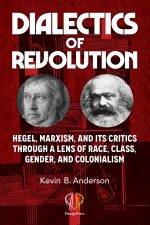
This book collects four decades of writings on dialectics, a number of them published here for the first time, by Kevin B. Anderson, a well-known scholar-activist in the Marxist-Humanist tradition. The essays cover the dialectics of revolution in a variety of settings, from Hegel and the French Revolution to dialectics today and its poststructuralist and pragmatist critics. In these essays, particular attention is given to Lenin’s encounter with Hegel and its impact on the critique of imperialism, the rejection of crude materialism, and more generally, on world revolutionary developments. Major but neglected works on Hegel and dialectics written under the impact of the struggle against fascism like Lukács’s The Young Hegel and Marcuse’s Reason and Revolution are given full critical treatment. Dunayevskaya’s intersectional revolutionary dialectics is also treated extensively, especially its focus on a dialectics of revolution that avoids class reductionism, placing gender, race, and colonialism at the center alongside class. In addition, key critics of Hegel and dialectics like Jacques Derrida, Michel Foucault, Antonio Negri, Pierre Bourdieu, and Richard Rorty, are themselves analysed and critiqued from a twenty-first century dialectical perspective. The book also takes up the dialectic in global, intersectional settings via a reconsideration of the themes of Anderson’s Marx at the Margins, where nationalism, race, and colonialism were theorized alongside capital and class as key elements in Marxist dialectical thought. As a whole, the book offers a discussion of major themes in the dialectics of revolution that still speak to us today at a time of radical transformation in all spheres of society and of everyday life.





Gabriel Kuhn
Besides prominent Black anarchists such as Lorenzo Kom’boa Ervin and Kuwasi Balagoon (whose main works – Anarchism and the Black Revolution and A Soldier’s Story: Revolutionary Writings by a New Afrikan Anarchist, respectively – have recently seen new editions), Atticus Bagby-Williams and Nsambu Za Suekama discuss radical Black theorists such as Frantz Fanon and Cedric Robinson. The engagement with the latter is of particular interest, as Robinson is mainly known for his work on Black Marxism. However, the subtitle of Robinson’s main work, Black Marxism: The Making of the Black Radical Tradition, suggests why Atticus Bagby-Williams and Nsambu Za Suekama would find it useful to relate Robinson’s studies to the emergence of Black anarchism. By doing so, they are making a very valuable contribution to the history of radical thought.
In their concluding chapter, “Toward Black Autonomy,” Atticus Bagby-Williams and Nsambu Za Suekama write that “contributions of Black anarchist politics will be vital towards building a more liberated post-capitalist world.” This, without doubt, is true. Track down a copy, read, and learn. — Gabriel Kuhn: LeftTwoThree https://lefttwothree.org/anarchism-and-the-black-radical-tradition/