

Kidnapped on the Global Sumud Lifeline to Gaza 2026

Customer Reviews
There are no reviews yet.
Only logged in customers who have purchased this product may leave a review.
Related products
-
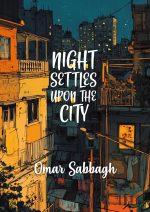
Night Settles Upon The City
USD $ 15.00 USD $ 16.00Price range: USD $ 15.00 through USD $ 16.00Select options This product has multiple variants. The options may be chosen on the product page
Night Settles Upon The City
USD $ 15.00 USD $ 16.00Price range: USD $ 15.00 through USD $ 16.00Written with urgency out of a war-time Beirut, this poetry collection registers the griefs and the heroism of the Lebanese, under siege yet again. Sabbagh lends his lyrical voice here, to give a voice to the voiceless, trying to find some harmonic sense out of catastrophe. This book will compel readers, both Lebanese and those with any kind of human heart. While much of the work was written swiftly, on impulse, and almost like, as one of the poem’s title’s has it, a ‘War Diary,’ in verse, this work aims nonetheless to last in its significance and resonance at a time when the world as a whole (let alone Lebanon herself) has become so unpredictable, so fickle and so perilous. Night Settles Upon The City aims to be a worthwhile addition to the contemporary literature of war and, more specifically, to the literary representations of the modern Lebanese reality and experience.
Omar Sabbagh is a poet who is privileged to write about war and destruction from the relative safety of his study. But this double-edged illusion is insidious — mental and emotional inwardly, and physical for those who are directly under attack. It is visceral, political, heart-wrenching — yet the poet seeks out light and hope through the act of writing, for the sake of ownership and sharing. He may say that “I cannot read minds and nor / will I ever wish to”, but he writes for the importance of record-keeping, seeking solace, both private and public — as the Night Settles Upon The City of Beirut.
— Sudeep Sen, Winner of the Rabindranath Tagore Literary PrizeOmar Sabbagh has long brought us a world in which personal experience stitches a hyphen between the eastern Mediterranean and the northerly British archipelago. Now he makes the tension inherent within that richness explicit, in a love-letter to his family and home city of Beirut. Written while the ‘night’ of war ‘settles upon the city’, his introductory ‘Thoughts’ show us how unthinkable war remains, even when it arrives on the doorstep. This is a book of witness to what cannot happen, and yet does.
– Fiona Sampson, Professor Fiona Sampson MBE FRSL.Two-Way Mirror: The Life of Elizabeth Barrett Browning WW Norton 2022 – Washington Post Book of the Year, New York Times Editors’ Choice, finalist Plutarch Prize, finalist PEN Jacqueline Bograd Award, Sunday Times Paperback of the year.The poet Omar Sabbagh lives in Beirut. His voice is playful, almost surreal at times. He talks of ‘the hairbrained monocle of war’ and suggests that if you live long enough in a place like Beirut ‘laughter becomes a lover’s distance-giving kiss’. Night Settles Upon the City offers us a poetry that is neither ideological nor partisan, not of the frontline but of a deeply threatened warzone. Its terms are easy-going, sorrowful, humane, formally intelligent and tinged with apprehension. It is humanity being human. Reading it is relief and hope.’
— George Szirtes FRSL, Eliot Prize winner.Night Settles Upon the City by Omar Sabbagh is a profoundly reflective and evocative collection that blends personal experience with the brutal realities of life in a war-torn Beirut. Through a tapestry of poems, essays, and prose, Sabbagh explores the intersections of love, grief, intellectual contemplation, and the relentless backdrop of violence. The writing oscillates between moments of tender introspection and stark depictions of societal collapse, embodying a kind of philosophical meditation on suffering and survival. Sabbagh’s voice is distinctively lyrical, capturing both the intimacy of individual loss and the broader existential weight of conflict. His reflections on war and its aftermath are imbued with a sense of historical consciousness, yet deeply grounded in the immediacy of personal anguish and resilience. The collection is not just about bearing witness to destruction, but also about finding fragments of humanity amidst the ruins. A haunting and powerful work that invites readers into the fragile space between beauty and despair.—Dr. Pamela Chrabieh, Kulturnest Co-founder & Managing Director
The Arabic term for poet means the one who feels, unlike the Greek origin of poetry, which describes the craft itself. Omar Sabbagh is the quintessential poet in the Arabic sense. In this collection, he vibrates with Beirut, where he now lives, at a time when the city’s famous cultural vibrations are overwhelmed by murderous quakes caused by the Israeli war machine.
—Gilbert Achcar, Professor of Development Studies and International Relations at SOAS University of London.Beirut’s Omar Sabbagh, lover of beauty, poet of lush lyrical power, addresses the spirit of the great Dr. Edward W. Said in one poem, saying these troubled seasons make him “restless now in (his) resting place.” I’m captivated by a further description of Said, “living paper, breathing ink of one whose thoughts still seem to think.” There is healing in such sensitive recognition. Wise voices we always needed are suddenly needed desperately. Sabbagh invokes his love for a precious home frequently under siege and his care for all the people who made and surround him. Gratitude for the wisdom, kindness and rich affections of Night Settles Upon the City.—Naomi Shihab Nye, recipient Lifetime Achievement in Poetry Award, the Wallace Stevens prizeIn Night Settles on the City, Omar Sabbagh gives voice to the bewilderment, fear, rage, and despair so many of us in the Middle East are currently feeling. His eloquent, tender poems grapple with the impossibility—yet absolute necessity—of language at a moment when words otherwise fail. Like all the best poems, Sabbagh’s challenge, soothe, haunt, and rehumanize us, ultimately arousing our better selves.
—Mai Al-Nakib, author of An Unlasting Home and The Hidden Light of ObjectsBoth erudite and demotic, felt through the body and ‘guided by ear’ Omar Sabbagh’s voice powers through the remote attacks on Beirut – the city in which he currently lives – the hourly atrocities and unspeakable suffering to reach us and to speak for us. ‘What’s to understand?’ he asks ‘That murder can be finessed?’ In his seminal new collection, Night Settles Upon the City, night becomes a ‘dark and violent animal’ with its ‘panther’s pelt’ of terror ‘slowly curving round us’ through which we hear the voice of the aggressor reflecting that ‘…each murderous attack/ I order seems to drain this world of innocence.’ Yet Sabbagh’s own voice remains measured, balanced, especially in the portraits he paints of his beloved father…‘It gets worse each day watching him/ ageing’ (‘The Old Man and his Walking Stick’). This poem ends with the lines ‘an old man and his son, fighting a war/ in a warzone we all must visit’. Alongside unimaginable horror we are shown the ordinary griefs and losses that we all suffer – of ageing, of failing, of being human; and it’s the humanity and compassion with which Sabbagh bears witness that will secure this book’s future among the handful of classics that will come to define our era.
— Jenny Lewis, MA Oxon., MPhil., PhD, Tutor for Poetry, Oxford UniversitySelect options This product has multiple variants. The options may be chosen on the product page -
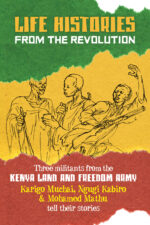
Life Histories from the Revolution: Three militants from the Kenya Land and Freedom Army tell their stories
USD $ 5.00 USD $ 18.00Price range: USD $ 5.00 through USD $ 18.00Select options This product has multiple variants. The options may be chosen on the product page
Life Histories from the Revolution: Three militants from the Kenya Land and Freedom Army tell their stories
USD $ 5.00 USD $ 18.00Price range: USD $ 5.00 through USD $ 18.00In the early 1970s, Donald Barnett — who worked with Karari Njama to produce Mau Mau From Within (published by Daraja Press) — also worked with three militants of the Kenya Land and Freedom Army to enable them to tell the story of their experience in fighting for freedom and against British colonialism. These rarely acknowledged militants were Karigo Muchai, Ngugi Kabiro and Mohamed Mathu. Their stories were published in 1973 by LSM Information Center (Richmond, British Columbia, Canada) as part of a series entitled Life Histories of the Revolution, as The Hardcore: The Story of Karigo Muchai; The Man in the Middle by Ngugi Kabiro; and The Urban Guerrilla by Mohamed Mathu.
As part of its mission of Nurturing reflection, sheltering hope and inspiring audacity, Daraja Press is please to republish the three booklets as a book that will help a new generation of activists — Kenyan and international — reflect on a history that might inspire audacious struggles to continue the struggle for freedom that was the goal of the Kenya Land and Freedom Army.
Donald Barnett’s introduction to each booklet contained the following text:
The life histories in this series have been recorded and prepared as historical documents from the revolutionary struggles of our time. The techniques and methods employed at each stage of the process, from initial contact to final editing, have therefore been chosen or fashioned with the purpose of guaranteeing the authenticity and integrity of the life history concerned. These stories, then, to the best of our ability to make them so, constitute a body of data and testimony as revealed by a few of those history-makers normally condemned to silence while others speak on their behalf.Select options This product has multiple variants. The options may be chosen on the product page -
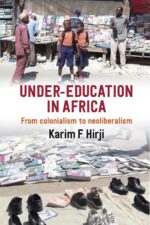
Under-Education in Africa
USD $ 22.00Select options This product has multiple variants. The options may be chosen on the product page
Under-Education in Africa
USD $ 22.00Under-Education in Africa: From Colonialism to Neoliberalism is a collection of essays on diverse aspects of educational systems that were written over a period of four and a half decades, written from the point of view of an activist educator.
With the focus on Tanzania, they cover education in the German colonial era, the days of Ujamaa socialism and the present neo-liberal times. Themes include the social function of education, the impact of external dependency on education, practical versus academic education, democracy and violence in schools, the role of computers in education, the effect of privatization on higher education, misrepresentation of educational history, good and bad teaching styles, book reading, the teaching of statistics to doctors and student activism in education.
Two essays provide a comparative view of the situation in Tanzania and the USA. Linking the state of the educational system with society as a whole, they explore the possibility of progressive transformation on both fronts. They are based on the author’s experience as a long-term educator, his original research, relevant books, newspaper reports and discussions with colleagues and students.
The author is a retired professor of medical statistics who has taught at colleges and universities in Tanzania and at universities in the USA and Norway.
Select options This product has multiple variants. The options may be chosen on the product page -

The Travails of a Tanzanian Teacher
USD $ 18.00Select options This product has multiple variants. The options may be chosen on the product page
The Travails of a Tanzanian Teacher
USD $ 18.00The Travails of a Tanzanian Teacher is a riveting account of the bumpy first decade of the work life of Karim F Hirji, a retired Professor of Medical Statistics. Filled with a distinctive variety of eye-opening episodes, it covers lecturing at the University of Dar es Salaam, the life of a political exile in a remote rural area and the challenges of setting up from scratch a one-of-a-kind educational institute in Africa. With a style that seamlessly combines the personal with the general, Hirji provides an illuminating description of different aspects of the Tanzanian political, educational, economic and rural landscape during the 1970s. Starting with a commentary on teacher training, he concludes with a critical comparison of modern university education in the nation with that of the earlier era.
Select options This product has multiple variants. The options may be chosen on the product page -
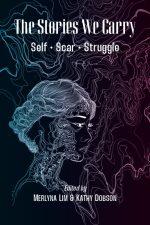
The Stories We Carry
The Stories We Carry is a compelling collection of essays that explore identity, trauma, and resilience through deeply personal narratives. Edited by Merlyna Lim and Kathy Dobson, this volume brings together twenty-two contributors—academics, artists, journalists, and storytellers—who refuse to separate personal experience from scholarly inquiry.
The collection unfolds in three interconnected movements: Self, Scar, and Struggle, examining how identity is shaped through history, gender, embodiment, and migration; how trauma and exclusion leave lasting marks; and how survival requires ongoing negotiation with institutions, technology, and community. Each essay is accompanied by hand-drawn illustrations, making the personal visible and visceral.
The contributors challenge academic conventions that dismiss personal writing as less rigorous, arguing instead that the narrated self is a legitimate site of knowledge. Their stories address Islamophobia, poverty, colonialism, queerness, neurodivergence, immigration bureaucracy, and the politics of belonging. This is not a book seeking inclusion in broken institutions, but one that insists the table itself must be rebuilt. It asks readers to sit with complexity, contradiction, and the unfinished work of being human.
-
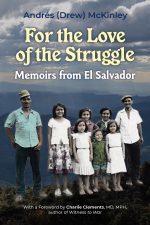
For the love of the struggle: Memoirs from El Salvador
USD $ 5.00 USD $ 18.00Price range: USD $ 5.00 through USD $ 18.00Select options This product has multiple variants. The options may be chosen on the product page
For the love of the struggle: Memoirs from El Salvador
USD $ 5.00 USD $ 18.00Price range: USD $ 5.00 through USD $ 18.00From his home in El Salvador, the author shares an intimate personal and political memoir that follows his remarkable journey from the comfort and security of a picturesque New England town to a stirring and heroic engagement in common cause with the struggle for peace and justice in El Salvador. After four years as a Peace Corp worker in northern Liberia beginning in the late 1960’s, followed by a stretch back in the United States as a street worker in the ghettos of North Philadelphia, McKinley finds himself in Central America as an aid worker in 1978. He quickly becomes engulfed by the political violence of the region and engaged with the people and their struggles against five decades of military dictatorship, centuries of poverty and exploitation. The story is marked by terror, adventure and courage, by trials and tragedy redeemed by the beauty and transcendence of people in struggle. Originally based in Guatemala heading up a Catholic relief agency, his commitment to the struggles for change in the country attracts the attention of the military, and his own government, forcing him to leave the country in late 1980. He moves to El Salvador where he begins a gradual incursion into the revolutionary struggle of this country, in a commitment that will last the rest of his life. Interwoven with this personal journey, is the story of Teresa Rivas, her husband Antonio, and their five children, a peasant family It also describes their life after the war, with resettlement in the lowlands of Guazapa where many ex-combatants were building a new life. It explains in detail the gradual emergence of the objective and subjective conditions for revolution in El Salvador, including the difficult choice for the use of violence as the only available option for transformative change in the country. The book also details the challenges of reconstruction after the Peace Accords that end the war in 1992, and the tragedy of opportunities lost during the immediate post-war period in the face of the ongoing resistance of traditional opponents to reform. As the memoir closes, the author reflects on his choice to be in El Salvador over the past 43 years, and the country as he finds it in these changing times; on the family with whom he has shared love and life there; on his continuing relationship with Antonio Rivas and his surviving family; and his gradual reconciliation, from a distance, with the country of his birth.
Select options This product has multiple variants. The options may be chosen on the product page -

Ghostlines – Re-Drawing the LAPSSET Corridor in Kenya
Ghostlines is a graphic novel that describes the journey of the author and three Kenyan artists along the LAPSSET development corridor, a braid of roads, pipelines, and resort cities that promises to bring development to Kenya’s marginalized north. It mixes conceptual and empirical insights into the human geography of infrastructure with the narrative flexibility and depth afforded by the medium graphic novel – a geo-graphic novel.
They meet Peter, a retired pilot who had previously worked for a conservancy and can tell stories about the LAPSSET from high above and from the ground. He understands how everyone involved is seeking to benefit from the corridor in their own way, even if that means building uninhabited “ghost huts” that manifest the presence of pastoral communities and thus qualify them for compensation. Jane is an activist for a women’s and Indigenous rights organization. She’s been fighting invisible monsters her entire life: stalking hyenas (metaphorical and real), corrupt politicians, and the patriarchy itself. The spectre of the LAPSSET is only the last one of these hidden monsters. They meet Joseph, a herder, who hopes that the LAPSSET might connect him to far places but worries that it will instead cut him off of the grazing grounds that are essential for the survival of his family. What is the LAPSSET – a road or a fence? In Oldonyoro they meet Rashid, a poet, who writes about the long history of the corridor. In his mind, it reaches far back to colonial times. “My grandfather suffered greatly,” he writes, “Is it my turn to face the worst? I wonder, a tricky treasure”. In the last village on their journey, they meet a group of women who have come together to support each other. Their position on the LAPSSET is more optimistic. The real connections of solidarity they forged contrast with the imaginary ghostlines of the LAPSSET. The narrative structure of the geo-graphic novel draws connections between the narrators, that is, the team of researchers and artists and the interviewees. They seek to unravel the idea of the omniscient or unbiased narrator and to reveal how storytellers bring their own ghosts into stories. By connecting all of these narratives along their journey, they challenge the single, universalist story that planners tell about large-scale infrastructure projects. Instead, they invite the reader to embrace the often-contradictory multiplicity of infrastructural relations, to see the ostensibly solid lines on maps for what they are: a messy, ever-changing braiding of multitudes.
-
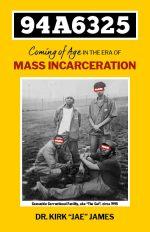
94A6325
USD $ 7.99 USD $ 25.00Price range: USD $ 7.99 through USD $ 25.00Select options This product has multiple variants. The options may be chosen on the product page
94A6325
USD $ 7.99 USD $ 25.00Price range: USD $ 7.99 through USD $ 25.0094A6325 is the compelling coming-of-age memoir of Dr. Kirk “Jae” James, a Black male, Jamaican immigrant, and father, chronicling his nearly decade-long experience (3,268 days) within the New York State carceral apparatus. The narrative is anchored by his arrest on April 13, 1994, when he was 18 years old, charged under the draconian Rockefeller Drug Laws and subsequently sentenced to life in prison. The story details his survival in infamous facilities such as Rikers Island, the maximum-security adolescent prison “The Cat” (Coxsackie), and Wyoming, where he fought to maintain his humanity while facing overwhelming fear and anxiety.
The book powerfully illustrates how legislative actions like the 13th Amendment, “tough on crime” rhetoric, the 1994 Crime Bill, and the 1996 Immigration laws acted as contemporary black codes and slave catchers, perpetually dehumanizing and criminalizing Black and brown populations. Jae endures three denials by the Parole Board while simultaneously fighting a six-year battle against a mandatory deportation order.
Drawing inspiration from mentors and comrades—including revolutionaries and activists like George Jackson and Pops—Jae transforms his time in prison into a quest for knowledge and self-actualization, culminating in earning an Associate Degree and winning his 212c waiver hearing against deportation in 2002.
More than just a survival story, 94A6325 serves as a vital first-person account and a call to embrace Abolition. The author, now a Clinical Assistant Professor at NYU, shares his journey as essential knowledge needed to confront the historical violence and systemic white supremacy woven into American democracy, urging readers to imagine a world without human cages, grounded in abundance and love. The story officially ends with his release on March 25, 2003.
This book is the first part in a series, with this one focusing on his incarceration from 1994 to 2003.
Dr Kirk “Jae James” talks about the book. The event centered on Dr. Kirk James’ memoir “94A6325: Coming of Age in the Era of Mass Incarceration,” which explores his nearly 9-year incarceration experience and its broader implications for systemic injustice. The panel discussion included Councilman Yusuf Salam, Dr. Michelle Munson, and Dr. Pierre Hargrove, who engaged in a conversation about the human impact of mass incarceration, the importance of community support during incarceration, and the ongoing challenges faced by formerly incarcerated individuals. The participants shared personal experiences and insights, highlighting the need for systemic change, the power of storytelling, and the resilience of those affected by the criminal justice system. The event aimed to foster reflection and dialogue on the structural harms of mass incarceration and the potential for collective healing and transformation. Watch the video here.
Published in collaboration with:
Select options This product has multiple variants. The options may be chosen on the product page