

Karim Hirji
Karim F Hirji is a retired Professor of Medical Statistics and a Fellow of the Tanzania Academy of Sciences. A recognized authority on statistical analysis of small sample discrete data, the author of the only book on the subject, he…
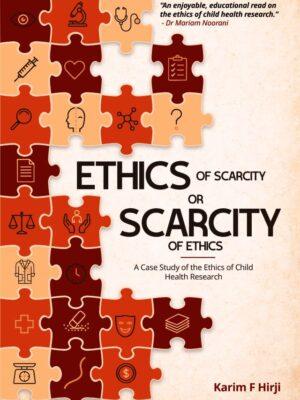
Ethics of Scarcity or Scarcity of Ethics is a journey into child health research with implications on the broader field of ethics of health research in the Global South. In contrast to other books on the topic, Ethics covers a wide terrain from micro-ethics to macro-ethics, conservative realism to radical realism, and immediate causes to systemic, root causes.
Ethics is written in a clear and engaging style by Dr. Karim F Hirji, a retired Professor of Medical Statistics, who was catalyzed by his participation in a study that utilized chest circumference to identify low birth weight babies. Hirji is an award winning biostatistician who has led research projects and taught in the United States, Norway and Tanzania. In Ethics, Hirji presents a critique of research methods that fail to confront the economic and political structures underlying the health issues faced by the people of the Global South.
Ethics begins with a sanguine interaction between two pediatricians and the author at the Muhimbili National Hospital in Dar es Salaam, Tanzania. Their exchange leads to the design, conduct, analysis and publication of a study that tackles a need to identify low birth weight babies in areas where weighing scales are not available. At the outset, the study is deemed a scientifically valid and ethically laudable undertaking. Yet, later revelations raise questions about its ethics and rationale. These doubts compel Professor Hirji years later, to reevaluate his own study and undertake a comprehensive survey of the literature on low-birth-weight studies from a systemic perspective.
Hirji determines a fundamental flaw in the low birth weight studies in that they accept the notion of scarcity of resources, a notion that he presents as ethically and factually dubious. The low birth weight studies fail to examine the misuse and abuse of resources that often lie at the root of the health maladies in the poor nations. The authors of the low birth weight studies do not question the priorities of nations that invest in large military budgets but not key items like weighing scales in rural clinics. The low birth weight studies, including his own, bypass these fundamental issues and instead seek a proxy measure to replace direct weighing. Hirji finds that not only is the general the scientific quality of the reviewed studies substandard, but also deems that their adherence to the tenets of the Nuremberg Code of research on human subjects wanting.
Ethics is an exposé of how health research in the poor nations superficially address or ignore fundamental features of the societal context that cause scarcity. Hirji illustrates this through examples, including the double standard of western researchers whose ethical focus is informed consent, while ignoring the broader moral issues of governments that violate human dignity with impunity. On the question of informed consent, consent from the authorities is taken as a valid substitute for individual consent. Ethics calls on researchers to avoid elitist conceptions of ethics and probe the root causes of health maladies, address systemic problems, ask critical questions and genuinely respect human dignity when undertaking health studies.
USD $ 23
Karim F Hirji is a retired Professor of Medical Statistics and a Fellow of the Tanzania Academy of Sciences. A recognized authority on statistical analysis of small sample discrete data, the author of the only book on the subject, he…
| Book Format | Print Book |
|---|
There are no reviews yet.
Only logged in customers who have purchased this product may leave a review.

John S. Saul, born and first educated in Toronto, Canada, moved to Tanzania almost sixty years ago and, since then, has also taught in Mozambique and South Africa as well as back in Canada at York University. In Tanzania, he discovered the centrality of the war for freedom from white rule and global capitalist dictate then taking shape further south – in Mozambique, Angola, Zimbabwe, Namibia and South Africa. Both his scholarly interest and his activist bent drew him to support and to seek to better understand the struggles in these nations-in-the-making, a political choice that now culminates in a final trilogy of books under the general title, The Rethinking Southern African Liberation Trilogy. The first volume of this trilogy, On Building a Social Movement: The North American Campaign for Southern African Liberation Revisited, was published by Africa World Press / Fernwood Books (2017). The present book is the second in that trilogy, with a third volume entitled Class, Race and the Thirty Years War for Southern African Liberation – A History set to conclude his work to be published by Cambridge University Press in 2022.
Here, Saul’s extended first chapter lays out the broad premises of the thinking that has guided his endeavours, ideas that takes the core reality of economic production and exploitation centrally but that are alive to the tangible impact on outcomes of a wide range of other social realities, including class, race, gender, sexuality, nationalism, the environment, politics and the state. A second section covers the essential unity of theory and political practice that underpins Saul’s findings. And a third and final section paints illuminating pictures of some core aspects of the diverse regional contexts — sites of both recolonization and continuing struggle, and all contexts whose trajectories will be further explored in his forthcoming third volume.

The book is a literary project with extra-literary objectives and implications. The texts combine various original writing styles to provoke the reader’s creative imagination and make auratic social space attainable. For realizing its main goal, through its creative aesthetics, the book debases normalized forms of social violence, exclusionism, and tribalism. It is meant to be universally relatable by an average reader regardless of her perceived and proclaimed identities. In a way, it is an embodiment of postnihilism, which is a philosophical theory that emphasizes the significance of negativity in the face of unspoken social rules of exclusionism. Postnihilism has been theorized in Revolutionary Hope After Nihilism (Bloomsbury 2022). “Auratic space” is a concept advanced in Totalitarian Space and the Destruction of Aura(SUNY Press 2019) and The Death of Home (De Gruyter 2024).
S. Bahozde’s (Saladdin Ahmed) Elsewhereness antipoetry actualizes its stated marching orders via forceful dialectical serial logic and keen humor (hilarity, really). This book is an “act of attacking the unimaginability of a better world. The Bikonian-Fanonian bursts of anti-poetics, their counter-measures break past the givens to model how such—proper name, place, political calculus—engender and resist, repel and authorize cunning sequences of anti-capitalist trespass. An (anti-) poetics that playfully negates its aesthetic medium of refusal and choice, all the while setting its sights on its key mark: encroaching nihilism in the face of brutal displacement. S. Bahozde’s work dismantles claims in favor of negations, clearing forth space for open-ended, future liberatory claims. Its poetry as propositional logic’s meditations on completion, works, and absence is shudderingly smart. This is poetry as food fueling revolutionary exilic work.”
— Jeremy Matthew Glick, Professor African Diasporic Literature and Modern Drama. Hunter College, English Department, City University of New York, author of The Black Radical Tragic
A voice speaks here which is at once profoundly Kurdish and cosmopolitan. While tracing the melancholy of the spaces of exile, its loneliness and longing, Bahozde takes the reader into spaces where the disillusionment with history does not lead to nihilism. Here the brevity of aphorism tackles the tangled metaphysics of absence and existence. Here is a foreignness that take us away from “pickled banalities” and disturbs our complacent belonging to places, nations, and histories
— Rohit Dalvi, professor of philosophy, Brock University, author of Deleuze and Guattari Explained
This is a passionate and bold set of works that range over topics and concerns widely with an almost febrile intensity. Bahozde’s poetic negations of “normalcy” gain their strength both from rich philosophical insights and from a searching, provocative imagination. Even when set in moments of apparent languor, they have an evident, restless energy.
— Gaurav Majumdar, Whitman College; author, Illegitimate Freedom: Informality in Modernist Literature, 1900-1940

Since its first edition in 2005, Global Health Watch (GHW) – the flagship publication of the People’s Health Movement (PHM) – has been critically reporting on the state of the world’s health. Published every three or four years, it comments on developments in global health while focusing on continuities with past popular struggles.
As with previous editions, GHW7 comes to life with contributions from over one hundred activists around the world, sharing experiences and analysis on issues affecting people’s health in the contexts they live in and efforts to progress towards greater health justice. This process was energized by the fifth People’s Health Assembly (PHA5), the global gathering of PHM, that took place in Argentina in April 2024 under the motto “Making ‘Health for All’ our struggle for ‘Buen Vivir”.
Political contributions from Latin America are manifest in the first GHW7 section, dedicated to “The global political and economic architecture”, where an up-to-date analysis of current health crises is followed by contributions that frame them in an eco-feminist perspective, showing how alternatives can be rooted in ancestral wisdoms and the practice of ‘Buen Vivir’. The second section addresses old and new challenges for public and global health systems through the critical lenses of gender justice and decoloniality. The third section, “Beyond Healthcare,” addresses key social and environmental determinants of health, while the “Watching” section critically apprises the state of global governance for health with a focus on several key institutions. The final section, “Resistance, struggles and alternatives,” highlights areas of transformative change by health activists in a global context of increasing repression. The book ends with a chapter on PHA5, highlighting how collective action is the most powerful medicine against ill health and health inequality at the human and planetary levels.
Global Health Watch 7 will include the following chapters
Chapters A2 and A3 have been translated from Spanish by Lila Esther Silgado Villadiego.
Summaries of the chapters that are currently available can be viewed by scrolling down and clicking on the “Description” tab. You can also download the chapters highlighted below.
Introduction: Mobilizing for Health Justice
A1. From a Political Economy of Disease to a Political Economy for Wellbeing
A2. Life at the Center: Ecofeminisms and Ecoterritorial Feminisms in the Struggle for Life
A3. Ancestral and Popular Knowledge for Buen Vivir
B1. Privatization and Financialization of Health Systems: Challenges and Public Alternatives
B2. Artificial Intelligence, Digital Technologies, and Health
B3. Building Equitable Health Systems: A Transformative Proposal from an Intersectional Gender Perspective
B4. Abolition Medicine as a Tool for Health Justice
B5. Decolonizing Global Health
C1. War, Conflict and Displacement
C2. People on the Move
C3. Putting the Right to Health to Work
C4. Tax Justice: A Pathway to Better Health
C5. Commercial/Corporate Determination of Health
D1. WHO’s Compromised Role in Global Health Leadership
D2. Unpacking Our Pandemic Failures for Future Pandemic Prevention, Preparedness, and Response
D3. Financing Pandemic Recovery, Prevention, Preparedness and Response
E1. National Struggles for the Right to Health
E2. Taking Extractives to Court
E3. Fear and Hope in ‘Speaking Truth to Power’: Struggles for Health in Times of Repression and Shrinking Spaces
E4. 5th People’s Health Assembly: Advancing in the Struggle for Liberation and Against Capitalism

This is a biography of the life of Dr Eyad El Sarraj, Gaza’s pioneering psychiatrist and founder of the Gaza Community Mental Healthcare Programme, written by his son, Wasseem El Sarraj. It is also a history of Palestine with a focus on Gaza. Eyad’s life was intimately intertwined with Palestine’s struggles so his choices and reactions reflected many of the major historical moments of the last 70 years. The book is an effort to provide a perspective on how the forces around him impacted his life, and how he took control of what he could achieve in an intractable situation. The book is interspersed with Wasseem’s own reflections as a mixed-race Palestinian, and as someone who has lived under occupation in Gaza.

This is a collection of observations and meditations by Professor Emeritus (York University, Toronto) and philosopher Ato Sekyi-Otu on events, issues, people and ideas culled from recent history and the world, from the US and Canada to Ghana. If there is a persistent thread in these entries, it is this: Virtually all of them testify to the ironic truth of the saying that there is no place like home, no place, that is to say, which looks like the lodestar called home or comes close to approximating its promise of being a just space of human flourishing. Most of the entries are, therefore, harsh, particularly those on the USA. That is because that nation, in his view, has, in recent history, made a major contribution to rendering the world and every homestead we inhabit unhomely and sabotaging attempts to better it. But no one or place is spared, certainly not the author’s native land, Ghana. Canada appears intermittently in these pages in rather fragmentary and contrastive observations. That paucity of comments may be taken to be the complement the author pays to Canada as a place of relative civility and glimmers of decency in a mad and cruel world. It is a short work of predominantly gloomy pictures. But there are a few countervailing images and invocations of hope here and there. There are 166 entries of unequal lengths arranged around 14 headings. These epigrams are contrapuntal variations on the philosopher’s searing imprecation and visionary invocation: unfinished ode, resounding with intermittent fury, to the dawn of human existence set free from all tyrannizing enclosures.
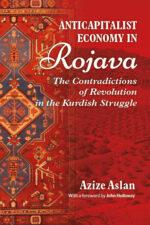
This book looks at the anti-capitalist economy and the organization of social relations in the context of the revolution and autonomy of Rojava (Kurdistan-Syria). It questions both the limitations and the historical problems of the phenomenon of revolution, and the conflicts and contradictions that emerge in this process. It also draws from the conflicts and contradictions the author has consistently felt as a “political subject” who wants to change the world, especially through her experience in the Kurdish struggle and the Kurdish Movement. For this reason, every question she raises and attempts to answer in this book—about the Kurds, Rojava, and the world in general, involves what she says is her own subjectivity.
The idea and dreams of revolution have existed since humans created systems of domination. Indeed, revolution, meaning the liberation from systems of domination, has undoubtedly been one of the most discussed subjects in history. There have been moments when the possibility of revolution has been clearer, and there have also been certain agreements on what it is and how to get there, but it has never been something completely definable. This continues to be true today. This book does not intend to define this great phenomenon, rather it looks at the revolutionary practices that create emancipating realities and embraces revolution as an undefined, contradictory and dynamic process. Although the rulers have traditionally written history, the history of social struggles has been and is still being created by many revolutionary and transformational processes. The future is being shaped based on desired revolutions and the struggles that, in turn, transform their actors, the people. Therefore, the desire and quest of the Kurdish people for liberation from the colonial rule of the nation-states of the Middle East—the subject of this book—has always been directly linked to the phenomenon of revolution.

In recent years, we have witnessed renewed calls for women to embrace anger as a source of power. These voices have Lorde’s “The Uses of Anger”, first delivered at the University of Connecticut (UCONN), Storrs, in 1981, to thank for charting an innovative scholarly and poetic terrain that theorizes anger as much more empowering and liberating than conventional discussions of the term typically allow.
Lorde’s essay redefined anger productively, approaching it as an epistemological tool igniting a desire for self and collective liberation. The result was a remarkable critical reflection that laid the groundwork for deconstructing broader systems of oppression, particularly, heteronormativity, heteropatriarchy, institutionalized racial poverty, racial capitalism, and white privilege. Lorde’s essay moved with precision, centering Black women’s struggles in a world built around the use – and abuse – of racialized people subjected to systematic dehumanization.
In their introduction, Jane Anna Gordon, Elva Orozco Mendoza, and Sherry Zane reflect on the inheritance, lessons, and responsibilities that Women’s, Gender, and Sexuality Studies must grapple with if it is to deepen and fulfill its radical mission.
Guided by the imperative to look backward to understand the present and forge a future, the book closes with a sankofic interview with M. Jacqui Alexander and Beverly Guy-Sheftall, conducted by Briona Simone Jones.

This work consists of a brief attempt to orient the study of the neocolonial state in Africa through an assessment of the manner in which it rules its people. It is argued that the state produces different modes of rule by deploying different politics over different parts of the population. In this manner, it can combine a genuinely democratic rule in the image of the West over some while subjecting the majority to colonial forms of domination. Imported political subjectivities from the West and its obsession with human rights discourse are reserved largely for a sphere of civil society in which the right to have rights is conferred upon citizens. In the domains of uncivil society and traditional society, the right to rights is not observed by the state so that different subjectivities, regularly including violence, govern the manner political problems and solutions are addressed both by the state and by people. In consequence, distinct political subjectivities prevail in the conceptualization of popular resistance in all three domains, and it becomes difficult to rally such different concerns and conceptions within an overall anti-neocolonial struggle.
Il s’agit d’une brève tentative d’orienter l’étude de l’État néocolonial en Afrique à travers une évaluation de la manière dont il gouverne son peuple. On soutient que l’État produit différents modes de contrôle étatique en déployant différentes politiques sur différentes parties de la population. De cette manière, il peut combiner une règle véritablement démocratique à l’image de l’Occident sur certains tout en soumettant la majorité à des formes coloniales de domination. Les subjectivités politiques importées de l’Occident et son obsession du discours sur les droits de l’homme sont largement réservées à une sphère de la société civile dans laquelle le droit d’avoir des droits est conféré aux citoyens. Dans les domaines de la société incivile et de la société « traditionnelle », le droit aux droits n’est pas respecté par l’État, de sorte que différentes subjectivités, y compris régulièrement la violence, régissent la manière dont les problèmes politiques et leurs solutions sont abordés à la fois par l’État et par le peuple. En conséquence, des subjectivités politiques distinctes prévalent dans la conceptualisation de la résistance populaire dans chacun des trois domaines, et il devient difficile de rallier des préoccupations et des conceptions aussi différentes au sein d’une lutte anticoloniale nation
DarajaPress uses Accessibility Checker to monitor our website's accessibility.