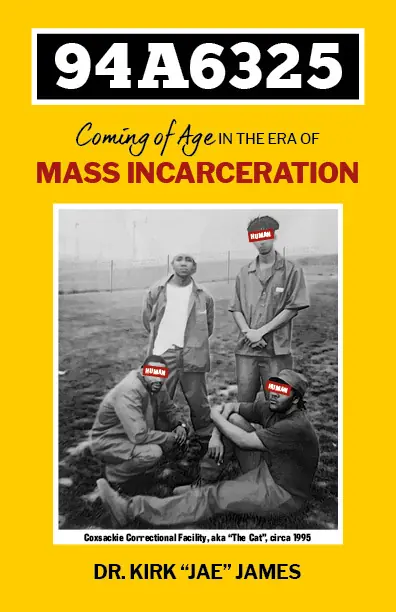
94A6325 is the compelling coming-of-age memoir of Dr. Kirk “Jae” James, a Black male, Jamaican immigrant, and father, chronicling his nearly decade-long experience (3,268 days) within the New York State carceral apparatus. The narrative is anchored by his arrest on April 13, 1994, when he was 18 years old, charged under the draconian Rockefeller Drug Laws and subsequently sentenced to life in prison. The story details his survival in infamous facilities such as Rikers Island, the maximum-security adolescent prison “The Cat” (Coxsackie), and Wyoming, where he fought to maintain his humanity while facing overwhelming fear and anxiety.
The book powerfully illustrates how legislative actions like the 13th Amendment, “tough on crime” rhetoric, the 1994 Crime Bill, and the 1996 Immigration laws acted as contemporary black codes and slave catchers, perpetually dehumanizing and criminalizing Black and brown populations. Jae endures three denials by the Parole Board while simultaneously fighting a six-year battle against a mandatory deportation order.
Drawing inspiration from mentors and comrades—including revolutionaries and activists like George Jackson and Pops—Jae transforms his time in prison into a quest for knowledge and self-actualization, culminating in earning an Associate Degree and winning his 212c waiver hearing against deportation in 2002.
More than just a survival story, 94A6325 serves as a vital first-person account and a call to embrace Abolition. The author, now a Clinical Assistant Professor at NYU, shares his journey as essential knowledge needed to confront the historical violence and systemic white supremacy woven into American democracy, urging readers to imagine a world without human cages, grounded in abundance and love. The story officially ends with his release on March 25, 2003.
This book is the first part in a series, with this one focusing on his incarceration from 1994 to 2003.
Dr Kirk “Jae James” talks about the book. The event centered on Dr. Kirk James’ memoir “94A6325: Coming of Age in the Era of Mass Incarceration,” which explores his nearly 9-year incarceration experience and its broader implications for systemic injustice. The panel discussion included Councilman Yusuf Salam, Dr. Michelle Munson, and Dr. Pierre Hargrove, who engaged in a conversation about the human impact of mass incarceration, the importance of community support during incarceration, and the ongoing challenges faced by formerly incarcerated individuals. The participants shared personal experiences and insights, highlighting the need for systemic change, the power of storytelling, and the resilience of those affected by the criminal justice system. The event aimed to foster reflection and dialogue on the structural harms of mass incarceration and the potential for collective healing and transformation. Watch the video here.
Dr. Kirk “Jae” James is an activist, scholar, writer, and speaker whose work sits at the intersection of love, critical consciousness, and collective liberation. Grounded in lived experience and academic research, Jae challenges systems of oppression through abolitionist scholarship,…
Dictators as Gatekeepers for Europe is a detailed journalistic account of how the EU is attempting to limit mobility within the African continent as a matter of the EU’s domestic policy agenda, hence the title hinting at the many agreements (with Turkey, Libya, Sudan) aimed at blocking migrants from approaching the European continent. The new “Berlin Wall” not only encircles Europe, but also generates a proliferation of militarised borders in Africa. …To summarise, the authors argue, Europe desires protected borders and open markets. The novelty is the amount of material that this book contains about African desires and strategies, both as a continent and as single states. This, in particular, makes the work a collection of extremely valuable directions of research. In fact, Africa, if one were to simplify the continent’s intentions, is depicted as aspiring to the exact opposite of Europe, namely open borders (with the African Union aspiring to free movement within the continent) and protected markets (protected from Western corporate predatory strategies). Moreover, contrary to the narrative of aid according to which the West “helps develop” Africa, the figures quoted by the authors suggest the opposite: while Sub-Saharan Africa receives $134 billion a year in development funding, $192 billions flow out of Africa, with $46 billion in profit for major corporations and another $35 billion vanishing in tax havens (218). https://www.law.ox.ac.uk/research-subject-groups/centre-criminology/centreborder-criminologies/blog/2022/02/double-book by Oana Pârvan.
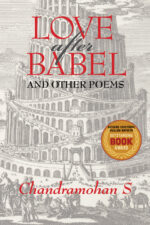
Love after Babel is a collection of poems that deal with themes such as caste, the resistance of Dalit people, Dalit literature, islamophobia and other political themes, with almost one hundred poems divided into three sections (Call Me Ishmail Tonight; Name Me a Word; Love after Babel). The introduction is by Suraj Yengde (award-winning scholar and activist from India, author of the bestseller Caste Matters, inaugural postdoctoral fellow at the Initiative for Institutional Anti-racism and Accountability, Shorenstein Center on Media, Politics and Public Policy at the Harvard Kennedy School).
Chandramohan’s poems are dialogues of the ‘ self’ with the ‘other’. He brings to life a world that subverts myths, literary canons, gender and caste stereotypes by pooling in sparklingly new metaphors with sensitivity and care. He draws his images from contemporary incidents as well as myths and legends of yore, and delves deep into the politicized realm, thus ‘rupturing the hymen of demarcations’ of identity, resistance, repression and love.
The Travails of a Tanzanian Teacher is a riveting account of the bumpy first decade of the work life of Karim F Hirji, a retired Professor of Medical Statistics. Filled with a distinctive variety of eye-opening episodes, it covers lecturing at the University of Dar es Salaam, the life of a political exile in a remote rural area and the challenges of setting up from scratch a one-of-a-kind educational institute in Africa. With a style that seamlessly combines the personal with the general, Hirji provides an illuminating description of different aspects of the Tanzanian political, educational, economic and rural landscape during the 1970s. Starting with a commentary on teacher training, he concludes with a critical comparison of modern university education in the nation with that of the earlier era.
USD $ 26.00
Select options
This product has multiple variants. The options may be chosen on the product page
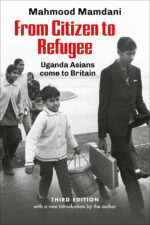
In his introduction to this new edition of From Citizen to Refugee: Uganda Asians Come to Britain, Mahmood Mamdani reminds us that long before 1972, most Ugandan ‘Asians’ had already been disenfranchised by law, both Ugandan and British. Despite a global industry that insists otherwise, Uganda Asians are a poor fit as victims: there was no large-scale loss of life during the expulsion, nor were there massacres of Asians, only of ‘indigenous’ peoples. Asians in Uganda, as in East or Southern Africa, he argues, were immigrants, not settlers: immigrants are prepared to be a part of the political community, whereas settlers ‘create their own political community, a colony, more precisely, settler colonialism.’ Mamdani insists that there is no single Asian legacy. there are several and they are contradictory. The Asian question in Uganda remains, but it is no longer the original Asian question. But it does allow us to think more broadly. Just as US law recognizes African Americans as Americans of African descent, so too must those of Asian origin in Africa consider themselves, and be considered, Asian Africans. It is in his bittersweet and touching book on the Asian expulsion from Uganda that one can trace the beginnings of author and intellectual Mahmood Mamdani’s world-view.. … In From Citizen to Refugee: Uganda Asians Come to Britain Mamdani offers portraits of people reduced to a vegetative existence in refugee camps, feeling the burden of not being fluent in English and struggling with the uncomfortably cold weather. Not surprisingly, these few months played a pivotal role in shaping Mamdani’s theoretical and political leanings, and it is here that one can locate his preoccupation with the formation of racial, ethnic and class identities during the colonial era and his overarching concern with issues of citizenship.
USD $ 22.00
Select options
This product has multiple variants. The options may be chosen on the product page
Mississipi; el estado más pobre de los EEUU, el que tiene el porcen- taje más alto de población Negra y con una historia dramática de terror racial y de resistencia Negra. Este es el contexto de la resistencia presentada en este recopilatorio de escritos.
Sin desanimarse por la incertidumbre, el miedo y la an- siedad causadas por el constante deterioro del orden ne- oliberal, la respuesta de las activistas Negras de Jackson ha sido organizarse. Inspiradas por la rica historia de lucha y resistencia en Mississipi y comprometidas con la Estra- tegia Jackson-Kush, construyen instituciones arreladas en el poder comunitario, que combinan política y desarrollo económico y que satisfacen necesidades reales de la gente para crear un model social alternativo.
Las experiencias y análisis recogidas reflejan el poder creativo que se genera cuando la lucha política se basa en una visión del mundo liberada de las contradicciones y li- mitaciones inherentes al liberalismo. Esta es, en definitiva, una historia sobre un porceso decolonial y socialista, orga- nizado y dirigido por personas Negras.
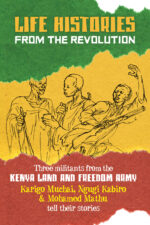
In the early 1970s, Donald Barnett — who worked with Karari Njama to produce Mau Mau From Within (published by Daraja Press) — also worked with three militants of the Kenya Land and Freedom Army to enable them to tell the story of their experience in fighting for freedom and against British colonialism. These rarely acknowledged militants were Karigo Muchai, Ngugi Kabiro and Mohamed Mathu. Their stories were published in 1973 by LSM Information Center (Richmond, British Columbia, Canada) as part of a series entitled Life Histories of the Revolution, as The Hardcore: The Story of Karigo Muchai; The Man in the Middle by Ngugi Kabiro; and The Urban Guerrilla by Mohamed Mathu.
As part of its mission of Nurturing reflection, sheltering hope and inspiring audacity, Daraja Press is please to republish the three booklets as a book that will help a new generation of activists — Kenyan and international — reflect on a history that might inspire audacious struggles to continue the struggle for freedom that was the goal of the Kenya Land and Freedom Army.
Donald Barnett’s introduction to each booklet contained the following text:
The life histories in this series have been recorded and prepared as historical documents from the revolutionary struggles of our time. The techniques and methods employed at each stage of the process, from initial contact to final editing, have therefore been chosen or fashioned with the purpose of guaranteeing the authenticity and integrity of the life history concerned. These stories, then, to the best of our ability to make them so, constitute a body of data and testimony as revealed by a few of those history-makers normally condemned to silence while others speak on their behalf.
The collection of essays in Partisan Universalism celebrates the work of Ato Sekyi-Otu, a scholar, teacher and friend, marking his extraordinary contribution to the philosophy, politics and praxis of liberation. As Ato Sekyi-Otu has argued in his recent book, Left Universalism, Africacentric Essays (Routlege 2019), universalism is an ‘inescapable presupposition of ethical judgment in general and critique in particular, especially indispensable for radical criticism of conditions of existence in postcolonial society and for vindicating visions of social regeneration’. Universalism must and can only be partisan.
“Responding to the invitation ‘to re-member severed but shareable things’, these lovers of truth, freedom, and dignity celebrate the searing intellect, generosity, wit, and compassion of the person and the scholar Ato Sekyi-Otu. … this is a precious contribution. Not to be missed!” —Jane Anna Gordon, author of Statelessness and Contemporary Enslavement and co-editor (with Drucilla Cornell) of Creolizing Rosa Luxemburg. /
“Critically engaging Ato Sekyi-Otu’s notion of partisan universalism, this timely volume of essays speaks directly to the onto-metaphysical issues that will give Africana thought the new foundations that will enable it to move beyond the linguistic turn, brush aside the ashes of Afro-pessimism. … A must read for all concerned with the future of Africana theory and praxis.” —Paget Henry, author of Caliban’s Reason/
“Ato Sekyi-Otu’s thought is one of the most important and exciting in Africa today. The texts compiled in this volume celebrate and engage with the work of Sekyi-Otu … They bear eloquent witness to Sekyi-Otu’s stature as a thinker and to his consistent commitment to the universalization of humanity in both theory and practice.” — Michael Neocosmos, Emeritus Professor in the Humanities, Rhodes University, South Africa.
The pamphlet begins with two letters written by Paul the Apostle in which Christianity first acquires a universal address. The new religion came to exclude people who were not Christians from the count of the human. This became explicit around a thousand years later when Pope Urban II authorised the First Crusade.
In 1492 planetary history was split in to two. Muhammad XII of Granada conceded defeat to Isabella and Ferdinand, the Catholic monarchs of Portugal and Spain, who went on to expel the Jews from the territory under their control. Europe became a Christian project. In the same year Christopher Columbus arrived in the Caribbean and Europe also became an imperial project with a planetary reach.
The origins of the racial ideology can be seen in this period, in which ideas about religion came to be entangled with fantastical ideas about the imagined purity of blood. But it was in the English colony of Virginia in the seventeenth century that the legitimation for the exclusion from the count of the human began to move from claims made in the name of religion to claims made in the name of science. This is the point at which modern racism, rooted in the appearance of the body, began to cast its malignant shadow across the planet.
The author argues that the struggle to put an end to the epoch of world history that opened in 1492 will require new ideas, and new practices. It follows the Caribbean tradition that runs from Aimé Césaire to Frantz Fanon and Sylvia Wynter in affirming the need for a counter-humanism, a radical humanism, a humanism that, in Césaire’s famous phrases, is “made to the measure of the world”. There is a need for a shift in the ground of reason towards the lived experience and struggles of people rendered, in Wynter’s phrase, as ‘pariahs outside of the new order’.