

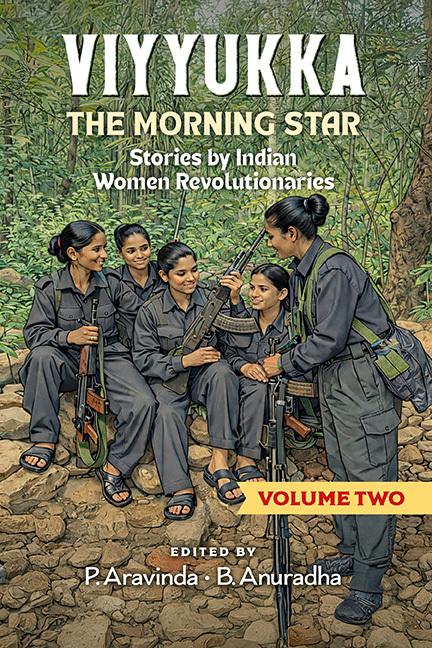
Viyyukka – The Morning Star (Vol 2)
Voices of India's Women Revolutionaries
Co-publisher:Revolutionary Writers Association
Categories: Asia, Biography, Colonialism, Feminism, India
Edited by P. Aravinda and B. Anuradha
This second volume of Viyyukka continues the powerful anthology of stories written by women revolutionaries in India’s Maoist movement, translated from Telugu to English. The collection brings together narratives penned by guerrilla soldiers who document their lived experiences within the revolutionary struggle, offering rare insights into the intersection of armed resistance, gender politics, and Adivasi community life.
The stories span four decades of revolutionary movement history, capturing both tactical engagements and intimate human moments—love, loss, camaraderie, and daily existence in guerrilla squads. What distinguishes this volume is the inclusion of autobiographical sketches by Adivasi women, narrated in their own tongues, detailing the circumstances that led them to become guerrillas. These first-person accounts reveal how poverty, land dispossession, state repression, and patriarchal violence converge to shape revolutionary consciousness.
Set primarily in the Dandakaranya forest region spanning multiple Indian states, the narratives illuminate the movement’s efforts to build alternative structures of governance through Janatana Sarkars (people’s governments), which implemented collective farming, education, healthcare, and resistance to mining corporations. The stories confront the brutal reality of state counter-insurgency operations including Salwa Judum and Operation Green Hunt, while celebrating the resilience of women who constitute nearly half the guerrilla army.
The collection demonstrates how women revolutionaries perform multiple roles—soldiers, writers, historians, doctors, and teachers—documenting their own history while fighting for land, dignity, and self-determination. These are not conventional fictions but testimonies written under extreme duress, smuggled across regions and preserved against overwhelming odds, offering a window into one of India’s most significant contemporary resistance movements.
This is a powerful and timely book. Reading Viyyukka is to encounter history in its most urgent form: not as abstract doctrine, but as the lived, written, and too-often silenced testimony of women for whom the pen was as vital as the gun. This anthology does not simply add voices to a historical record; it fundamentally questions the record itself. By foregrounding the female guerrilla imaginary—with its profound complexities of comradeship, grief, motherhood, and even the critique of revolutionary justice—these stories exceed the boundaries of political propaganda to become essential documents of human endurance and creativity. In a time when their politics is declared defeated, the women of Viyyukka remind us that some struggles are not measured by victory alone, but by the indestructible insistence on bearing witness. — Sharmila Purkayastha, independent researcher, New Delhi
ISBN Print: 9781997742272
Publication Date: March 2026
Page Count: 302
Binding Type: Soft cover
Trim Size: 6in x 9in
Language: English
USD $ 5.00 USD $ 26.00Price range: USD $ 5.00 through USD $ 26.00
| Book Format | Print Book, PDF |
|---|
Customer Reviews
There are no reviews yet.
Only logged in customers who have purchased this product may leave a review.
Related products
-

The imperative of Utu / Ubuntu in Africana scholarship
USD $ 5.00 USD $ 15.00Price range: USD $ 5.00 through USD $ 15.00Select options This product has multiple variants. The options may be chosen on the product page
The imperative of Utu / Ubuntu in Africana scholarship
USD $ 5.00 USD $ 15.00Price range: USD $ 5.00 through USD $ 15.00Written in commemoration of the 50th anniversary of Africana Studies and Research Center, Cornell University, this publication celebrates the birth of Black studies as a liberated academic zone. Professor Mũgo reflects upon the significance of Africana studies, specifically within the context of America’s predominantly White universities, revisiting the hers/his/torical context that birthed Black studies as a field of knowledge. She reflects on the ownership of knowledge, its production, dissemination and custodianship while proposing utu/ubuntu as imperatives in defining transformative education. The hypothesis and heart of the argument is that knowledge and scholarship can either be colonizing, alienating and enslaving; or, alternatively, they can be conscientizing, humanizing and liberating, creating new human beings with the agency to transform life and the world, for the better. he dismisses the false myth of dominating, colonizing and imperialist cultures that claim to have a monopoly of knowledge and whose purpose is to justify the dehumanization of the conquered, the attempted erasure of their knowledges, heritages and ultimately, entire cultures.
Select options This product has multiple variants. The options may be chosen on the product page -
MATHARE: An Urban Bastion of Anti-Oppression Struggle in Kenya.
USD $ 5.00 USD $ 15.00Price range: USD $ 5.00 through USD $ 15.00Select options This product has multiple variants. The options may be chosen on the product page
MATHARE: An Urban Bastion of Anti-Oppression Struggle in Kenya.
USD $ 5.00 USD $ 15.00Price range: USD $ 5.00 through USD $ 15.00History is written by the victors of any war. But what happens when the victors forget to write down their history or omit the cog of the struggle? This is the untold story of Mathare Slum that has never been told to the world: of the role it played in anti-colonial struggle and the planning ground for the Mau Mau struggle which culminated with the fall of the British Colonial Empire in Kenya in the midnight of December 12th 1963. Mathare has also played a critical role in anti-oppression struggle against the four regimes that we’ve had since independence and continues to do so up to date. This history has not been documented and has only been done piecemeal. This has overtime eroded the rich history of Mathare and led to a distorted history of once a planning ground and a bulwark of Kenya Land and Freedom Army (KFLA). The current generation are not cognizant with the critical role Mathare played in the independence of our country. Presently, Mathare is majorly known for all the negative reasons and its proximity to Mathari Mental Hospital has contorted its image to the outside world. My story tries to re-tell the history of Mathare from an informed insider perspective by threading the struggles from the colonial era to the present day and the role it has played in agitating for social justice. My story brings to view the past history of this informal settlement in the heart of Nairobi, the present struggle and the promising future through community organizing.
Select options This product has multiple variants. The options may be chosen on the product page -
Insurgent Feminisms: Writing War
USD $ 5.00 USD $ 35.00Price range: USD $ 5.00 through USD $ 35.00Select options This product has multiple variants. The options may be chosen on the product page
Insurgent Feminisms: Writing War
USD $ 5.00 USD $ 35.00Price range: USD $ 5.00 through USD $ 35.00War is never just the war itself, it’s not the event or the epoch. War is the impossible and unending afterlife, the struggle to breathe after being bludgeoned, and the re-situating of one’s self and of one’s place after displacement and fragmentation.
Insurgent Feminisms: Writing War advances a new paradigm of war writing by focusing on gender. War is always fought upon the backs of women, often under the pretense of saving them. Yet, along the way, the brutalities unleashed on women during wartime remain relentless. In this collection, insurgency emerges in the raw and meticulous language of witnessing, and in the desire to render the space of conflict in radically different ways. These feminist and queer perspectives on war come out of regions and positions that disobey the rules of war writing. Comprising reportage, fiction, memoir, poetry, and conversations from over sixty writers, the collection includes contributions by Chika Unigwe, Nathalie Handal, Ubah Cristina Ali Farah, Suchitra Vijayan, Bélen Fernández, Uzma Falak, Otoniya Juliane Okot Bitek, Sarah Ladipo Manyika, Lara Pawson, Gaiutra Bahadur, Robtel Neajai Pailey, Sumana Roy and Lina Mounzer, among several others.
Bhakti Shringarpure co-founded Warscapes magazine in November 2011 and it has now transitioned into the Radical Books Collective.
Veruska Cantelli is a writer, translator, editor, and Associate Professor of Interdisciplinary Studies at Champlain College in Vermont, USA.
Select options This product has multiple variants. The options may be chosen on the product page -

Revolutionary Hope vs Free-Market Fantasies Keeping the Southern Africa Liberation Struggle Alive: Theory, Practice, Context
USD $ 5.00 USD $ 20.00Price range: USD $ 5.00 through USD $ 20.00Select options This product has multiple variants. The options may be chosen on the product page
Revolutionary Hope vs Free-Market Fantasies Keeping the Southern Africa Liberation Struggle Alive: Theory, Practice, Context
USD $ 5.00 USD $ 20.00Price range: USD $ 5.00 through USD $ 20.00John S. Saul, born and first educated in Toronto, Canada, moved to Tanzania almost sixty years ago and, since then, has also taught in Mozambique and South Africa as well as back in Canada at York University. In Tanzania, he discovered the centrality of the war for freedom from white rule and global capitalist dictate then taking shape further south – in Mozambique, Angola, Zimbabwe, Namibia and South Africa. Both his scholarly interest and his activist bent drew him to support and to seek to better understand the struggles in these nations-in-the-making, a political choice that now culminates in a final trilogy of books under the general title, The Rethinking Southern African Liberation Trilogy. The first volume of this trilogy, On Building a Social Movement: The North American Campaign for Southern African Liberation Revisited, was published by Africa World Press / Fernwood Books (2017). The present book is the second in that trilogy, with a third volume entitled Class, Race and the Thirty Years War for Southern African Liberation – A History set to conclude his work to be published by Cambridge University Press in 2022.
Here, Saul’s extended first chapter lays out the broad premises of the thinking that has guided his endeavours, ideas that takes the core reality of economic production and exploitation centrally but that are alive to the tangible impact on outcomes of a wide range of other social realities, including class, race, gender, sexuality, nationalism, the environment, politics and the state. A second section covers the essential unity of theory and political practice that underpins Saul’s findings. And a third and final section paints illuminating pictures of some core aspects of the diverse regional contexts — sites of both recolonization and continuing struggle, and all contexts whose trajectories will be further explored in his forthcoming third volume.
Select options This product has multiple variants. The options may be chosen on the product page -

White Saviorism in International Development: Theories, Practices and Lived Experiences
USD $ 5.00 USD $ 22.00Price range: USD $ 5.00 through USD $ 22.00Select options This product has multiple variants. The options may be chosen on the product page
White Saviorism in International Development: Theories, Practices and Lived Experiences
USD $ 5.00 USD $ 22.00Price range: USD $ 5.00 through USD $ 22.00Given the growing interest in understanding the meaning, manifestations, analyses and implications of racism in North/South relations, White Saviorism in International Development seeks to remedy the shortcomings of the development studies literature on the prevalence of White Saviorism in Western development initiatives in the Global South. The volume comprises theoretical chapters, testimonies, stories and lived experiences from 19 contributors from across the Global South. With sensitivity and intelligence, these practitioners and academics create a tapestry that unveils the implicit and explicit forms of White Saviorism in international development.
Select options This product has multiple variants. The options may be chosen on the product page -
Anticapitalist Economy in Rojava: The Contradictions of Revolution in the Kurdish Struggles
USD $ 5.00 USD $ 22.00Price range: USD $ 5.00 through USD $ 22.00Select options This product has multiple variants. The options may be chosen on the product page
Anticapitalist Economy in Rojava: The Contradictions of Revolution in the Kurdish Struggles
USD $ 5.00 USD $ 22.00Price range: USD $ 5.00 through USD $ 22.00This book looks at the anti-capitalist economy and the organization of social relations in the context of the revolution and autonomy of Rojava (Kurdistan-Syria). It questions both the limitations and the historical problems of the phenomenon of revolution, and the conflicts and contradictions that emerge in this process. It also draws from the conflicts and contradictions the author has consistently felt as a “political subject” who wants to change the world, especially through her experience in the Kurdish struggle and the Kurdish Movement. For this reason, every question she raises and attempts to answer in this book—about the Kurds, Rojava, and the world in general, involves what she says is her own subjectivity.
The idea and dreams of revolution have existed since humans created systems of domination. Indeed, revolution, meaning the liberation from systems of domination, has undoubtedly been one of the most discussed subjects in history. There have been moments when the possibility of revolution has been clearer, and there have also been certain agreements on what it is and how to get there, but it has never been something completely definable. This continues to be true today. This book does not intend to define this great phenomenon, rather it looks at the revolutionary practices that create emancipating realities and embraces revolution as an undefined, contradictory and dynamic process. Although the rulers have traditionally written history, the history of social struggles has been and is still being created by many revolutionary and transformational processes. The future is being shaped based on desired revolutions and the struggles that, in turn, transform their actors, the people. Therefore, the desire and quest of the Kurdish people for liberation from the colonial rule of the nation-states of the Middle East—the subject of this book—has always been directly linked to the phenomenon of revolution.Select options This product has multiple variants. The options may be chosen on the product page -

Strategic litigation and the struggle for Lesbian, Gay and Bisexual equality in Africa
USD $ 5.00 USD $ 25.00Price range: USD $ 5.00 through USD $ 25.00Select options This product has multiple variants. The options may be chosen on the product page
Strategic litigation and the struggle for Lesbian, Gay and Bisexual equality in Africa
USD $ 5.00 USD $ 25.00Price range: USD $ 5.00 through USD $ 25.00There has been a rise in the use of strategic litigation related to seeking equality for lesbian, gay, and bisexual (LGB) persons. Such developments are taking place against the backdrop of active homophobia in Africa. The law and the general public should, argues the author, treat LGB persons in the same way that heterosexuals are treated. In the past two decades,30 strategic cases have been fi led by LGB activists in the Common Law African countries, namely in Botswana, Kenya, Nigeria, South Africa, and Uganda. While the majority of the cases have been successful, they have not resulted in significant social change in any of the countries. On the contrary, there have been active backlashes, counter-mobilisations, and violence against LGB persons, as well as the further criminalisation of same-sex relations and constitutional prohibitions on same-sex marriages in some of the jurisdictions. The author argues that activists in Common Law Africa have to design LGB strategic litigation in such a way as to fi t within the actual social and political conditions in their countries if strategic litigation is to spur social change.
Adrian Jjuuko is an exceptional scholar. A rare combination of intellectual brilliance, commitment and hard work. The book is born of this. It reflects his incisive analytical skills, anchored in solid knowledge of the law and jurisprudential developments in the field. His ventures into political theory, philosophy, and the social sciences give the analysis additional clarity and empirical grounding.
In Strategic Litigation, Adrian Jjuuko has hugely succeeded in bringing to light pertinent issues regarding LGB rights in the African context today. By making reference to various scholarly works and critical analyses, the author has cleverly driven home the message that progressive decriminalization of LGB relationships and constitutional protection of LGB persons in Common Law Africa should be deliberate steps towards demystifying the erstwhile taboo of LGB persons’ equality and social justice. Yet, Jjuuko throws in a word of caution; societal attitudes towards LGB persons still remain largely negative, as exemplified in pervasive disapproval (including religious) of their rights. This implies that a lot is still required from all stakeholders to demystify and accommodate the social position of the LGB community in Common Law Africa today. Kisito, J. M. (2022). Book Review: Strategic litigation and the struggle for lesbian, gay and bisexual equality in Africa by Adrian Jjuuko. Feminism & Psychology, 32(4), 584-587. https://doi-org.proxy.library.carleton.ca/10.1177/09593535221104876 (Original work published 2022)
Select options This product has multiple variants. The options may be chosen on the product page -
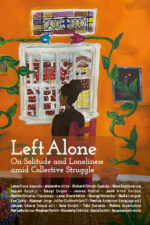
Left Alone: On Solitude and Loneliness amid Collective Struggle
USD $ 5.00 USD $ 28.00Price range: USD $ 5.00 through USD $ 28.00Select options This product has multiple variants. The options may be chosen on the product page
Left Alone: On Solitude and Loneliness amid Collective Struggle
USD $ 5.00 USD $ 28.00Price range: USD $ 5.00 through USD $ 28.00Left Alone brings together 13 authors and 6 visual artists from Africa, Asia, Latin America, Europe and North America to individually and collectively reflect – in words and images – on an urgent psycho-political issue that has not yet been explicitly addressed through a left political lens, that is, Left Loneliness. Combining academic and more personal-political texts, including an interview, poetry, a Rap and a powerful short story, the book explores the contributors personally and/or vicariously lived experiences of Left Loneliness from a variety of genres and left political currents: Marxist, Feminist, Anti-/De-Colonial, Anti-Racist, Queer, Post-Soviet, Anti-Ableist and others. Says Feminist writer Sara Ahmed: “Loneliness might be what we are threatened with if we persist in being or doing what we are being or doing.” In this sense, Left Loneliness is neither a metaphor nor a secondary contradiction and definitely not a type of petty bourgeois “personalism”. Rather, it might be considered one of the rank and file psycho-affective elements shaping and at the same time resulting from our myriad, intersecting, unremitting, yet always fragile and potentially shattering political attempts to revolutionise our inner and outer worlds. Given its (growing?) existence in our everyday left subjectivities, the book argues that Left Loneliness and related states of solitude, isolation and alienation, among others, have both debilitating and productive (epistemic) dimensions, with very concrete psycho-somatic repercussions for Left Mental and Physical Health and hence our capacities to persist and build on “being or doing what we are being or doing”. Given that continuing and deepening our multiple ongoing struggles for liberation will depend on our constant ability to (re-)create, sustain and care for both our individual selves and the communities that we are a part of, the aim of Left Alone is to contribute to the strengthening of these personal collectivities in action in-against-and beyond capitalism, colonialism and heteropatriarchy by inviting the comrade-readers into what will ideally be a deeply stimulating and enabling personal-political engagement with the texts and images hailing from countries such as Argentina, Kenya, Kyrgyzstan, Guinea-Bissau/Portugal, Turkey/Kurdistan, Jamaica, Italy, the UK, Germany and the USA. As Lena Grace Anyuolo from Kenya puts it, “My sisters and brothers, Come, Let us gather, To lay the structures for a joyous existence.”
Select options This product has multiple variants. The options may be chosen on the product page