
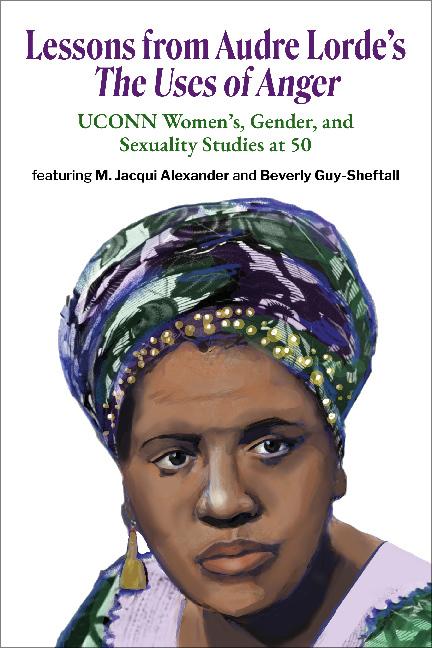
Lessons from Audre Lorde’s The Uses of Anger: UCONN Women’s, Gender, and Sexuality Studies at 50
In recent years, we have witnessed renewed calls for women to embrace anger as a source of power. These voices have Lorde’s “The Uses of Anger”, first delivered at the University of Connecticut (UCONN), Storrs, in 1981, to thank for charting an innovative scholarly and poetic terrain that theorizes anger as much more empowering and liberating than conventional discussions of the term typically allow.
Lorde’s essay redefined anger productively, approaching it as an epistemological tool igniting a desire for self and collective liberation. The result was a remarkable critical reflection that laid the groundwork for deconstructing broader systems of oppression, particularly, heteronormativity, heteropatriarchy, institutionalized racial poverty, racial capitalism, and white privilege. Lorde’s essay moved with precision, centering Black women’s struggles in a world built around the use – and abuse – of racialized people subjected to systematic dehumanization.
In their introduction, Jane Anna Gordon, Elva Orozco Mendoza, and Sherry Zane reflect on the inheritance, lessons, and responsibilities that Women’s, Gender, and Sexuality Studies must grapple with if it is to deepen and fulfill its radical mission.
Guided by the imperative to look backward to understand the present and forge a future, the book closes with a sankofic interview with M. Jacqui Alexander and Beverly Guy-Sheftall, conducted by Briona Simone Jones.
USD $ 15.00

| Book Format | Print Book, PDF |
|---|
Customer Reviews
There are no reviews yet.
Only logged in customers who have purchased this product may leave a review.
Related products
-

Finding a Voice: Asian Women in Britain (New and Expanded Edition)
Price range: USD $ 5.00 through USD $ 20.00Select options This product has multiple variants. The options may be chosen on the product page
Finding a Voice: Asian Women in Britain (New and Expanded Edition)
Price range: USD $ 5.00 through USD $ 20.00irst published in 1978, and winning the Martin Luther King Memorial Prize for that year, Finding a Voice established a new discourse on South Asian women’s lives and struggles in Britain. Through discussions, interviews and intimate one-to-one conversations with South Asian women, in Urdu, Hindi, Bengali and English, it explored family relationships, the violence of immigration policies, deeply colonial mental health services, militancy at work and also friendship and love. The seventies was a time of some iconic anti-racist and working-class struggles. They are presented here from the point of view of the women who participated in and led them.
This new edition includes a preface by Meena Kandasamy, some historic photographs, and a remarkable new chapter titled ‘In conversation with Finding a Voice: 40 years on’ in which younger South Asian women write about their own lives and struggles weaving them around those portrayed in the book.
Select options This product has multiple variants. The options may be chosen on the product page -

Stratégies familiales, diasporas et investissements
Price range: USD $ 5.00 through USD $ 30.00Select options This product has multiple variants. The options may be chosen on the product page
Stratégies familiales, diasporas et investissements
Price range: USD $ 5.00 through USD $ 30.00À rebours des thèses soutenant que la migration contribue au développement ou que l’in- vestissement dans le développement réduit la croissance de la migration « irrégulière », ce livre marque une rupture tonifiante avec les idées communes abondamment véhiculées dans la littérature sur les liens entre migration, mobilités et développement en Afrique. Il accorde un intérêt manifeste pour la plus grande part des mobilités africaines, lesquelles se situent à l’intérieur du continent, et à la formation des diasporas en dehors des fron- tières nationales et continentales. Cette considération conjointe des mobilités « Sud-Sud » et « Sud-Nord » permet de remettre en cause l’hypothèse selon laquelle il existe des diffé- rences fondamentales entre elles.
Cet ouvrage examine les fluctuations ordinaires des mouvements de populations – à travers l’Afrique, comme dans le reste du monde –, qui étendent les familles, génèrent de nouvelles relations, reconfigurent les connexions économiques et politiques, et sont intégrées dans l’expérience quotidienne des millions de personnes qui y prennent part.
The in-depth knowledge of the mostly African authors adds to the quality of a research field, which was for long far too Eurocentric. – Ilke ADAM, Vrije Universiteit Brussel (Belgium)
Il était temps de mettre en lumière ce que migration et mobilité représentent en Afrique. L’ouvrage offre une perspective originale et décoloniale sur le sujet. – Eric HAHONOU, Roskilde Universitet (Denmark)
Christian Bouquet, « Quelques éclairages nouveaux sur les migrations africaines », EspacesTemps.net [En ligne], Books, 2020 | Mis en ligne le 20 November 2020, consulté le 20.11.2020. URL : https://www.espacestemps.net/en/articles/quelques-eclairages-nouveaux-sur-les-migrations-africaines/ ; DOI : 10.26151/esapcestemps.net-jc2a-6b03
Avec la participation de John O. IGUE, Saydou KOUDOUGOU, Pierre-Joseph LAURENT, Bassirou MALAM SOULEY, Hamidou MANOU NABARA, Marème NIANG NDIAYE, Amadou SARR DIOP, Sadio SOUKOUNA , Eric Stève TAMO MBOUYOU et Astadjam YAOUBA.
Select options This product has multiple variants. The options may be chosen on the product page -
 Select options This product has multiple variants. The options may be chosen on the product page
The Enduring Relevance of Walter Rodney’s ‘How Europe Underdeveloped Africa’
USD $ 15.00Soon after its publication in 1972, Walter Rodney’s How Europe Underdeveloped Africa gained global popularity among students, scholars, activists and people concerned with African affairs. His innovative application of the method of political economy transformed the paradigm for rendition of the continent’s past. Because it stridently took the traditional historians and the prevailing neo-colonial order to task, it was also pilloried by the defenders of the status quo. And, in these neoliberal times, mainstream scholars and pundits proclaim that it is no longer relevant for Africa.
In Walter Rodney: An Enduring Legacy, Karim Hirji makes a systematic case that, on the contrary, Rodney’s seminal work retains its singular value for understanding where Africa has come from, where it is going, and charting the path towards genuine development for its people. After giving a broad picture of Rodney and his times, Hirji examines in detail the criticisms levelled against his work, and conducts a focused review of modern day textbooks on African history. It is seen that most of the claims against Rodney lack a sound basis and that direct representations of his ideas are replete with distortions, unfair selectivity and political bias. Yet, the long term influence of Rodney on African history is unmistakable.
Hirji’s succinct, coherent defence of an intellectual giant who lived and died for humanity is an essential read for anyone with an interest in Africa and related regions.
Select options This product has multiple variants. The options may be chosen on the product page -
Abolitionist Agroecology, Food Sovereignty and Pandemic Prevention
Price range: USD $ 5.00 through USD $ 15.00Select options This product has multiple variants. The options may be chosen on the product page
Abolitionist Agroecology, Food Sovereignty and Pandemic Prevention
Price range: USD $ 5.00 through USD $ 15.00COVID-19 has exposed the racialized nature of food systems, but also potentially grants opportunities to build anew. Maywa Montenegro explores a series of breakdowns, from fractured supply chains to uncontrolled infection among essential food workers to Black, Brown, and Indigenous communities scythed through by the virus along old grooves of race-class oppression. She traces the likely origins of COVID-19 to spillover sites forged by agroindustrial expansion into forested regions where pathogens spring free and infect humans. Industrial animal agriculture drives these ecological changes that incubate future outbreaks. Pandemics have their roots in the violent separation of communities from their territories, seeds, knowledge and wealth. Racism enables such theft as fundamental to capitalist expansion.
To tackle pandemics and food injustices, Montenegro calls for an abolitionist agroecology. No anti-capitalist alternative can ignore the racism that is central to the transnational industrial food system. Scholars including Angela Davis, Ruth Wilson Gilmore, and Mariame Kaba have argued that although abolition is frequently seen as an oppositional strategy — to eradicate, for example, prisons and police — abolition is equally propositional. An abolitionist agroecology cracks open multiple possibilities that respond to the exigencies of a pandemic planet — there is no ‘normal’ to which we can safely return.
Select options This product has multiple variants. The options may be chosen on the product page -

Lenin150 (Samizdat): 2nd expanded edition
Price range: USD $ 5.00 through USD $ 30.00Select options This product has multiple variants. The options may be chosen on the product page
Lenin150 (Samizdat): 2nd expanded edition
Price range: USD $ 5.00 through USD $ 30.00Lenin150 (Samizdat) aims to contribute to the re-kindling of the communist attractor by engaging, in the spirit of critical solidarity, with Vladimir Ilyich Ulyanov in the year of his 150th anniversary. Conceived out of the former Soviet republic of Kyrgyzstan, the book brings together contributions from all continents, ranging in style from the academic to the lyrical. As such, these compelling, and in some cases absolutely urgent, appropriations of (the spectre of) Lenin aspire to be of considerable use-value for the struggles ahead.
Select options This product has multiple variants. The options may be chosen on the product page -

Transforming ourselves, Transforming the World: An open conspiracy for social change – Second Edition
Price range: USD $ 5.00 through USD $ 20.00Select options This product has multiple variants. The options may be chosen on the product page
Transforming ourselves, Transforming the World: An open conspiracy for social change – Second Edition
Price range: USD $ 5.00 through USD $ 20.00This book is for all those—community workers, adult educators, social activists of every kind—who want to overcome pessimism and play a part in changing society in the direction of peace, justice and dignity for all human beings. As author Brian Murphy points out, many of us are pessimistic about our ability to change the world when confronted by the powerful forces of big corporations and big government. Murphy reveals the social and personal dilemmas which hold people back from social engagement, and argues that the various constraints we face can be overcome.
In this new edition, David Austin explains in his Introduction why this book, first published in 1999, is perhaps more relevant to our times than ever, offering insights from his own experiences of engaging critically with the book and with others. And in his Afterword, Brian Murphy reflects on the continued relevance of the original text, emphasizing how our humanity is being corroded and commodified. To reclaim our humanity, he argues, we must transform ourselves to transform the world.
Brian Murphy’s immensely inspiring book,Transforming Ourselves, Transforming the World, deeply challenges us to think and rethink everything we knew and thought we knew.—Nnimmo Bassey, Executive Director, Health of Mother Earth Foundation & Right Livelihood Award Laureate in 2010
We need more conversations like the one in this book, which are rooted in hope while honestly working through a foundational way of seeing and understanding ourselves in the bigger picture.— Christina Warner, Co-Executive Director and Director of Campaigns and Organising, Council of Canadians.
This is one of the coolest, enjoyable and important books I have read in recent years. Written from the heart as well as the head, it is a breathtakingly visionary, unique and insightful take on the life of the ultimate activist.—Hope Chigudu, Feminist activist
Select options This product has multiple variants. The options may be chosen on the product page -

Revolución Rinky-Dink: Yendo Más Allá del Capitalismo Negando Consentimiento, y Promoviendo Construcciones Creativas y Destrucciones Creativas
Suggested Price: USD $ 4.99Este panfleto aborda la pregunta: ¿cómo podemos pasar de A a B, del capitalismo al poscapitalismo? La revolución de Rinky-dink involucra acciones e inacciones que son fáciles, seguras, mundanas, sin glamour y factibles dentro de la vida de cada persona.
Howard Waitzkin presenta una intervención clara y directa para el cambio revolucionario en el sistema económico capitalista global. Cubre mucho terreno, con sofisticación, mientras mantiene la discusión en tierra. Su enfoque en las formas de facilitar un desafío al capital y construir una mayor transformación revolucionaria es crucial en esta coyuntura histórica. Esta discusión sobre construcciones creativas y destrucciones creativas es particularmente útil.
— Brett Clark, profesor de sociología de la Universidad de Utah y autor De El Robo De La Naturaleza: Capitalismo Y Grieta Ecológica, The Robbery of Nature: Capitalism and Ecological Rift en inglés.
El fin del capitalismo es posible. Waitzkin nos lleva un paso más allá en el proceso creativo para esta transformación. A través de ejemplos específicos de grupos organizados dentro de los Estados Unidos y en el extranjero, este trabajo constituye una guía práctica para todos. Waitzkin alienta nuestra creatividad para actos organizados y seguros además de omisiones para trascender el capitalismo.
— Nylca J. Munoz Sosa, abogada, líder de salud pública y activista centrada en la justicia sanitaria y la descolonización en Puerto Rico.
-

Partisan Universalism: Essays in Honour of Ato Sekyi-Otu
Price range: USD $ 5.00 through USD $ 18.00Select options This product has multiple variants. The options may be chosen on the product page
Partisan Universalism: Essays in Honour of Ato Sekyi-Otu
Price range: USD $ 5.00 through USD $ 18.00The collection of essays in Partisan Universalism celebrates the work of Ato Sekyi-Otu, a scholar, teacher and friend, marking his extraordinary contribution to the philosophy, politics and praxis of liberation. As Ato Sekyi-Otu has argued in his recent book, Left Universalism, Africacentric Essays (Routlege 2019), universalism is an ‘inescapable presupposition of ethical judgment in general and critique in particular, especially indispensable for radical criticism of conditions of existence in postcolonial society and for vindicating visions of social regeneration’. Universalism must and can only be partisan.
“Responding to the invitation ‘to re-member severed but shareable things’, these lovers of truth, freedom, and dignity celebrate the searing intellect, generosity, wit, and compassion of the person and the scholar Ato Sekyi-Otu. … this is a precious contribution. Not to be missed!” —Jane Anna Gordon, author of Statelessness and Contemporary Enslavement and co-editor (with Drucilla Cornell) of Creolizing Rosa Luxemburg. /
“Critically engaging Ato Sekyi-Otu’s notion of partisan universalism, this timely volume of essays speaks directly to the onto-metaphysical issues that will give Africana thought the new foundations that will enable it to move beyond the linguistic turn, brush aside the ashes of Afro-pessimism. … A must read for all concerned with the future of Africana theory and praxis.” —Paget Henry, author of Caliban’s Reason/
“Ato Sekyi-Otu’s thought is one of the most important and exciting in Africa today. The texts compiled in this volume celebrate and engage with the work of Sekyi-Otu … They bear eloquent witness to Sekyi-Otu’s stature as a thinker and to his consistent commitment to the universalization of humanity in both theory and practice.” — Michael Neocosmos, Emeritus Professor in the Humanities, Rhodes University, South Africa.Select options This product has multiple variants. The options may be chosen on the product page