
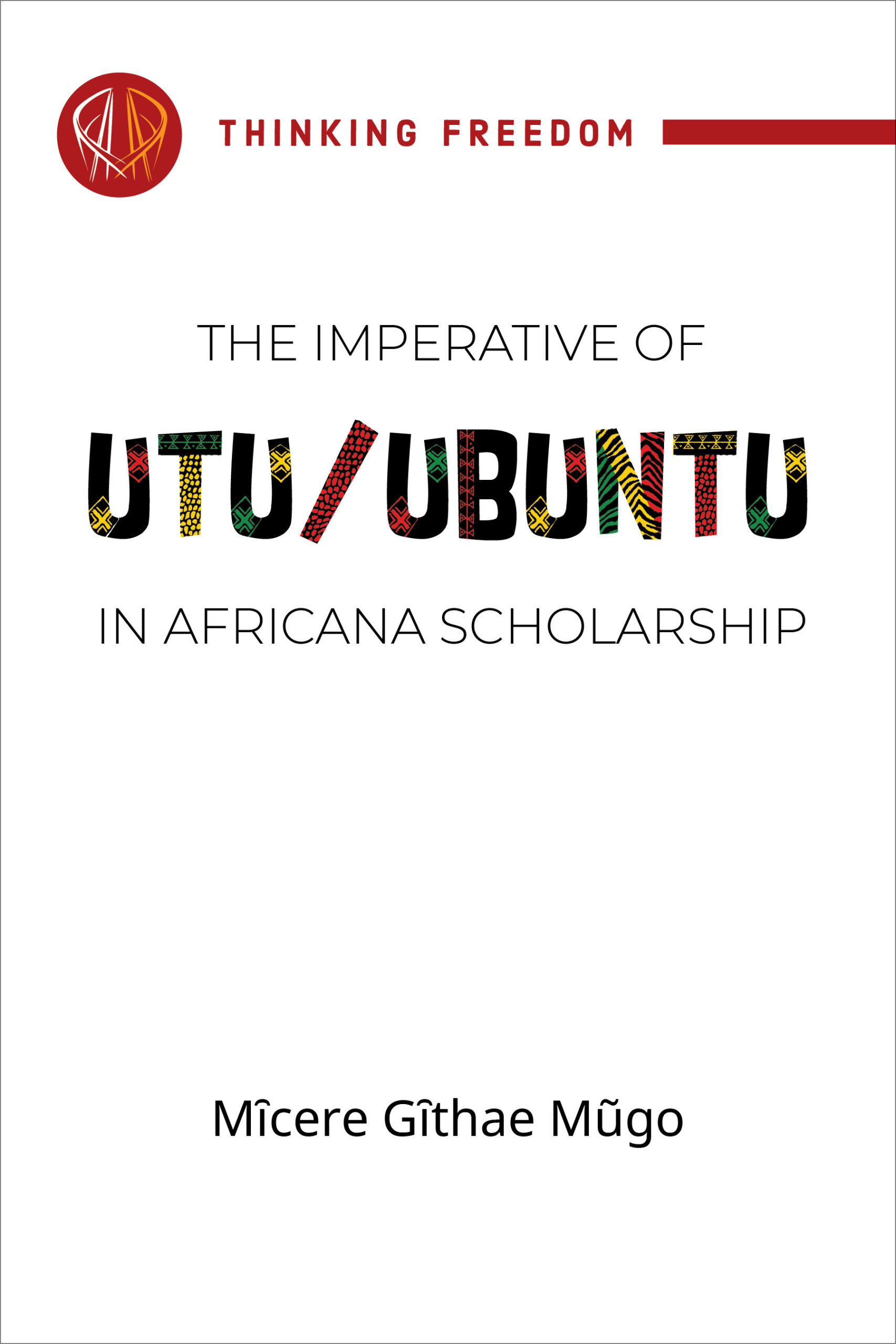
The imperative of Utu / Ubuntu in Africana scholarship
Written in commemoration of the 50th anniversary of Africana Studies and Research Center, Cornell University, this publication celebrates the birth of Black studies as a liberated academic zone. Professor Mũgo reflects upon the significance of Africana studies, specifically within the context of America’s predominantly White universities, revisiting the hers/his/torical context that birthed Black studies as a field of knowledge. She reflects on the ownership of knowledge, its production, dissemination and custodianship while proposing utu/ubuntu as imperatives in defining transformative education. The hypothesis and heart of the argument is that knowledge and scholarship can either be colonizing, alienating and enslaving; or, alternatively, they can be conscientizing, humanizing and liberating, creating new human beings with the agency to transform life and the world, for the better. he dismisses the false myth of dominating, colonizing and imperialist cultures that claim to have a monopoly of knowledge and whose purpose is to justify the dehumanization of the conquered, the attempted erasure of their knowledges, heritages and ultimately, entire cultures.
USD $ 5.00 USD $ 15.00Price range: USD $ 5.00 through USD $ 15.00

Written in commemoration of the 50th anniversary of Africana Studies and Research Center, Cornell University, this publication celebrates the birth of Black studies as a liberated academic zone. Professor Mũgo reflects upon the significance of Africana studies, specifically within the context of America’s predominantly White universities, revisiting the hers/his/torical context that birthed Black studies as a field of knowledge. She reflects on the ownership of knowledge, its production, dissemination and custodianship while proposing utu/ubuntu as imperatives in defining transformative education. The hypothesis and heart of the argument is that knowledge and scholarship can either be colonizing, alienating and enslaving; or, alternatively, they can be conscientizing, humanizing and liberating, creating new human beings with the agency to transform life and the world, for the better. he dismisses the false myth of dominating, colonizing and imperialist cultures that claim to have a monopoly of knowledge and whose purpose is to justify the dehumanization of the conquered, the attempted erasure of their knowledges, heritages and ultimately, entire cultures.
| Book Format | Print Book, PDF |
|---|
Customer Reviews
There are no reviews yet.
Only logged in customers who have purchased this product may leave a review.
Related products
-
Extracting Profit: Imperialism, Neoliberalism and the New Scramble for Africa
A piercing historical explanation of poverty and inequality in African societies today and the social impact of resource-driven growth, Extracting Profit explains why Africa, in the first decade and a half of the twenty-first century, has undergone an economic boom. Rising global prices in oil and minerals have produced a scramble for Africa’s natural resources, led by investment from U.S., European and Chinese companies, and joined by emerging economies from around the globe. African economies have reached new heights, even outpacing rates of growth seen in much of the rest of the world. Examined through the lens of case studies of the oil fields of the Niger River Delta, the Chad-Cameroon Pipeline and the East African infrastructure boom, this period of “Africa rising” did not lead to the creation of jobs, but has instead fueled the extraction of natural resources, profits accruing to global capital, and an increasingly wealthy African ruling class.
Extracting Profit argues that the roots of today’s social and economic conditions lie in the historical legacies of colonialism and the imposition of so-called “reforms” by global financial institutions such as the World Bank and International Monetary Fund. The chokehold of debt and austerity of the late twentieth century paved the way for severe assaults on African working classes through neoliberal privatization and deregulation. And while the scramble for Africa’s resources has heightened the pace of ecological devastation, examples from Somalia and the West African Ebola outbreak reveal a frightening surge of militarization on the part of China and the U.S.
Yet this “new scramble” has not gone unchallenged. With accounts of platinum workers’ struggles in South Africa, Nigerian labor organizing and pro-democracy upheavals in Uganda and Burkina Faso, Extracting Profit offers several narratives of grassroots organizing and protest, pointing to the potential for resistance to global capital and fundamental change, in Africa and beyond.
And in an updated Preface, the author analyses the implications of the Covid-19 pandemic and escalating climate emergency, as both the crises and resistance to extraction accelerate across the continent.
Reviews-
“Lee Wengraf’s Extracting Profit – Imperialism, Neoliberalism and The New Scramble for Africa is at once historical and contemporary. It unpacks ongoing resource crimes by analytically exposing its historical roots and pointing to ways by which the oppressed can cut off the bonds that lock in their subjugation.” —Nnimmo Bassey, Director, Health of Mother Earth Foundation
“Lee Wengraf provides an important reminder that Africa’s position within the world economy is heavily determined by its unequal insertion into the global capitalist system and ongoing manifestations of imperialism.” –James Chamberlain, Sheffield Political Economy Research Institute
“Lee Wengraf’s Extracting Profit provides a breathtakingly detailed account and analysis of some of the major socioeconomic ills that have been plaguing Africa for centuries. Amongst the host of issues she tackles, arguably the most consequential are mass poverty in African societies, their indefensible economic inequalities and the steady plundering of the continent’s resources, starting from the slave-trade era up till the present-day.” –Remi Adekoya, Review of African Political Economy
“Extracting Profit offers several narratives of grassroots organizing and protest, pointing to the potential for resistance to global capital and fundamental change, in Africa and beyond.” –Developing Economics
“Evidently, this book is well-researched and it contributes to the expansion of the frontiers of Marxist scholarship on Africa’s development dilemma within the global capitalist order. This book lends credence to the pioneering works of such notable radical scholars as Andre Gunder Frank, Walter Rodney, and Samir Amin among several others. It should be read by students and teachers of political economy, development studies, Marxism and philosophy.” –Marx & Philosophy Review of Books
“Extracting Profit provides a great arch of scutiny from the earliest carve-up of the African continent, through colonialism, war, imperialism, to the recent neoliberal takeover. The book demonstrates the continued importance of Marxist analysis on the continent, asserting the centrality of class analysis and a project of revolutionary change. Wengraf provides us with a major contribution, that highlights contemporary developments and the role of China on the African continent that has perplexed and baffled scholars. An indispensable volume.” —Leo Zeilig, author of Frantz Fanon: The Militant Philosopher of Third World Revolution
“The history of resource frontiers everywhere is always one of lethal violence, militarism, empire amidst the forcing house of capital accumulation. Lee Wengraf in Extracting Profit powerfully reveals the contours of Africa’s 21st century version of this history. The scramble for resources, markets, and investments have congealed into a frightening militarization across the continent, creating and fueling the conditions for further political instability. Wengraf documents how expanded American, but also Chinese, presence coupled with the War on Terror, point to both the enduring rivalry among global superpowers across the continent and a perfect storm of resource exploitation. Wengraf offers up a magisterial synopsis of the challenges confronting contemporary Africa.” —Michael Watts, University of California, Berkeley
“One of the most well-known stylized facts of Africa’s recent growth experience is that it has been inequality-inducing in ways that previous growth spurts were not. Lee Wengraf, in her new book Extracting Profit , expertly utilises the machinery of Marxian class analysis in making sense of this stylized fact. Along the way we learn much about Africa’s historical relationship with imperialism and its contemporary manifestations. This book should be required reading for all those who care about Africa and its future.” —Grieve Chelwa, Contributing Editor, Africa Is A Country
“In recent years countries in the African continent have experienced an economic boom—but not all have benefited equally. Extracting Profit is a brilliant and timely analysis that explodes the myth of “Africa Rising,” showing how neoliberal reforms have made the rich richer, while leaving tens of millions of poor and working class people behind. Lee Wengraf tells this story within the context of an imperial rivalry between the United States and China, two global superpowers that have expanded their economic and military presence across the continent. Extracting Profit is incisive, powerful, and necessary: If you read one book about the modern scramble for Africa, and what it means for all of us, make it this one.” —Anand Gopal, author, No Good Men Among the Living: America, the Taliban, and the War Through Afghan Eyes
“Thorough and thoughtful, Wengraf’s book has a radical depth that underscores its significance. It’s definitely a must-read for anyone who cherishes an advanced knowledge on the exploitation of Africa as well as the politics that undermines Africa’s class freedom.” —Kunle Wizeman Ajayi, Convener, Youths Against Austerity and General Secretary of the United Action for Democracy, Nigeria
“Extracting Profit is a very important book for understanding why the immense majority of the African population remain pauperised, despite impressive growth rates of mineral-rich countries on the continent. It continues the project of Walter Rodney’s How Europe Underdeveloped Africa. And in several ways, it also goes beyond it, capturing the changing dynamics of global capitalism 45 years after Rodney’s magnus opus.
In this book, Lee Wengraf debunks the myth of “Africa Rising” and the supposed expansion of an entrepreneurial middle-class, revealing “reforms” imposed by international financial institutions as mechanisms for fostering imperialism in an era of sharpening contradictions of the global capitalist economy. The adverse social, economic, political and environmental impact of these are elaborated on as a systemic whole, through the book’s examination of the sinews of capital’s expansion in the region: the extractive industries.
But, Wengraf does not stop at interrogating the underdevelopment of Africa. Her book identifies a major reason for the failures of national liberation projects: while the working masses were mobilised to fight against colonial domination, the leadership of these movements lay in the hands of aspiring capitalists, and intellectuals. The urgency of the need for a strategy for workers’ power internationally, she stresses correctly, cannot be overemphasized.
Reading Extracting Profit would be exceedingly beneficial for any change-seeking activist in the labour movement within and beyond Africa.” —Baba Aye, editor, Socialist Worker (Nigeria)
-
-

Mobilités, circulations et frontières
USD $ 5.00 USD $ 30.00Price range: USD $ 5.00 through USD $ 30.00Select options This product has multiple variants. The options may be chosen on the product page
Mobilités, circulations et frontières
USD $ 5.00 USD $ 30.00Price range: USD $ 5.00 through USD $ 30.00Ce livre est un apport précieux pour demander à changer de focale et de perspective au sujet des migrations à l’intérieur du continent africain. Celles-ci sont bien plus importantes quan- titativement, mais aussi économiquement et historiquement, que les migrations de l’Afrique vers l’Europe. Elles sont beaucoup plus silencieuses et infiniment moins étudiées que celles du Sud vers le Nord. Ces migrations sont vitales, tant pour les pays de départ que pour ceux d’arrivée. Ainsi, des millions de jeunes partent chaque année pour les pays de la côte, et cela sans susciter les mêmes résistances, fantasmes et peurs qu’en Europe.
Cet ouvrage a le grand mérite d’intégrer les migrations dans la perspective plus large des mobilités, puis d’en examiner les liens avec le développement. Il est rédigé par de jeunes chercheurs africains, qui produisent à partir de leurs terrains spécifiques des analyses à valeur générale sur les sociétés contemporaines. Ils contribuent ainsi au renouvellement des sciences sociales à partir des pays africains.
On peut en revanche souligner que l’ouvrage a relevé un défi important : celui d’éclairer à la fois les dynamiques de l’expérience migratoire, des trajectoires suivies par les migrants et des espaces migratoires à l’intérieur de l’Afrique. — Sylvie Ayimpam, « Mobilités, circulations et frontières. Migrations, mobilités et développement en Afrique », Anthropologie & développement [En ligne], 51 | 2020, mis en ligne le 01 décembre 2020, consulté le 23 février 2021. URL : http://journals.openedition.org/anthropodev/1068 ; DOI : https://doi.org/10.4000/anthropodev.1068
These companion volumes are refreshing because they introduce us to many less well- known instances which amply illustrate just how mobile African populations really are at the regional, intra-regional and global scales. – Paul NUGENT, University of Edinburgh (United Kingdom)
Un ouvrage d’une grande actualité qui aborde la question des migrations sous un angle radicalement nouveau et original : l’articulation dynamique entre la migration, la mobilité et le développement en Afrique de l’Ouest. Ces deux volumes bilingues renouvellent le débat sur les migrations : de quoi faire réfléchir ensemble l’Afrique et l’Europe. – Marie-Caroline SAGLIO-YATZIMIRSKY, INALCO, CESSMA Paris (France)
Christian Bouquet, « Quelques éclairages nouveaux sur les migrations africaines », EspacesTemps.net [En ligne], Books, 2020 | Mis en ligne le 20 November 2020, consulté le 20.11.2020. URL : https://www.espacestemps.net/en/articles/quelques-eclairages-nouveaux-sur-les-migrations-africaines/ ; DOI : 10.26151/esapcestemps.net-jc2a-6b03
Avec la participation de Naluwembe BINAISSA, Alimou DIALLO, Nyalo Barkissa DRABO, Sylvester KOHOL, A. Aziz MOSSI, Loppa NGASSOU, Lawrence Rafaih OKELLO, Mutiat Titilope OLADEJO, Zakaria SORÉ, Astadjam YAOUBA et Irissa ZIDNABA.
Select options This product has multiple variants. The options may be chosen on the product page -

Rinky-Dink Revolution: Moving Beyond Capitalism
USD $ 5.00 USD $ 15.00Price range: USD $ 5.00 through USD $ 15.00Select options This product has multiple variants. The options may be chosen on the product page
Rinky-Dink Revolution: Moving Beyond Capitalism
USD $ 5.00 USD $ 15.00Price range: USD $ 5.00 through USD $ 15.00This pamphlet tackles the question: how do we get from A to B, capitalism to post-capitalism?
It is critical reading to understand why:
* Capitalist-oriented industrial agriculture and its destruction of habitat are the upstream causes that led to the COVID-19 pandemic as well as other past and future pandemics of devastating, emerging viral pathogens.
* COVID-19 may trigger a collapse of the global capitalist system but it is not the cause.
* Health-care and public-health systems organized around capitalist principles don’t do well in pandemics, compared to those not organized around capitalist principles.
* The current economic collapse, triggered by a pandemic, opens a door for revolutionary transformation.The pamphlet is also available in Spanish and Korean.
Select options This product has multiple variants. The options may be chosen on the product page -
Social Media and Capitalism: People, Communities and Commodities
USD $ 5.00 USD $ 18.00Price range: USD $ 5.00 through USD $ 18.00Select options This product has multiple variants. The options may be chosen on the product page
Social Media and Capitalism: People, Communities and Commodities
USD $ 5.00 USD $ 18.00Price range: USD $ 5.00 through USD $ 18.00Technology is one of the central elements of contemporary human life. The world as one knows it today is a space increasingly mediated by technological interventions, be it in the field of contemporary cultural expressions or political, organizational forms. Social media has played an important role in this transformation. Gone are the days when social media was merely a conduit for conversations. Today, it is a diverse field of operations spanning advertising mechanisms, branding processes and even direct commercial exchanges between users: the prime focus of this particular book.
Direct user-to-user trading through social media within an institutional form is a relatively new dimension in the dynamic world of social media. Yet, just like every other form of innovation within the paradigm of market relations, social media commerce or social media trading has also created newer and diverse alterations in how individuals interact with the existing socio-political fabric within which they exist. This book analyses these alterations and critically investigates the role of Capital in creating them.
The book analyses real-world interactions, interviews and observations through the theoretical framework provided by Marxist political economy and social theory. It draws upon the theoretical scope provided by Marx’s dialectical methods of social analysis and uses it to unearth the effects that trading and commercial activities performed through virtual communities have on society and individuals.
Select options This product has multiple variants. The options may be chosen on the product page -

Dictators as Gatekeepers for Europe
USD $ 5.00 USD $ 20.00Price range: USD $ 5.00 through USD $ 20.00Select options This product has multiple variants. The options may be chosen on the product page
Dictators as Gatekeepers for Europe
USD $ 5.00 USD $ 20.00Price range: USD $ 5.00 through USD $ 20.00Dictators as Gatekeepers for Europe is a detailed journalistic account of how the EU is attempting to limit mobility within the African continent as a matter of the EU’s domestic policy agenda, hence the title hinting at the many agreements (with Turkey, Libya, Sudan) aimed at blocking migrants from approaching the European continent. The new “Berlin Wall” not only encircles Europe, but also generates a proliferation of militarised borders in Africa. …To summarise, the authors argue, Europe desires protected borders and open markets. The novelty is the amount of material that this book contains about African desires and strategies, both as a continent and as single states. This, in particular, makes the work a collection of extremely valuable directions of research. In fact, Africa, if one were to simplify the continent’s intentions, is depicted as aspiring to the exact opposite of Europe, namely open borders (with the African Union aspiring to free movement within the continent) and protected markets (protected from Western corporate predatory strategies). Moreover, contrary to the narrative of aid according to which the West “helps develop” Africa, the figures quoted by the authors suggest the opposite: while Sub-Saharan Africa receives $134 billion a year in development funding, $192 billions flow out of Africa, with $46 billion in profit for major corporations and another $35 billion vanishing in tax havens (218). https://www.law.ox.ac.uk/research-subject-groups/centre-criminology/centreborder-criminologies/blog/2022/02/double-book by Oana Pârvan.
Select options This product has multiple variants. The options may be chosen on the product page -
Unearthing justice: How to protect your community from the mining industry AFRICA EDITION
ONLY AVAILABLE IN EASTERN AND SOUTHERN AFRICA
We are pleased to announce that Daraja Press will soon be making Unearthing Justice, originally published by Between The Lines, available in Africa through our partners at Zand Graphics Ltd (throughout East Africa and the Horn) and Sherwood Books (South Africa, Namibia, Botswana, Lesotho, Mozambique and Swaziland).
Originally published in 2019, this new edition has an Introduction by Yao Graham, TWN-Africa. The author, Joan Kuyek, is a community-focused mining analyst and organizer living in Ottawa. She was the founding National Co-ordinator of MiningWatch Canada from 1999–2009 and continues to do work for MiningWatch and for a number of communities affected by mining.
The mining industry continues to be at the forefront of colonial dispossession around the world. It controls information about its intrinsic costs and benefits, propagates myths about its contribution to the economy, shapes government policy and regulation, and deals ruthlessly with its opponents.
Brimming with case studies, anecdotes, resources, and illustrations, Unearthing Justice exposes the mining process and its externalized impacts on the environment, Indigenous Peoples, communities, workers, and governments. But, most importantly, the book shows how people are fighting back. Whether it is to stop a mine before it starts, to get an abandoned mine cleaned up, to change laws and policy, or to mount a campaign to influence investors, Unearthing Justice is an essential handbook for anyone trying to protect the places and people they love.
-

Class, gender, race and colonialism
USD $ 5.00 USD $ 11.00Price range: USD $ 5.00 through USD $ 11.00Select options This product has multiple variants. The options may be chosen on the product page
Class, gender, race and colonialism
USD $ 5.00 USD $ 11.00Price range: USD $ 5.00 through USD $ 11.00Description (1600 / 2500)
It is important to see both Marx’s brilliant generalisations about capitalist society and the very concrete ways in which he examined not only class, but also gender, race, and colonialism, and what today would be called the intersectionality of all of these. His underlying revolutionary humanism was the enemy of all forms of abstraction that denied the variety and multiplicity of human experience, especially as his vision extended outward from Western Europe. For these reasons, no thinker speaks to us today with such force and clarity.It is clear today that the emancipation of labour from capitalist alienation and exploitation is a task that still confronts us. Marx’s concept of the worker is not limited to European white males, but includes Irish and Black super-exploited and therefore doubly revolutionary workers, as well as women of all races and nations. But, his research and his concept of revolution go further, incorporating a wide range of agrarian non-capitalist societies of his time, from India to Russia and from Algeria to the Indigenous peoples of the Americas, often emphasising their gender relations. In his last, still partially unpublished writings, he turns his gaze Eastward and Southward. In these regions outside Western Europe, he finds important revolutionary possibilities among peasants and their ancient communistic social structures, even as these are being undermined by their formal subsumption under the rule of capital. In his last published text, he envisions an alliance between these non-working-class strata and the Western European working class.
Select options This product has multiple variants. The options may be chosen on the product page -
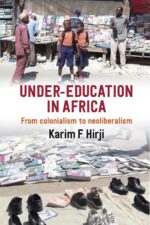
Under-Education in Africa
USD $ 22.00Select options This product has multiple variants. The options may be chosen on the product page
Under-Education in Africa
USD $ 22.00Under-Education in Africa: From Colonialism to Neoliberalism is a collection of essays on diverse aspects of educational systems that were written over a period of four and a half decades, written from the point of view of an activist educator.
With the focus on Tanzania, they cover education in the German colonial era, the days of Ujamaa socialism and the present neo-liberal times. Themes include the social function of education, the impact of external dependency on education, practical versus academic education, democracy and violence in schools, the role of computers in education, the effect of privatization on higher education, misrepresentation of educational history, good and bad teaching styles, book reading, the teaching of statistics to doctors and student activism in education.
Two essays provide a comparative view of the situation in Tanzania and the USA. Linking the state of the educational system with society as a whole, they explore the possibility of progressive transformation on both fronts. They are based on the author’s experience as a long-term educator, his original research, relevant books, newspaper reports and discussions with colleagues and students.
The author is a retired professor of medical statistics who has taught at colleges and universities in Tanzania and at universities in the USA and Norway.
Select options This product has multiple variants. The options may be chosen on the product page