
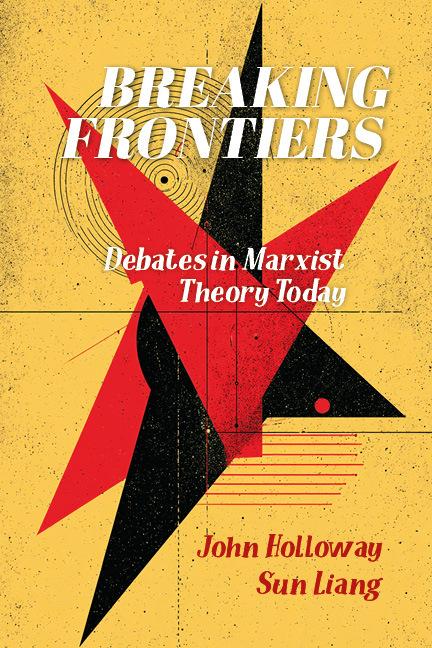
Breaking the Frontiers
Debates in Marxist Theory Today
This is a collection of articles reflecting the most exciting recent developments in radical-Marxist thought. Just as the world is closing in on us, leaving little room for radical critique, this book raises its voice to show how rich current radical-Marxist critique is.
This book has taken on a vibrant life of its own, moving beyond its unusual origins. The book was born when Sun Liang, Professor at the East China Normal University, in Shanghai, approached John Holloway, Professor at the Benemérita Universidad Autónoma in Puebla, Mexico, with the news that he had received funding to publish a book in Chinese with a collection of articles that would introduce recent Western critiques of capitalism to a Chinese audience, and inviting John to join him in co-editing the collection. Together, we elaborated a list of topics that should be covered and then approached authors who would be knowledgeable, interesting and willing to write on those topics. This book is now complete and will be published in Chinese in the current year.
The book has developed beyond our expectations into something autonomous from its origins: an impressive collection of radical-Marxist articles covering a very wide range of topics. By radical-Marxist we mean Marxist approaches that are particularly interested in breaking conceptual frontiers, exploring new political directions and opening to new areas of preoccupation. Rather than looking for authors who share the same ideas, we looked for people who are developing the most exciting ways forward. We have an impressive list of authors, some very established, some just starting out but with very fresh ideas. This could be either for readers who want to explore what Marxists are talking about, or for readers who want to learn about debates in specific areas (on artificial intelligence or labour or time, for example). It would have something of the attraction of an encyclopaedia, but much more lively and sharp-ended.
We think the book will be appealing for a general public interested in learning more about current Marxist debates, and it should be very attractive indeed for advanced undergraduate and postgraduate courses in contemporary political theory, critical theory and Marxist theory.
There are two things that makes this book really special. The first is just the quality and range of authors. Established and less established, coming from different parts of the planet, these are people searching for a way forward, aware that the idées reçues of Marxist debate are not adequate for finding a way out of the growing catastrophe that is capitalism. And the second is the origin of the book, the surprising dialogue between the Chinese and the western perspectives. We are doing something that has never been done before, as far as we know.

Customer Reviews
There are no reviews yet.
Only logged in customers who have purchased this product may leave a review.
Related products
-
A region in revolt: Mapping the recent uprisings in North Africa and West Asia
USD $ 5.00 USD $ 15.00Price range: USD $ 5.00 through USD $ 15.00Select options This product has multiple variants. The options may be chosen on the product page
A region in revolt: Mapping the recent uprisings in North Africa and West Asia
USD $ 5.00 USD $ 15.00Price range: USD $ 5.00 through USD $ 15.00A wave of mass protest movements has spread across North Africa and West Asia, including Sudan, Algeria, Iraq, Lebanon and Iran. The mass protests have much in common, from opposing authoritarian regimes and worsening economic situations to demanding radical changes in social relations. Despite their similarities, each protest movement operates under different conditions that cannot be ignored. The specific historic, political and economic contexts of each country have determined who the key actors of the uprisings are and their location across old and new divides. This book elaborates on these similarities and differences to paint a clearer picture of these movements and draw out lessons to inform future struggles.
Select options This product has multiple variants. The options may be chosen on the product page -

Stratégies familiales, diasporas et investissements
USD $ 5.00 USD $ 30.00Price range: USD $ 5.00 through USD $ 30.00Select options This product has multiple variants. The options may be chosen on the product page
Stratégies familiales, diasporas et investissements
USD $ 5.00 USD $ 30.00Price range: USD $ 5.00 through USD $ 30.00À rebours des thèses soutenant que la migration contribue au développement ou que l’in- vestissement dans le développement réduit la croissance de la migration « irrégulière », ce livre marque une rupture tonifiante avec les idées communes abondamment véhiculées dans la littérature sur les liens entre migration, mobilités et développement en Afrique. Il accorde un intérêt manifeste pour la plus grande part des mobilités africaines, lesquelles se situent à l’intérieur du continent, et à la formation des diasporas en dehors des fron- tières nationales et continentales. Cette considération conjointe des mobilités « Sud-Sud » et « Sud-Nord » permet de remettre en cause l’hypothèse selon laquelle il existe des diffé- rences fondamentales entre elles.
Cet ouvrage examine les fluctuations ordinaires des mouvements de populations – à travers l’Afrique, comme dans le reste du monde –, qui étendent les familles, génèrent de nouvelles relations, reconfigurent les connexions économiques et politiques, et sont intégrées dans l’expérience quotidienne des millions de personnes qui y prennent part.
The in-depth knowledge of the mostly African authors adds to the quality of a research field, which was for long far too Eurocentric. – Ilke ADAM, Vrije Universiteit Brussel (Belgium)
Il était temps de mettre en lumière ce que migration et mobilité représentent en Afrique. L’ouvrage offre une perspective originale et décoloniale sur le sujet. – Eric HAHONOU, Roskilde Universitet (Denmark)
Christian Bouquet, « Quelques éclairages nouveaux sur les migrations africaines », EspacesTemps.net [En ligne], Books, 2020 | Mis en ligne le 20 November 2020, consulté le 20.11.2020. URL : https://www.espacestemps.net/en/articles/quelques-eclairages-nouveaux-sur-les-migrations-africaines/ ; DOI : 10.26151/esapcestemps.net-jc2a-6b03
Avec la participation de John O. IGUE, Saydou KOUDOUGOU, Pierre-Joseph LAURENT, Bassirou MALAM SOULEY, Hamidou MANOU NABARA, Marème NIANG NDIAYE, Amadou SARR DIOP, Sadio SOUKOUNA , Eric Stève TAMO MBOUYOU et Astadjam YAOUBA.
Select options This product has multiple variants. The options may be chosen on the product page -

Extracting Profit: Imperialism, Neoliberalism and the New Scramble for Africa
A piercing historical explanation of poverty and inequality in African societies today and the social impact of resource-driven growth, Extracting Profit explains why Africa, in the first decade and a half of the twenty-first century, has undergone an economic boom. Rising global prices in oil and minerals have produced a scramble for Africa’s natural resources, led by investment from U.S., European and Chinese companies, and joined by emerging economies from around the globe. African economies have reached new heights, even outpacing rates of growth seen in much of the rest of the world. Examined through the lens of case studies of the oil fields of the Niger River Delta, the Chad-Cameroon Pipeline and the East African infrastructure boom, this period of “Africa rising” did not lead to the creation of jobs, but has instead fueled the extraction of natural resources, profits accruing to global capital, and an increasingly wealthy African ruling class.
Extracting Profit argues that the roots of today’s social and economic conditions lie in the historical legacies of colonialism and the imposition of so-called “reforms” by global financial institutions such as the World Bank and International Monetary Fund. The chokehold of debt and austerity of the late twentieth century paved the way for severe assaults on African working classes through neoliberal privatization and deregulation. And while the scramble for Africa’s resources has heightened the pace of ecological devastation, examples from Somalia and the West African Ebola outbreak reveal a frightening surge of militarization on the part of China and the U.S.
Yet this “new scramble” has not gone unchallenged. With accounts of platinum workers’ struggles in South Africa, Nigerian labor organizing and pro-democracy upheavals in Uganda and Burkina Faso, Extracting Profit offers several narratives of grassroots organizing and protest, pointing to the potential for resistance to global capital and fundamental change, in Africa and beyond.
And in an updated Preface, the author analyses the implications of the Covid-19 pandemic and escalating climate emergency, as both the crises and resistance to extraction accelerate across the continent.
Reviews-
“Lee Wengraf’s Extracting Profit – Imperialism, Neoliberalism and The New Scramble for Africa is at once historical and contemporary. It unpacks ongoing resource crimes by analytically exposing its historical roots and pointing to ways by which the oppressed can cut off the bonds that lock in their subjugation.” —Nnimmo Bassey, Director, Health of Mother Earth Foundation
“Lee Wengraf provides an important reminder that Africa’s position within the world economy is heavily determined by its unequal insertion into the global capitalist system and ongoing manifestations of imperialism.” –James Chamberlain, Sheffield Political Economy Research Institute
“Lee Wengraf’s Extracting Profit provides a breathtakingly detailed account and analysis of some of the major socioeconomic ills that have been plaguing Africa for centuries. Amongst the host of issues she tackles, arguably the most consequential are mass poverty in African societies, their indefensible economic inequalities and the steady plundering of the continent’s resources, starting from the slave-trade era up till the present-day.” –Remi Adekoya, Review of African Political Economy
“Extracting Profit offers several narratives of grassroots organizing and protest, pointing to the potential for resistance to global capital and fundamental change, in Africa and beyond.” –Developing Economics
“Evidently, this book is well-researched and it contributes to the expansion of the frontiers of Marxist scholarship on Africa’s development dilemma within the global capitalist order. This book lends credence to the pioneering works of such notable radical scholars as Andre Gunder Frank, Walter Rodney, and Samir Amin among several others. It should be read by students and teachers of political economy, development studies, Marxism and philosophy.” –Marx & Philosophy Review of Books
“Extracting Profit provides a great arch of scutiny from the earliest carve-up of the African continent, through colonialism, war, imperialism, to the recent neoliberal takeover. The book demonstrates the continued importance of Marxist analysis on the continent, asserting the centrality of class analysis and a project of revolutionary change. Wengraf provides us with a major contribution, that highlights contemporary developments and the role of China on the African continent that has perplexed and baffled scholars. An indispensable volume.” —Leo Zeilig, author of Frantz Fanon: The Militant Philosopher of Third World Revolution
“The history of resource frontiers everywhere is always one of lethal violence, militarism, empire amidst the forcing house of capital accumulation. Lee Wengraf in Extracting Profit powerfully reveals the contours of Africa’s 21st century version of this history. The scramble for resources, markets, and investments have congealed into a frightening militarization across the continent, creating and fueling the conditions for further political instability. Wengraf documents how expanded American, but also Chinese, presence coupled with the War on Terror, point to both the enduring rivalry among global superpowers across the continent and a perfect storm of resource exploitation. Wengraf offers up a magisterial synopsis of the challenges confronting contemporary Africa.” —Michael Watts, University of California, Berkeley
“One of the most well-known stylized facts of Africa’s recent growth experience is that it has been inequality-inducing in ways that previous growth spurts were not. Lee Wengraf, in her new book Extracting Profit , expertly utilises the machinery of Marxian class analysis in making sense of this stylized fact. Along the way we learn much about Africa’s historical relationship with imperialism and its contemporary manifestations. This book should be required reading for all those who care about Africa and its future.” —Grieve Chelwa, Contributing Editor, Africa Is A Country
“In recent years countries in the African continent have experienced an economic boom—but not all have benefited equally. Extracting Profit is a brilliant and timely analysis that explodes the myth of “Africa Rising,” showing how neoliberal reforms have made the rich richer, while leaving tens of millions of poor and working class people behind. Lee Wengraf tells this story within the context of an imperial rivalry between the United States and China, two global superpowers that have expanded their economic and military presence across the continent. Extracting Profit is incisive, powerful, and necessary: If you read one book about the modern scramble for Africa, and what it means for all of us, make it this one.” —Anand Gopal, author, No Good Men Among the Living: America, the Taliban, and the War Through Afghan Eyes
“Thorough and thoughtful, Wengraf’s book has a radical depth that underscores its significance. It’s definitely a must-read for anyone who cherishes an advanced knowledge on the exploitation of Africa as well as the politics that undermines Africa’s class freedom.” —Kunle Wizeman Ajayi, Convener, Youths Against Austerity and General Secretary of the United Action for Democracy, Nigeria
“Extracting Profit is a very important book for understanding why the immense majority of the African population remain pauperised, despite impressive growth rates of mineral-rich countries on the continent. It continues the project of Walter Rodney’s How Europe Underdeveloped Africa. And in several ways, it also goes beyond it, capturing the changing dynamics of global capitalism 45 years after Rodney’s magnus opus.
In this book, Lee Wengraf debunks the myth of “Africa Rising” and the supposed expansion of an entrepreneurial middle-class, revealing “reforms” imposed by international financial institutions as mechanisms for fostering imperialism in an era of sharpening contradictions of the global capitalist economy. The adverse social, economic, political and environmental impact of these are elaborated on as a systemic whole, through the book’s examination of the sinews of capital’s expansion in the region: the extractive industries.
But, Wengraf does not stop at interrogating the underdevelopment of Africa. Her book identifies a major reason for the failures of national liberation projects: while the working masses were mobilised to fight against colonial domination, the leadership of these movements lay in the hands of aspiring capitalists, and intellectuals. The urgency of the need for a strategy for workers’ power internationally, she stresses correctly, cannot be overemphasized.
Reading Extracting Profit would be exceedingly beneficial for any change-seeking activist in the labour movement within and beyond Africa.” —Baba Aye, editor, Socialist Worker (Nigeria)
-
-

Transforming ourselves, Transforming the World: An open conspiracy for social change – Second Edition
USD $ 5.00 USD $ 20.00Price range: USD $ 5.00 through USD $ 20.00Select options This product has multiple variants. The options may be chosen on the product page
Transforming ourselves, Transforming the World: An open conspiracy for social change – Second Edition
USD $ 5.00 USD $ 20.00Price range: USD $ 5.00 through USD $ 20.00This book is for all those—community workers, adult educators, social activists of every kind—who want to overcome pessimism and play a part in changing society in the direction of peace, justice and dignity for all human beings. As author Brian Murphy points out, many of us are pessimistic about our ability to change the world when confronted by the powerful forces of big corporations and big government. Murphy reveals the social and personal dilemmas which hold people back from social engagement, and argues that the various constraints we face can be overcome.
In this new edition, David Austin explains in his Introduction why this book, first published in 1999, is perhaps more relevant to our times than ever, offering insights from his own experiences of engaging critically with the book and with others. And in his Afterword, Brian Murphy reflects on the continued relevance of the original text, emphasizing how our humanity is being corroded and commodified. To reclaim our humanity, he argues, we must transform ourselves to transform the world.
Brian Murphy’s immensely inspiring book,Transforming Ourselves, Transforming the World, deeply challenges us to think and rethink everything we knew and thought we knew.—Nnimmo Bassey, Executive Director, Health of Mother Earth Foundation & Right Livelihood Award Laureate in 2010
We need more conversations like the one in this book, which are rooted in hope while honestly working through a foundational way of seeing and understanding ourselves in the bigger picture.— Christina Warner, Co-Executive Director and Director of Campaigns and Organising, Council of Canadians.
This is one of the coolest, enjoyable and important books I have read in recent years. Written from the heart as well as the head, it is a breathtakingly visionary, unique and insightful take on the life of the ultimate activist.—Hope Chigudu, Feminist activist
Select options This product has multiple variants. The options may be chosen on the product page -

Tishio La Ukombozi: Ubeberu na Mapinduzi Zanzibar
USD $ 5.00 USD $ 25.00Price range: USD $ 5.00 through USD $ 25.00Select options This product has multiple variants. The options may be chosen on the product page
Tishio La Ukombozi: Ubeberu na Mapinduzi Zanzibar
USD $ 5.00 USD $ 25.00Price range: USD $ 5.00 through USD $ 25.00Kitabu hiki kinaturudisha katika kipindi cha kusisimuwa cha miaka ya vita baridi, kipindi ambacho, sambamba na kipindi cha leo, madola ya kibeberu yamekuwa yakifanya njama za kubadilisha serikali zilizokuwepo na kuziweka madarakani zile zenye kufuata amri. Kwa kutumia kumbukumbu za picha za Johari, nyaraka za siri za Marekani na Uingereza, pamoja na mahojiano ya kina, kitabu kinatowa uchambuzi juu ya nafasi na satwa ya Chama cha Umma Party nchini Zanzibar na kiongozi wake mwenye upeo mkubwa wa mambo, Mwanamapinduzi mfuasi wa Itikadi ya Karl Marx, Abdulrahman Mohamed Babu. Kwa kuangalia kwa njia ya uwiano wa mifano inayokwenda sambamba ya wahka wa Marekani kuhusu Uchina ya Kikomunisti katika miaka ya 1960 na woga walionao hivi sasa kuhusu ushawishi wa Uchina, kitabu kinatafakari juu ya mivutano mipya iliyopo katika kupigania rasilmali za Afrika, kuundwa kwa kikosi cha AFRICOM, na jinsi Wanasiasa wa Afrika Mashariki wanavyoshiriki katika kuimarisha udhibiti wa Marekani katika nchi zao, na “Vita dhidi ya Ugaidi” katika ukanda wa Afrika Mashariki hivi sasa.
Now available from Mkuki Na Nyota Publishers, Tanzania: http://www.mkukinanyota.com
Select options This product has multiple variants. The options may be chosen on the product page -
Politics, Democratization and Academia in Uganda: The Case of Makerere University
USD $ 6.99 USD $ 20.00Price range: USD $ 6.99 through USD $ 20.00Select options This product has multiple variants. The options may be chosen on the product page
Politics, Democratization and Academia in Uganda: The Case of Makerere University
USD $ 6.99 USD $ 20.00Price range: USD $ 6.99 through USD $ 20.00As the oldest (and arguably best-known) university in Uganda and the wider eastern and central Africa region, Makerere University looms large in the history of higher education on the continent. Alma mater to presidents, public intellectuals and pundits of all disciplines, Makerere has attracted considerable scholarly and popular attention, both in respect of its prominence and achievements, and well as with regard to its failures and foibles. The proposed book focuses on a particularly understudied aspect of the place of higher education in the African context, i.e. the relationship between a public university of unique historical importance and the contestations over democratization that have taken place both within campus and outside of it. It is built around the late-1980s struggle by the Makerere University Academic Staff Association (MUASA) for improved living conditions against the backdrop of the early programs of structural adjustment and economic reform that the National Resistance Army/Movement (NRA/M) government adopted soon after taking power in 1986. Although seemingly introverted in focus, in many respects the MUASA action represented the earliest forms of political struggle against a regime of governance that promised a great deal, but disappointingly delivered considerably less.
The focus on MUASA provides a critical entry-point to a wider debate about the place of organized democratic action by academics in a post-conflict context where the traditional institutions of political and civil society, i.e. political parties and non-governmental organizations (NGOs) have either been severely compromised or discredited, or where they are too weak and inorganic to provide any form of significant counter-juxtaposition to the government in power. By organizing the first strike by academic staff in the sixty-seven (67) year history of the university, for a time MUASA became the focal-point for democratic organizing against a regime that was yet to fully expose its nefarious and anti-democratic colours. The book examines the broader issues concerning the relationship between organized academic action and democratization; the place of the Media in reviewing these struggles; the position of students as a critical component of academe; “big P” and “small p” politics affecting female academics, and finally, the paradoxical role of the School of Law in both aiding and inhibiting the struggle against dictatorship in a country which has enjoyed
Select options This product has multiple variants. The options may be chosen on the product page -

Dialectics of revolution : Hegel, Marxism, and its critics through a lens of race, class, gender, and colonialism
USD $ 5.00 USD $ 18.00Price range: USD $ 5.00 through USD $ 18.00Select options This product has multiple variants. The options may be chosen on the product page
Dialectics of revolution : Hegel, Marxism, and its critics through a lens of race, class, gender, and colonialism
USD $ 5.00 USD $ 18.00Price range: USD $ 5.00 through USD $ 18.00This book collects four decades of writings on dialectics, a number of them published here for the first time, by Kevin B. Anderson, a well-known scholar-activist in the Marxist-Humanist tradition. The essays cover the dialectics of revolution in a variety of settings, from Hegel and the French Revolution to dialectics today and its poststructuralist and pragmatist critics. In these essays, particular attention is given to Lenin’s encounter with Hegel and its impact on the critique of imperialism, the rejection of crude materialism, and more generally, on world revolutionary developments. Major but neglected works on Hegel and dialectics written under the impact of the struggle against fascism like Lukács’s The Young Hegel and Marcuse’s Reason and Revolution are given full critical treatment. Dunayevskaya’s intersectional revolutionary dialectics is also treated extensively, especially its focus on a dialectics of revolution that avoids class reductionism, placing gender, race, and colonialism at the center alongside class. In addition, key critics of Hegel and dialectics like Jacques Derrida, Michel Foucault, Antonio Negri, Pierre Bourdieu, and Richard Rorty, are themselves analysed and critiqued from a twenty-first century dialectical perspective. The book also takes up the dialectic in global, intersectional settings via a reconsideration of the themes of Anderson’s Marx at the Margins, where nationalism, race, and colonialism were theorized alongside capital and class as key elements in Marxist dialectical thought. As a whole, the book offers a discussion of major themes in the dialectics of revolution that still speak to us today at a time of radical transformation in all spheres of society and of everyday life.
Select options This product has multiple variants. The options may be chosen on the product page -

Finding a Voice: Asian Women in Britain (New and Expanded Edition)
USD $ 5.00 USD $ 20.00Price range: USD $ 5.00 through USD $ 20.00Select options This product has multiple variants. The options may be chosen on the product page
Finding a Voice: Asian Women in Britain (New and Expanded Edition)
USD $ 5.00 USD $ 20.00Price range: USD $ 5.00 through USD $ 20.00irst published in 1978, and winning the Martin Luther King Memorial Prize for that year, Finding a Voice established a new discourse on South Asian women’s lives and struggles in Britain. Through discussions, interviews and intimate one-to-one conversations with South Asian women, in Urdu, Hindi, Bengali and English, it explored family relationships, the violence of immigration policies, deeply colonial mental health services, militancy at work and also friendship and love. The seventies was a time of some iconic anti-racist and working-class struggles. They are presented here from the point of view of the women who participated in and led them.
This new edition includes a preface by Meena Kandasamy, some historic photographs, and a remarkable new chapter titled ‘In conversation with Finding a Voice: 40 years on’ in which younger South Asian women write about their own lives and struggles weaving them around those portrayed in the book.
Select options This product has multiple variants. The options may be chosen on the product page