

Jade Saab
Jade Saab is a Lebanese/Canadian writer and activist currently finishing a PhD at the University of Glasgow on Ideology and the Process of Social- ist Revolution. He is a regional organiser with the Industrial Workers of the World.
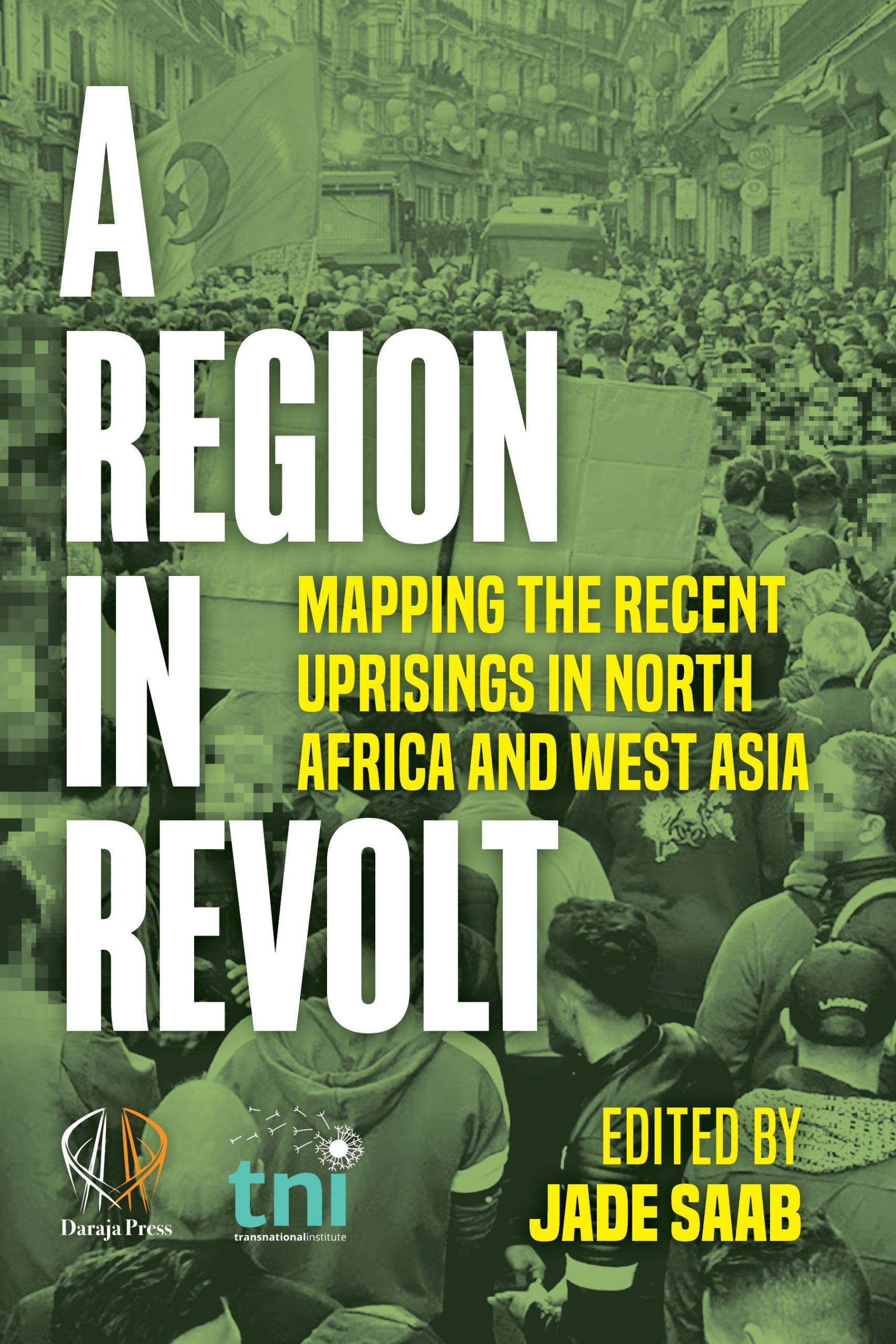
A wave of mass protest movements has spread across North Africa and West Asia, including Sudan, Algeria, Iraq, Lebanon and Iran. The mass protests have much in common, from opposing authoritarian regimes and worsening economic situations to demanding radical changes in social relations. Despite their similarities, each protest movement operates under different conditions that cannot be ignored. The specific historic, political and economic contexts of each country have determined who the key actors of the uprisings are and their location across old and new divides. This book elaborates on these similarities and differences to paint a clearer picture of these movements and draw out lessons to inform future struggles.
USD $ 5 USD $ 15Price range: USD $ 5 through USD $ 15
Jade Saab is a Lebanese/Canadian writer and activist currently finishing a PhD at the University of Glasgow on Ideology and the Process of Social- ist Revolution. He is a regional organiser with the Industrial Workers of the World.
A wave of mass protest movements has spread across North Africa and West Asia, including Sudan, Algeria, Iraq, Lebanon and Iran. The mass protests have much in common, from opposing authoritarian regimes and worsening economic situations to demanding radical changes in social relations. Despite their similarities, each protest movement operates under different conditions that cannot be ignored. The specific historic, political and economic contexts of each country have determined who the key actors of the uprisings are and their location across old and new divides. This book elaborates on these similarities and differences to paint a clearer picture of these movements and draw out lessons to inform future struggles.
| Book Format | Print Book, PDF |
|---|
A piercing historical explanation of poverty and inequality in African societies today and the social impact of resource-driven growth, Extracting Profit explains why Africa, in the first decade and a half of the twenty-first century, has undergone an economic boom. Rising global prices in oil and minerals have produced a scramble for Africa’s natural resources, led by investment from U.S., European and Chinese companies, and joined by emerging economies from around the globe. African economies have reached new heights, even outpacing rates of growth seen in much of the rest of the world. Examined through the lens of case studies of the oil fields of the Niger River Delta, the Chad-Cameroon Pipeline and the East African infrastructure boom, this period of “Africa rising” did not lead to the creation of jobs, but has instead fueled the extraction of natural resources, profits accruing to global capital, and an increasingly wealthy African ruling class.
Extracting Profit argues that the roots of today’s social and economic conditions lie in the historical legacies of colonialism and the imposition of so-called “reforms” by global financial institutions such as the World Bank and International Monetary Fund. The chokehold of debt and austerity of the late twentieth century paved the way for severe assaults on African working classes through neoliberal privatization and deregulation. And while the scramble for Africa’s resources has heightened the pace of ecological devastation, examples from Somalia and the West African Ebola outbreak reveal a frightening surge of militarization on the part of China and the U.S.
Yet this “new scramble” has not gone unchallenged. With accounts of platinum workers’ struggles in South Africa, Nigerian labor organizing and pro-democracy upheavals in Uganda and Burkina Faso, Extracting Profit offers several narratives of grassroots organizing and protest, pointing to the potential for resistance to global capital and fundamental change, in Africa and beyond.
And in an updated Preface, the author analyses the implications of the Covid-19 pandemic and escalating climate emergency, as both the crises and resistance to extraction accelerate across the continent.
“Lee Wengraf’s Extracting Profit – Imperialism, Neoliberalism and The New Scramble for Africa is at once historical and contemporary. It unpacks ongoing resource crimes by analytically exposing its historical roots and pointing to ways by which the oppressed can cut off the bonds that lock in their subjugation.” —Nnimmo Bassey, Director, Health of Mother Earth Foundation
“Lee Wengraf provides an important reminder that Africa’s position within the world economy is heavily determined by its unequal insertion into the global capitalist system and ongoing manifestations of imperialism.” –James Chamberlain, Sheffield Political Economy Research Institute
“Lee Wengraf’s Extracting Profit provides a breathtakingly detailed account and analysis of some of the major socioeconomic ills that have been plaguing Africa for centuries. Amongst the host of issues she tackles, arguably the most consequential are mass poverty in African societies, their indefensible economic inequalities and the steady plundering of the continent’s resources, starting from the slave-trade era up till the present-day.” –Remi Adekoya, Review of African Political Economy
“Extracting Profit offers several narratives of grassroots organizing and protest, pointing to the potential for resistance to global capital and fundamental change, in Africa and beyond.” –Developing Economics
“Evidently, this book is well-researched and it contributes to the expansion of the frontiers of Marxist scholarship on Africa’s development dilemma within the global capitalist order. This book lends credence to the pioneering works of such notable radical scholars as Andre Gunder Frank, Walter Rodney, and Samir Amin among several others. It should be read by students and teachers of political economy, development studies, Marxism and philosophy.” –Marx & Philosophy Review of Books
“Extracting Profit provides a great arch of scutiny from the earliest carve-up of the African continent, through colonialism, war, imperialism, to the recent neoliberal takeover. The book demonstrates the continued importance of Marxist analysis on the continent, asserting the centrality of class analysis and a project of revolutionary change. Wengraf provides us with a major contribution, that highlights contemporary developments and the role of China on the African continent that has perplexed and baffled scholars. An indispensable volume.” —Leo Zeilig, author of Frantz Fanon: The Militant Philosopher of Third World Revolution
“The history of resource frontiers everywhere is always one of lethal violence, militarism, empire amidst the forcing house of capital accumulation. Lee Wengraf in Extracting Profit powerfully reveals the contours of Africa’s 21st century version of this history. The scramble for resources, markets, and investments have congealed into a frightening militarization across the continent, creating and fueling the conditions for further political instability. Wengraf documents how expanded American, but also Chinese, presence coupled with the War on Terror, point to both the enduring rivalry among global superpowers across the continent and a perfect storm of resource exploitation. Wengraf offers up a magisterial synopsis of the challenges confronting contemporary Africa.” —Michael Watts, University of California, Berkeley
“One of the most well-known stylized facts of Africa’s recent growth experience is that it has been inequality-inducing in ways that previous growth spurts were not. Lee Wengraf, in her new book Extracting Profit , expertly utilises the machinery of Marxian class analysis in making sense of this stylized fact. Along the way we learn much about Africa’s historical relationship with imperialism and its contemporary manifestations. This book should be required reading for all those who care about Africa and its future.” —Grieve Chelwa, Contributing Editor, Africa Is A Country
“In recent years countries in the African continent have experienced an economic boom—but not all have benefited equally. Extracting Profit is a brilliant and timely analysis that explodes the myth of “Africa Rising,” showing how neoliberal reforms have made the rich richer, while leaving tens of millions of poor and working class people behind. Lee Wengraf tells this story within the context of an imperial rivalry between the United States and China, two global superpowers that have expanded their economic and military presence across the continent. Extracting Profit is incisive, powerful, and necessary: If you read one book about the modern scramble for Africa, and what it means for all of us, make it this one.” —Anand Gopal, author, No Good Men Among the Living: America, the Taliban, and the War Through Afghan Eyes
“Thorough and thoughtful, Wengraf’s book has a radical depth that underscores its significance. It’s definitely a must-read for anyone who cherishes an advanced knowledge on the exploitation of Africa as well as the politics that undermines Africa’s class freedom.” —Kunle Wizeman Ajayi, Convener, Youths Against Austerity and General Secretary of the United Action for Democracy, Nigeria
“Extracting Profit is a very important book for understanding why the immense majority of the African population remain pauperised, despite impressive growth rates of mineral-rich countries on the continent. It continues the project of Walter Rodney’s How Europe Underdeveloped Africa. And in several ways, it also goes beyond it, capturing the changing dynamics of global capitalism 45 years after Rodney’s magnus opus.
In this book, Lee Wengraf debunks the myth of “Africa Rising” and the supposed expansion of an entrepreneurial middle-class, revealing “reforms” imposed by international financial institutions as mechanisms for fostering imperialism in an era of sharpening contradictions of the global capitalist economy. The adverse social, economic, political and environmental impact of these are elaborated on as a systemic whole, through the book’s examination of the sinews of capital’s expansion in the region: the extractive industries.
But, Wengraf does not stop at interrogating the underdevelopment of Africa. Her book identifies a major reason for the failures of national liberation projects: while the working masses were mobilised to fight against colonial domination, the leadership of these movements lay in the hands of aspiring capitalists, and intellectuals. The urgency of the need for a strategy for workers’ power internationally, she stresses correctly, cannot be overemphasized.
Reading Extracting Profit would be exceedingly beneficial for any change-seeking activist in the labour movement within and beyond Africa.” —Baba Aye, editor, Socialist Worker (Nigeria)

À rebours des thèses soutenant que la migration contribue au développement ou que l’in- vestissement dans le développement réduit la croissance de la migration « irrégulière », ce livre marque une rupture tonifiante avec les idées communes abondamment véhiculées dans la littérature sur les liens entre migration, mobilités et développement en Afrique. Il accorde un intérêt manifeste pour la plus grande part des mobilités africaines, lesquelles se situent à l’intérieur du continent, et à la formation des diasporas en dehors des fron- tières nationales et continentales. Cette considération conjointe des mobilités « Sud-Sud » et « Sud-Nord » permet de remettre en cause l’hypothèse selon laquelle il existe des diffé- rences fondamentales entre elles.
Cet ouvrage examine les fluctuations ordinaires des mouvements de populations – à travers l’Afrique, comme dans le reste du monde –, qui étendent les familles, génèrent de nouvelles relations, reconfigurent les connexions économiques et politiques, et sont intégrées dans l’expérience quotidienne des millions de personnes qui y prennent part.
The in-depth knowledge of the mostly African authors adds to the quality of a research field, which was for long far too Eurocentric. – Ilke ADAM, Vrije Universiteit Brussel (Belgium)
Il était temps de mettre en lumière ce que migration et mobilité représentent en Afrique. L’ouvrage offre une perspective originale et décoloniale sur le sujet. – Eric HAHONOU, Roskilde Universitet (Denmark)
Christian Bouquet, « Quelques éclairages nouveaux sur les migrations africaines », EspacesTemps.net [En ligne], Books, 2020 | Mis en ligne le 20 November 2020, consulté le 20.11.2020. URL : https://www.espacestemps.net/en/articles/quelques-eclairages-nouveaux-sur-les-migrations-africaines/ ; DOI : 10.26151/esapcestemps.net-jc2a-6b03
Avec la participation de John O. IGUE, Saydou KOUDOUGOU, Pierre-Joseph LAURENT, Bassirou MALAM SOULEY, Hamidou MANOU NABARA, Marème NIANG NDIAYE, Amadou SARR DIOP, Sadio SOUKOUNA , Eric Stève TAMO MBOUYOU et Astadjam YAOUBA.

From his home in El Salvador, the author shares an intimate personal and political memoir that follows his remarkable journey from the comfort and security of a picturesque New England town to a stirring and heroic engagement in common cause with the struggle for peace and justice in El Salvador. After four years as a Peace Corp worker in northern Liberia beginning in the late 1960’s, followed by a stretch back in the United States as a street worker in the ghettos of North Philadelphia, McKinley finds himself in Central America as an aid worker in 1978. He quickly becomes engulfed by the political violence of the region and engaged with the people and their struggles against five decades of military dictatorship, centuries of poverty and exploitation. The story is marked by terror, adventure and courage, by trials and tragedy redeemed by the beauty and transcendence of people in struggle. Originally based in Guatemala heading up a Catholic relief agency, his commitment to the struggles for change in the country attracts the attention of the military, and his own government, forcing him to leave the country in late 1980. He moves to El Salvador where he begins a gradual incursion into the revolutionary struggle of this country, in a commitment that will last the rest of his life. Interwoven with this personal journey, is the story of Teresa Rivas, her husband Antonio, and their five children, a peasant family It also describes their life after the war, with resettlement in the lowlands of Guazapa where many ex-combatants were building a new life. It explains in detail the gradual emergence of the objective and subjective conditions for revolution in El Salvador, including the difficult choice for the use of violence as the only available option for transformative change in the country. The book also details the challenges of reconstruction after the Peace Accords that end the war in 1992, and the tragedy of opportunities lost during the immediate post-war period in the face of the ongoing resistance of traditional opponents to reform. As the memoir closes, the author reflects on his choice to be in El Salvador over the past 43 years, and the country as he finds it in these changing times; on the family with whom he has shared love and life there; on his continuing relationship with Antonio Rivas and his surviving family; and his gradual reconciliation, from a distance, with the country of his birth.

The industrial food system is a major driver of climate change. Food sovereignty is critical to any lasting and just solution. The Great Climate Robbery shows readers how the industrial food system causes climate change, how food and agribusiness corporations are getting away with it and what can be done to turn things around.
Under-Education in Africa: From Colonialism to Neoliberalism is a collection of essays on diverse aspects of educational systems that were written over a period of four and a half decades, written from the point of view of an activist educator.
With the focus on Tanzania, they cover education in the German colonial era, the days of Ujamaa socialism and the present neo-liberal times. Themes include the social function of education, the impact of external dependency on education, practical versus academic education, democracy and violence in schools, the role of computers in education, the effect of privatization on higher education, misrepresentation of educational history, good and bad teaching styles, book reading, the teaching of statistics to doctors and student activism in education.
Two essays provide a comparative view of the situation in Tanzania and the USA. Linking the state of the educational system with society as a whole, they explore the possibility of progressive transformation on both fronts. They are based on the author’s experience as a long-term educator, his original research, relevant books, newspaper reports and discussions with colleagues and students.
The author is a retired professor of medical statistics who has taught at colleges and universities in Tanzania and at universities in the USA and Norway.

In Decolonization and Afro-Feminism, Sylvia Tamale presents a powerful and urgent call for Africa’s intellectual, cultural, and political liberation through an Afro-feminist lens. The book critically examines how colonialism has deeply entrenched systems of oppression—based on race, gender, sexuality, class, and knowledge production—and argues that true decolonization requires more than political independence; it demands a radical rethinking of African identities, histories, and futures.
Tamale challenges Eurocentric and patriarchal frameworks that continue to dominate African societies, institutions, and academia. She explores themes such as:
The coloniality of gender and sexuality, using case studies like Caster Semenya to expose how Western norms pathologize African bodies.
The importance of intersectionality in understanding overlapping systems of oppression.
The role of Afro-ecofeminism in reconnecting African ecological wisdom with social justice.
The need to decolonize African academia, law, and family structures to recenter Indigenous knowledge and epistemologies.
The potential of Ubuntu as a framework for justice, community, and relationality.
The book is both a scholarly critique and a visionary roadmap, emphasizing that decolonization must be a feminist, inclusive, and holistic project—one that reclaims Africa’s dignity, autonomy, and intellectual sovereignty.
Written with clarity and passion, Decolonization and Afro-Feminism is essential reading for students, activists, scholars, and anyone committed to understanding and advancing Africa’s liberation in the 21st century.

The collection of essays in Partisan Universalism celebrates the work of Ato Sekyi-Otu, a scholar, teacher and friend, marking his extraordinary contribution to the philosophy, politics and praxis of liberation. As Ato Sekyi-Otu has argued in his recent book, Left Universalism, Africacentric Essays (Routlege 2019), universalism is an ‘inescapable presupposition of ethical judgment in general and critique in particular, especially indispensable for radical criticism of conditions of existence in postcolonial society and for vindicating visions of social regeneration’. Universalism must and can only be partisan.
“Responding to the invitation ‘to re-member severed but shareable things’, these lovers of truth, freedom, and dignity celebrate the searing intellect, generosity, wit, and compassion of the person and the scholar Ato Sekyi-Otu. … this is a precious contribution. Not to be missed!” —Jane Anna Gordon, author of Statelessness and Contemporary Enslavement and co-editor (with Drucilla Cornell) of Creolizing Rosa Luxemburg. /
“Critically engaging Ato Sekyi-Otu’s notion of partisan universalism, this timely volume of essays speaks directly to the onto-metaphysical issues that will give Africana thought the new foundations that will enable it to move beyond the linguistic turn, brush aside the ashes of Afro-pessimism. … A must read for all concerned with the future of Africana theory and praxis.” —Paget Henry, author of Caliban’s Reason/
“Ato Sekyi-Otu’s thought is one of the most important and exciting in Africa today. The texts compiled in this volume celebrate and engage with the work of Sekyi-Otu … They bear eloquent witness to Sekyi-Otu’s stature as a thinker and to his consistent commitment to the universalization of humanity in both theory and practice.” — Michael Neocosmos, Emeritus Professor in the Humanities, Rhodes University, South Africa.
ONLY AVAILABLE IN EASTERN AND SOUTHERN AFRICA
We are pleased to announce that Daraja Press will soon be making Unearthing Justice, originally published by Between The Lines, available in Africa through our partners at Zand Graphics Ltd (throughout East Africa and the Horn) and Sherwood Books (South Africa, Namibia, Botswana, Lesotho, Mozambique and Swaziland).
Originally published in 2019, this new edition has an Introduction by Yao Graham, TWN-Africa. The author, Joan Kuyek, is a community-focused mining analyst and organizer living in Ottawa. She was the founding National Co-ordinator of MiningWatch Canada from 1999–2009 and continues to do work for MiningWatch and for a number of communities affected by mining.
The mining industry continues to be at the forefront of colonial dispossession around the world. It controls information about its intrinsic costs and benefits, propagates myths about its contribution to the economy, shapes government policy and regulation, and deals ruthlessly with its opponents.
Brimming with case studies, anecdotes, resources, and illustrations, Unearthing Justice exposes the mining process and its externalized impacts on the environment, Indigenous Peoples, communities, workers, and governments. But, most importantly, the book shows how people are fighting back. Whether it is to stop a mine before it starts, to get an abandoned mine cleaned up, to change laws and policy, or to mount a campaign to influence investors, Unearthing Justice is an essential handbook for anyone trying to protect the places and people they love.
DarajaPress uses Accessibility Checker to monitor our website's accessibility.