
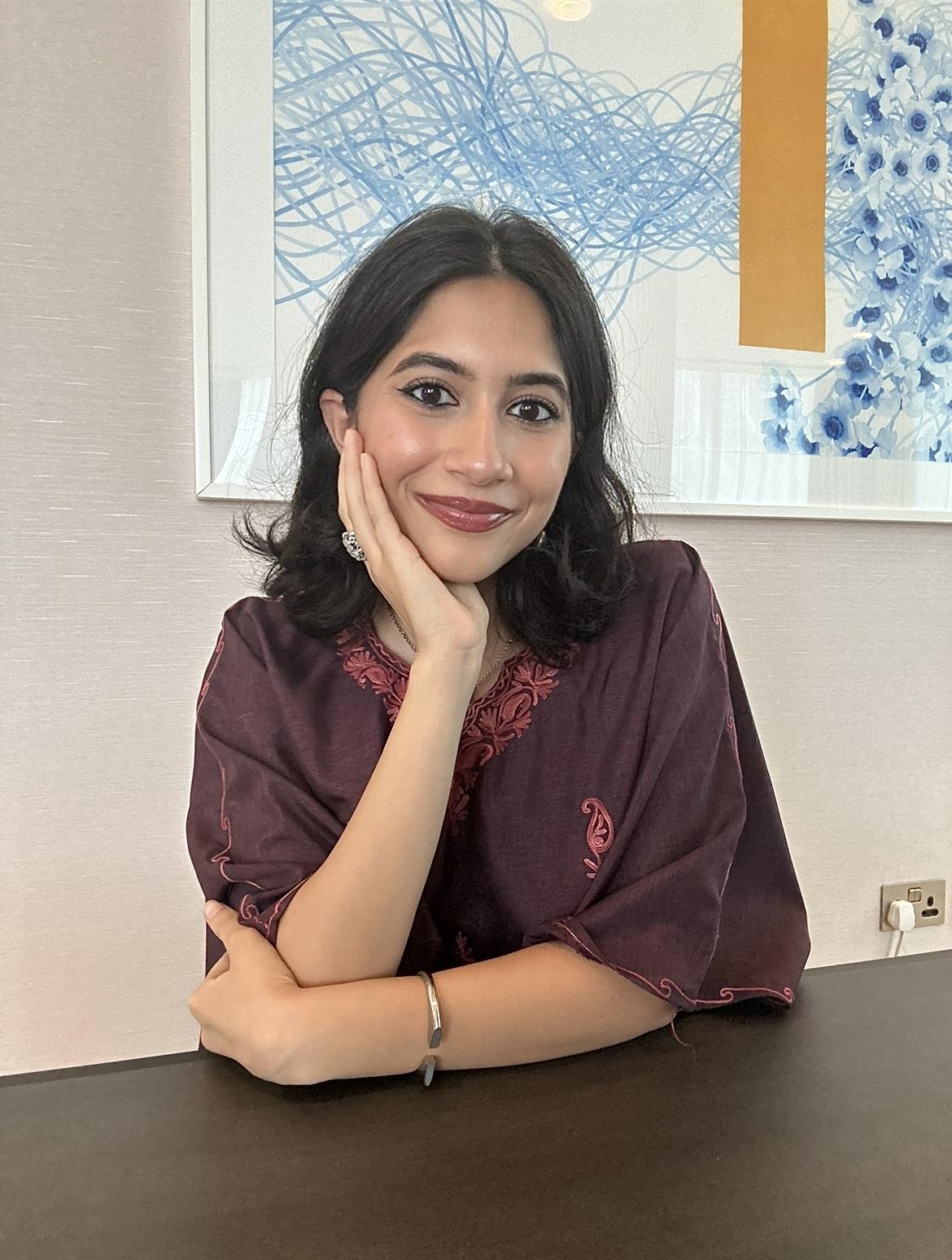
Leena Khan speaks about her first novel ‘Flames of the Cherry Tree’
Welcome to the Daraja Press Podcast.
Firoze: Good morning, good afternoon, good evening, wherever you may be. This is Firoze Manji from Daraja Press. Today I have the honor of speaking to the author of this extraordinary novel, Flames of the Cherry Tree. It’s a sweeping, intimate portrait of a young woman’s coming of age against the backdrop of colonialism, rebellion, and indeed the birth of today’s occupied Kashmir—at once tender and unflinching. It traces the story of one family through oppression, repression, and resistance, illuminating the forgotten histories that have shaped Kashmir today and the hope that survives in its people.
Leena Khan is an extraordinary woman. She’s currently a Juris Doctor at Harvard Law School with an interest in international human rights law, and she has a long history of studying at Georgetown University with many prizes and awards, including work on Arab studies, and has published on that herself. So, enough of my chattering. Welcome, Leena. Wonderful to have you on the show. Thank you for finding the time to meet with us.
Leena: Thank you so much for the incredible introduction. It’s such an honor to speak with you, and I’m really excited to be here.
Firoze: That’s wonderful. Leena, let me start by asking you, how did you become who you are today?
Leena: That is a very huge question, and I think at the heart of my answer is literature. When I think about the defining aspects of who I am, I’m a very values-driven, mission-driven person. My journey into becoming a lawyer and going to law school is very much entangled with a sense of wanting to make the world a better place. It’s entangled with recognizing that injustice in the domestic context in the United States, which is where I go to law school, and injustice abroad in places like Sudan, Palestine, Myanmar, and countless other examples, are fundamentally intertwined. The tool with which I hope to confront this difficult and challenging reality is the law.
The way that I came about recognizing and awakening to the very neocolonial aspects of our international system and our world is through literature. I’ve read Ta-Nehisi Coates’ essays, and I felt myself awakening and radicalizing through them. I’ve read Noam Chomsky’s incredible book, The Myth of American Idealism, reading about countless examples of how we’ve transitioned from the more material, obvious colonial era, pre-World War II, to a more soft-power neocolonial era that’s equally extractive today, but just in a more insidious, under-the-covers way.
That defines who I am. It’s recognizing this reality, hoping to fight against it, and holding on to a fundamental optimism that the world can be a better place — a journey through which I’ve passed by way of literature and reading—not just non-fiction like the essays and books that I’ve mentioned, but also fiction, which is why I’m also a writer.
Firoze: In that history you just plotted, Kashmir doesn’t appear.
Leena: Yes. Well, I assumed that we would get to that because the book is about… but yeah, Kashmir is one of many examples of colonialism being alive and well in the modern day.
Firoze: Right. So why did you write this book? How did you come about writing it?
Leena: The process was actually quite personal. I mean, growing up, in my childhood, my grandparents used to tell me stories about their childhood memories of Kashmir. They grew up in Kashmir and immigrated to the United States after they finished medical college there. Hearing about these beloved memories from people that I love and admire so much gave Kashmir almost a sacred tint from my perspective, where I wanted to be closer to it, closer to my heritage, in order to be closer to my grandparents.
My favorite story was when my grandmother told me about how, when she was a little girl, she always felt very much like a tomboy in a society with quite strict gender roles in Kashmir. Because of that, she very much felt her individuality. She had a rebellious streak, an instinct against authority. She grew up in a family with a lot of siblings, many women that very much existed in their femininity, and so again, she kind of felt like an outlier. One rule that she had in her household was that she and her siblings were forbidden from climbing the cherry trees in their orchard. So, obviously, that’s what she did basically on a daily basis. She would be the one sibling that climbed to the top of the cherry tree, and to her other siblings on the grass below, she would toss them fruits so that they could enjoy it, enjoy the fruits, and she would be eating the cherries at the top of the tree herself.
Whenever her father heard the ruckus and came marching in to disrupt the fun, her siblings would be able to scatter and run away because they were on the ground. But she was trapped on the cherry tree eating her cherries and was forced to simply await whatever punishment was lying for her waiting on the ground. And no matter how harsh that punishment was, you could trust that she would be in the exact same spot the next day, at the top of her cherry tree.
That anecdote I thought was so vivid, so charming, and so real. It was something that I wanted to write to feel closer to Kashmir and, by virtue of that, to my grandparents. So that was the first scene that I wrote of my novel, and the rest of the story kind of just bloomed from that point through my own imagination.
Firoze: I mean, that sets the scene very well. It’s exactly what you write about in the book. I think it’s a terrific title—Flames of the Cherry Tree—it really rings a bell in terms of the history of Kashmir, especially as you set it in the time of the partition of India and Pakistan. So the flames are something that sits very well with the image of that cherry tree.
So in writing this, what were you hoping to convey to the reader? Why should they read this? What does the reader take away, or what do you want them to take away from this?
Leena: When the word Kashmir comes into conversation, the mainstream media narrative on this topic is that Kashmir is basically a battleground upon which two enemy nuclear superpowers, India and Pakistan, hash out their grievances. And that’s very much how it’s treated. I mean, especially in the modern context under the Indian-occupied side of Kashmir, you have military personnel walking on residential blocks . You have young men being forcibly disappeared every single day. It’s a place of very deep suffering.
I wanted to show the story of Kashmir as a narrative that begins actually way before the advent of modern India and Pakistan. The seed of the modern military occupation of…
Firoze: W ell, is that the military police coming for you that we hear in the background?
Leena Good question. Hopefully not. Hopefully I’m safe in my dorm in law school, but that was excellent timing.
So, the modern-day military occupation—the seeds of it began before the modern invention of India and Pakistan, during the Dogra regime, where a system of slavery, begar or forced slavery, was basically imposed upon the majority Muslim population. The feudal system privileged an elite few largely based on religion at the expense of the masses. And so my message was I wanted to expose the roots of the struggle in modern-day Kashmir. And I wanted to do so holistically, because Kashmir is also so much more than its oppression.
I mean, it’s a place where humans have invented the most beautiful craftsmanship that you can imagine. I’m wearing Kashmir embroidery right now—this is actually my grandmother’s blouse. Kashmir is the birthplace of the pashmina shawl. It’s a place of deep religiosity and religious devotion where people center God in everything that they say and they do. So that’s my message to the reader and what I hope people will take away: that this novel is a lesson in history, but it’s also a recognition of humanity.
Firoze: Yeah, no, I think that comes across very well. I mean, they say that great novels are characterized by how the reader finds themselves being a different person at the end of it from what they were when they started. I mean, clearly, you also have undergone that transition. You are no longer who you were when you started. So to what extent do you think you achieve that from the reader’s perspective?
Leena: Well, I can start by explaining the exact feelings that I hope to invoke in the reader in interacting with my story. I mean, what I envisioned was very much what I experienced myself reading one of my favorite authors. Her name is Susan Abulhawa. She’s a Palestinian-American author that writes historical fiction centering on Palestine in English. And I remember the exact feeling in my chest when I finished her novel, Mornings in Jenin, which is an intergenerational story that traces the history of Palestine from the Nakba to modern day. And it was like there was this fire, this urge for action.
I mean, through her novel, I read about horrific systemic injustices much like those in Kashmir. And it unlocked this, almost rage, in me for a better world—that this is important, that this is what we have to work towards, otherwise what is the point of being alive? That exact fire in my chest is the feeling that I hope to ignite in others for Kashmir through my novel. I hope that I am inviting people to recognize the injustice in Kashmir, to fall in love with the characters, to embrace the urge to fight for them, and to let that guide how you understand the world around you.
As to the extent to which I feel like I accomplished that mission, I think that it’s very easy to empathize with characters when the person in question is someone that you love. And so my hope is that my characters do all the work for me. I mean, I’m pretty biased considering that I invented them, but I think that they’re very lovable. So because of that, it’s quite easy to empathize with them and thus pursue this journey very authentically of experiencing an urge for action and to make the world a better place on their behalf.
Firoze: Okay. So, you have this character Aafreen. It’s a young girl that dreams to be a doctor like her beloved grandpa. So, is your grandfather also a physician?
Leena: Yes, my grandfather is a now-retired physician. He worked in internal medicine, and he is probably the most inspiring person that I know. If I had to invent with my own hands a perfect human being, my grandfather would be the one that pops up out of that process.
Firoze: I hope he’s watching this.
Leena: I hope so too.
Firoze: Yeah. So, you have this young woman who, contrary to the sort of norms prevailing at the time in Kashmir, dreams to become a doctor and indeed goes down that path against considerable odds. And then she gets swept into this whole whirlwind of tragedy, of horrors, and intertwined with that is falling in love. And to begin with, she falls in love with Edward, who is in both class and caste terms not her equal, as it were. In reading this, my hope was that she would commit class suicide in choosing Edward. Was I wrong to feel that?
Leena: Well, that was her hope. I mean, I think the whole point of introducing Edward as a love interest when she was relatively young—and so relatively also untouched by societal expectations and without true realization of the hardships and realities that come with pursuing a romantic interest that society frowns upon, especially at that time and age—so I just wanted to portray the angst and the true innocence with which she pursued her love for Edward. But the choice ultimately fell out of her hands because of Edward’s own decision and own agency in rejecting her.
And I think that was something I was very intentional in conveying in this story: that although in relative terms in their relationship, Afreen held the power—she is part of the family that he is employed and working for, and in class terms she was a step above him—it was his choice to reject her. It was an expression very much so of human agency and an opportunity for Edward to be the author of his own destiny.
Firoze: So then Hussein, who… she eventually reconnects with—I almost said “you,” it’s difficult to separate Aafreen from Leena. There’s this tragedy of love and so on, but you bring this to a horrific point of the murder of the family, Moaj and Dadaji, under horrendous circumstances. I’ve read this now several times, and I felt that there was grief momentarily, but the reader wasn’t, in a sense, allowed to share that grief. I mean, grief is… when I lost my mother, she still remained there, the grief still remains, and that was many decades ago. I just wondered what motivated you to have the story, in a sense, accelerate at that point into a different domain?
Leena: It’s a very interesting question. I mean, I knew from the starting process of writing this novel that I wanted to end it with the Jammu massacre and the murder of Aafreen’s close family. And I recognize that, as you mentioned, it was very abrupt. I mean, the whole novel leading up to P art T hree is basically a family drama and a love story until everything very suddenly falls apart. And I think that’s because I really wanted to have the shock factor be that much more potent—just the idea that in the blink of an eye, your entire life can change.
So this sort of relates to how I feel in my own daily life. I feel very shielded in my privilege almost at a subconscious level. Bad things on a daily basis happen to people in conflict zones. And that might seem like it’s simply the natural state of the world, but what a ridiculous assumption that is. I mean, we’re all equal in our humanity. We’re all equally entitled to joy and to safety. And almost in an exercise of humility, I wanted to show how quickly that can change, that can all be taken away. Aafreen had a beautiful life, and we got to see it, but we also got to see that change very quickly. That was very intentional.
And as for her grief, we did get a short taste of it—a few pages at least—but I also wanted to show that life goes on. I mean, that’s why the book ends with a glimpse into the new generation. I think part of writing fiction and part of reading fiction is very much an exercise in hope, in the possibility of a happy ending. And as long as that potential exists, even just in our imagination—as long as there’s just a 1% possibility of a better world—then that possibility is real and we have to hold on to that. And so that’s why I shifted from the grief and the loss to the opportunity for hope.
Firoze: The novel takes you into such detail about youth and evolution and the love that she expressed. But Aafreen then returns to Srinagar. We’re not told about what happened to all the ethnic violence that had actually led her there. Was there a longer novel planned with more detail about Aafreen as an adult? I would have loved to know more about how she was thinking, why she was thinking, what her emotions and feelings were. But the novel closed too quickly for me. Were there particular circumstances that made you feel you needed to end it somewhere? I mean, there’s always the classic statement: great works of art are never completed, they’re merely abandoned. So I can understand in one way, but tell me more about your thinking and feeling. Why were we not given more about such an incredibly lovable character who then becomes a grandmother? There’s a huge left-out history there. Are we going to have this in volume two?
Leena: So, in regards to the historical timeline, the violence about that was occurring during partition was largely concentrated to Jammu, not in Srinagar or the Kashmir region. And as for what happened in the aftermath of the Jammu massacre, to be completely honest, there isn’t much record of it. I feel like there was not much reporting or journalistic coverage of the violence that took place, which actually made research very, very difficult for this novel because resources were quite scarce. And my assumption is that the reason why is because there’s a vested interest in sterilizing the origins of occupied Kashmir. So that’s my answer on the historical timeline of what actually happened.
And then in terms of the novel itself, I mean, I could write thousands of pages on the history of Kashmir and the evolution of these characters and this story. So I feel like you kind of have to choose a point to end somewhere. And I think that the advent of modern-day India and Pakistan and the birth of Kashmir in the modern context was a very appropriate transition point to end that. Yeah, I mean, Afreen’s story had to end somewhere.
In terms of life circumstances, I did submit the final manuscript of the novel, I think, the week of my orientation for my first semester of law school. So it was as complete as I hoped for it to be, especially considering that my life very quickly was taken over by my current academic circumstances. So in this specific world of Aafreen and her family, the story is over. I don’t think there will be a volume two.
Firoze: It’s striking that you could have written something, given the trajectory of your academic training. I just think to myself, where did she get the time to write this? Because it must have gone through many iterations. I know even with our interaction, it has gone through various iterations. I think I’m not the only one who thinks that you’re an extraordinarily talented writer of a novel. And where do you see that aspect of your life and your capabilities evolving?
Leena: Thank you so much. I mean, that obviously means a lot coming from you. Reading and writing is where I feel like I derive a lot of my purpose and my joy from, and it’s very much an integral part of how I understand the world. So it’s something that I will never stop doing. I mean, even now in this period of my life where I’m very much subsumed by my academics and the rigor of law school, I find time to read novels. I find time to write fiction because otherwise, I mean, what is the point of life? We all deserve to find joy. So that’s something that I think definitely will stay with me for a very long time.
And I’m also finding ways to forge connections between fiction writing and reading fiction and my career. I mean, litigation and the law is very much an art of storytelling. So I’m able to connect these two aspects of my life very much, I think.
Firoze: So, you don’t have something planned for us yet?
Leena: To be continued.
Firoze: I really do hope so. I think you have an exceptional talent for telling stories, and you’re right. Litigation is about stories, and I think that’s a really important thing to recognize. It’s always the story first, the evidence after. That’s the reality of courts. But I think you’ve done a really wonderful job, and I really do encourage you to pursue this aspect of writing. I think you have shown what the possibilities are, and you are getting recognition even with the novel appearing quite recently. So I’m not the only one who recognizes talent.
Leena: Thank you so much.
Firoze: Are there messages that you’d like to convey to listeners and readers?
Leena: There is, yes. I think that everyone should pursue reading, especially reading fiction, as an act of revolution, as an act of resistance. I think that educating yourself through narratives, through the process of relating to others and building empathy, is very much the way in which you can pave a better future and work towards making the world a better place because fiction allows you to imagine one. And so I hope that if you do read my novel, you read it with that perspective and you take that with you into reading other stories in the future and maybe also writing your own.
Firoze: Would it be too much to ask you who are the three novelists who had the most influence on you?
Leena: Wow, okay. I mentioned Susan Abulhawa already, just because her novels on Palestine really shaped me in terms of general education and sparking curiosity on the Palestinian cause in general, and just the fact that she was able to write such vivid, explicit stories that pulled readers into shock and horror at the realities of the occupation in Palestine. So Susan Abulhawa was one.
Another writer is Elif Shafak. She also writes historical fiction, and her prose is beautiful. She is just a master of words. Reading her work is very much like experiencing art; she’s just very beautiful in the way that she writes, and that’s something that I really hoped to emulate in my own writing.
And then, I mean, this is a very cliché answer, but I’m going to be as honest as possible. A writer that very much has shaped who I am as a reader and as a person is J.K. Rowling. I read Harry Potter—it was the book series that sparked my love for reading. My parents were actually worried that I wasn’t going to read at all as a child because I completely rejected reading books up until the age of like seven or eight, until my dad sat me down and forced me to read the first three pages of Harry Potter. And he said, “If you don’t like it, you can continue watching TV and living your best life, but if you do like it, just continue reading.” And after that, I was hooked. I mean, they did not see me for a week because I was just in my bed devouring the entire series. So, J.K. Rowling, I think, is a writer that shaped me in the sense that she really opened the door and opened my imagination to the possibilities of world-building and immersing yourself in a story.
Firoze: How interesting. I had the misfortune of being sent to the UK to boarding school.
Leena: Oh, really?
Firoze: And I opened the pages of J.K. Rowling, and I’m afraid I just had to put it down. It’s too much like private school. Yeah, I’ve been there, done that. Never again. Thank you very much. But anyway, well, Leena, it’s just a pleasure to have had this opportunity to talk with you. And I don’t know whether at some point we should invite you to come to Canada. I can’t come there; I won’t come there—decided that I’m not crossing the border to Mordor—but I hope we can arrange something for you to come. I think people would be very interested to meet you.
Leena: I would absolutely love that, and it would be my honor.
Firoze: Yeah, so let’s try and plan that. A real pleasure talking with you. Thank you for giving time in your academic struggle for your qualification as a lawyer, and I hope that goes really well for you.
Leena: Thank you so much, Firoze.
Firoze: The Daraja Press podcast is produced by me, Firoze Manji, and Pierre Loiselle. Music by Arlo Maverick. You can find more podcast episodes, our books, and much more at DarajaPress.com. And thank you for listening.
Comments (0)