
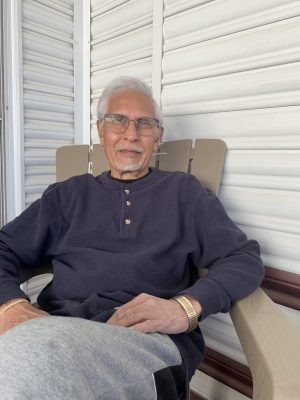
Joe Pillay talks to Doug Miller about Taking Up the Spear, Shadrach Mufumulo’s Struggle Against Apartheid.
Welcome to Daraja Press Podcasts. On this episode,
Taking Up the Spear, Shadrach Mufumulo’s Struggle Against Apartheid.
Shadrach Mufumulo was an ordinary South African who became a committed freedom fighter. His story
is told by Joe Pile, himself a former ANC underground activist, political prisoner in exile,
who came to know Mufumulo personally and documented his remarkable life. He was a genuine freedom
fighter. that had struggled greatly, had been imprisoned, was tortured twice,
never gave up the struggle. In this conversation, Amandla Radio’s Doug Miller speaks with Joe
Pillay about both the brutality of apartheid and the determination of those who fought to end it.
This interview was originally recorded for CKUT-FM in Montreal.
I’m Doug Miller here today with Joe Pillay in… Edmonton. Good day,
Joe, and welcome to Amandler Radio. Good day to you. Thanks so much.
Joe has written a book entitled Taking Up the Spear, Shadrach Mapumu’s Struggle Against Apartheid.
It’s a compelling life history of an ordinary man caught up in the epic struggle against a
pernicious system designed to ensure the superiority of one race over another. Before I start
talking to Joe about the book, however, It’s important to point out that Joe himself was a freedom
fighter deeply involved in the underground work of the African National Congress. Along with his
brother Ivan, they grew up in Durban, South Africa, in a society steeped in racist oppression and
resistance to it. They were part of an underground cell carrying out the work of sabotage,
publicity, building the structure for infiltration of arms, materials, and fighters. Joe had to
flee into… exiled in Swazilin, from where he was kidnapped by the South African forces,
imprisoned and tortured, and finally was able to seek refuge in Canada. Joe’s story is just as
fascinating as Chadwick’s. So Joe, can you briefly tell us about your political trajectory and
involvement? I was always against apartheid and did everything that I could to promote the
struggle. And when I lived in Durban for the first 32 years of my life,
I became involved in the Black Consciousness Movement and later formed a three-man cell with my
brother Ivan, who was younger than myself. Patrick saw me and I,
and we connected. would the underground ANC movement to promote the struggle.
So my involvement in the struggle has been from the time I remember the struggle of the people.
Thank you. Now, the central figure of your biography, of course, is Shadrach Mapumulu,
but it seems to me your first encounter with him was not a particularly good one. That’s right.
Yeah, because I didn’t meet Shadrach in South Africa.
I met him later. But my connection with the African National Congress and the three-man cell was
to promote the struggle in South Africa. And to do this,
we contacted the African National Congress. in Swaziland,
and they gave us certain instructions. At one stage, they wanted us to buy vehicles to transport
arms and ammunition into the country to promote the struggle.
And to buy the vehicles to convey the arms and ammunition,
they had to get someone’s name to buy those vehicles.
And they thought that I was the ideal person for that because I was running a retail furniture
outlet called the Bargain Furniture Center, which gave us a good cover for the vehicles and a good
cover for having meetings, etc. So in buying those vehicles,
I had to provide my information, my ID, my address,
where I worked, etc., etc. I provided that information and everything was going well.
I was told that the vehicles had been bought. A mechanic was looking at it and it will soon be
delivered to me. So one Friday evening,
after a busy day at work, I got home and my brother Ivan pulled me aside and said,
you’d have to leave the country right away. I said, why? He said,
well, Shadrach has been arrested. Who is Shadrach?
Shadrach is an ex-Robin Islander. He spent 10 years in Robin Island, and he has all your
information. I said, why are we working with someone that had already been arrested and was in
Robin Island? Don’t we know that he would be suspect and he’ll be carefully watched?
Well, Ivan told me, he was supposed to leave the country and he didn’t.
I said, well, he’s supposed to do a lot of things that he didn’t do. And then Ivan said,
well, that’s neither here nor there, but you will have to leave the country. I said,
I just can’t leave the country. I’m managing a furniture business. I’ve got to make arrangements.
And Ivan said, you won’t be managing anything if the special branch gets hold of you.
You’ll be lucky to be alive. And so I had to pack my bags, pack my knapsack,
got hold of the little money, the money I could, and left my home for the last time.
And so I was not very happy that I had to all of a sudden leave the country.
because of a man named Shadrach Mapumuru. That’s right. Yeah. Doesn’t sound like you were very
impressed, that’s for sure. How did your anger at Shadrach sort of disappear after you did finally
meet him in person? Yeah, I met him in person after I myself was abducted.
I realized that it was not totally his fault. He had been given some instructions.
to collect other people and leave the country. And while he was doing that, he got arrested.
But my meeting with him, I realized that he was a genuine freedom fighter that had struggled
greatly, had been imprisoned, was tortured twice,
never gave up the struggle, was a very, very dedicated person. And his whole life was a struggle.
And so I was very impressed with him and decided that, you know,
that I would interview him and take notes. It was a difficult time because I was in danger of being
shot this time, not abducted. He was also carefully watched. There was no telephones and we did not
have any computers, so we had to work very carefully. But over that period of time,
I really got to know him well and was very impressed with these contributions to the struggle.
I’ve written life histories before, and it’s quite a laborious task. You were really motivated here
to record him. What stood out? What do you think made you so impressed with him?
Well, he was one of the first groups of people that was involved.
in furthering the struggle. You know, he had very little education,
probably one or two years of formal education. And he mainly communicated in Zulu and,
you know, had a difficult time at the beginning when he worked as a servant for white families
because they couldn’t speak Zulu and he couldn’t speak. english so you know from that point onwards
he actually learned english and studied english because he was wanting to know more about the
struggle and the oppression of his people he tried his very best to prosper in a very difficult
country and in a very difficult situation but everything he did was prevented by apartheid and
apartheid laws. And he, you know, he really overcame those and joined the struggle,
learned from the struggle, was imprisoned, was tortured. And,
you know, but he never gave up on the struggle.
You’re listening to the Daraja Press Podcast. Daraja is the Swahili word for bridge.
As its name suggests, Daraja Press seeks to build bridges, especially bridges of solidarity between
and amongst movements, intellectuals and those engaged in struggles for a just world.
Check out our other episodes, books and more at darajapress.com.
So now let’s get back to the show.
You know, so many young Zulu men. They just shrug and say that’s the way it is and they go to work
in the system or they actually get involved in it one way or the other. What do you think was
behind his drive, his motivation to work so hard to fight it?
The drive behind it was, first of all, his own suffering at the hands of apartheid.
You know, he tried to open a business. He got his brother to run a stall for him.
in Kata Manor. And the area was declared a white area.
And the bulldozers bulldozed all the houses, right?
He had to close down his shop. At one time, the rain was pouring. A woman outside was giving birth
in the rain. People were getting soaked, right?
You know, and… This made him realize what it was. It also made him realize that the peaceful
struggle of the people wasn’t succeeding. The peaceful struggle was met with bullets and beaten
down and so forth. And so there was no way of legally fighting.
And I think also the history. of him living in Mapumulu, where his relatives took part in a
struggle before that and fought, right? And many of them were injured in that struggle,
right? And so he was convinced that the only way to defeat apartheid was to take part in the
struggle. And I think when he was first arrested in Robben Island,
and met all the others that were involved in the struggle. And there was a struggle there in Robben
Island itself. And when he learned of their struggle,
their philosophies, there was a camaraderie formed that even after he was released,
that he embarked on the struggle again, was tortured again, was house arrested,
was banned. But he never gave up. So eventually he comes out and goes right back into the struggle.
And then before you know it, he’s in trouble again. Right.
Yeah. He’s arrested again. And in South Africa, you had what was called the 90 days law.
When the police could arrest anybody that they were suspicious of.
And the person had no recourse to lawyers. family or relatives.
They were in solitary confinement and the police could do whatever they wanted to do with them.
So they were tortured. They were kicked. A plastic bag was put over his head where he suffocated
and fainted and lost consciousness. Done several times. And towards the end,
you know, he… confessed to doing certain things.
And when he was taken to the magistrate court to swear under the oath,
under oath that he had done these things, on the way he said,
I’m not signing anything. You can punish me as much as you want,
but I only said those things because I repeated what you told me.
And so he couldn’t be charged. But one of the things that also helped,
Why they couldn’t charge him was that several of us, when we heard that he was being arrested,
left the country. So there was no witnesses against him.
But they did punish him, and he was still detained for a few years,
but then escaped into Swaziland. And their tragedy didn’t leave him behind again.
I mean, it was a terrible way that things ended. Yes, yeah.
It was around the end of 1986, right, when I had already got the materials for the book.
Towards the end of 1986, he was taking care of his three sons.
His wife was a nurse, and whenever she… night shift. care of the sick and the injured.
Shadrach was solely responsible for his three sons, and he was taking care of them.
The South Africans raided Babane, the capital of Swaziland,
and Manzini. And when they attacked his flat,
his apartment, he hid the children and made sure that they were safe.
But the South Africans shot him. and carried him and dumped him into the boot of a car and
transported him. Along the way, he was transferred into a van.
With no medical care, with no one to care for his wounds, he bled to death.
Oh my gosh, tragic. Did they ever recover his body? Yes,
he bled to death, right. The South African police had him buried secretly,
you know, with bogus relatives. When his family came to know about it,
they applied for his body to be exhumed and reburied.
Their application was successful, and he was to be buried in Chesterfield.
His mother… relatives and friends were on their way to the funeral in a chartered bus.
But on the way, they didn’t quite make it because the bus was halted.
The bus was halted. They were prevented from attending the funeral.
His mother was prevented from attending her own son’s funeral. Only 200 people were allowed at the
funeral, and a contingent of police were there.
There was a helicopter hovering above, taking pictures of the mourners,
right? And Shadrach was buried there,
right? But all his life, he struggled for the better South Africa. And why do you think it would be
important for… people to read his stories, but particularly Canadians? I think it’s important to
read Shadrach’s story because there are struggles all over the world.
And we know that in struggles like this, where there’s been racism,
etc., where people have suffered all the lives, it’s very,
very difficult to recover from that. And so we learn a lot by reading the struggles of people like
Shadrach and what they have gone through, the mistakes they have made.
And there were a lot of mistakes that were made in the struggle. For example,
Shadrach should have left the country at a certain time, and he didn’t, which led to other errors
and which put the struggle backwards. to delay the struggle for another 10 years or more.
So in Shadrach’s story also talks about the history of the struggle during that time.
And so even when Mandela was arrested, mistakes were made.
And so struggles, we learn from struggles like this, what precautions to take,
right? And we are having, you know, we… have struggles all over the place.
And we know that when struggles are not properly conducted,
people suffer. People end up in prison.
Wow, Joe, this is amazing. Thank you so much for bringing this book into reality and making it
available to us. On that score, it is available through Daraja Press. here in Canada,
dharaja, D-A-R-A-J-A, dharajapress.com. It is a very engrossing read.
I would highly recommend it to anybody. Thanks for bringing it to life for us, Joe. It was a
wonderful read. Thank you for taking the trouble to bring this book to the attention of a wider
population. Thanks again. Thanks, and have a good day.
You were listening to an interview with Joe Pillay by Doug Miller for Amandla Radio on CKUT-FM.
His book, Taking Up the Spear, is available on Daraja Press at darajapress.com.
Produced by Pierre Loiselle, Doug Miller, and Froze Mangi. Music by Arlo Maverick.
Thanks for listening.
Gerry Rowe
July 17, 2026Thanks to everyone past and present involved in this struggle.