
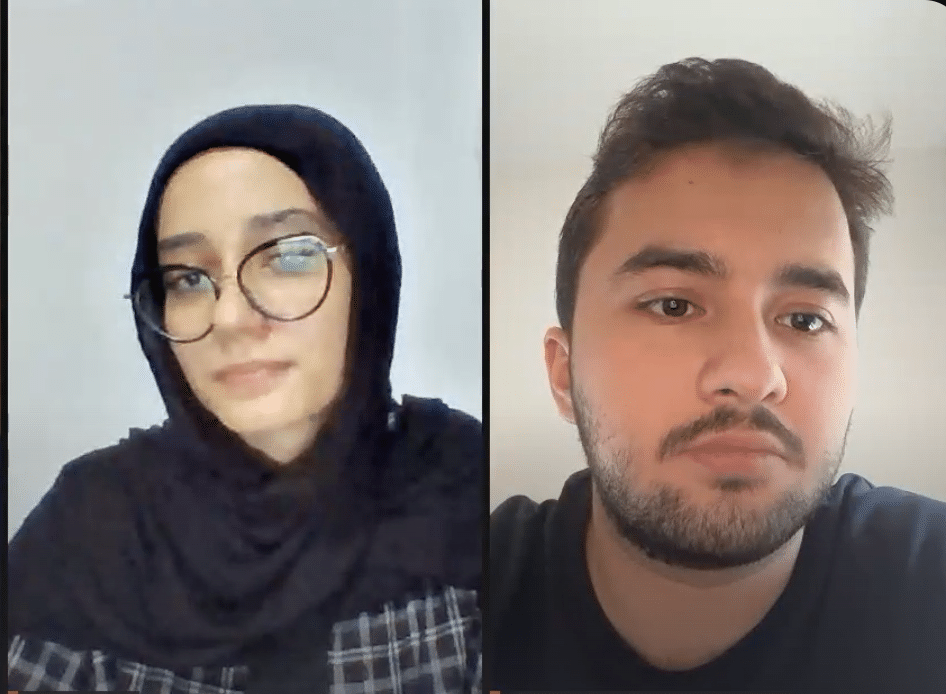
Yara Nasser and Tareq AlSourani talk about Gaza Held In Time
In this Daraja Press conversation, Firoze Manji interviews Yara Nasser and Tareq AlSourani about their book, Gaza Held in Time: A Tapestry of Two Lives. They reflect on writing, identity, displacement, and the changes they have experienced since publication.
Yara, speaking from Gaza, describes writing as both personal exploration and a lifeline. She discusses interrupted education, efforts to leave Gaza to continue studying, and the friendships she has developed through a local book club. Her reflections challenge the idea that Palestinian creativity must focus exclusively on suffering: she wants readers to recognize her individuality, interests, and evolving voice.
Tareq, now studying in Canada, explores exile, uncertainty, financial pressures, and separation from his father, who remains in Gaza. He contrasts familiar community life at home with the isolation and demands of rebuilding abroad, while expressing determination to create a future and remain connected to Gaza.
Both authors emphasize that their book represents their own experiences, not every Palestinian’s story. They discuss their complementary working styles, the challenges of finding a publisher, and meaningful responses from readers. Throughout, the conversation highlights memory, human connection, and a refusal to abandon hope, urging audiences to listen to young Palestinians as individuals with ambitions and futures.
Transcript
Gaza Held In Time_ Yara Nasser and Tareq Al Sourani
[00:00:00]
Writing as a lifeline — preview
Yara Nasser: I always think that writing is, is, is, is a tool you can, you can use in order to figure out things and to explore things, and to, to even reveal some, some ideas in your mind that you never knew they existed.
But I’d say it’s a lifeline right now. It’s, it’s a way I can reflect on my life, my own life, what, what I’m thinking of, um, who I really am. So I write a lot about a lot of things. I don’t write just about, uh, maybe personal essays or, or something. I don’t write just about Gaza. And this is what, what I like the, what I like about the stuff.
Welcome & publishing Gaza Held in Time
Morning, good afternoon, good evening, wherever you may be. This is Firoze Manji from Daraja Press. Welcome to our podcast. Today, I’m interviewing two really remarkable individuals who wrote a book called [00:01:00] Gaza Held in Time
It is a tapestry of two lives and offers a personal and deeply emotional account of life in Gaza, chronicling the experiences of two young individuals before and during the recent genocide. Through alternating narratives, Tareq, who eventually left Gaza, and Yara, who remained, explain themes of survival, displacement, memory, and the enduring human spirit.
The authors aim to humanize Gaza beyond the news headlines, illustrating the rich cultural fabric of the region and the profound impact of war on daily life, while also challenging readers to remember and engage with their story. The two [00:02:00] authors, Tareq Al-Surani, who was seventeen when he wrote the book, and Yara Nasser, who was eighteen, have done a remarkable job.
And, , the book has received considerable attention, including, being translated into Spanish and, , had the books chosen by the Palestine, Solidarity Committee in the UK as one of their recommended books. So a very warm welcome to Yara and Tareq
Firoze Manji: welcome, Yara. Welcome, Tareq. really good to have you, on the program today. So Yara, how has the experience of sharing your story, changed you, if at all, or as… in terms of your personality or as a writer? what has publishing done for [00:03:00] you?
Yara Nasser: Okay. Uh, I don’t think I’ve ever said this before, but when the book was first published, I, I struggled to feel any pride towards it.
I’m not sure why, but I’ve struggled to feel proud about publishing a book, and I’ve struggled to accept the, the being labeled as a writer because I really wasn’t sure if, if I’m truly a writer or, um, I’m just someone experiencing a crisis that, that once this crisis is over, I, I won’t be able to create anything meaningful again, or I wouldn’t be able to be, to reach such point.
I’m not saying that, that such persons or such people who, who create things, uh, who have created things during this genocide are bad people. But, um, I’m saying, I’m saying this to myself mainly. And I guess, I guess this question has been, has been in the back of my mind during the past [00:04:00] year, and I’ve been trying to figure out where this question is come, is coming from and, and where this feeling is coming from, where this un- non-existential, variety is coming from.
But I guess now I’m, I’m more close to, to, to y- to who Yara is in her truest, in her truest sense. I, I write differently, and I, I write for different reasons. I write because I want to write, um, not because I want to, to propose or I want to, to, to, to be represented in a, in, in a singular way. So- i’d say that I’ve changed a lot, and I’m now more aware of why, of why I’m doing all of this in the first place.
And for that, I’m grateful. I’m grateful that I’ve had-
Uh, I think we’ve lost Ju- yeah. Uh, let’s wait for her to come back. Tariq, how has writing changed you?
Tareq AlSourani: It changed a lot. I think it [00:05:00] changed a lot in my life, in my personal life, and, uh, also in my future. I think it has changed, um … A lot has changed since last year, since we published it, and, uh, a lot has changed in me as well and in the world as well. Uh, in Gaza things are not getting much better right now, but, uh, a lot is changing. And for me especially, uh, as I’m outside, uh, unlike Yara, uh, there are sort of, lots of new challenges now for me, here in Canada, abroad in exile, in diaspora.
I mean back growing up I’ve always heard of diaspora which is in Arabic called Al-ghurba. I’ve always heard how hard it is and, and how exhausting it is and how exhausting it is to, to live abroad and, and to build a new life. But I’ve never [00:06:00] imagined that I will experience this, experience this one day.
Um, out of nowhere suddenly found myself in this Al-ghurba situation at such a young age two years ago. The book made, the book made me realize that it’s important for me to talk about my story and where it came from. And for the past two years, I’ve, I’ve heard lots of, feedback and testimonies and everything from, from lots of different people from different ages, from, for example, now in un- in university as well, people…
Yara Nasser: Um, yeah, I was saying that I’m grateful that I’ve got… That, yeah, I had my time figuring this out. And yeah, I’m grateful for this ex- uh, for this experience that, yeah, I kept going, but, uh, but I didn’t…
But I ceased questioning this process, and I ceased questioning myself.
Firoze Manji: Right. [00:07:00] Well, I just asked him about, you know, how it has changed his life. And of course, he’s in Canada and facing completely new challenges, a completely new life. so do you want to continue, Tareq, Yes.
Tareq AlSourani: I’m, I’m now in a program, a, a scholarship program where people come from all around the world and from different, uh, challenges, very, very different places. For example, especially this program that I’m in, I’ve, I’ve seen people from countries that I’ve, I’ve never heard of even. From, for example, Bhutan, in Asia, around Nepal and Nepal and these countries and, and, and lots of small countries in, uh, Africa as well, Brunei.
So there’s lots of, lots of people that are really interesting, and it made me realize that everyone has their own stories and something really to share, uh, regardless of where we come from. And, uh, a student from Nepal, a few days ago, she approached me, and she said, “I got the book, and I finished [00:08:00]it on one sitting.
I, I couldn’t stop reading.” Um, I was like, “It’s a, it’s a pleasure.” And people really, I realize they do appreciate, knowing stories and reading stories and, and knowing more about what’s happening and happened with me. Uh, but what I’m focusing more, what I’m focus- focusing the most on right now, I believe, is just building what’s, what’s next.
Uh, making sure that I can survive here, because there’s unfortunately no way back at all. Uh, my, my other international fellows, they have, they have a safety net. They have a safe way back if anything happens, if anything goes wrong. But for me, there’s, there’s no way back at all. and, and so my, my, my first priority now is to just survive here.
Lots of the immigration complications and the political complications, I’m, I’m following, uh, the political [00:09:00] complications of, of lots of places around the world just to see and to, to predict how are things happening now. And then of course, in the past few years as well, almost three years now, I’ve, uh, I didn’t see my father yet.
He’s still working in Gaza. So this has also added a very huge layer of, uh, complexity, uh, hardship as well. It’s not an easy thing at all, you know? But, but unfortunately sometimes, uh, it’s just, it’s just how it is now and, and in Canada, survival here is, is not easy at all, especially for, for, for a family of, four, or five coming just newly here, so- That’s, this is how the situation overall is.
Yeah. But, um, I’m really glad of the impact that the book has, has done for me over the past few years.
Learning from each other
Firoze Manji: the book was really interesting in that it’s written from very two different perspectives, two different [00:10:00] people, two different experiences. to what extent have you learnt from each other, and what is it that you’ve learnt, from each other, in that process?
Yara?
Yara Nasser: Um, I would say something that maybe I’ve, I haven’t told Tareq before, that I’m always stricken by how, how professional he is, and how he just, yeah, he just keeps thing- things going, keeps things moving. Uh, yeah, while, while I’m someone who keeps questioning things and, yeah, maybe we still need more time, maybe don’t trust things.
And maybe this, this was the reason this book has came to life. Because if it, if, if I were to, to publish this book on my own at first, maybe it, I wouldn’t have completed that process or I wouldn’t have published the, the book or what I wrote in the book in the first place. So I always, say this, but Tareq keeps things moving and [00:11:00] he’s always so sufficient and yeah, always rushing things, uh, for the good.
For the good of this process and for the good of this project.
Tareq AlSourani: Okay. Uh, thank you, Yara. And, um, I think as I tell Yara and, uh, other people as well usually, I… It’s impossible for me to produce this work without Yara. And also, I don’t think it’s possible for Yara to produce this without, without our shared work because every, every one of us has done their part.
And each one of us has added their own personality to the book and their own unique touch. I’m always, uh, I’m, I’m used to just being stressful all the time, to keep rushing things and to do things quickly, especially, especially now.
Firoze Manji: yeah. one of the [00:12:00] things that so many people have said to me is how striking they are, they find the book.
The… Almost always when people I talk to about the book say, “Yara, your poetry is extremely moving. and I think you shouldn’t, underestimate your talents as a writer.”
but I was, you know, saying, just, you know, how struck I am by so many people commenting on how much they like the book. But I’m always struck by your poetry and the way in which you express yourself, you know? And I think you shouldn’t underestimate your capability as a poet, and as a writer, yeah?
so, I was just asking, you know, what, looking back at it, are there things that, that you wish you had said differently or you wish you could have added now?
Yara Nasser: Yeah. Looking back at, at, at the book, I, I wouldn’t say I want to add anything because, [00:13:00] yeah, it just, it is what it is, and I’m really glad, about how it turned out and printed.
I wouldn’t say that I would add anything or I would change anything, because it, it just represents, uh, who we were at the time. And yeah, maybe now we think differently, we write differently, but I wouldn’t change that because that was Yaria in, in 2025 and in 2024, and I wouldn’t change that for anything.
Firoze Manji: Right.
Yara Nasser: I really want people to see who I were and back, back at the time, and who I am today. I want them to see the difference, maybe.
Refusing to lose hope
Firoze Manji: Okay. the book is often described as as a testament or, and a refusal. So a year or more on, what does refusal mean to you now? Ali, should we start with you?
Tareq AlSourani: Yes. Um, I think it, I would describe it [00:14:00] as a refusal to lose hope in the future. Uh, there’s, there’s always, there’s always, challenges. There’s always very much difficulties. Uh, but I, I w- I would say it was a refusal to, to lose hope in the future. And also commenting on the, on the previous question, I think a year ago, um, this is all what we had to share.
This is all what we had to say. Uh, there’s, there’s nothing else that we can possibly do or, or share. But I think moving forward, I’m, I’m, I’m actually starting to think probably in the next few years to, to do another project like this, to do another book. Uh, I’m not sure when. If it’s in one year, two years, three years, or 10 years, but I’m, I’m pretty sure that there’s something that is gonna come after this, after this, uh, after this one.
Especially now now because the [00:15:00] story is, uh, continuing to be built. It’s, it’s contin- And I believe for Yara as well, hopefully if she soon con- continue her studies, there is a big story that is awaiting and, and there is a, a big future that is awaiting. Um, we’re just beginning our, our story. and it shouldn’t be all about surviving and, and just-
Firoze Manji: Sure
Tareq AlSourani: surviving the basic needs. Um- F- for example, dealing, dealing with the world. Dealing with the world, I realized it’s not an easy thing at all. I mean, I mean, people might expect coming from Gaza and, and, and being, uh, being framed as the guy from Gaza, uh, will all be sunshine and rainbows outside, uh-
Firoze Manji: Yeah
Tareq AlSourani: when, when dealing and, and, and negotiating with the world around us. But I’ve, I’ve seen lots of, people here in, in Canada, for example, uh, lots of challenges. but I [00:16:00] believe that there is still hope, even though I always think it’s unfair. I always think it’s, uh, it’s hard to continue. You know, what, what would I say if I, uh, haven’t seen my father in three years now?
What would I say about this? What, what, how, how might I even have the willingness to continue living in this world? But sometimes I just say there’s a future awaiting. There is a story to be told, and to be built as well, to be written, to be published, uh, and people might, uh, be inspired through this. Uh, and so, yes, this is the reason that I’m continuing and refusing to let hope go
Firoze Manji: I think a lot of people are struck by, what an intimate story this is, Yeah
from two different perspectives
Tareq AlSourani: Well, it struck [00:17:00] me
Firoze Manji: and that, it’s an expression of your own experiences. and I think it’s, very powerful for that reason.
and I think, you know, you end by saying that the story is not over.
Tareq AlSourani: Yeah.
Firoze Manji: and clearly it isn’t. and I hope certainly personally, whether as one of your readers or one of your publishers, that you will continue to write. Yeah. Mm-hmm. and this combination is very powerful.
so thank you for what you’ve managed to do. let me, turn to some questions for Yara. a lot has happened in the last year.
Yara Nasser: Yeah.
Firoze Manji: Give us an idea of how that’s changed things for you.
Yara: studies, identity & daily writing
Yara Nasser: Yeah. Since the publishing of the book, I, I just focused on continuing my high school studies, which has taken a lot of time. Like, [00:18:00] the bo- the book was published in July, and I was able to, to sit my exams in October, so that’s a three months gap. Which is, which is a lot, a lot of time, which is a long time period.
Um, and I did my exams while I was displaced in, in Deir al Balah, and I had no internet connection. I, I was living with 11 other people, so … And I faced a lot of technical issues, during, sitting the exams. And yeah, after that time I was really maybe lost and confused. I really didn’t know what am I supposed to do now.
I have published a book and I’m trying to figure out how to, to evacuate from Gaza. But I really don’t know what, what am I supposed to do with this time, with the time of when I’m, when I’m s- when I’m still in Ga- in Gaza, what am I supposed to do? So yeah, I enrolled at, a local university. Didn’t find it, [00:19:00] didn’t find it to be matching my interests, and didn’t enjoy any, any, any, any moment of being a student in that university.
I just finished the first year in that university and then, then just stop. Now I’m just trying to, to keep things moving and to keep myselves, myself as busy as I can, because I really don’t want to, to stop. I’m, I’m trying to, to get out of Gaza. I’m trying to keep producing meaningful things and to be, to get more close to who I really am and to, to Yara and her two sons.
So maybe, yeah, last year was, was, uh, was a, a year of an internal exploring and finding what I really want to do and what I want to do in this period of time.
Firoze Manji: does writing poetry feature in that?
Yara Nasser: Yeah, it features a lot. I, I write on a daily basis, like I write more than I [00:20:00] used to write last year, because now I have more time, and maybe I, I’m in a different state of mind and, and I approach writing differently.
I don’t think of writing the same way I, I used to think about it last year. So I write a lot. I write a lot, like, on a daily basis.
Firoze Manji: Wow. And you say you’re not a writer.
Yara Nasser: I’m not sure if I am. Well, uh- I’m still trying to figure out if I’m a writer or not.
Firoze Manji: it’s what you’re doing. but it may be interesting to know from you, you know, what does…
Writing as a lifeline
Firoze Manji: you say you write every day, what does it mean for you? is it a lifeline? Is it, is it only an internal preoccupation, or is it, something that reflects the context in which you find yourself?
Yara Nasser: Yeah. I’d say it’s both. I always think that writing is, is, is, is a tool you can, you can use in order to figure out things and to explore things, [00:21:00] and to, to even reveal some, some ideas in your mind that you never knew they existed.
But I’d say it’s a lifeline right now. It’s, it’s a way I can reflect on my life, my own life, what, what I’m thinking of, um, who I really am. So I write a lot about a lot of things. I don’t write just about, uh, maybe personal essays or, or something. I don’t write just about Gaza. And this is what, what I like the, what I like about the stuff.
Writing now is, I h- it has, my writing now has more personality and more character. It’s, it’s more Yara, maybe I, I’d say.
Memory, home & resistance
Firoze Manji: Yeah, one of the really sort of profound questions that you pose is, you know, how do you mourn something that still continues and still exists? can you elaborate on that for us, please?
Yara Nasser: Yeah. I, I [00:22:00] think I wrote that, that line because people here in Gaza always say that we’ve lost a lot of things. We’ve lost our homes. Maybe we’ve lost ourselves during these three- the past three years. And they say that they’ve lost versions of, um, of themselves. But I … Maybe I approach it differently because I think that every version of, of ourselves and, and everything that has been part of our lives don’t just leave.
It, it leaves traces, and it shapes who we are. And maybe Yara, Yara as a kid and Yara as a teenager, the, the, that shape who I am today. So I wouldn’t say that I’ve lost these things, and I wouldn’t say that I’ve lost the version of myself before the genocide or, or before October 2023. I would- I wouldn’t say that I’ve lost myself when, when I’ve lost my home, when I’m not living in my home anymore.
I would say that living in my home revealed something in my, in [00:23:00] my personality. And I’m not living there anymore, and missing that home and longing for that home has created something for me and has changed many things in, in me. So technically, that home is not lost, and that person is not lost. So maybe that’s why I, I wrote that line.
Firoze Manji: but you also wrote that memory is resistance. so, what memories have you clung to most fiercely?
Yara Nasser: Um, I … In the beginning of 2026, I was … A- as I said, I was really lost because of I just finished high school. I’m not really, I’m not really sure what am I supposed to do. So a- at the, at that same time, I, I signed up for, uh, for a book club, a local book club with some, with some young people here in Gaza.
And I … At first I, I wasn’t really sure if I want to, to sign up for that book club. But then I joined that book club, and joined, some really amazing people, [00:24:00] and that I’m grateful to, to have around me right now, and to have them as my friends. So maybe that book club has made me yeah, introduced me to, or gave me the chance to be the reader again.
Because at the time I, I was really feeling detached from anything. I, I’m a reader myself. I’ve been reading my whole life. And once, once I finished high c- high school, I, I couldn’t just read any book or do anything that, that I used to like. So I joined that book club, and I was in the place of the, of the reader again.
At the time I, I, I stopped writing for a lot of time. I had a huge, a massive writer’s block, uh, because, yeah, for once I wanted to be the reader again. I wanted to, to do something normal again. So I, I’d say that that book club turned out being so much precious than, than I’ve ever thought it would be.
Firoze Manji: Right. [00:25:00] Yeah. So what kind of books does a book club are you reading?
Yara Nasser: We, we read every genre. We keep our options always open, because not everyone likes the same genres or the same kind of books. We’ve read, we’ve read plays, we’ve read, fiction, nonfiction. We’ve, we’ve read a lot of things. And mo- most, more often we keep changing activities.
We keep doing different things so that, uh, everyone would stay on track, and everyone would, would stay, uh, yeah, connected to, to the process of reading, and sharing our perspectives, and meeting every week.
Firoze Manji: So that connection and the reading are sort of part of the joy, that you celebrate. are there other aspects of joy and beauty that you would like to comment on in your life?
Yara Nasser: Um, I wouldn’t, I wouldn’t name or call anything [00:26:00] in my life right now beautiful because nothing has changed. It just, yeah, they say that there’s a ceasefire, but nothing has changed really. Uh, they keep bombing every, on a daily basis. Traces and, and, and shadows of starvation keeps hitting the city every now and then.
But I’d say that I’ve been coping with, with, with, uh, things differently because I’m not, I’m not thinking, uh, I’m not thinking the same way I used to think. Maybe the, the traces of, of anything beautiful or anything joyful is, um, is, is, yeah, is the things where I put in my writing, is the things I, I try to reflect on, on my writing.
In, in most of my writings right now, you d- you wouldn’t even say that I’m someone from Gaza. You would say that she’s just a writer from … This could be from anywhere, from anywhere in this world. And this happened to me a lot. Like, I’ve, I’ve shared [00:27:00] some, some pieces of my writing on Substack, and some, some person reached out to me and we started discuss- discussing what writing means to us.
And then later on, that, that person explored accidentally that I’m from Gaza. And he was really astonished and surprised because he didn’t think that I was from Gaza. ‘Cause I’m, I’m not trying to sh- to show this. I don’t think it’s necessary to show this.
You are listening to Yara Nasser and Tareq Alsourani talk about their book Gaza Held In Time: A tapestry of two lives. We will continue momentarily.
Firoze Manji: Well, I’m struck by the fact, both in this conversation and others I’ve had with Palestinians, is the [00:28:00] capacity to not just assert your humanity, but to invent what it means to be human.
Yeah. and, given the circumstances that, people in Gaza are facing, it is quite extraordinary. And it’s a, it’s a source of, … How can I express it? it also gives courage to those of us who are not there to say, “We must fight on.” And so, I think that’s very important.
and so, you know, I think your writings are something I would love to see, whenever you feel able to. Yeah. even if it’s not for publication. I would love to read that. are there … Any questions that you would like To pose or to ask us to discuss, or Tarek you may have questions for her as well.
Yara Nasser: Yeah. I’d, I’d like to answer if Tarek has, has any questions, because I, I don’t really have any.
The uncertainty of leaving Gaza
Tareq AlSourani: Well, I, always the, the, the question I constantly [00:29:00] ask Yara whenever I catch up with her all the time is, are there any updates on your university, you know, applications and the process of, of leaving and…
Because I believe at this point it’s, it’s really important to start looking forward, and to start having at least a vision for the future and how might it might look like. I think the hardest thing anyone could face, regardless of where they are from, is uncertainty. Mm. Is not having any foresight for what the future might look like.
And this is something that we have directly faced when we, when me and Anna, when we evacuated first, uh, in Egypt. Uh, we couldn’t see any, and we, we couldn’t see any vision there. We couldn’t see any… We couldn’t see ourselves [00:30:00] for the next few years. And so, and so yes, back, back to Yara, I, I always ask her this question and, I’m, I’m seeing, I’m seeing some students, some friends trying like this.
They’ve been trying for two years, some friends, and, and they have managed to leave. And so I’m hoping, uh, for her to, to be able to continue what, what she’s passionate about, uh, soon, inshallah.
Yara Nasser: Yeah, I’m keeping my fingers crossed because I’ve been trying to evacuate since August 2025, and it’s, it’s a long process.
It’s not easy because, country’s dynamics keeps changing. Country’s politics keeps changing. One country this day would be, would be very, uh, yeah, would be, uh, willing to, to invite or to, to, to welcome students from Gaza or Palestinians in general, and, and the u- and the next day it doesn’t. So [00:31:00] dynamics keeps changing, and things keep changing.
It’s not always that easy a- or as easy as we think. Mm-hmm. Um, yeah, I’m keeping my fingers crossed because I’m, I’m really trying. I’m des- I’m really desperate to get out of here right now. And yeah, I never stop trying regarding this because it’s, it’s a necessity at this point. I don’t think that, yeah, living, that I’m willing to live yet another year in, in Gaza right now before finishing my, my, my studies or before being, being to, being able to exist, uh, somewhere else because of who I am, not because I’m coming from Gaza or because I’m Gazan or Palestinian.
Tareq: home, exile & family
Firoze Manji: Yeah. And- Tarek, you’ve managed to leave. and, I think you’ve already commented how it is not an easy transition. and I think, one of the characteristics of people [00:32:00] who leave home is, that- Nowhere can be home again. it’s a temporary, even if probably it’s ending up permanent for so many Palestinians.
comments on that?
Tareq AlSourani: Uh, it, it is hard to imagine anywhere home, uh, after leaving. I mean, I mean, it’s, it’s really, it’s really different. so back, back in Gaza, the street I, I lived in, for example, I know everyone. I know… So for example, today is Friday. So on Fridays, I used to go in the morning to go to Zahran, which is a famous falafel place, get some sandwiches and, and, and deal with human beings and say hi, good morning, «صباح الخير» you know.
Th- there was a feeling of this, um, human sense, human connection that, um… And then after that, going for Friday prayers and then, and then having, uh, the Friday meal [00:33:00] with the family and… This is w- this was a typical Friday, uh, at, at home. But here, every day looks the same. Ev- every day is just the same, and everything feels very, very automated.
Uh, even, even dealing with, with people here, humans, uh, I’m still trying to find ways to connect as, as normal human beings here because people here just feel so automated and, and very, not easy to deal with, um, especially in these environments. Um, I’m not sure if the same in, in Europe or, but at least outside Gaza, outside home, it’s not as easy to, to connect with people and to communicate with them.
There are lots of aspects to consider when talking to anyone. Whereas, whereas in Gaza, I used to go into a normal, grocery store, a small grocery store and, and chat with, [00:34:00] with, uh, with the cashier for like an hour. That’s, that’s normal. But here, everything feels, uh, money and money and money and if you have money, you can do something.
If you didn’t have money, you can- can’t do anything. And so it’s been, it’s been quite difficult to deal with that. And, um, what, what is also important for– something important that I have gotten from the book is the feeling that I am producing something, is I’m, I’m doing, I’m contributing something to the world because- Um, because here it’s, uh, it’s just everything is the same.
And, and a- another, another thing as well is the difference now between my reality and Yara’s reality. I, I wouldn’t really describe myself as a writer, at least as much as Yara. Uh, but
But yeah, but the difference now between both of our, our [00:35:00] realities is now I don’t really have … So, my first priority is, is just to finish, to finish, uh, go to classes and, and, build a career for myself, build a future. Because I’m, I’m talking to friends and, and alumni from my, my own international scholarship as well, you know.
They’ve graduated now, and then they don’t have … They, they’re not, they’re looking for jobs, and they’re not finding any because it’s, it’s really tough, the job market here. I’m thinking about this from now, from my first year, uh, especially as a Gazan. You know, I, I, I, I didn’t really find it … I find it kind of difficult as well to talk to people here and, and applying for jobs as a Gazan, you know.
Uh, when people see a guy from Gaza, “Oh, am I going to hire this guy?” I mean, “Who is this guy?” I’m, I’m … You know, I’m not sure if you’re getting my point, but it’s quite, it’s quite uneasy to do so. [00:36:00] Uh, whereas for, for Yara, I’m, I’m happy for her that she’s, she’s able to, to write on a daily basis. I didn’t know that personally, but, uh, I’m, I’m happy to hear that.
But here- Everything is just, uh, different and demanding.
Firoze Manji: do you feel any guilt about having got away?
Tareq AlSourani: Um I always think, uh, feel of guilt and think mostly about the people I left behind. You know, I– Over the years, over the years especially, especially the last period before leaving and before, before twenty twenty-three, uh, after twenty twenty and then this, this period, I, I, I used to participate in many programs and many, uh, summer, you know, programs in, in, in Gaza.
And I think this is also where I saw Yara for the first time. And-
Firoze Manji: Yeah …
Tareq AlSourani: and so over the– these few, few years, I’ve met lots of people and, and lots of young people [00:37:00] like me in Gaza, where I’m not really connected to most of them now. But I, I look, I sometimes I catch up on– with them over social media and, you know, seeing what, what’s happening in their lives.
Uh, but I see many of my friends, they change a lot, and their lives change a lot. And some of them, some of them managed to go out, but some of them are still there. They, they didn’t do anything since then. and so I, I truly think about, my friends who I was very, very good friends with before leaving, and now we’re, we’re not connecting– connected at all.
Um- I also, you know, think about my family, especially my father, you know, sacrificing and, you know, what’s the purpose? It’s quite personal, but, uh, being a father not seeing your children for three years, you know, this is something that is, [00:38:00] uh, that is… I don’t know how to describe this even, you know. It’s, it’s quite hard, uh, for, for our families.
This, in the past two years, I lived, when I lived outside of Canada, when I studied two years in Jordan, my family of six were split across three countries after we, we lived in the same house. Uh, we’re living across three countries. I, I was in Jordan managing my studies, trying to, to get a scholarship so that I can continue my life, especially as the oldest son.
I have to get a scholarship to be a- to afford to study and to continue my life. My father was working and, and the past two years when, when the situation was much, much worse, it is bad now, but it, it wasn’t really easy, especially the first two years in Canada. My, my mother was still managing to start her program, her master’s program, while taking care of three kids.
Firoze Manji: But you write about [00:39:00] Gaza being inside you. tell us more about how, what that means more than the friends and the connection to family.
Tareq AlSourani: Uh, Gaza being inside me is I always remember Gaza in, in every situation. Whenever I do something, whenever, uh … I, I post regularly on LinkedIn. and whenever something happens with me, I go back to the, to where I started in Gaza and, and say that I started from there, and I built myself from there.
I grew up there. I, I built this whole mindset there. I, um … And, and some people r- reached out to me recently as well saying, uh, “Every, every time you talk about something, whether it’s career, whether it’s university, whether it’s, a milestone, you, you circuit back on Gaza all the time.” And, and they were very, uh, interested in that.
and so my, my thinking is how can I [00:40:00] still be connected with Gaza even if I’m outside, and how possibly may I connect with Gaza as well in the future, and how I possibly I can go back, hopefully, if the situation improves in the future and, and give back to the community and, and see people again. Um, because this is, this is just a place even if I physically cannot go there and return there, and it’s, there’s no way back physically there, it is still something that I go back to in my mind, which is Gaza and how I grew up and childhood.
Firoze Manji: So living in Canada, have you been involved politically in the solidarity campaigns and getting people more aware of what is happening in Palestine?
Tareq AlSourani: Well, this is, uh, this is really happening through the book without me doing anything. I’m, I’m, I’m just starting [00:41:00] here. I started in September before, before I was in Jordan and everything.
But, uh, since coming here, uh, people, people o- of course obviously know about the book and everything because it’s everywhere over the internet. Uh, so for example, some people when I’m, I’m just at university, they come to me and they show me the book that they have gotten it, they have ordered already because they see me.
So even my presence in these communities and, and my presence in, in such these places, especially in, in Western Canada, far west, like Vancouver, BC, there isn’t many of, of, the representation from the Middle East, especially from Palestine. So my presence here even is, is enough for people to come up to me and say, “I found this book and, and I ordered it, and I got it, and I read it, and I finished it.”
And, uh, in one sitting, And And, and moving forward, yeah, a-about involving, being involved politically. Uh, recently I joined the [00:42:00] youth council for the Liberal Party here in West Vancouver. We didn’t really start doing anything yet. It’s– everything’s just very new, getting started. But I’ve joined the youth council.
I’m, I’m, I’m trying to see what these people do, what these youth councils do, what do they talk about. And so o-once w-we start the meetings and, and everything like that, I’ll, I’ll bring up many of the things I care about. I’ve, I’ve used to participate in many of the youth programs in Gaza, youth code and everything like that.
But I’m, I’m figuring out… I’m trying to figure out and understand what do these youth programs look like here in Canada.
Firoze Manji: Mm-hmm. Yara, do you have some questions for Tareq?
Yara Nasser: I’ve, I’ve been pretty much updated on, on what have been going on his life, but maybe hearing it from Tareq himself, yeah, feels different.
I, I was really focused on what he was saying, [00:43:00] and I know, I, I do know that leaving isn’t as easy as some people think. That it’s really harsh, and it comes with many different sacrifices and circumstances, but, uh, consequences that we don’t, we can’t, we, we don’t have anything to, to, to do about them. So yeah, I don’t have any questions, but I really just hope that things would, would get better and very soon, and that he’d be able to, to even meet his father again, and yeah, that his family would be reunited again.
Bringing the book to the world
Tareq AlSourani: Yeah. And, and, uh, thank you, Yara. And also maybe just a few thoughts before, before wrapping up. I would like to thank both Yara and you for, for this whole process. I think, I think that Yara would, uh… Also, this, this was one, one of the questions, one of the previous questions is, what I’ve learned from Yara is to stay grounded and is to, to do things really, carefully and, and, [00:44:00] and give care to, to things more because I’ve, I’ve always, as I mentioned, rushed, and I’m always stressed.
I always want to get things done. Uh, I’m not sure if this is, uh, related to me personally or if this has, if, if leaving, uh, and experiencing the world has affected this more as well. I’m sure it did, and it did. Um, but yeah, I think what she helped with, with the most is keeping me grounded in, in this process.
and, and especially we faced lots of challenges as well before publishing and then, you know, getting this project just together and, and, uh, in the process of, of publishing. Uh, I would like to thank you as well because-
Firoze Manji: Sure …
Tareq AlSourani: I, we were really asking ourselves how, how, how can we get this to the world?
How can we get this work to the world? Uh, it, it is impactful. It is beautiful. Yara’s poetry is, is [00:45:00] wonderful. But- How can we deliver this to the world? How can, how can people see this? How can people access these stories? How can people access our voices? And so I was, I was looking for publishers, and I, I emailed 11 publishers around the world, in Europe, just random from, I search on Google.
And then, um, m- all of them didn’t reply. All of them, even the Palestinian specialized ones, some of them didn’t have any capacity for any fu- new projects. But, when I received your reply, it was really, really, I think, life-changing. Maybe if not for now, if not for the past year, if not now, not for the next year, for, for life, because this project will stay for us for a lifetime.
So I think your reply and your, your willingness to take this project with us and to, to get it published and delivered to the world and, and, and especially [00:46:00] because we’re still young. We don’t know how things work. We don’t know how publishing and printing and delivering and shipping work. And so th- this has been something that, both of us are really grateful for.
Firoze Manji: Well, for us, we’re really proud to have been, able to publish this, remarkable work. and, you have a lot to be proud of. you know, there are not many 17 and 18-year-olds who have published a book. And not just published a book, but have had that book translated into Spanish. you know,
You know, it’s a reflection of the importance of what you have put together, and don’t think you should lose sight of that. we’re just the means for getting it out. it’s the substance, what you’ve contributed, what you’ve, in a sense, invented, that makes this a really important book.
so you know, you should keep faith with that. and I hope see that as the only a [00:47:00] starting point. there are many stories to be told, on both sides of, the border. say the border, fucking Israel doesn’t even have a border, you know? so, but yeah. so are there…
A message to readers & supporters
Firoze Manji: We’ll be, sending out this podcast to a fairly wide list of people. a message that you want to convey to people, or just that, to read your book, of course, huh? but you know, what do you want to say to people who are sympathetic to our organizing around Gaza, who are seeking to stop the genocide?
what messages would you have them-
Yara Nasser: Uh, okay. I would say that, that the real purpose of, of getting this book published is that we wanted to give people a glimpse of on, on how, on what it means to be someone from Gaza and to be a teenager from Gaza. But we never said that we [00:48:00] are representing everyone from Gaza.
I really want everyone who is going to read this book to take this as some personal experiences, uh, reflecting who we are as people, not … We’re not representing everyone in Gaza. I’d be happy if someone from Gaza came to me and said, uh, and said that this line, uh, resonates with them, and this line feels close to, to, to their experiences.
But I never, I never intended to, to write something that, that is the voice of the voiceless or, or some kind of, uh, of, of ex- of claims. Because I think it, that, that isn’t even possible. You wouldn’t be able to represent a, a whole group of people, uh, yourself or to, to, to be the voice to them. I, I am happy that, uh, I had the chance to, to reflect on who I am and to reflect on, on some of the experiences I, [00:49:00]uh, I came across, not just, uh, besides being Gazan and besides, uh, living under occupation and living under siege.
I sometimes write about things that, that aren’t related or aren’t necessarily related to Gaza. I, I wrote in the book about mortality and about different things, a- about, uh, about experiencing, uh, experiences that many faces worldwide, uh, experience and, and come across globally, a- about some universe- universal issues.
And this is what, what I wanted everyone to feel. I really wanted, wanted them to, to, to look, to look for any, anything that links them to this book. The not thinking of us as just some, some people from Gaza. So I would say the same over and over again, and I would tell them to read the, the, to the reader section again, even if they get the, the, the book [00:50:00] before a year ago or something.
I, I would ask them to read that section again, because it really, it really conveys what, what we want, what we want them to know or what, what we want them to do with what they have just read.
Firoze Manji: Tarek, do you want to add to that?
Tareq AlSourani: Uh, I think, uh, pretty much Ma- covered everything, uh, and lots of things in, in her answer.
But I think one important, very important point that she mentioned here is the fact that we are representing ourselves in this work. Not representing Gaza as a whole, or not representing each and every one young, young person in Gaza. Because we all have different stories and, and different- Stages of, of our life.
So we all have different things that we have encountered and different things that are coming. So, it really helped us to express ourselves in this work and to the world. And I think this is a need to, uh, especially, [00:51:00] uh, the young people of Gaza. Um, and so what I would convey to the people is, uh, to listen to the young people of Gaza, to try as much as possible to fulfill this need for, for, for the people like us who have things to say and who have ambitions and who have, their vision to, to their futures.
Um, yeah, that’s, that’s what I think.
Firoze Manji: Well, I think, you know, you are right. these are very personal stories. but I don’t think you should lose sight of that. the … Gaza is often presented as numbers, as analyses. but we rarely get, exposed to the intimacy, and the vulnerability that you have shown in opening your heart so openly.
and that takes [00:52:00] immense courage. Doesn’t matter where you are. to write in that way I think is really important. And, and it is because of that actually contrary to your belief that it’s only about you, it is more generalizable because we all have hearts and feelings. and so you touch a common humanity in that, and I think you should feel proud to being able to do so.
… I know you’re both in very different but both very difficult circumstances. but, I hope what this project you’ve started on, you will find resources, possibilities for continuing. it is a huge contribution. And so, I’d like to thank you on behalf of Daraja, for Making [00:53:00] us part of that, story, and for, and for your time today.
and, I’m sure there’ll be lots of people who will be very interested in this. I already have emails from people wanting, so please let us know as soon as it’s ready. and, Yara, there’s, a woman who bought a book from Daraja who just wrote to say, that she knows, your mother, I think.
so, it’s a small world, huh? Yeah,
Yara Nasser: it is. It is indeed.
Firoze Manji: It
Yara Nasser: is. Yeah, just-
Firoze Manji: Yara, Yara …
A reader’s response & closing thanks
Yara Nasser: this Wednesday my… I came home back from the book club and some other, uh, some other places, to find my father having, uh, on a video call with his colleague in Jerusalem. And then he called for me and asked me to, to, to, yeah, to chit-chat with her.
Turns out she, uh, her 90-year-old mother, bought the book and read it in one sitting. And, uh, once she, she finished reading the, the book, she asked her daughter to, to call [00:54:00] us immediately. And she said that, “I really want, I really want to talk, uh, to talk to you, and I really want to, to tell you how, how meaningful it is.”
So, yeah, I talked to that old lady and she said… She even mentioned some quotes from the book, and about hope and that, uh, that they cannot bump hope. And she said that she’s even a writer. She wrote a book about Palestine before that. She’s really into literature. And we had this really long talk about literature and about plays and about books.
It was, it was a really adorable moment. And, uh, yeah, maybe these kind of feedbacks is what makes me realize how, how meaningful this, this project has been, and, and how, how, how grateful I am that I’ve never… I didn’t stop re- uh, writing for this book, and I didn’t just quit mid, mid-process or something.
Firoze Manji: Great. Well, thank you for, taking [00:55:00] time to, do this. Thank you for having me.
Tareq AlSourani: Thank you
Firoze Manji: for having me. No, my pleasure, my honor.
Tareq AlSourani: Thank
you.
You have been listening to the Daraja Press podcast. You can find out more about Daraja Press, its books and podcasts, at darajapress.com. D, A, R, A, J, A, P, R, E, S, S, dot, C, O, M. Thank you for listening.
Comments (0)