

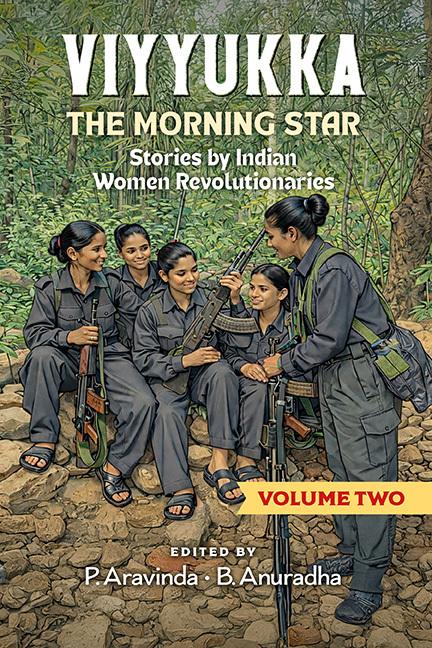
Viyyukka – The Morning Star (Vol 2)
Voices of India's Women Revolutionaries
Co-publisher:Revolutionary Writers Association
Categories: Asia, Biography, Colonialism, Feminism, India
Edited by P. Aravinda and B. Anuradha
This second volume of Viyyukka continues the powerful anthology of stories written by women revolutionaries in India’s Maoist movement, translated from Telugu to English. The collection brings together narratives penned by guerrilla soldiers who document their lived experiences within the revolutionary struggle, offering rare insights into the intersection of armed resistance, gender politics, and Adivasi community life.
The stories span four decades of revolutionary movement history, capturing both tactical engagements and intimate human moments—love, loss, camaraderie, and daily existence in guerrilla squads. What distinguishes this volume is the inclusion of autobiographical sketches by Adivasi women, narrated in their own tongues, detailing the circumstances that led them to become guerrillas. These first-person accounts reveal how poverty, land dispossession, state repression, and patriarchal violence converge to shape revolutionary consciousness.
Set primarily in the Dandakaranya forest region spanning multiple Indian states, the narratives illuminate the movement’s efforts to build alternative structures of governance through Janatana Sarkars (people’s governments), which implemented collective farming, education, healthcare, and resistance to mining corporations. The stories confront the brutal reality of state counter-insurgency operations including Salwa Judum and Operation Green Hunt, while celebrating the resilience of women who constitute nearly half the guerrilla army.
The collection demonstrates how women revolutionaries perform multiple roles—soldiers, writers, historians, doctors, and teachers—documenting their own history while fighting for land, dignity, and self-determination. These are not conventional fictions but testimonies written under extreme duress, smuggled across regions and preserved against overwhelming odds, offering a window into one of India’s most significant contemporary resistance movements.
This is a powerful and timely book. Reading Viyyukka is to encounter history in its most urgent form: not as abstract doctrine, but as the lived, written, and too-often silenced testimony of women for whom the pen was as vital as the gun. This anthology does not simply add voices to a historical record; it fundamentally questions the record itself. By foregrounding the female guerrilla imaginary—with its profound complexities of comradeship, grief, motherhood, and even the critique of revolutionary justice—these stories exceed the boundaries of political propaganda to become essential documents of human endurance and creativity. In a time when their politics is declared defeated, the women of Viyyukka remind us that some struggles are not measured by victory alone, but by the indestructible insistence on bearing witness. — Sharmila Purkayastha, independent researcher, New Delhi
ISBN Print: 9781997742272
Publication Date: March 2026
Page Count: 302
Binding Type: Soft cover
Trim Size: 6in x 9in
Language: English
USD $ 5.00 USD $ 26.00Price range: USD $ 5.00 through USD $ 26.00
| Book Format | Print Book, PDF |
|---|
Customer Reviews
There are no reviews yet.
Only logged in customers who have purchased this product may leave a review.
Related products
-

International Brigade Against Apartheid: Secrets of the People’s War That Liberated South Africa
USD $ 27.00Select options This product has multiple variants. The options may be chosen on the product page
International Brigade Against Apartheid: Secrets of the People’s War That Liberated South Africa
USD $ 27.00We hear for the first time from the internationalist secretly working for the ANC’s armed wing, Umkhonto we Sizwe (MK), in the struggle to liberate South Africa from apartheid rule. They acted as couriers, provided safe houses in neighbouring states and within South Africa, helped infiltrate combatants across borders, and smuggled tons of weapons into the country in the most creative ways. Driven by a spirit of international solidarity, they were prepared to take huge risks and face great danger. The internationalists reveal what motivated them as volunteers, not mercenaries: they gained nothing for their endeavours save for the self-esteem in serving a just cause. Against such clandestine involvement, the book includes contributions from key people in the international Anti-Apartheid Movement and its public mobilisation to isolate the apartheid regime. These include worldwide campaigns like Stop the Sports Tours, boycotting of South African products and black American solidarity. The Cuban, East German and Russian contributions outlined those countries’ support for the ANC and MK. The public, global Anti-Apartheid Movement campaigns provide the dimensions from which internationalists who secretly served MK emerged. Edited by Ronnie Kasrils. First published by Jacana Media (Pty) Ltd in 2021, ISBN: 978-1-4314-3202-8, this Daraja Press edition is available in North America and East Africa.
Select options This product has multiple variants. The options may be chosen on the product page -

Finding a Voice: Asian Women in Britain (New and Expanded Edition)
USD $ 5.00 USD $ 20.00Price range: USD $ 5.00 through USD $ 20.00Select options This product has multiple variants. The options may be chosen on the product page
Finding a Voice: Asian Women in Britain (New and Expanded Edition)
USD $ 5.00 USD $ 20.00Price range: USD $ 5.00 through USD $ 20.00irst published in 1978, and winning the Martin Luther King Memorial Prize for that year, Finding a Voice established a new discourse on South Asian women’s lives and struggles in Britain. Through discussions, interviews and intimate one-to-one conversations with South Asian women, in Urdu, Hindi, Bengali and English, it explored family relationships, the violence of immigration policies, deeply colonial mental health services, militancy at work and also friendship and love. The seventies was a time of some iconic anti-racist and working-class struggles. They are presented here from the point of view of the women who participated in and led them.
This new edition includes a preface by Meena Kandasamy, some historic photographs, and a remarkable new chapter titled ‘In conversation with Finding a Voice: 40 years on’ in which younger South Asian women write about their own lives and struggles weaving them around those portrayed in the book.
Select options This product has multiple variants. The options may be chosen on the product page -

A Mutiny of Morning: Reclaiming the Black Body from Heart of Darkness
USD $ 5.00 USD $ 15.00Price range: USD $ 5.00 through USD $ 15.00Select options This product has multiple variants. The options may be chosen on the product page
A Mutiny of Morning: Reclaiming the Black Body from Heart of Darkness
USD $ 5.00 USD $ 15.00Price range: USD $ 5.00 through USD $ 15.00Nikesha Breeze has taken pages from Joseph Conrad’s Heart of Darkness, taken his words, and forced them to leave his colonized mind. She has made the words her own in poetic form. She illuminates the invisible Black voices inside, a radical, surgical, and unapologetic Black appropriation, at the same time as a careful birthing and spiritual road map. The resulting poems are sizzling purifications, violent restorations of integrity, pain, wound, bewilderment, rage, and, sometimes, luminous generosity. This is a work of Reclamation. The author, Nikesha Breeze, has slowly, page by page, reclaimed the text of the book Heart of Darkness by Joseph Conrad. This racist turn-of-the-19th-century book was pivotal in the continued dehumanization of Black people and in particular of African people, as it painted an image of bestiality on the Congo people and the continent. It is laced with racist imagery and language. The author has reappropriated the book, page by page, making “BlackOut” poetry for each page, isolating methodically the words to create new poems of power and black voice within the text —stealing the language and reappropriating the power.
Select options This product has multiple variants. The options may be chosen on the product page -

Settler Colonialism
USD $ 5.00 USD $ 10.00Price range: USD $ 5.00 through USD $ 10.00Select options This product has multiple variants. The options may be chosen on the product page
Settler Colonialism
USD $ 5.00 USD $ 10.00Price range: USD $ 5.00 through USD $ 10.00Settler Colonialism examines the genesis in the USA of the first full-fledged settler state in the world, which went beyond its predecessors in 1492 Iberia and British-colonized Ireland with an economy based on land sales and enslaved African labor, an implementation of the fiscal-military state. Both the liberal and the rightwing versions of the national narrative misrepresent the process of European colonization of North America. Both narratives serve the critical function of preserving the “official story” of a mostly benign and benevolent USA as an anticolonial movement that overthrew British colonialism. The pre-US independence settlers were colonial settlers just as they were in Africa and India or like the Spanish in Central and South America. The nation of immigrants myth erases the fact that the United States was founded as a settler state from its inception and spent the next hundred years at war against the Native Nations in conquering the continent. Buried beneath the tons of propaganda—from the landing of the English “pilgrims” (Protestant Christian evangelicals) to James Fenimore Cooper’s phenomenally popular The Last of the Mohicans claiming settlers’ “natural rights” not only to the Indigenous peoples’ territories but also to the territories claimed by other European powers—is the fact that the founding of the United States created a division of the Anglo empire, with the US becoming a parallel empire to Great Britain, ultimately overcoming it. From day one, as was specified in the Northwest Ordinance, which preceded the US Constitution, the new “republic for empire,” as Thomas Jefferson called the new United States, envisioned the future shape of what is now the forty-eight states of the continental US. The founders drew up rough maps, specifying the first territory to conquer as the “Northwest Territory.” That territory was the Ohio Valley and the Great Lakes region, which was already populated with Indigenous villages and farming communities thousands of years old. Even before independence, mostly Scots Irish settlers had seized Indigenous farmlands and hunting grounds in the Appalachians and are revered historically as first settlers and rebels, who in the mid-twentieth century began claiming indigeneity. Self-indigenizing by various groups of settlers is a recurrent theme in story of settler colonialism, white supremacy, and the history of erasure and exclusion about which I have written elsewhere.
Select options This product has multiple variants. The options may be chosen on the product page -
 Select options This product has multiple variants. The options may be chosen on the product page
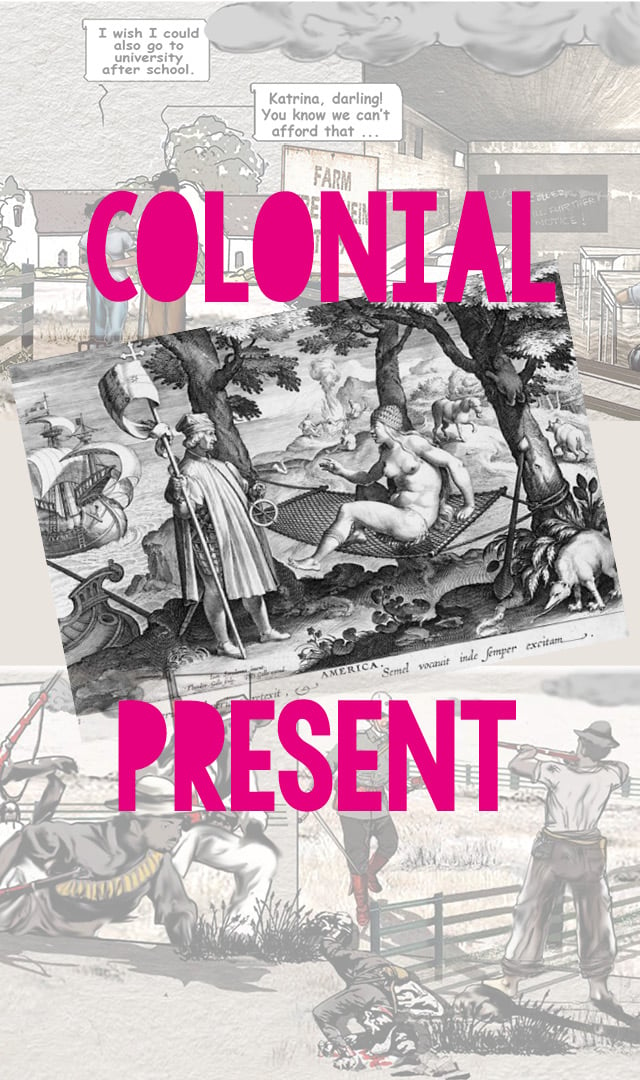
Episodes From a Colonial Present
Editors and Authors: Daniel Bendix, Chandra-Milena Danielzik, Franziska Müller, Lata Narayanaswamy, Juan Telleria, Miriam friz Trzeciak, Aram Ziai
Artists: Hangula Werner, Roshni Vyam, Michel Esselbrügge, Qi Zhou, RotmInas – Rotmi Enciso & Ina Riaskov, Maite Mentxaka Tena, Lena Ziyal
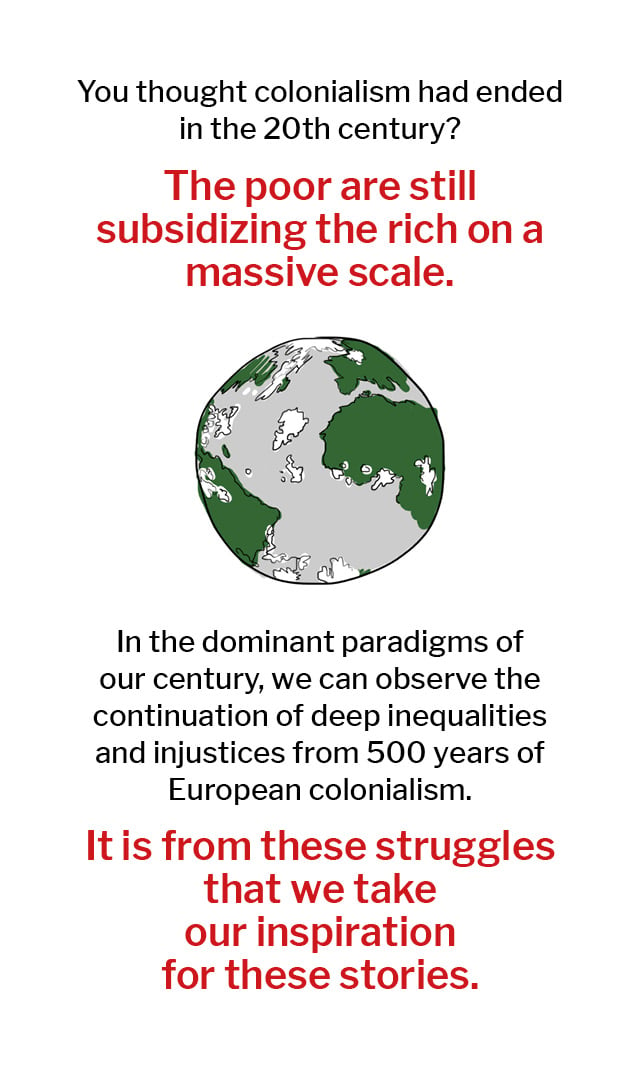
Postcolonial critique reveals the traces of the colonial past in every corner of our present lives and exposes the colonial violence inherent in global inequality. This collective comic project illuminates the coloniality of everyday life as well as the decolonising potential of everyday struggles in the spaces, discourses and practices of so-called global development.

Reviews
What an absolute impertinence! My lawyers are already involved. It’s just as well that I was able to use tax money for the purchase.
—Queen Elizabeth III love true crime books, but this one got a bit boring after a while. It could do with more bloodshed.
—Lothar von TrothaI added this book to my list to burn. Just saying.
—Diego de LandaA waste of time. So glad I didn’t buy it, but stole my copy.
—Christopher ColumbusI didn’t get it. Are they suggesting colonialism is not quite over?
—Harry S. TrumanSelect options This product has multiple variants. The options may be chosen on the product page -

Midko The Firefly
Midko the Firefly is the third volume in the Viyyukka Series, collecting 16 revolutionary short stories by Gumudavelli Renuka (Midko), translated from Telugu. The book portrays the lives of Maoist revolutionaries, Adivasi communities, and the brutal state repression they face in the forests of Dandakaranya, Telangana, and Andhra-Odisha border regions.
Through stories like “The Flow,” “Revolutionary Generation,” “Gangi,” and “Snatch the Guns!”, Renuka explores themes of sacrifice, love, separation, and political awakening. She centers women’s experiences—mothers who lose children, wives who outgrow husbands, young Adivasi girls who join armed squads, and ordinary women who defy superstition and state violence. The narratives depict police encounters, fake encounters, torture, rape, and the destruction of Adivasi villages through state-sponsored vigilante groups like Salwa Judum.
Renuka portrays the revolutionary movement not as idealized heroism but as a space of constant struggle—internally against patriarchal tendencies, externally against a ruthless state. Stories like “Teachers” and “Marching Forward” show how ordinary Adivasi villagers educate revolutionaries about their own mistakes. “The Closed Heart” tells of a wife who locks her husband out to his death, choosing the revolution over family loyalty.
The collection ends with a glossary and notes on translators, grounding the fiction in real political contexts, martyrs, and historical events like Operation Kagaar (2024-2026), which led to Renuka’s own torture and killing by police on March 31, 2025.
-

Finding A Voice
USD $ 20.00First published in 1978, and winning the Martin Luther King Memorial Prize for that year, Finding a Voice established a new discourse on South Asian women’s lives and struggles in Britain. Through discussions, interviews and intimate one-to-one conversations with South Asian women, in Urdu, Hindi, Bengali and English, it explored family relationships, the violence of immigration policies, deeply colonial mental health services, militancy at work and also friendship and love. The seventies was a time of some iconic anti-racist and working-class struggles. They are presented here from the point of view of the women who participated in and led them.
This new edition includes a preface by Meena Kandasamy, some historic photographs, and a remarkable new chapter titled ‘In conversation with Finding a Voice: 40 years on’ in which younger South Asian women write about their own lives and struggles weaving them around those portrayed in the book.
-

Some Of Us Are Brave (Vol 2): Interviews and Conversations with Sistas in Life and Struggle
USD $ 5.00 USD $ 23.00Price range: USD $ 5.00 through USD $ 23.00Select options This product has multiple variants. The options may be chosen on the product page
Some Of Us Are Brave (Vol 2): Interviews and Conversations with Sistas in Life and Struggle
USD $ 5.00 USD $ 23.00Price range: USD $ 5.00 through USD $ 23.00A society born of white supremacy and patriarchy must, by definition, ignore the voices of Black women. We know that unfortunately, such an attitude will also naturally seep into every stratum of that society
Part of the contribution to correct that was the centering and airing of Black women’s voices through Some of Us Are Brave: A Black Women’s Radio Program that aired on Pacifica’s Los Angeles radio station (KPFK) from 2003 until 2011.
The program covered a myriad of issues by amplifying the voices of a broad cross-section of Black women. Some of those voices have been preserved here in this volume. In addition to capturing various moments in time with a variety of women, this is also a means of taking the intellectual production of and about Black women out of the hands of institutions that are both fundamentally anti-Black and anti-woman.
Volume 1 contains interviews under the headings The Shoulders on Which We Stand and Black Lives Have Always Mattered.
Volume 2 covers Black Women’s Health, Bruthas on Sistas, and Sistas in Struggle.
Select options This product has multiple variants. The options may be chosen on the product page