

Tariq Mehmood
Tariq Mehmood is an award winning novelist and documentary film-maker. His first novel, Hand On the Sun (London: Penguin Books, 1983), dealt with the experience of the resistance to racism by young migrant to the UK of the 1970s and…
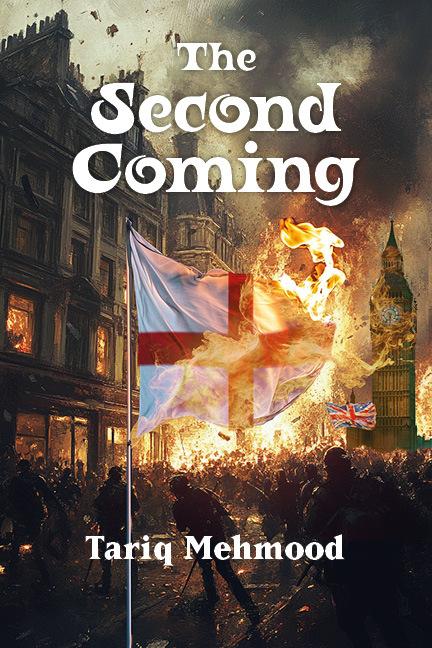
In the remnants of a fractured UK, England is on the brink of collapse where far-right militias rise to power. As Islamophobia and English nationalism ignite brutal violence, 19-year-old Marah Sultana is thrust into a fight for survival. Hunted by forces seeking control, she carries a secret powerful enough to change the course of the war—and the future of the world. In a world in which America’s reign as a superpower has crumbled, its mercenaries now rule in its shadow,
In The Second Coming, Tariq Mehmood delivers a searing, unflinching narrative that mirrors his own lifelong struggle for justice. This novel is not just fiction—it’s a reflection of real-world battles. Mehmood’s powerful storytelling compels readers to confront uncomfortable truths while offering a gripping, emotional journey of resistance and survival.
A dystopian desi mash-up of The Handmaid’s Tale, Clockwork Orange, and V for Vendetta. The Second Coming warns of the dangers of right-wing nationalism and white supremacy and imagines where such hate could take England if it is not, somehow, nipped in the bud. — Paul Cochrane, journalist, Middle East Eye
A must-read dystopian fantasy about race, religion, and love. Unmissable – Melvin Burgess, novelist, winner of the Carnegie Medal and the LA prize for Teenage Fiction
An unforgettable novel, both vivid and nightmarishly plausible. — Peter Kalu, novelist, storyteller, playwright and poet.
A story of resilience and hope told against the brutal realities of patriarchy and colonial violence.
— Amrit Wilson, activist, feminist, and author of Finding a Voice: Asian Women in Britain (Daraja Press)
USD $ 10.00 USD $ 22.00Price range: USD $ 10.00 through USD $ 22.00
Tariq Mehmood is an award winning novelist and documentary film-maker. His first novel, Hand On the Sun (London: Penguin Books, 1983), dealt with the experience of the resistance to racism by young migrant to the UK of the 1970s and…
| Book Format | Print Book, EPub |
|---|
Only logged in customers who have purchased this product may leave a review.

The pamphlet begins with two letters written by Paul the Apostle in which Christianity first acquires a universal address. The new religion came to exclude people who were not Christians from the count of the human. This became explicit around a thousand years later when Pope Urban II authorised the First Crusade.
In 1492 planetary history was split in to two. Muhammad XII of Granada conceded defeat to Isabella and Ferdinand, the Catholic monarchs of Portugal and Spain, who went on to expel the Jews from the territory under their control. Europe became a Christian project. In the same year Christopher Columbus arrived in the Caribbean and Europe also became an imperial project with a planetary reach.
The origins of the racial ideology can be seen in this period, in which ideas about religion came to be entangled with fantastical ideas about the imagined purity of blood. But it was in the English colony of Virginia in the seventeenth century that the legitimation for the exclusion from the count of the human began to move from claims made in the name of religion to claims made in the name of science. This is the point at which modern racism, rooted in the appearance of the body, began to cast its malignant shadow across the planet.
The author argues that the struggle to put an end to the epoch of world history that opened in 1492 will require new ideas, and new practices. It follows the Caribbean tradition that runs from Aimé Césaire to Frantz Fanon and Sylvia Wynter in affirming the need for a counter-humanism, a radical humanism, a humanism that, in Césaire’s famous phrases, is “made to the measure of the world”. There is a need for a shift in the ground of reason towards the lived experience and struggles of people rendered, in Wynter’s phrase, as ‘pariahs outside of the new order’.

This was Tariq Mehmood’s first novel, published by Penguin Books in 1983, charting the experience of the second generation migrants to the UK. Set in the declining textile industry of the North of England, it is a raw story of pain and anger at the relentlessness of British racism, from the street to the state – a story of an unquenchable desire for justice, and reclaiming human dignity. A dignity that is wrapped around new questions of Identity, a crossroad between religion, language, history and resistance. It is a little big story, that talks to the extremities of social, political and literary issues today? Can stories of a generation be appropriated? How important is religion in identity? If all you have is a story to tell, who should you tell it? Are the issues of today, just the issues of today or can we learn something from the past? In these stories, friendship is not defined by religion or colour, but by humanity. And racism is much more than skin deep. It is an exhilarating read that bears witness to the urgent 80’s battles against state and popular racism. As important now as then. In this new edition, Mehmood provides a Foreword that describes how the novel came to be written and the lives of real people on whom the characters were created. In the Afterword, Mehmood revisits some of the characters who are now 40-years older, and reflects on how the book would have been written today where the conditions of mass mobilizations no longer exist in neoliberal Britain.
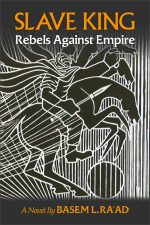
In thirty chapters, the narrative develops the incredible story of how a boy (Younis/Eunus/Euno) captured as a slave in Afamia, Syria challenges the Roman Empire in Sicily, circa 140-132 BCE. The chapters dramatize the circumstance of his capture, his experiences as a tutor, the growth of his prophetic and magical abilities, events that fomented the uprising (cruelties, rapes, crucifixions), the role of female characters, connections to other historical events (e.g., the destruction of Carthage), as well as scenes of an exorcism, an ancient marriage ceremony, a play performed outside a besieged city, and several battles against the Roman legions. An epilogue by an imagined contemporary narrator, who explains why she wrote the novel, ends the work. In the chapters and epilogue, while using ancient sources to some extent (sparse and biased as they are), the work departs from them to resolve contradictions, fill in gaps, and present an alternative narrative of historical and cultural issues. It’s intended to remedy the neglect of this story in both ancient and modern sources, reverse the demonization explicit and implicit in them, and remedy the imbalance in the dominant constructs. It promotes the event as significant, certainly just as important as (if not more than) the Spartacus rebellion seven decades afterwards, or others that are commonly recounted. A significant aspect of this revolt comes from the fact that Younis was able to forge a coalition of slaves, farmers and herders that defeated Roman armies and established an independent entity on more egalitarian principles. The novel also touches on a range of topics, such as prophecy, magic, languages, the construct of Western civilization, representation of regional cultures, customs, and mythologies. An idealized statue of this rebel stands today in Enna, Sicily, along with an inscription that seems designed to appeal to tourists, yet Younis’ rebellion contradicts the dominant notions promoted in Italy and throughout the West, especially the identification with imperial Rome. This novel is intended to remedy his legacy. A fictionalised account of a slave rebellion in Roman Sicilia more than sixty years before Spartacus, it tells the story of the slave Younis from Afamia (now in Syria), a mystic and seer who led a great uprising sustained much longer than Spartacus’.

À rebours des thèses soutenant que la migration contribue au développement ou que l’in- vestissement dans le développement réduit la croissance de la migration « irrégulière », ce livre marque une rupture tonifiante avec les idées communes abondamment véhiculées dans la littérature sur les liens entre migration, mobilités et développement en Afrique. Il accorde un intérêt manifeste pour la plus grande part des mobilités africaines, lesquelles se situent à l’intérieur du continent, et à la formation des diasporas en dehors des fron- tières nationales et continentales. Cette considération conjointe des mobilités « Sud-Sud » et « Sud-Nord » permet de remettre en cause l’hypothèse selon laquelle il existe des diffé- rences fondamentales entre elles.
Cet ouvrage examine les fluctuations ordinaires des mouvements de populations – à travers l’Afrique, comme dans le reste du monde –, qui étendent les familles, génèrent de nouvelles relations, reconfigurent les connexions économiques et politiques, et sont intégrées dans l’expérience quotidienne des millions de personnes qui y prennent part.
The in-depth knowledge of the mostly African authors adds to the quality of a research field, which was for long far too Eurocentric. – Ilke ADAM, Vrije Universiteit Brussel (Belgium)
Il était temps de mettre en lumière ce que migration et mobilité représentent en Afrique. L’ouvrage offre une perspective originale et décoloniale sur le sujet. – Eric HAHONOU, Roskilde Universitet (Denmark)
Christian Bouquet, « Quelques éclairages nouveaux sur les migrations africaines », EspacesTemps.net [En ligne], Books, 2020 | Mis en ligne le 20 November 2020, consulté le 20.11.2020. URL : https://www.espacestemps.net/en/articles/quelques-eclairages-nouveaux-sur-les-migrations-africaines/ ; DOI : 10.26151/esapcestemps.net-jc2a-6b03
Avec la participation de John O. IGUE, Saydou KOUDOUGOU, Pierre-Joseph LAURENT, Bassirou MALAM SOULEY, Hamidou MANOU NABARA, Marème NIANG NDIAYE, Amadou SARR DIOP, Sadio SOUKOUNA , Eric Stève TAMO MBOUYOU et Astadjam YAOUBA.
Ce livre est un apport précieux pour demander à changer de focale et de perspective au sujet des migrations à l’intérieur du continent africain. Celles-ci sont bien plus importantes quan- titativement, mais aussi économiquement et historiquement, que les migrations de l’Afrique vers l’Europe. Elles sont beaucoup plus silencieuses et infiniment moins étudiées que celles du Sud vers le Nord. Ces migrations sont vitales, tant pour les pays de départ que pour ceux d’arrivée. Ainsi, des millions de jeunes partent chaque année pour les pays de la côte, et cela sans susciter les mêmes résistances, fantasmes et peurs qu’en Europe.
Cet ouvrage a le grand mérite d’intégrer les migrations dans la perspective plus large des mobilités, puis d’en examiner les liens avec le développement. Il est rédigé par de jeunes chercheurs africains, qui produisent à partir de leurs terrains spécifiques des analyses à valeur générale sur les sociétés contemporaines. Ils contribuent ainsi au renouvellement des sciences sociales à partir des pays africains.
On peut en revanche souligner que l’ouvrage a relevé un défi important : celui d’éclairer à la fois les dynamiques de l’expérience migratoire, des trajectoires suivies par les migrants et des espaces migratoires à l’intérieur de l’Afrique. — Sylvie Ayimpam, « Mobilités, circulations et frontières. Migrations, mobilités et développement en Afrique », Anthropologie & développement [En ligne], 51 | 2020, mis en ligne le 01 décembre 2020, consulté le 23 février 2021. URL : http://journals.openedition.org/anthropodev/1068 ; DOI : https://doi.org/10.4000/anthropodev.1068
These companion volumes are refreshing because they introduce us to many less well- known instances which amply illustrate just how mobile African populations really are at the regional, intra-regional and global scales. – Paul NUGENT, University of Edinburgh (United Kingdom)
Un ouvrage d’une grande actualité qui aborde la question des migrations sous un angle radicalement nouveau et original : l’articulation dynamique entre la migration, la mobilité et le développement en Afrique de l’Ouest. Ces deux volumes bilingues renouvellent le débat sur les migrations : de quoi faire réfléchir ensemble l’Afrique et l’Europe. – Marie-Caroline SAGLIO-YATZIMIRSKY, INALCO, CESSMA Paris (France)
Christian Bouquet, « Quelques éclairages nouveaux sur les migrations africaines », EspacesTemps.net [En ligne], Books, 2020 | Mis en ligne le 20 November 2020, consulté le 20.11.2020. URL : https://www.espacestemps.net/en/articles/quelques-eclairages-nouveaux-sur-les-migrations-africaines/ ; DOI : 10.26151/esapcestemps.net-jc2a-6b03
Avec la participation de Naluwembe BINAISSA, Alimou DIALLO, Nyalo Barkissa DRABO, Sylvester KOHOL, A. Aziz MOSSI, Loppa NGASSOU, Lawrence Rafaih OKELLO, Mutiat Titilope OLADEJO, Zakaria SORÉ, Astadjam YAOUBA et Irissa ZIDNABA.

No hubo nada más que oscuridad en la primavera de 2020 cuando la pandemia de Covid-19 se enfureció y cerró la economía. Pero mientras que los manifestantes de derecha exigieron el fin del cierre de emergencia, un conflicto mucho más grande se estaba gestando bajo la superficie. Una rebelión exploto en Minneapolis en respuesta al asesinato policial de George Floyd, y durante la rebelion una estación de policía fue tomada y prendido fuego. Después de esto la revuelta se extendió rápidamente por todo los Estados Unidos. Los manifestantes saquearon los centros urbanos, lucharon contra la policía, quemaron coches de policía y destruyeron edificios de gobierno. El proletario negro lideró la carga, pero los proletarios blancos, latinos, asiáticos e indígenas también se unieron a la lucha, demostrando nuevas posibilidades para construir alianzas en esta sociedad segregada. Si bien las rebeliones contra la policía continuaron durante el verano y el otoño, el levantamiento retrocedió con el comienzo del invierno. Pero este conflicto está lejos de terminar.
Preparándonos para las grandes luchas que vienen, El Significado Revolucionario de la Revuelta de George Floyd proporciona un análisis de lo que sucedió durante los disturbios de 2020 en los Estados Unidos, sus potenciales, límites internos, e implicaciones estratégicas.

Settler Colonialism examines the genesis in the USA of the first full-fledged settler state in the world, which went beyond its predecessors in 1492 Iberia and British-colonized Ireland with an economy based on land sales and enslaved African labor, an implementation of the fiscal-military state. Both the liberal and the rightwing versions of the national narrative misrepresent the process of European colonization of North America. Both narratives serve the critical function of preserving the “official story” of a mostly benign and benevolent USA as an anticolonial movement that overthrew British colonialism. The pre-US independence settlers were colonial settlers just as they were in Africa and India or like the Spanish in Central and South America. The nation of immigrants myth erases the fact that the United States was founded as a settler state from its inception and spent the next hundred years at war against the Native Nations in conquering the continent. Buried beneath the tons of propaganda—from the landing of the English “pilgrims” (Protestant Christian evangelicals) to James Fenimore Cooper’s phenomenally popular The Last of the Mohicans claiming settlers’ “natural rights” not only to the Indigenous peoples’ territories but also to the territories claimed by other European powers—is the fact that the founding of the United States created a division of the Anglo empire, with the US becoming a parallel empire to Great Britain, ultimately overcoming it. From day one, as was specified in the Northwest Ordinance, which preceded the US Constitution, the new “republic for empire,” as Thomas Jefferson called the new United States, envisioned the future shape of what is now the forty-eight states of the continental US. The founders drew up rough maps, specifying the first territory to conquer as the “Northwest Territory.” That territory was the Ohio Valley and the Great Lakes region, which was already populated with Indigenous villages and farming communities thousands of years old. Even before independence, mostly Scots Irish settlers had seized Indigenous farmlands and hunting grounds in the Appalachians and are revered historically as first settlers and rebels, who in the mid-twentieth century began claiming indigeneity. Self-indigenizing by various groups of settlers is a recurrent theme in story of settler colonialism, white supremacy, and the history of erasure and exclusion about which I have written elsewhere.
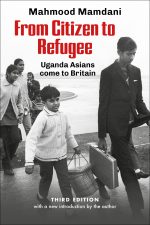
In his introduction to this new edition of From Citizen to Refugee: Uganda Asians Come to Britain, Mahmood Mamdani reminds us that long before 1972, most Ugandan ‘Asians’ had already been disenfranchised by law, both Ugandan and British. Despite a global industry that insists otherwise, Uganda Asians are a poor fit as victims: there was no large-scale loss of life during the expulsion, nor were there massacres of Asians, only of ‘indigenous’ peoples. Asians in Uganda, as in East or Southern Africa, he argues, were immigrants, not settlers: immigrants are prepared to be a part of the political community, whereas settlers ‘create their own political community, a colony, more precisely, settler colonialism.’ Mamdani insists that there is no single Asian legacy. there are several and they are contradictory. The Asian question in Uganda remains, but it is no longer the original Asian question. But it does allow us to think more broadly. Just as US law recognizes African Americans as Americans of African descent, so too must those of Asian origin in Africa consider themselves, and be considered, Asian Africans. It is in his bittersweet and touching book on the Asian expulsion from Uganda that one can trace the beginnings of author and intellectual Mahmood Mamdani’s world-view.. … In From Citizen to Refugee: Uganda Asians Come to Britain Mamdani offers portraits of people reduced to a vegetative existence in refugee camps, feeling the burden of not being fluent in English and struggling with the uncomfortably cold weather. Not surprisingly, these few months played a pivotal role in shaping Mamdani’s theoretical and political leanings, and it is here that one can locate his preoccupation with the formation of racial, ethnic and class identities during the colonial era and his overarching concern with issues of citizenship.
DarajaPress uses Accessibility Checker to monitor our website's accessibility.
Paul Cochrane
A lot of people on the planet are praying for the Second Coming – Messianic Christians awaiting Jesus and Muslims for the Mahdi to return. Tariq Mehmood is not among that crowd. Instead he spends a lot of time imagining and discussing possible futures. Some of these fictional futures may be realised – Mehmood teaches a creating writing course, ‘After Zionism – Imagining the Rebirth of Palestine’ at the American University of Beirut – and others – like the setting for his book The Second Coming – hopefully will not be prophetic. …Mehmood’s young adult novel is set in a near future in a fragmenting Britain, with England descending into civil war as far-right militias come to power. It is a dystopian desi mash-up of The Handmaid’s Tale, Clockwork Orange, and V for Vendetta. It warns of the dangers of right-wing nationalism and white supremacy, and imagines where such racism could take England if it is not, somehow, nipped in the bud. … “The Second Coming is about holding on to your mind, your loves, your dreams. And to endure the brutality knowing you must live,” said the author, Tariq Mehmood. — Paul Cochrane