Beside the Sickle Moon is near future literary activism based on Israel’s occupation of Palestine. The story tells a first person narrative through Laeth Awad, a Palestinian who lives above his convenience store experiencing days pass through smoke clouds with his cousin Aylul. One night upon returning to their village from Ramallah they encounter an Israeli checkpoint within the buffer zone that hadn’t been there before. It isn’t long until the two stumble upon Israel’s plans to construct a luxury hotel for incoming settlers, Ma’al Luz. Demolition crews and military personnel are due to fulfill this contract in the months to come and with them as overseer is the infamous Meir Cohen, a Mossad operative who played a key role in the fall of Gaza.
Aylul believes from their father, an Al Qassam militant who died in the battle for Jericho, that only the threat of annihilation breeds the best of human action. They use their contacts to connect with the factions, who grant them strength to defend their village from occupation. With these resources in hand Aylul forms Al Mubarizun, a group crowning themselves Palestine’s final resistance.
Laeth doubts the existence of a future, lost in philosophical ambivalence as he tries to follow his cousin into the depths of guerrilla warfare. He questions the futility of resistance when all former allies have normalized relations with Israel. And what of the innocents on the other side of the Wall who had no say in where they were born? Though a minority of the population, he is not alone in this sentiment. Palestinian youth begin to empathize with this logic enough to create a new social movement, the Forgotten Ones. Coining the derogatory term that their critics slung, the NGO advocates for a peaceful transition to Israel’s colonization where most Palestinians hear whimpers of surrender.
Set in a hauntingly plausible future, where Israel has marked a century of Palestinian occupation … As a novel of the future, Beside the Sickle Moon is, unsurprisingly, preoccupied with temporality, attempting to reconcile the vastness of macro-historical events with the immediacy of everyday life. … One of the most chilling features of Husien’s novel as history is the world’s renewed abandonment of Palestine. In a future of systemic global crisis, nations have closed ranks and shut their eyes. Israeli mines run on the slave labor of Palestinian captives, and refugee camps have become invisibilized death zones … — Londiwe Gamedze https://africasacountry.com/2024/11/reading-the-present-as-history






Michael Neocosmos
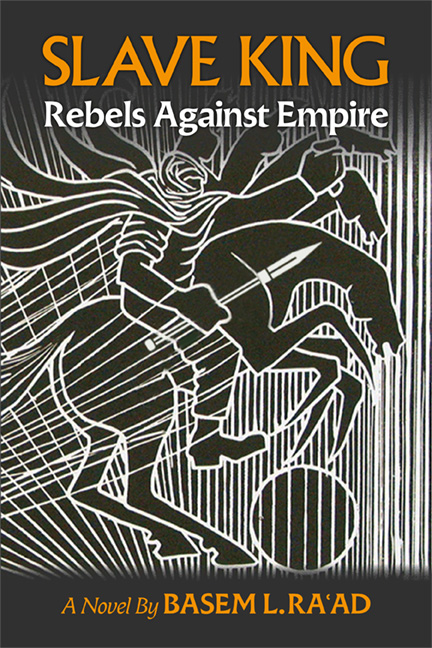
A fictionalized account of a slave rebellion in Roman Sicilia more than sixty years before Spartacus, it tells the story of the slave Younis from Afamia (now in Syria), a mystic and seer who led a great uprising sustained much longer than Spartacus’s. As with the Messinian rebellion against Spartan oppression centuries earlier, the West has been slow to take such events seriously and reinstate their presence in popular culture as expressions of human spirituality and resistance. The role of seers as leaders is reminiscent of Ayi Kwei Armah’s The Healers on ancient Africa. This book is a fascinating and brilliant telling of popular struggle. It is a minor classic. — Michael Neocosmos, Emeritus Professor in Humanities, Rhodes University, South Africa, author of Thinking Freedom; Towards a Theory of Emancipatory Politics
Adrienne Mayor
I highly recommend Basem Ra’ad’s compelling and deeply researched historical novel about the fire-breathing Syrian slave who challenged Roman might in the second century BCE, seeking independence for his thousands of followers. This little-known story of resistance deserves wide attention. … an amazing and important story. — Adrienne Mayor, author, The Poison King: The Life and Legend of Mithradates, Rome’s Deadliest Enemy
Tariq Mehmood
What Basem L. Ra’ad has done in this remarkable novel about slave uprisings against the Roman Empire is to demonstrate how ‘the history of all hitherto existing society is the history of class struggles.’ He shows why the dominant discourse needs to be revised.A moving story that casts light on many of the strifes in our times. — Tariq Mehmood, author, Song of Gulzarina, Associate Professor, American University of Beirut
Hilton Obenzinger
Slave King disrupts two millennia of malign stories about one of antiquity’s original slave revolts. Not cannibals, not demons, but slaves, farmers and herdsmen created a kingdom of equality and compassion. With deep knowledge, Ra’ad re-imagines freedom emerging from Mediterranean multicultural shores. It is a profound re-creation of history in thrilling fiction. —Hilton Obenzinger, author of Witness 2017-2020 and American Palestine: Melville, Twain, and the Holy Land Mania