

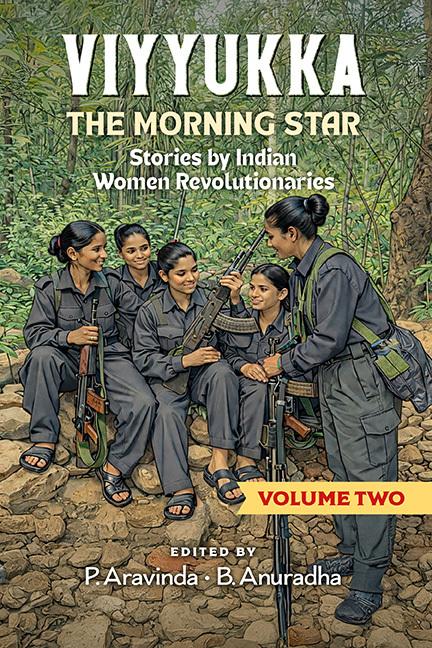
Viyyukka – The Morning Star (Vol 2)
Voices of India's Women Revolutionaries
Co-publisher:Revolutionary Writers Association
Categories: Asia, Biography, Colonialism, Feminism, India
Edited by P. Aravinda and B. Anuradha
This second volume of Viyyukka continues the powerful anthology of stories written by women revolutionaries in India’s Maoist movement, translated from Telugu to English. The collection brings together narratives penned by guerrilla soldiers who document their lived experiences within the revolutionary struggle, offering rare insights into the intersection of armed resistance, gender politics, and Adivasi community life.
The stories span four decades of revolutionary movement history, capturing both tactical engagements and intimate human moments—love, loss, camaraderie, and daily existence in guerrilla squads. What distinguishes this volume is the inclusion of autobiographical sketches by Adivasi women, narrated in their own tongues, detailing the circumstances that led them to become guerrillas. These first-person accounts reveal how poverty, land dispossession, state repression, and patriarchal violence converge to shape revolutionary consciousness.
Set primarily in the Dandakaranya forest region spanning multiple Indian states, the narratives illuminate the movement’s efforts to build alternative structures of governance through Janatana Sarkars (people’s governments), which implemented collective farming, education, healthcare, and resistance to mining corporations. The stories confront the brutal reality of state counter-insurgency operations including Salwa Judum and Operation Green Hunt, while celebrating the resilience of women who constitute nearly half the guerrilla army.
The collection demonstrates how women revolutionaries perform multiple roles—soldiers, writers, historians, doctors, and teachers—documenting their own history while fighting for land, dignity, and self-determination. These are not conventional fictions but testimonies written under extreme duress, smuggled across regions and preserved against overwhelming odds, offering a window into one of India’s most significant contemporary resistance movements.
This is a powerful and timely book. Reading Viyyukka is to encounter history in its most urgent form: not as abstract doctrine, but as the lived, written, and too-often silenced testimony of women for whom the pen was as vital as the gun. This anthology does not simply add voices to a historical record; it fundamentally questions the record itself. By foregrounding the female guerrilla imaginary—with its profound complexities of comradeship, grief, motherhood, and even the critique of revolutionary justice—these stories exceed the boundaries of political propaganda to become essential documents of human endurance and creativity. In a time when their politics is declared defeated, the women of Viyyukka remind us that some struggles are not measured by victory alone, but by the indestructible insistence on bearing witness. — Sharmila Purkayastha, independent researcher, New Delhi
ISBN Print: 9781997742272
Publication Date: March 2026
Page Count: 302
Binding Type: Soft cover
Trim Size: 6in x 9in
Language: English
USD $ 5.00 USD $ 26.00Price range: USD $ 5.00 through USD $ 26.00
| Book Format | Print Book, PDF |
|---|
Customer Reviews
There are no reviews yet.
Only logged in customers who have purchased this product may leave a review.
Related products
-

Finding A Voice
USD $ 20.00First published in 1978, and winning the Martin Luther King Memorial Prize for that year, Finding a Voice established a new discourse on South Asian women’s lives and struggles in Britain. Through discussions, interviews and intimate one-to-one conversations with South Asian women, in Urdu, Hindi, Bengali and English, it explored family relationships, the violence of immigration policies, deeply colonial mental health services, militancy at work and also friendship and love. The seventies was a time of some iconic anti-racist and working-class struggles. They are presented here from the point of view of the women who participated in and led them.
This new edition includes a preface by Meena Kandasamy, some historic photographs, and a remarkable new chapter titled ‘In conversation with Finding a Voice: 40 years on’ in which younger South Asian women write about their own lives and struggles weaving them around those portrayed in the book.
-
Lenin150 (Samizdat): 2nd expanded edition
USD $ 5.00 USD $ 30.00Price range: USD $ 5.00 through USD $ 30.00Select options This product has multiple variants. The options may be chosen on the product page
Lenin150 (Samizdat): 2nd expanded edition
USD $ 5.00 USD $ 30.00Price range: USD $ 5.00 through USD $ 30.00Lenin150 (Samizdat) aims to contribute to the re-kindling of the communist attractor by engaging, in the spirit of critical solidarity, with Vladimir Ilyich Ulyanov in the year of his 150th anniversary. Conceived out of the former Soviet republic of Kyrgyzstan, the book brings together contributions from all continents, ranging in style from the academic to the lyrical. As such, these compelling, and in some cases absolutely urgent, appropriations of (the spectre of) Lenin aspire to be of considerable use-value for the struggles ahead.
Select options This product has multiple variants. The options may be chosen on the product page -

Some Of Us Are Brave (Vol 2): Interviews and Conversations with Sistas in Life and Struggle
USD $ 5.00 USD $ 23.00Price range: USD $ 5.00 through USD $ 23.00Select options This product has multiple variants. The options may be chosen on the product page
Some Of Us Are Brave (Vol 2): Interviews and Conversations with Sistas in Life and Struggle
USD $ 5.00 USD $ 23.00Price range: USD $ 5.00 through USD $ 23.00A society born of white supremacy and patriarchy must, by definition, ignore the voices of Black women. We know that unfortunately, such an attitude will also naturally seep into every stratum of that society
Part of the contribution to correct that was the centering and airing of Black women’s voices through Some of Us Are Brave: A Black Women’s Radio Program that aired on Pacifica’s Los Angeles radio station (KPFK) from 2003 until 2011.
The program covered a myriad of issues by amplifying the voices of a broad cross-section of Black women. Some of those voices have been preserved here in this volume. In addition to capturing various moments in time with a variety of women, this is also a means of taking the intellectual production of and about Black women out of the hands of institutions that are both fundamentally anti-Black and anti-woman.
Volume 1 contains interviews under the headings The Shoulders on Which We Stand and Black Lives Have Always Mattered.
Volume 2 covers Black Women’s Health, Bruthas on Sistas, and Sistas in Struggle.
Select options This product has multiple variants. The options may be chosen on the product page -

MATHARE: An Urban Bastion of Anti-Oppression Struggle in Kenya.
USD $ 5.00 USD $ 15.00Price range: USD $ 5.00 through USD $ 15.00Select options This product has multiple variants. The options may be chosen on the product page
MATHARE: An Urban Bastion of Anti-Oppression Struggle in Kenya.
USD $ 5.00 USD $ 15.00Price range: USD $ 5.00 through USD $ 15.00History is written by the victors of any war. But what happens when the victors forget to write down their history or omit the cog of the struggle? This is the untold story of Mathare Slum that has never been told to the world: of the role it played in anti-colonial struggle and the planning ground for the Mau Mau struggle which culminated with the fall of the British Colonial Empire in Kenya in the midnight of December 12th 1963. Mathare has also played a critical role in anti-oppression struggle against the four regimes that we’ve had since independence and continues to do so up to date. This history has not been documented and has only been done piecemeal. This has overtime eroded the rich history of Mathare and led to a distorted history of once a planning ground and a bulwark of Kenya Land and Freedom Army (KFLA). The current generation are not cognizant with the critical role Mathare played in the independence of our country. Presently, Mathare is majorly known for all the negative reasons and its proximity to Mathari Mental Hospital has contorted its image to the outside world. My story tries to re-tell the history of Mathare from an informed insider perspective by threading the struggles from the colonial era to the present day and the role it has played in agitating for social justice. My story brings to view the past history of this informal settlement in the heart of Nairobi, the present struggle and the promising future through community organizing.
Select options This product has multiple variants. The options may be chosen on the product page -

Class, gender, race and colonialism
USD $ 5.00 USD $ 11.00Price range: USD $ 5.00 through USD $ 11.00Select options This product has multiple variants. The options may be chosen on the product page
Class, gender, race and colonialism
USD $ 5.00 USD $ 11.00Price range: USD $ 5.00 through USD $ 11.00Description (1600 / 2500)
It is important to see both Marx’s brilliant generalisations about capitalist society and the very concrete ways in which he examined not only class, but also gender, race, and colonialism, and what today would be called the intersectionality of all of these. His underlying revolutionary humanism was the enemy of all forms of abstraction that denied the variety and multiplicity of human experience, especially as his vision extended outward from Western Europe. For these reasons, no thinker speaks to us today with such force and clarity.It is clear today that the emancipation of labour from capitalist alienation and exploitation is a task that still confronts us. Marx’s concept of the worker is not limited to European white males, but includes Irish and Black super-exploited and therefore doubly revolutionary workers, as well as women of all races and nations. But, his research and his concept of revolution go further, incorporating a wide range of agrarian non-capitalist societies of his time, from India to Russia and from Algeria to the Indigenous peoples of the Americas, often emphasising their gender relations. In his last, still partially unpublished writings, he turns his gaze Eastward and Southward. In these regions outside Western Europe, he finds important revolutionary possibilities among peasants and their ancient communistic social structures, even as these are being undermined by their formal subsumption under the rule of capital. In his last published text, he envisions an alliance between these non-working-class strata and the Western European working class.
Select options This product has multiple variants. The options may be chosen on the product page -

Anticapitalist Economy in Rojava: The Contradictions of Revolution in the Kurdish Struggles
USD $ 5.00 USD $ 22.00Price range: USD $ 5.00 through USD $ 22.00Select options This product has multiple variants. The options may be chosen on the product page
Anticapitalist Economy in Rojava: The Contradictions of Revolution in the Kurdish Struggles
USD $ 5.00 USD $ 22.00Price range: USD $ 5.00 through USD $ 22.00This book looks at the anti-capitalist economy and the organization of social relations in the context of the revolution and autonomy of Rojava (Kurdistan-Syria). It questions both the limitations and the historical problems of the phenomenon of revolution, and the conflicts and contradictions that emerge in this process. It also draws from the conflicts and contradictions the author has consistently felt as a “political subject” who wants to change the world, especially through her experience in the Kurdish struggle and the Kurdish Movement. For this reason, every question she raises and attempts to answer in this book—about the Kurds, Rojava, and the world in general, involves what she says is her own subjectivity.
The idea and dreams of revolution have existed since humans created systems of domination. Indeed, revolution, meaning the liberation from systems of domination, has undoubtedly been one of the most discussed subjects in history. There have been moments when the possibility of revolution has been clearer, and there have also been certain agreements on what it is and how to get there, but it has never been something completely definable. This continues to be true today. This book does not intend to define this great phenomenon, rather it looks at the revolutionary practices that create emancipating realities and embraces revolution as an undefined, contradictory and dynamic process. Although the rulers have traditionally written history, the history of social struggles has been and is still being created by many revolutionary and transformational processes. The future is being shaped based on desired revolutions and the struggles that, in turn, transform their actors, the people. Therefore, the desire and quest of the Kurdish people for liberation from the colonial rule of the nation-states of the Middle East—the subject of this book—has always been directly linked to the phenomenon of revolution.Select options This product has multiple variants. The options may be chosen on the product page -
 Select options This product has multiple variants. The options may be chosen on the product page
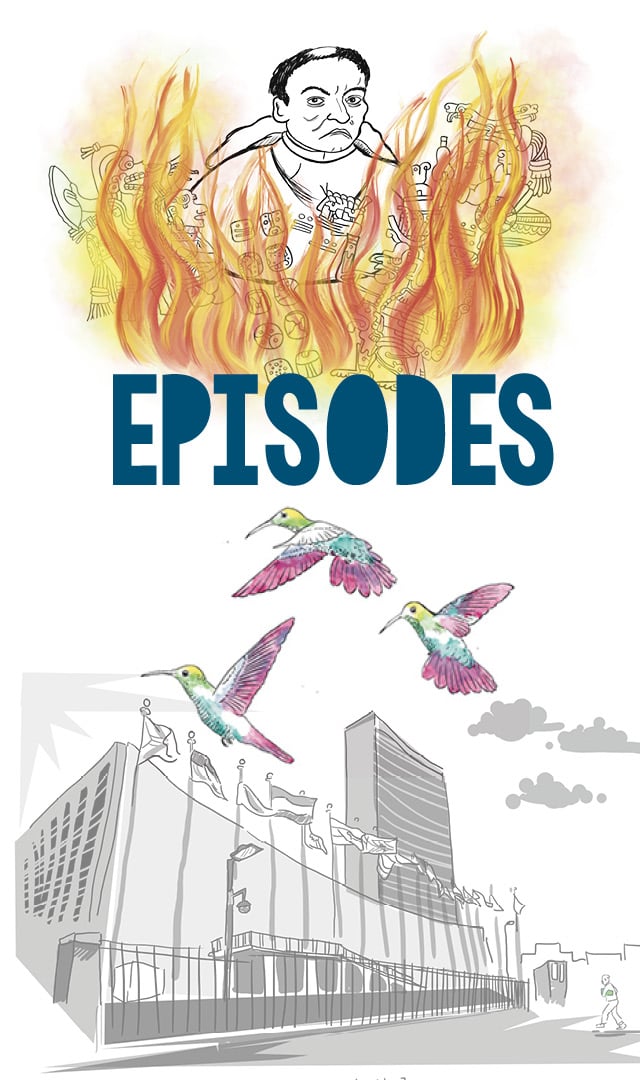
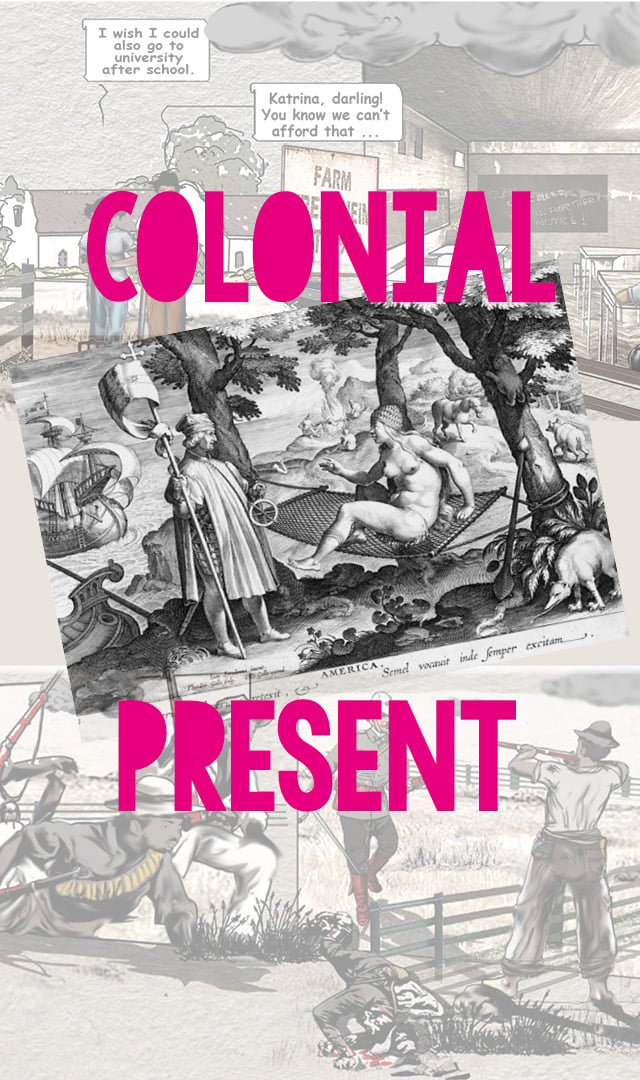
Episodes From a Colonial Present
Editors and Authors: Daniel Bendix, Chandra-Milena Danielzik, Franziska Müller, Lata Narayanaswamy, Juan Telleria, Miriam friz Trzeciak, Aram Ziai
Artists: Hangula Werner, Roshni Vyam, Michel Esselbrügge, Qi Zhou, RotmInas – Rotmi Enciso & Ina Riaskov, Maite Mentxaka Tena, Lena Ziyal
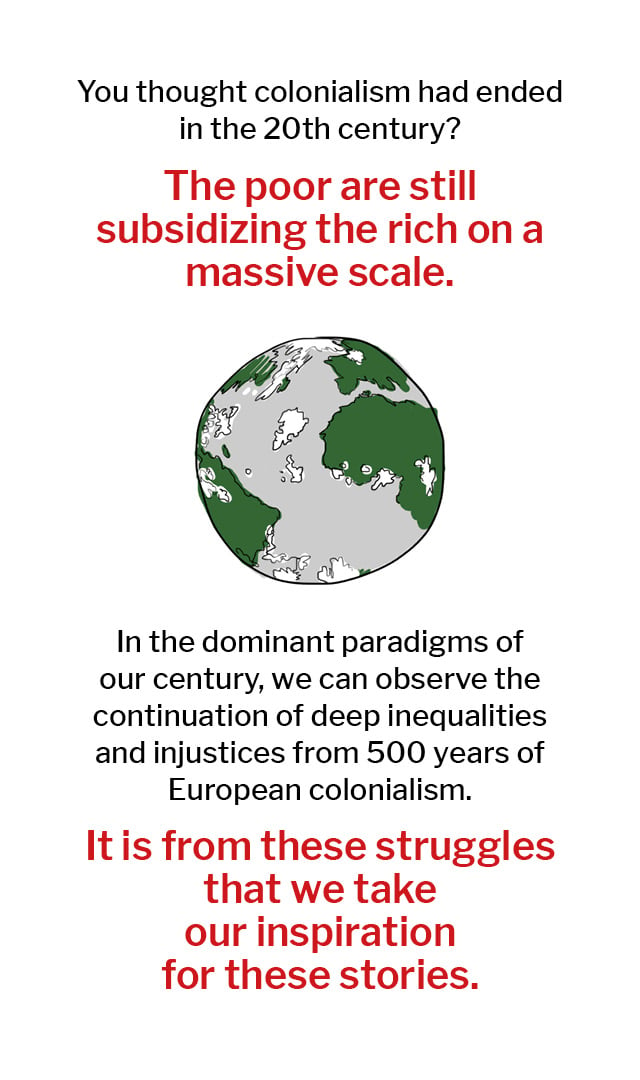
Postcolonial critique reveals the traces of the colonial past in every corner of our present lives and exposes the colonial violence inherent in global inequality. This collective comic project illuminates the coloniality of everyday life as well as the decolonising potential of everyday struggles in the spaces, discourses and practices of so-called global development.

Reviews
What an absolute impertinence! My lawyers are already involved. It’s just as well that I was able to use tax money for the purchase.
—Queen Elizabeth III love true crime books, but this one got a bit boring after a while. It could do with more bloodshed.
—Lothar von TrothaI added this book to my list to burn. Just saying.
—Diego de LandaA waste of time. So glad I didn’t buy it, but stole my copy.
—Christopher ColumbusI didn’t get it. Are they suggesting colonialism is not quite over?
—Harry S. TrumanSelect options This product has multiple variants. The options may be chosen on the product page -

Dialectics of revolution : Hegel, Marxism, and its critics through a lens of race, class, gender, and colonialism
USD $ 5.00 USD $ 18.00Price range: USD $ 5.00 through USD $ 18.00Select options This product has multiple variants. The options may be chosen on the product page
Dialectics of revolution : Hegel, Marxism, and its critics through a lens of race, class, gender, and colonialism
USD $ 5.00 USD $ 18.00Price range: USD $ 5.00 through USD $ 18.00This book collects four decades of writings on dialectics, a number of them published here for the first time, by Kevin B. Anderson, a well-known scholar-activist in the Marxist-Humanist tradition. The essays cover the dialectics of revolution in a variety of settings, from Hegel and the French Revolution to dialectics today and its poststructuralist and pragmatist critics. In these essays, particular attention is given to Lenin’s encounter with Hegel and its impact on the critique of imperialism, the rejection of crude materialism, and more generally, on world revolutionary developments. Major but neglected works on Hegel and dialectics written under the impact of the struggle against fascism like Lukács’s The Young Hegel and Marcuse’s Reason and Revolution are given full critical treatment. Dunayevskaya’s intersectional revolutionary dialectics is also treated extensively, especially its focus on a dialectics of revolution that avoids class reductionism, placing gender, race, and colonialism at the center alongside class. In addition, key critics of Hegel and dialectics like Jacques Derrida, Michel Foucault, Antonio Negri, Pierre Bourdieu, and Richard Rorty, are themselves analysed and critiqued from a twenty-first century dialectical perspective. The book also takes up the dialectic in global, intersectional settings via a reconsideration of the themes of Anderson’s Marx at the Margins, where nationalism, race, and colonialism were theorized alongside capital and class as key elements in Marxist dialectical thought. As a whole, the book offers a discussion of major themes in the dialectics of revolution that still speak to us today at a time of radical transformation in all spheres of society and of everyday life.
Select options This product has multiple variants. The options may be chosen on the product page